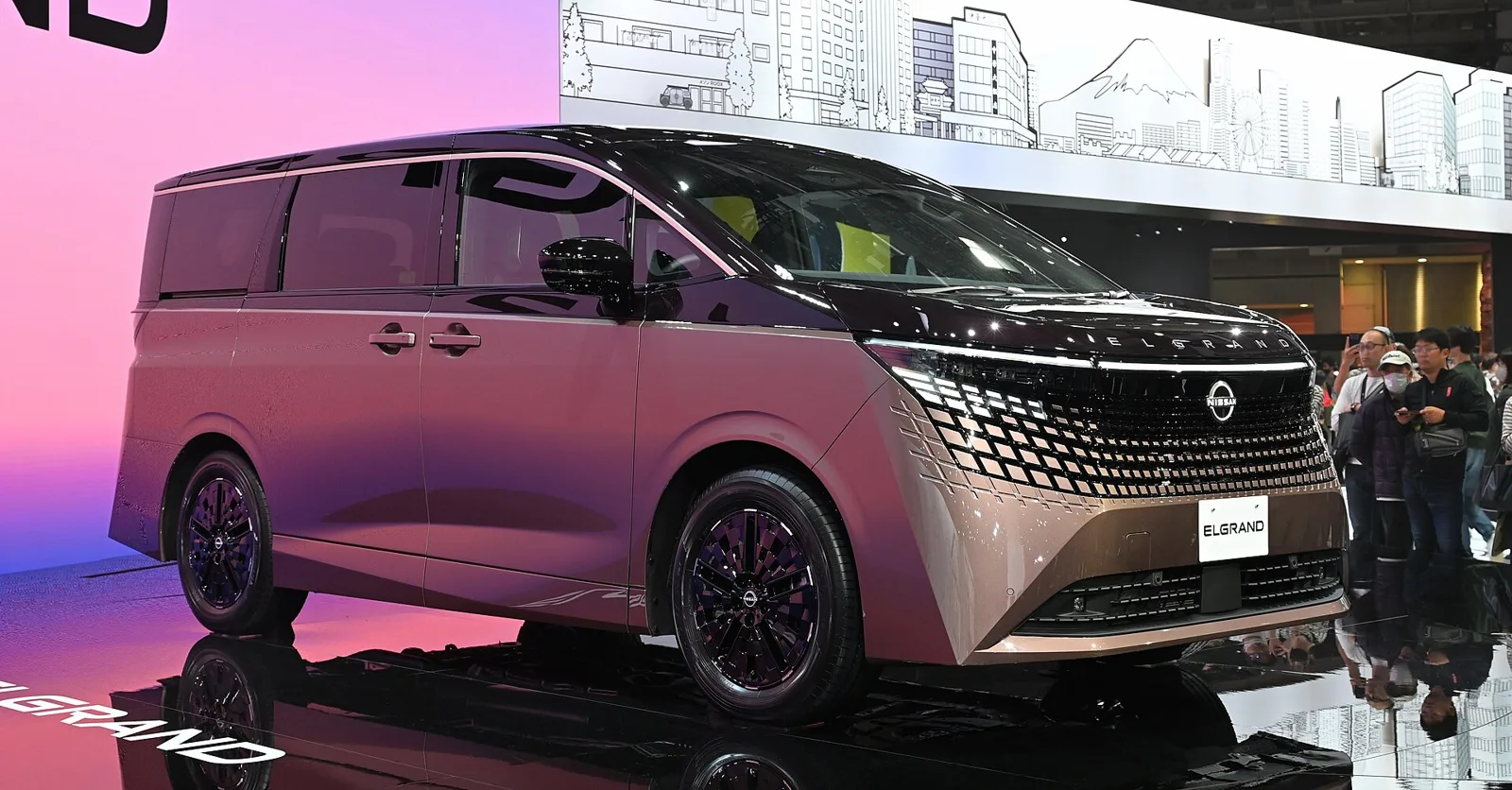
A large Japanese minivan built since 1997 by Nissan Shatai, from the rear-drive E50 to the e-Power hybrid E53 of 2026.
Nissan Shatai has built this large minivan for Nissan since 1997. The model has spanned the E50, E51, E52 and E53 generations, and the newest E53 is a series hybrid with e-Power that went on sale in July 2026 in X and G grades.
The Nissan Elgrand is a large minivan that Nissan has sold since 1997, with its bodies built by Nissan Shatai. It has passed through four generations, coded E50, E51, E52 and E53, and each one has taken a different route to the market. The early cars were rear-drive people carriers, while the latest E53 runs as a series hybrid.
What did the first-generation Elgrand introduce?
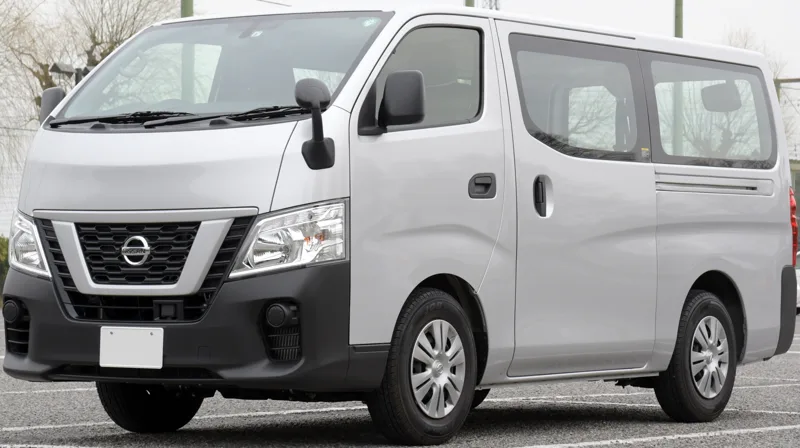
The first generation was produced from May 1997 to May 2002, with commercial versions staying in production until December 2017. It replaced the older Caravan Coach passenger role with a more luxurious version, and it offered a choice of petrol and diesel engines.
Petrol engines included the VG33E and the VQ35DE, while the diesel options were the QD32ETi and ZD30DDTi. The E50 had a 4-speed automatic and was available in either 2WD or 4WD. Top trims could be fitted with CarWings satellite navigation, a feature that was then fairly advanced in the class.
Trim levels included V, VG, X, XL, Highway Star, Rider and S Edition. The Caravan Elgrand was sold only at Nissan Store, while the Homy Elgrand was limited to Japanese Nissan Prince Store dealerships.
A minivan that began as a rear-drive people carrier in 1997 and reached its fourth generation as a series hybrid.
How did the E50 change over its life?
A minor facelift arrived in August 1999, and the Homy and Caravan nameplates were dropped at that point. A further facelift on 23 August 2000 gave the car a slightly redesigned front fascia, which kept the basic shape but refreshed the look.
The E50 was also used for specialist vehicles. The second-generation Nissan Paramedic ambulance appeared on the E50 chassis from May 1998, and its body from the B pillar rearward was carried over from the high-roof Paramedic II.
Which rebadged and commercial versions came from the E50?
Isuzu sold the E50 as the Fargo Filly from 1997 to 2002 in the Japanese market. The same family was offered as the Super Medic II ambulance, which Isuzu marketed until 2002. Each of these versions had its own recalls, which are part of the model's record.
The Elgrand Jumbo Taxi was a 10-passenger commercial van based on the E50 Paramedic. It was offered between 2000 and 2011, giving the line a practical role outside private family use.
What did the E51 bring in 2002?
The second generation E51 launched in May 2002 and went on sale on 21 May 2002. It competed with the Toyota Alphard and the Honda Elysion, and the Jumbo Taxi and Paramedic stayed on the older E50 chassis. The E51 was a different car, with power sliding doors and a rear roof spoiler.
The E51 also brought turn signal repeaters built into the side mirrors and 16-inch (XL) or 17-inch (HWS) aluminium alloy wheels. A new front fascia with a chromed grille gave it a sportier look than its predecessor.
The E51 was sold only through Nissan dealers in Japan at first, with small exports to Hong Kong and Brunei. It became a popular grey import in Australia, the United Kingdom, Canada and New Zealand, which is one reason the model is still seen abroad. Hong Kong later took the E51 and E52 in large numbers.
What powered the E51 Elgrand?
The E51 used either a 2.5-litre or a 3.5-litre V6 from the VQ engine family, combined with a five-speed automatic that had Tiptronic shift. Additional controls included Power and Snow settings, and a four-wheel drive option was available.
The rear suspension was a multilink arrangement, with ventilated disc brakes at all four corners. The car was built to handle its weight, which the heaviest XL version pushed to 2.2 tons.
How was the E51 equipped inside?
Interior features included captain-style seats, an eight-speaker sound system, and an optional nine-speaker Bose system. A TV and DVD player with a 9-inch (230 mm) screen was fitted, along with an eight-inch LCD for the Carwings vehicle information system.
The second row could be folded flat, and the front captain seats could be turned to face the back, which created a dining arrangement. Keyless-go was standard on most models, and optional extras included heated front seats and power curtains.
The car also offered a reversing camera with guidance lines, lane control and assisted braking. In 2008 the car gained four-view camera technology that gave an aerial all-round view when reversing.
What were the E51 special editions?
The Rider was a sporty version of the VG five-door. It had a front bumper change, a front fog lamp, side sill protectors, leather-lined interior and a Rider sound system with six speakers and a subwoofer. It rode on 17-inch aluminium wheels with 215/60R17 tyres and went on sale on 2 October 2002.
The Rider had an Autech Tuned Nismo version. The Autech Rider S, which followed later in 2003, had a slightly altered bumper design and a special finisher.
The Autech Elgrand VIP was a version of the XL with a four-seat layout, leather-wrapped rear seats, an electric slide step and rear-seat audio. JDM models went on sale on 19 December 2002.
How did the E51 get facelifts?
The first facelift went on sale in August 2004, and it integrated the front grille and headlight units. The rear lighting was revised, and door mirrors with integrated turn signals became standard, while the brake lights were converted to LEDs.
A 2.5-litre VQ25DE model was added in December 2004. The Elgrand Enchante was unveiled at the 2004 Tokyo Motor Show, and a second facelift in October 2007 added a new Highway Star grille with a body-colour line. The Around View Monitor became an option on all variants.
What was the Nissan Forum concept?
The Nissan Forum was a concept based on the E51 Elgrand, developed by Nissan Design America. It had trackless sliding side doors, hidden sunshades in the skyview moonroof panels and LED lights front and rear.
The concept was shown at the 2008 North American International Auto Show. Its design later carried over to the Nissan Quest, the North American counterpart of the E52.
What changed with the E52 in 2010?
The third generation E52 dropped the rear-wheel drive layout of the earlier car and shared a platform with the North American Quest (RE52). It was released in Japan on 18 August 2010 and was built until January 2014 in its pre-facelift form.
Moving away from rear-wheel drive gave the E52 a different character from the earlier cars, which all used rear-wheel drive layouts.
All E52 models were available in front-wheel or all-wheel drive, and the continuously variable transmission was the only transmission option. The 2.5-litre inline-four was rated at 170 PS (125 kW), while the 3.5-litre V6 was rated at 280 PS (206 kW).
The Enchant, a version with a mobility access seat in the second row, was offered in the Highway Star grades and the 250 XG. Japanese trim names included Highway Star Black Leather, Urban Chrome and Premium.
How did the E52 update through 2011 and 2012?
The 2011 update added an object motion sensor, a power liftgate and standard active AFS on the 250 models. The Urban Chrome variants had dark chrome grilles and 18-inch aluminium wheels, and the 2011 update went on sale on 11 November 2011.
In September 2011 a two-row four-seat version joined the existing three-row seven-seat model. The 2012 update brought collision avoidance with four ultrasound sonars and an around view monitor, while the Carwings navigation became standard on the higher grades.
What did the 2014 and 2020 facelifts change?
The 2014 facelift was announced in November 2013 and went on sale on 15 January 2014. The Highway Star grille was widened vertically, and the LED headlights and front bumper were reshaped. Standard cruise control became available on all models. The facelift also reached Malaysia in May 2014 and Indonesia in July 2014.
The 2020 facelift arrived on 12 October 2020, when the 250XG was discontinued and only the Highway Star remained. The interior adopted a horizontal theme with a large 10-inch display, and the captain's chairs gained folding seatbacks and angle-adjustable armrests. A minor change for 2022 added Nissan's new logo.
What is the fourth-generation E53?
Nissan teased the fourth generation in late April 2025, and the production version was revealed at the Japan Mobility Show on 29 October 2025. It took styling cues from the Hyper Tourer Concept, which was showcased on 17 October 2023, but in a more restrained form.
The E53 is exclusively a series hybrid, using the third generation of Nissan's e-Power system with a ZR15DDTe engine as standard. It went on sale on 16 July 2026 in X and G grades, with Autech variants and a VIP version also offered. The Step Type seating layout was optional on every grade.
How did the Elgrand reach international markets?
There is a strong grey import market for Elgrands in Canada, the United Kingdom, Australia, New Zealand and Russia, and previously the Philippines. Enthusiasts drive much of that demand, along with buyers who need a seven or eight-passenger vehicle.
In Hong Kong the E50 was imported in limited numbers, while the E51 and E52 were mass-imported, and both generations were sold officially by Nissan dealers. In Indonesia the third-generation car launched in early 2011 with the 3.5-litre V6, and the 2.5-litre four followed in September 2012.
What are the Nissan Elgrand specifications?
| Specification | Detail |
|---|---|
| Built since | 1997 by Nissan Shatai |
| E50 model years | 1997-2002; commercial versions until 2017 |
| E51 model years | 2002-2010 |
| E52 model years | 2010-2026 |
| E53 model years | 2026 onward |
| E50 engines | VG33E and VQ35DE petrol; QD32ETi and ZD30DDTi diesel |
| E51 engines | 2.5-litre or 3.5-litre VQ-series V6 |
| E52 2.5-litre engine | QR25DE, 170 PS (125 kW) |
| E52 3.5-litre engine | VQ35DE, 280 PS (206 kW) |
| E53 engine | ZR15DDTe with e-Power |
| Heaviest XL version | 2.2 tons |