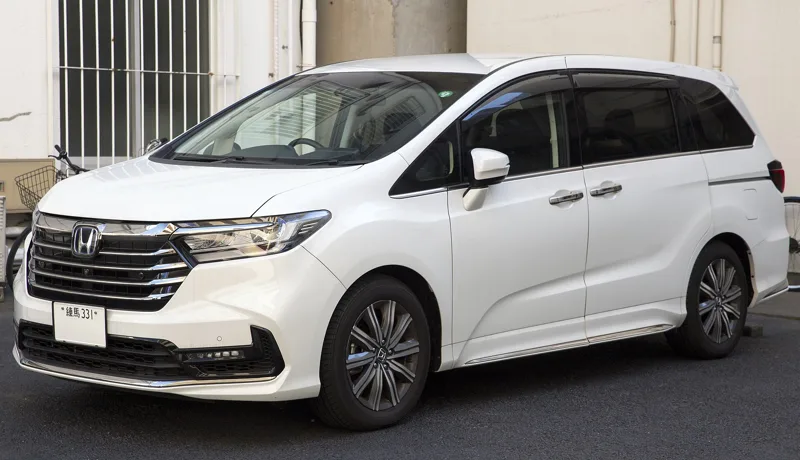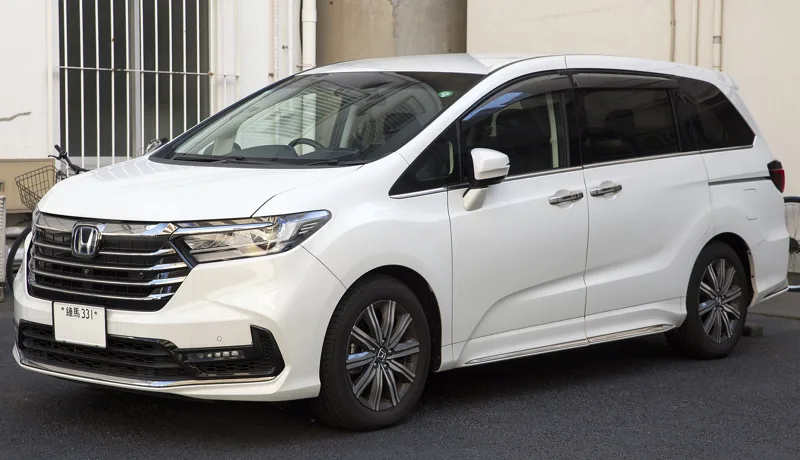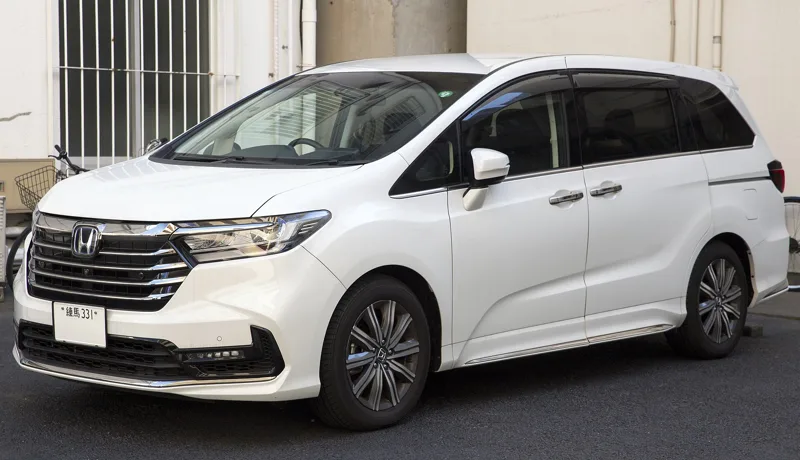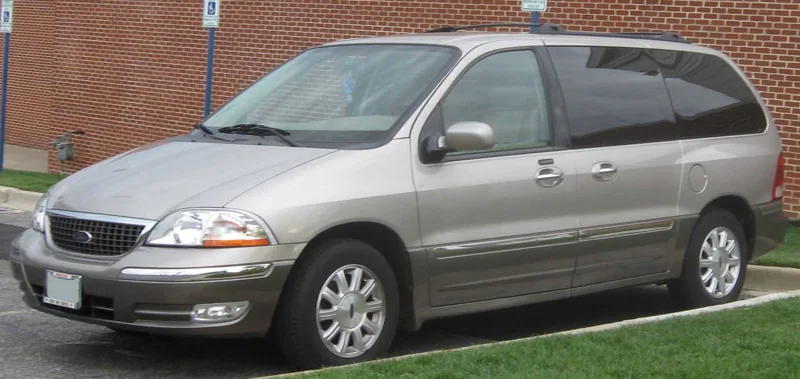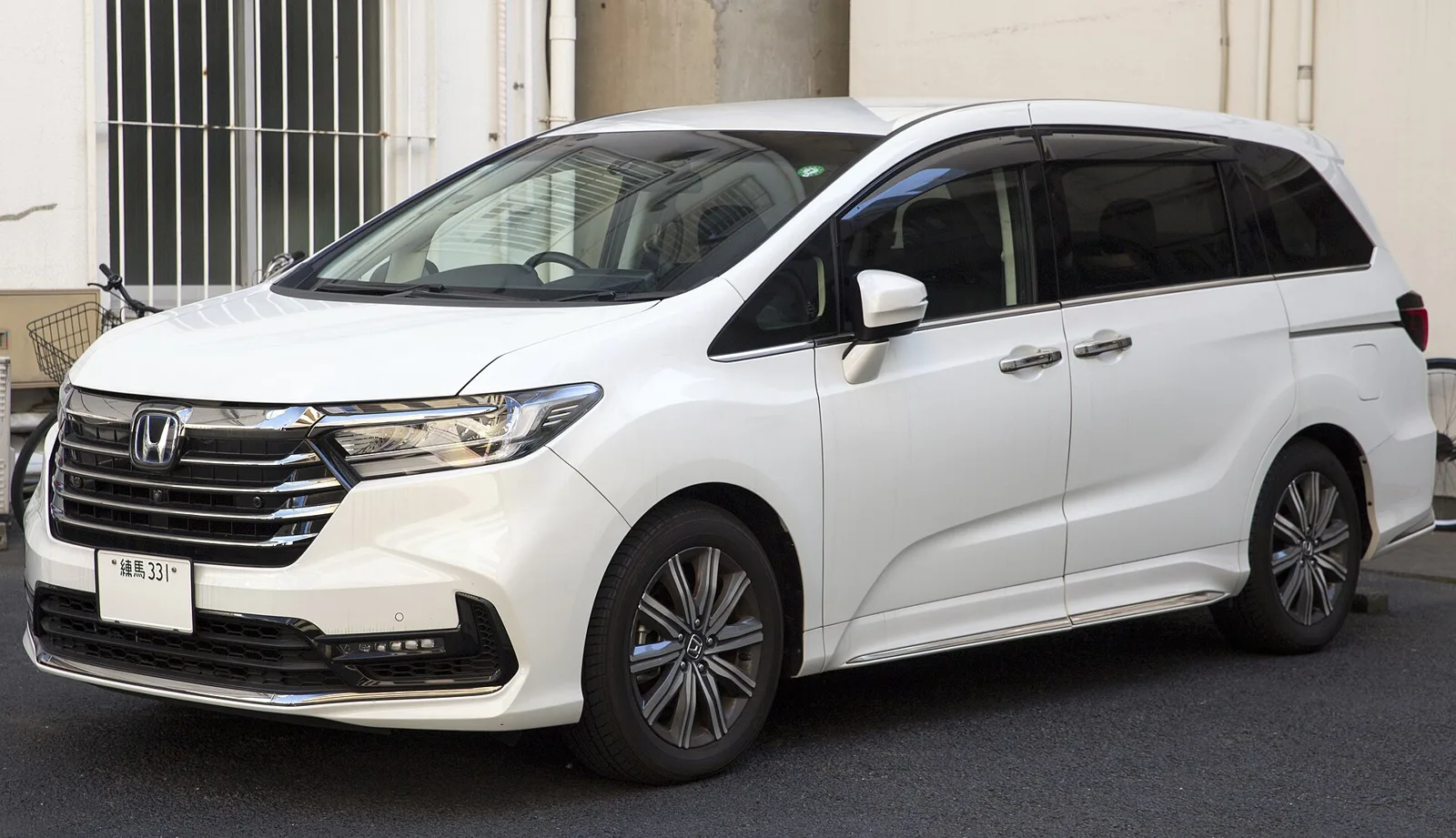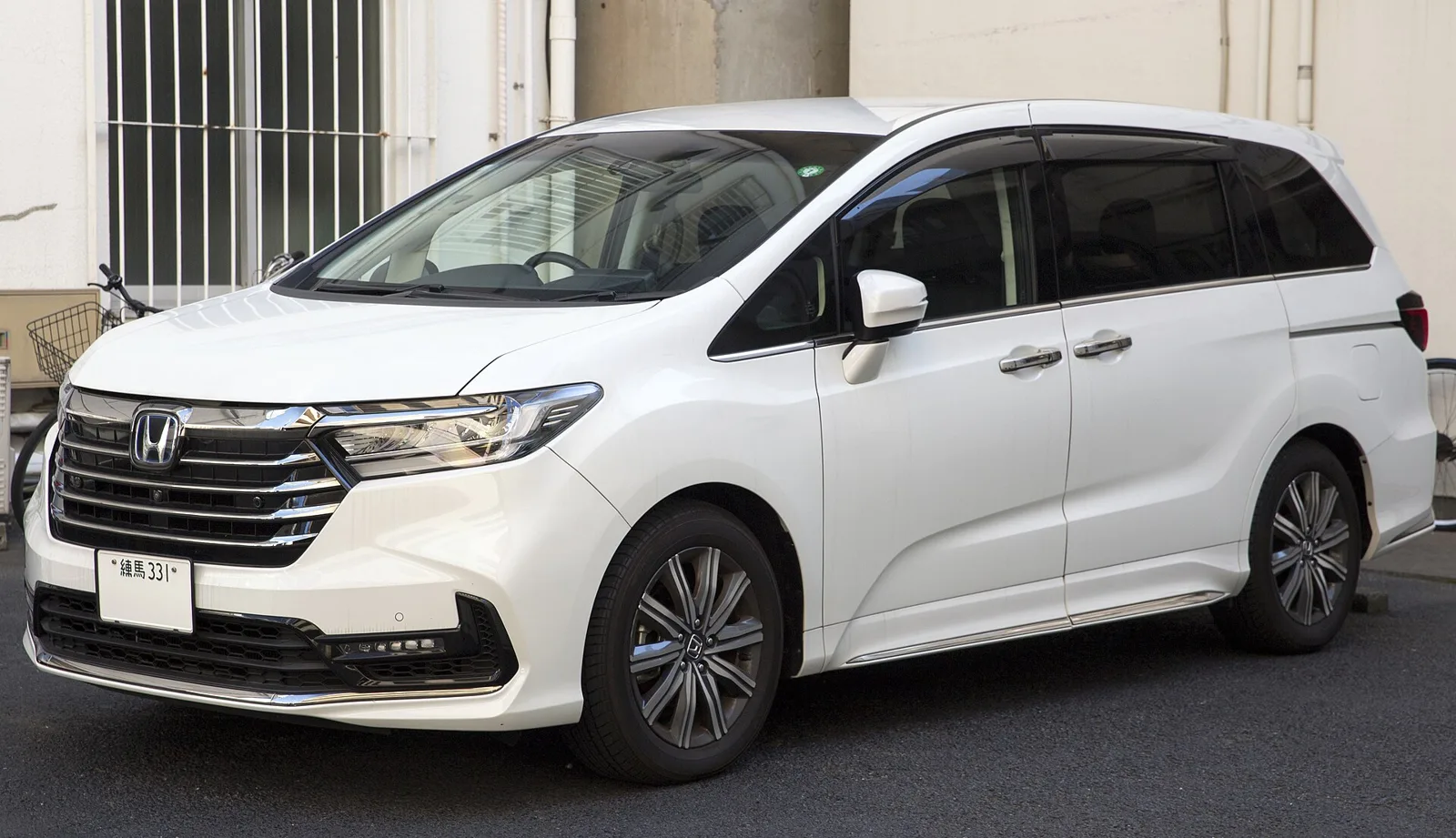
A Japanese-born minivan that became a larger North American model against a Toyota built around the Camry's platform.
The Honda Odyssey is a minivan that began in Japan in 1994 and became a larger North American model from 1999, with a fifth generation launched in 2013. The Toyota Sienna arrived in 1997 on a Camry-based platform and kept AWD for years, with a hybrid fourth generation for 2021.
The Honda Odyssey and the Toyota Sienna both chase the family-hauling buyer, but each was shaped by a different home market. The Odyssey started in 1994 as a compact Japanese minivan, then grew into a larger North American model from 1999 and is now in its fifth generation. The Sienna arrived in 1997 as a front-wheel-drive replacement for the Previa, and it kept all-wheel drive after GM's minivans dropped it in 2006.
How did the Odyssey and Sienna begin?
The Odyssey was conceived in Japan during the economic downturn of the 1990s, a squeeze that forced a smaller vehicle built in an existing factory. The result was a compact MPV that sold well at home and less well in North America. Europe knew the first generation as the Honda Shuttle.
Toyota took a different route. Its Sienna replaced the mid-engined, rear-wheel-drive Previa and was built on an extended platform from the Camry, which is why Toyota pitched it as the Camry of minivans. Three trims were offered, CE, LE and XLE, and production took place at Georgetown, Kentucky.
A minivan that began as a compact Japanese model and a Camry-based rival that kept all-wheel drive for years.
How did the Odyssey grow for North America?
Honda's answer to the size problem was to split the model. From model year 1999 the North American Odyssey became a large MPV, while a smaller Odyssey continued in Japan and other markets. Honda built a plant in Lincoln, Alabama with the capacity to make the larger models. In Japan the bigger car was sold as the LaGreat between 1999 and 2004.
The second generation, which arrived in December 1999, was a major upgrade rather than an all-new shape. The car came out 3.3 inches (85 mm) longer and 0.4 inches (10 mm) wider than its predecessor. Base models kept the smaller dimensions and engine, while the better-equipped versions picked up bigger bumpers and a larger grille.
Sienna buyers met the bigger Odyssey a year after launch. The Sienna's 1998 debut had been a V6 minivan, and the redesigned Odyssey was also V6 equipped, which put it squarely in the Sienna's path.
What engines did each minivan use?
The first Odyssey used a 2.2-litre engine rated at 130 PS (96 kW; 128 hp). A slightly larger 2.3-litre unit with 150 PS (110 kW; 148 hp) replaced it in August 1997, and a 200 PS (147 kW; 197 hp) V6 became an option in Japan that October. From 1997 the 3.0-litre J30A V6 went into the RA5 model, which was front-wheel drive only.
The Sienna launched with a 3.0-litre 1MZ-FE V6 with 194 hp (145 kW) and torque of 209 lb-ft (284 N m). Its second generation switched to a 3.3-litre 3MZ-FE V6 with a five-speed automatic, and in 2007 Toyota fitted a 3.5-litre 2GR-FE V6 producing 266 hp (198 kW). The 2010 model added a four-cylinder option, the 1AR-FE, which was the first four-cylinder Toyota had offered in a North American minivan since 1997.
What did the second-generation Sienna change?
Toyota unveiled the second-generation Sienna at the Detroit show on 6 January 2003 and moved production from Georgetown to Indiana. The chief engineer, Yuji Yokoya, and his relatives put more than 53,000 miles (85,000 km) on the old van across North America, hunting for its weak points. The result had 45 percent more volume and 39 percent more cargo space than the first generation. The seats moved to a 60/40 split, and the flat-folding third row could be had even on all-wheel-drive cars. The gear lever left the steering column for the centre console and gained a gated pattern. Lower trims could seat eight, and the third row folded flat to take plywood and drywall sheets up to 1.2 by 2.4 m (4 by 8 feet). The 3.3-litre 3MZ-FE V6 was matched to a five-speed automatic, and all-wheel drive split the engine's output 50:50 between front and rear. Every 2004 to 2007 model carried a factory tow package rated at 3,500 pounds (1,600 kg). The drag coefficient was 0.30, and the EPA rated front-drive versions at 17 mpg city and 23 mpg highway, with AWD at 16 and 22. Options included xenon headlamps, a laser-assisted cruise control, parking sensors, a convex mirror for watching the passengers, a voice-activated navigation system with a backup camera, a 10-speaker JBL audio system and a rear-seat DVD player with two 110 V outlets. The turning radius came to 11.2 metres (37 ft).
Which of the two offered all-wheel drive?
Both did, though for different periods. The first Odyssey was offered with optional four-wheel drive on the RA2 and RA4 chassis, and the third-generation RB2 4WD came only with an automatic transmission. Japanese fourth-generation cars took a 5-speed automatic for 4WD.
Toyota offered all-wheel drive on the Sienna from the second generation onward. The second generation split its power 50:50 front and rear, and the third generation kept AWD with the V6 on the LE, XLE and Limited. Once GM dropped its all-wheel-drive minivans after 2006, the Sienna stood alone in its class with AWD until the 2021 Chrysler Pacifica added an AWD option in 2020.
What did the third-generation Odyssey change?
The third generation was the first full redesign since 1994. It kept a five-door body but looked sleeker, lower and more like a car. Honda kept its height down, which suited the multi-level car parks common in Japan, and cruise control appeared on the Japanese-market model for the first time. The new model used the Honda K24A i-VTEC, a 160 PS (118 kW) engine of 2.4 litres that was also used in the CR-V and the Accord. The V6 disappeared. A 200 PS (147 kW) version of the same engine powered the sporty Absolute, and a 4WD Absolute made 190 PS (140 kW). Its fuel consumption matched that of the old 2.2-litre engine. The 4WD version came only with an automatic, while the front-drive car used a continuously variable transmission, except for the Absolute, some Japanese S and B models, and export versions. The combination of a sleeker body and the new engines produced a sales success, and Australia logged its best year in 2005.
How did the Odyssey sell in Australia?
The second-generation Odyssey started strongly in Australia and then slumped. Sales hit an all-time low in 2002, and in 2003 only 649 units were sold, almost a third of the total for 2000. The third generation turned the picture around, with a best-ever year in 2005 of 3,543 units. That year the Odyssey beat the Toyota Tarago in sales for the first time.
By the fourth generation, the Odyssey was the top people mover bought by private owners in Australia.
What changed with the fifth-generation Odyssey?
The fifth-generation car was teased on 26 September 2013 and reached Japanese showrooms on 1 November 2013. It was bigger than its predecessors, switched its hinged side doors for dual power sliding doors, and offered seven- or eight-seat layouts. Seven-seat versions had premium cradle seats with ottomans in the second row.
Power came from a new i-VTEC Earth Dreams unit of 2.4 litres rated at 175 PS (173 hp; 129 kW) and 225 N m (166 lb-ft). Direct injection lifted the top Absolute grade to 190 PS (187 hp; 140 kW) and 237 N m (175 lb-ft). Honda quoted 14.0 km/L (33 mpg-US) on the JC08 test cycle, and the suspension moved to MacPherson struts at the front with a torsion beam at the back.
The Odyssey Hybrid reached Japan on 4 February 2016, pairing a 2.0-litre petrol engine with Honda's Sport Hybrid i-MMD system. Set against the Accord Hybrid's power control unit, the new one is 23 percent smaller and weighs 27 percent less.
What did the Sienna's later generations bring?
US sales of the third-generation car opened in February 2010, and it was the first Sienna to win a Top Safety Pick from the IIHS. Its SE trim was new, with 19-inch (480 mm) wheels, firmer suspension and revised steering. Toyota's chief engineer for the car, Kazuo Mori, reportedly had to fight corporate opposition to get the SE package into the range.
The fourth-generation Sienna arrived for the 2021 model year as a hybrid on the TNGA-K platform, a platform common to most of Toyota's bigger people carriers and crossovers. Chinese production began in July 2021 at two Toyota joint ventures, and the car is marketed there as the Granvia. It is not made in right-hand drive.
How did the two minivans fare on safety?
The first Sienna was one of the few minivans of its time to offer side torso airbags and Vehicle Stability Control as options, with anti-lock brakes standard. The IIHS rated it Good in all six frontal crash measures, a clear step up from the Previa. The second generation earned an overall Good in the frontal offset test, and models from 2006 onward earned Good overall.
The fourth generation made stability control and curtain airbags standard across the range. Its Japanese sales began on 17 October 2008, and the Absolute grade reached 206 hp.
Were there problems to weigh up?
The first-generation Sienna carried an oil sludge problem that led to a class-action settlement. The issue affected V6 engines across many Toyota models, and the symptoms included oil smoke, very dark oil shortly after a change, a petrol smell in the oil and eventually engine failure. Buyers looking at older examples should check the service history.
Specifications side by side
| Feature | Honda Odyssey | Toyota Sienna |
|---|---|---|
| First generation | 1994, compact MPV based on the Accord sedan | 1997 launch, 1998 model year, based on an extended Camry platform |
| Current generation | Fifth generation, 2013 (Japan sale from 1 November 2013) | Fourth generation, 2021 model year, hybrid |
| Body layout | Seven- or eight-seat layouts; dual power sliding doors on the fifth generation | Front-wheel drive with AWD option; not sold right-hand drive |
| First-generation engine | 2.2 L, later 2.3 L; 3.0 L J30A V6 from 1997 | 3.0 L 1MZ-FE V6, 194 hp (145 kW) |
| Fifth or fourth-generation engine | 2.4 L Earth Dreams, 175 PS (173 hp; 129 kW) | Not listed |
| All-wheel drive | Optional 4WD on early models; RB2 4WD in the third generation | Offered on the second and third generations; AWD into 2021 |
| Hybrid | Odyssey Hybrid from 4 February 2016 (Japan) | Fourth generation hybrid, 2021 model year |
| Fuel economy | 14.0 km/L (33 mpg-US), JC08 cycle | Third generation: 18 mpg-US city and 24 mpg-US highway (FWD V6) |
| Safety | Electronic stability control and curtain airbags standard on all grades (fourth generation) | First Top Safety Pick (third generation); Good in all six frontal measures (first generation) |
| Assembly | Lincoln, Alabama plant built for the larger models | Georgetown, Kentucky (first generation); Indiana (second generation) |
Which family suits each minivan?
The Odyssey suits a buyer who wants the seven- or eight-seat fifth generation, or a hybrid version that arrived in 2016.
The Sienna suits a buyer who wants all-wheel drive in a minivan, which for many years was a rare option among North American minivans. Its third-generation SE trim adds a sportier drive, and the fourth generation brought hybrid running to the line-up.
On the evidence here, neither minivan takes a clear overall lead. The Odyssey brings a hybrid from 2016 and a best-ever Australian year of 3,543 units, while the Sienna brings a long run of all-wheel drive and the first Sienna Top Safety Pick. Families who want the most room should compare the second and third rows in person before choosing.