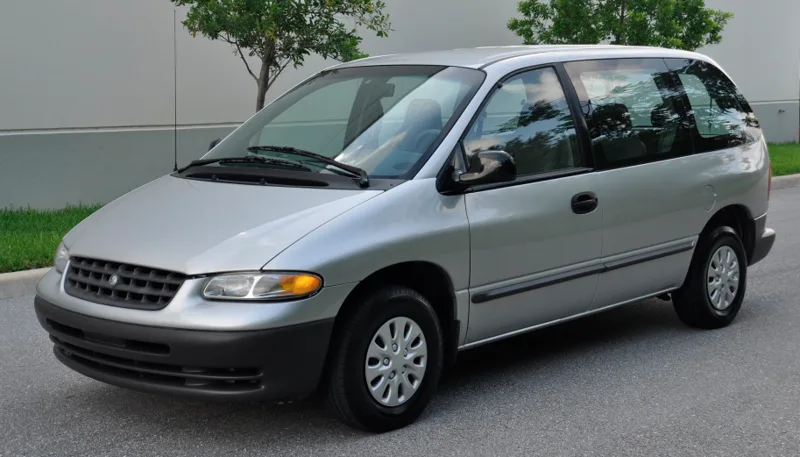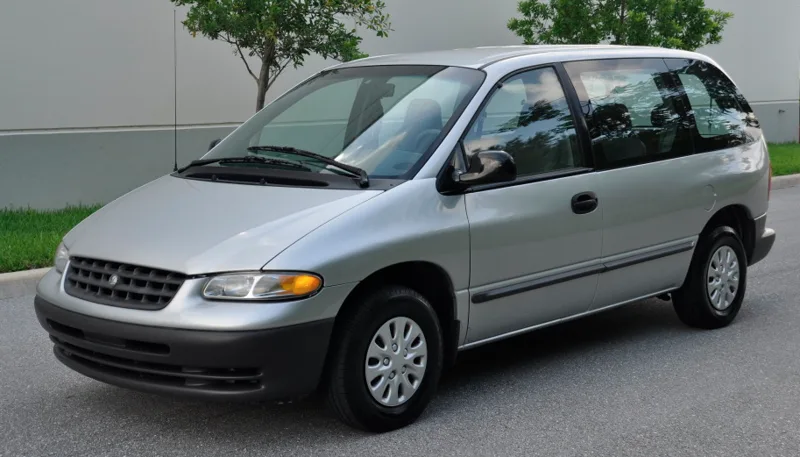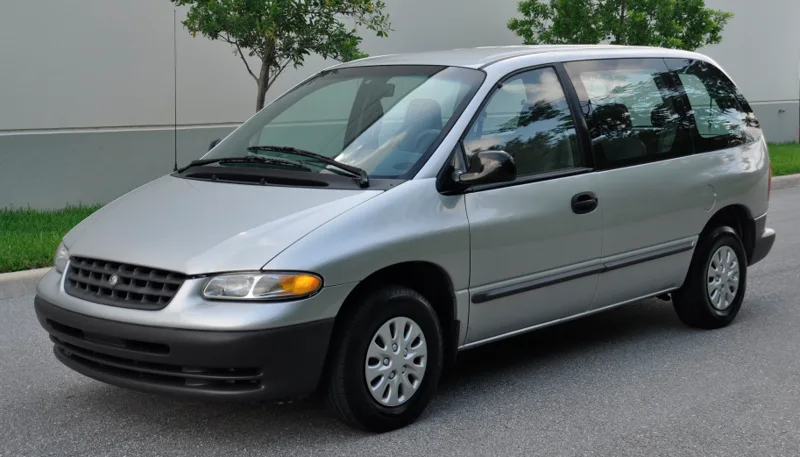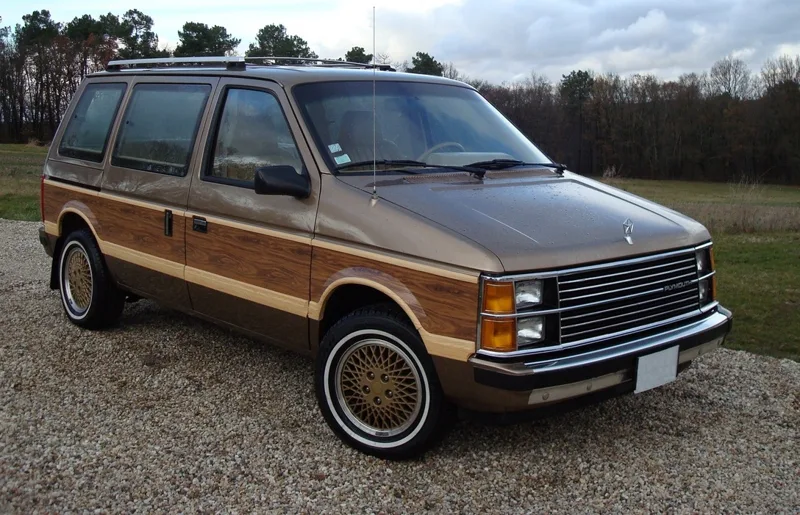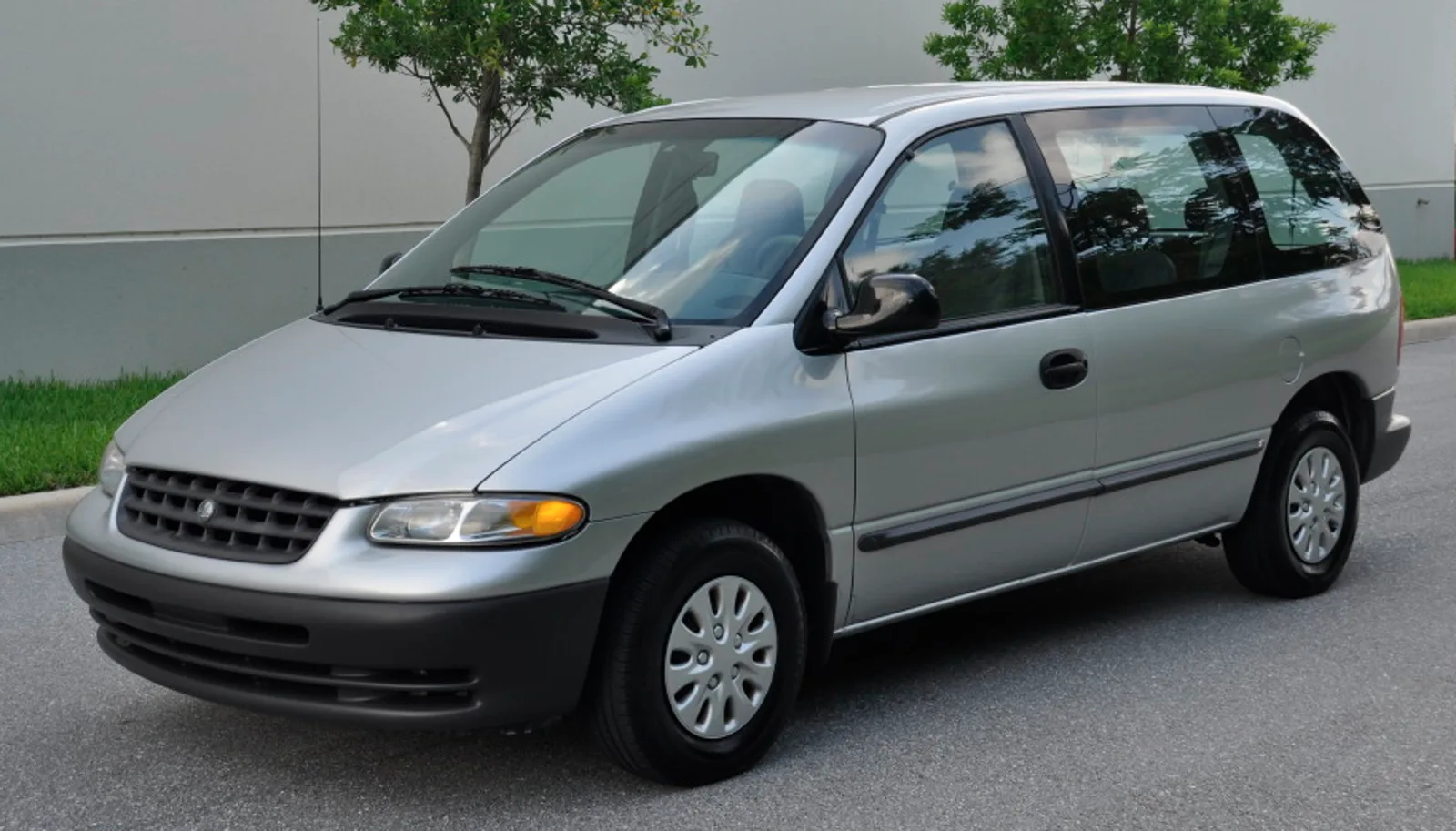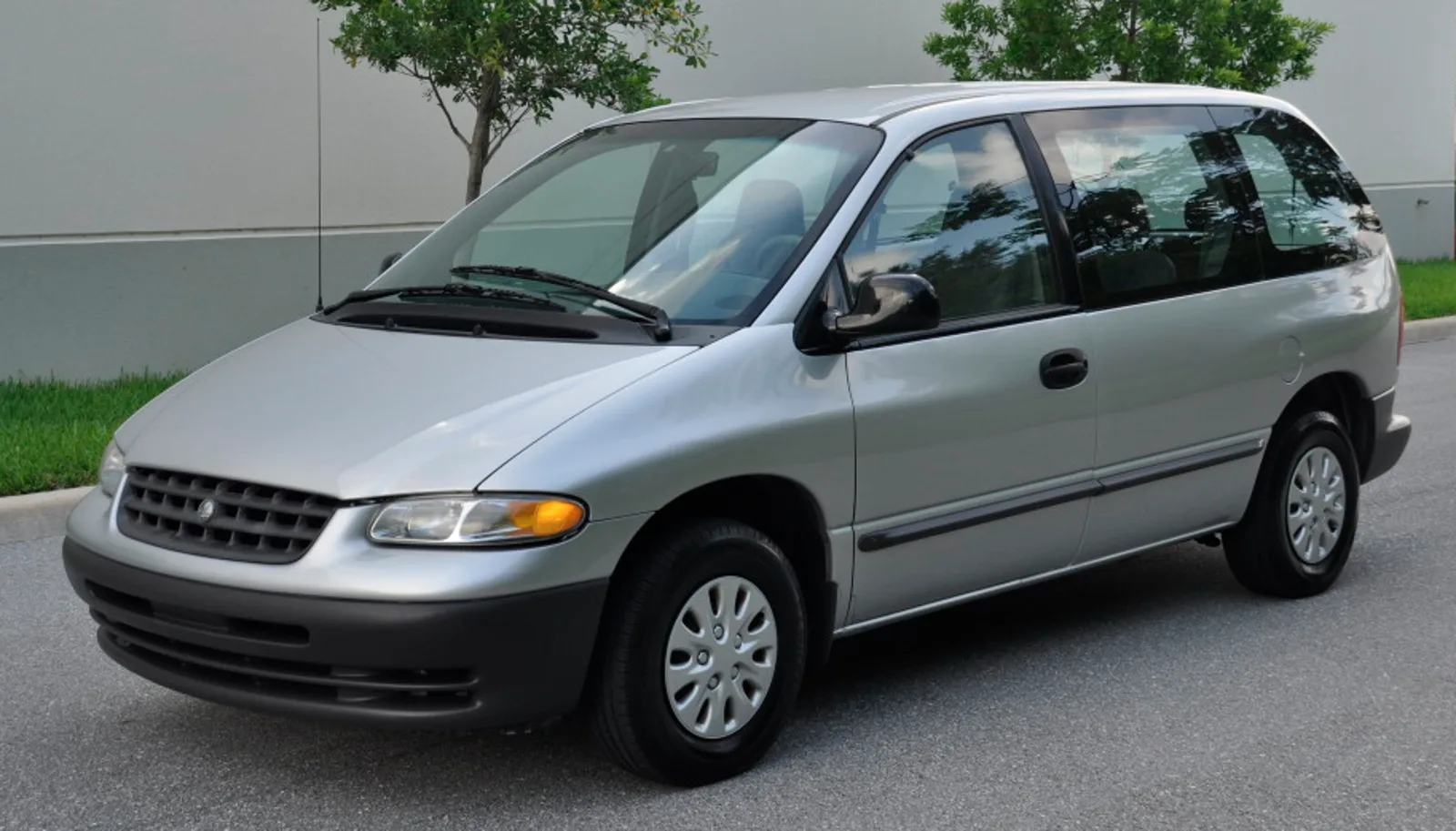
A ground-up American minivan with a sliding door against a Japanese van that began compact and only grew for North America in 1999.
The Chrysler NS minivans sold from 1996 to 2000 and the Honda Odyssey from 1994 competed head to head in North America. The NS vans brought a driver-side sliding door to mid-size minivans, while the first Odyssey was a compact van that sold better in Japan than in North America.
The Chrysler NS minivans and the Honda Odyssey both aimed at North American families, but they started from opposite points. The Chrysler vans were a ground-up minivan with a driver-side sliding door. The Odyssey began as a compact van built on an Accord sedan platform, and it only became a larger model for North America from 1999.
Why did the Odyssey and the NS vans compete so directly?
Both vans were sold to the same North American family buyers, and the NS vans listed the Honda Odyssey among their chief rivals. The Odyssey had arrived first, in 1994, and it was better received in Japan than in North America.
The Ford Windstar and Toyota Sienna were the other chief rivals of the NS vans. Both competitors were three-row, front-wheel drive vans, and the Windstar had arrived nearly exactly a year before the NS vans did.
The Odyssey had a head start. It launched in Japan and North America in 1994, a year before the NS vans went on sale, and in 1995 it also took a Japanese car award from the Automotive Researchers' and Journalists' Conference.
Two family vans from the mid-1990s: one built as a mid-size sliding-door van, the other a compact that only grew for North America in 1999.
How did each van start out?
The first Odyssey was conceived and engineered in Japan after that country's economic crisis of the 1990s. The crisis limited its size and forced production into an existing plant with minimal changes, so the result was a smaller van in the compact MPV class. It was marketed in Europe as the Honda Shuttle.
Chrysler's NS programme was a much larger undertaking. Development began in 1990, design work was approved in September 1991 and the design froze in May 1992. The cost reached $2.8 billion, about $4.6 billion in 2017 dollars, the most Chrysler had spent on one vehicle at the time.
Honda's North American Odyssey was the one that grew. Honda built a plant in Lincoln, Alabama, with the ability to make larger models, and from the 1999 model year it sold a larger Odyssey in North America while Japan kept a smaller version.
Size and body: what separated the two?
The NS vans rode on a new unibody platform with a 113.3-inch wheelbase on the standard length and 119.3 inches on the long-wheelbase version. Their cab-forward body lowered the drag coefficient from 0.39 to 0.35, and the liftgate gained an exterior handle that ended the old pop-and-lift routine.
The Odyssey's body changed in steps. The second generation arrived in December 1999 in Japan and Australia, and measured against its predecessor it added 85 mm (3.3 in) of length and 10 mm (0.4 in) of width. It kept a shape close to the first generation, and the major change was inside.
Sliding doors were the clearest contrast. The NS vans adopted a driver-side sliding door, a feature first used on compact minivans like the Nissan Stanza Wagon. The Odyssey kept rear hinged side doors until the fifth generation, when Honda switched them to dual power sliding doors, much like most Japanese minivans by then.
Which engines did each van offer?
The NS vans opened with a 2.4-litre four-cylinder rated at 150 hp and offered three V6s depending on the market. The first Odyssey began with a 2.2-litre four rated at 128 hp, then a 2.3-litre, and a 3.0-litre V6 joined the range in 1997.
The two four-cylinder engines were close on paper. The NS 2.4-litre rated 150 hp, while the Odyssey's 2.3-litre was rated 150 PS (110 kW; 148 hp). The Odyssey's V6 reached 200 PS (147 kW; 197 hp) in Japan from October 1997, and it grew to 210 PS (154 kW) in the second generation.
| Specification | Chrysler minivans (NS) | Honda Odyssey |
|---|---|---|
| Model years covered | 1996 to 2000 | First generation 1994; second generation from December 1999 |
| Body type | Mid-size; driver-side sliding door | Compact at launch; rear hinged doors until the fifth generation |
| Wheelbase | 113.3 inches (standard); 119.3 inches (long) | Not given |
| Drag coefficient | 0.35 | Not given |
| Four-cylinder engine | 2.4-litre, 150 hp | 2.2-litre at 130 PS (96 kW; 128 hp); 2.3-litre at 150 PS (110 kW; 148 hp) from 1997 |
| V6 engine | 3.0-litre (Mitsubishi), 3.3-litre (Chrysler), 3.8-litre | 3.0-litre J30A from 1997; 210 PS (154 kW) in the second generation |
| Transmission | Three-speed TorqueFlite or four-speed Ultradrive; no manual in US or Canada | Four-speed automatic on four-cylinder models; five-speed automatic on the V6 from 2000 |
| Manual option | Five-speed manual on export vans | None offered in European sales |
| Build location | Windsor, Ontario and Fenton, Missouri | Existing Japanese plant at launch; Lincoln, Alabama plant for larger models |
| Fuel economy | Not given | 14.0 km/L (40 mpg-imp; 33 mpg-US) JC08, fifth generation |
| Crash results | Dodge Grand Caravan 1996 to 2000: Marginal, IIHS 40 mph offset | Not given; fourth generation added electronic stability control |
| Australian sales | Not given | 3,543 in 2005, the best year |
Which van was safer on paper?
Published crash results are more detailed for the NS vans than for the Odyssey. The 1996 to 2000 Dodge Grand Caravan rated Marginal in the IIHS 40 mph offset test, yet Folksam rated the 1996 to 2000 generation Safest in its 2009 real-world study.
NHTSA gave the Grand Caravan four stars for the driver and front passenger in frontal impact. The side test awarded five stars to the driver and three to the rear occupant, though it also recorded a fuel leak that could cause a fire.
For the Odyssey, the safety story is one of equipment. The fourth generation added electronic stability control and curtain airbags as standard on all grades, which was a clear step forward for the range. Folksam's 2009 study covered 172 car models, and its Safest rating meant at least 30% safer than the average car.
How did sales compare?
No sales totals are published for the NS vans, so volume cannot be compared directly. The Odyssey's best year in Australia was 2005, when 3,543 were sold and the van outsold the Toyota Tarago for the first time.
The second generation did less well in Australia. Sales hit an all-time low in 2002, and 649 units sold in 2003, almost a third of the total in 2000. The third generation turned that around, and the fourth was the best-selling people mover among private buyers there.
What changed in the later Odyssey generations?
The third generation, launched in Japan in October 2003, was a sleeker, lower van with a 2.4-litre K24A rated 160 PS (118 kW), the same engine used in the CR-V and Accord. The V6 was dropped, and the sportier Absolute used a 200 PS (147 kW) version of the same engine.
The fourth generation went on sale in Japan on 17 October 2008, and it kept the 2.4-litre engine with more power and better economy. The fifth generation, teased on 26 September 2013, switched to a 2.4-litre i-VTEC Earth Dreams engine with dual power sliding doors and a MacPherson strut front suspension.
A hybrid version reached Japan in early February 2016, pairing a 2.0-litre petrol engine with the Sport Hybrid i-MMD name. Its power control unit was 23 percent smaller and 27 percent lighter than the Accord Hybrid's.
What was inside the first Odyssey?
Every Odyssey since the first generation has been a six- or seven-seat van. Japanese-market cars had dual air conditioning with separate controls for the front and rear rows, and the L and Aero models had a sunroof.
The first generation's optional four-wheel drive was offered on the RA2 and RA4 chassis, while the RA5 with the 3.0-litre V6 was front-wheel drive only. The Japanese range started with B, S and L grades, a top-of-the-line Exclusive joined in January 1996, and an M grade followed in October 1996, when the base B grade was dropped.
How did the Odyssey change in the 1997 and 2001 updates?
The 1997 facelift arrived in August 1997 and dropped the Exclusive grade, which was replaced that October by the Prestige in VG and VZ grades. The 2001 restyle added an MQ grade and a sportier Absolute, with clear-lens tail lights in place of amber indicators.
The 2001 update also gave the Absolute a body kit and darker lens tail lights. The four-cylinder version kept the F23A 2.3-litre engine as standard on the RA6 and RA7 chassis, with the 3.0-litre J30A V6 optional on the RA8 and RA9.
Two special editions followed in 2003. The Premium Sound Spirit, based on the MQ grade, arrived in Japan in February with a Bose audio setup, 16-inch aluminium wheels and interior trim styled to look like forged metal. In May the Fine Spirit joined the Absolute, Absolute Limited and M grades with a special body colour and a metallic grey grille.
What changed inside the second-generation Odyssey?
The second-generation interior was completely new. The automatic column shifter moved to the centre console, and a touchscreen climate control replaced the old manual controls, working with Honda's new navigation system.
Woodgrain trim was standard on every model, and the V6 versions of the VG and VZ grades had leather and velour seat and door materials over the basic cloth. The second and third rows were reconfigured, the spare wheel moved beneath the third row, and the L and Absolute versions gained a third-row heater. The sunroof was no longer offered.
The second generation also introduced a manual mode on every gearbox. The classic hydro-automatic stayed, but the driver could manage shifting with the selector's plus and minus positions, where the electronics allowed it.
What did the third generation change?
The third generation was the first full redesign since the Odyssey arrived in 1994. It went on sale in Japan in October 2003, with a lower, sleeker body and a 2.4-litre K24A engine that replaced the V6, and it became a sales success.
Cruise control appeared on the Japanese-market Odyssey for the first time. The 4WD version received a new DPS system and came only with an automatic gearbox, while the 2WD version used only a CVT, apart from the Absolute and export models.
Honda gave the Absolute a 200 PS (147 kW) variant of the K24A, and it claimed the new engine matched the fuel consumption of the old 2.2-litre unit. The new van was the lowest Odyssey yet, designed with multi-level parking in mind, particularly for Japan.
What did the fifth generation bring?
The fifth generation changed the rear doors to power sliding units and moved the front to MacPherson struts, and its seven-seat versions had premium cradle seats with ottomans on the second row. Honda's Concept M, shown at the 2013 Shanghai Auto Show, had previewed the look.
The RC1 and RC2 models came in seven or eight-seat layouts. Power came from a 2.4-litre i-VTEC Earth Dreams engine rated 175 PS (173 hp; 129 kW), with direct injection on the top Absolute grade lifting output to 190 PS (187 hp; 140 kW). Torque was 225 N-m (166 lb-ft) in the base model and 237 N-m (175 lb-ft) in the Absolute.
In Japan the fifth generation also replaced the first-generation Elysion, aimed at the Toyota Alphard and Nissan Elgrand in the full-size luxury MPV class.
Which buyer suits each van?
A buyer who wants a driver-side sliding door on a mid-size van, with a choice of Chrysler, Dodge and Plymouth badges, would look first at the NS vans. A buyer who wants a Honda with a V6 and a five-speed automatic from 2000 would look at the Odyssey.
The Odyssey has the clearer sales record of the two, from its 2005 peak in Australia onward. The NS vans have more detailed published crash results, but with no sales figures published for them, their market share cannot be ranked.