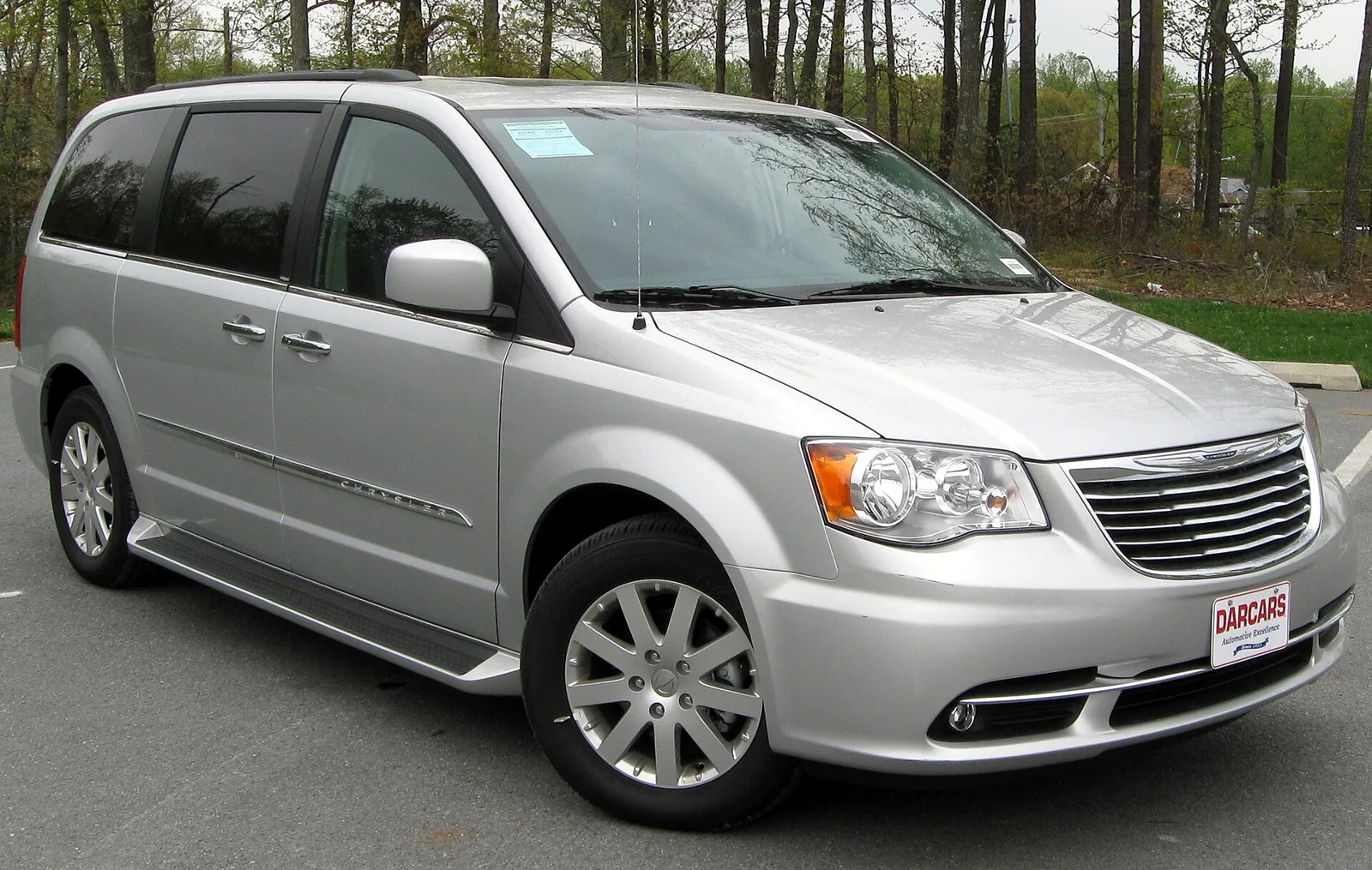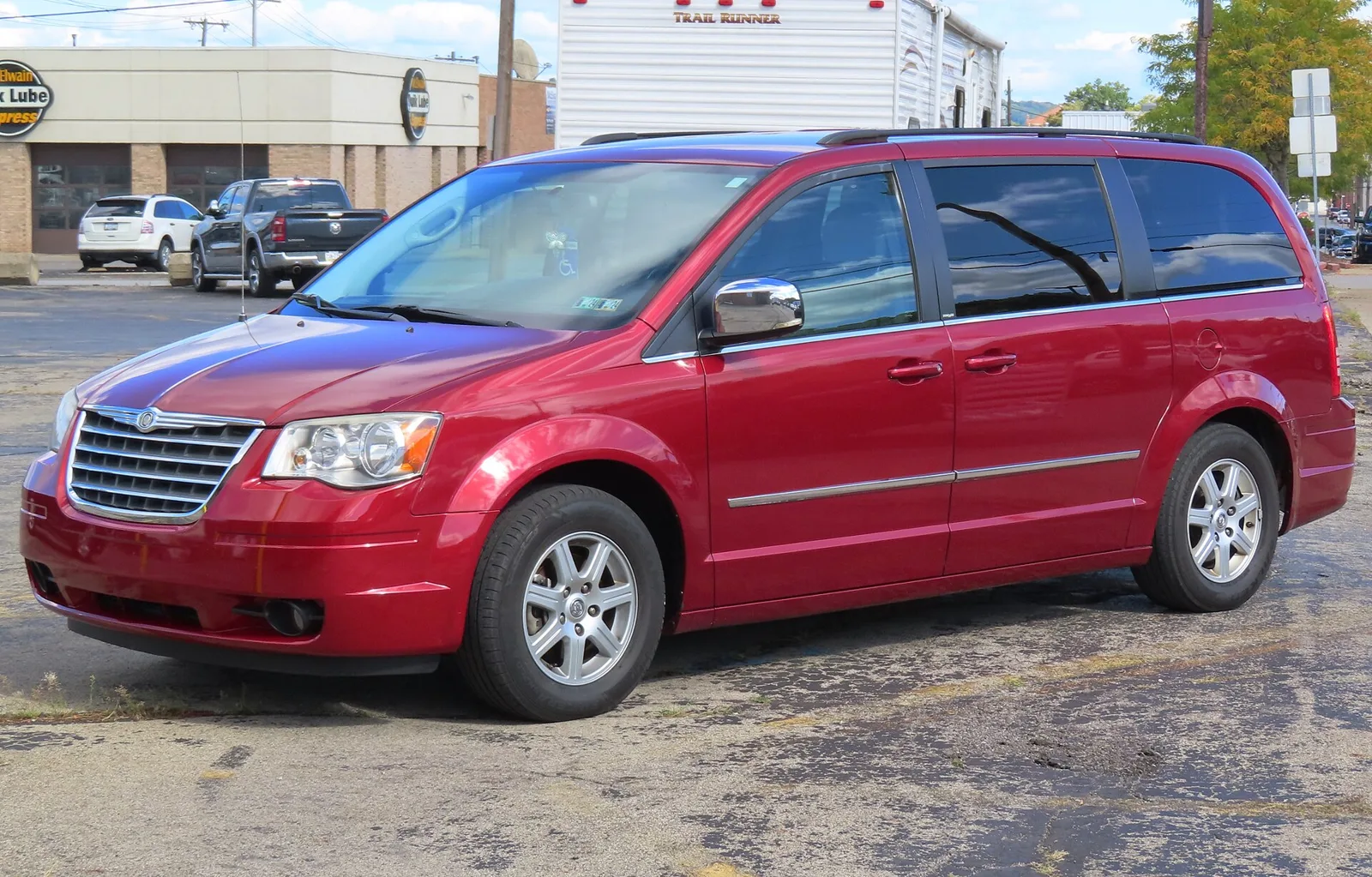
A nameplate produced for about 75 years, a minivan that added Stow n Go seating, and a flagship that ended when the Pacifica took over for 2017.
Five generations of the Town & Country were sold between 1990 and 2016, carrying a station wagon's name into the minivan era. Chrysler retired the nameplate for 2017, when the Pacifica took its place.
The Chrysler Town & Country was a minivan built from the 1990 to 2016 model years as the flagship of Chrysler's range. It was the third Chrysler minivan introduced in North America, and it ranked above the long-wheelbase Dodge and Plymouth vans in the range. Five generations went on sale before the nameplate was retired for 2017.
Where did the Town & Country name come from?
The name came from Chrysler's flagship station wagon line, which had used woodgrain trim as a design feature. Station wagon production ended after the 1988 model year, which left the nameplate idle for the first time since 1945.
Chrysler saw a minivan under the old name as a way to win higher-profit sales. It also had pre-manufactured long-wheelbase bodies that Dodge and Plymouth had already planned to sell, so the new model needed few distinct parts to keep tooling costs down.
The Town & Country was benchmarked against the largest Chrysler sedans of the day, including the 1989 and 1990 New Yorker Landau and Fifth Avenue. Woodgrain stayed with the nameplate, and the vans were treated as a premium product from the start.
A minivan that carried a station wagon's name, added Stow n Go seating and ended as Chrysler's longest-produced nameplate.
What was the first generation like?
The first generation debuted in spring 1989, badged as an early 1990 model. It used the Chrysler S platform, with the same body as the long-wheelbase Dodge and Plymouth vans. It was offered only in white at first, with black added in June 1989, and every van had a tan interior.
The exterior was monochrome, with body-coloured bumpers and mirrors. A waterfall grille was designed for the Town & Country, and a crystal Pentastar hood ornament also appeared on the New Yorker and Fifth Avenue. The 15-inch wheels were the same as those on the Voyager LX.
Inside, the van had leather seats, upgraded wood trim and an Infinity sound system shared with the Imperial. Power windows and locks, seven-passenger seating and front and rear air conditioning came as standard, and the model was sold in a single trim level.
Which engines did the first generation use?
The first Town & Country came with the 3.0L Mitsubishi 6G72 V6, producing 142hp. Those early vans were certified by the EPA as 1989 vehicles. For 1990 the Chrysler-built 3.3L V6 replaced it, adding 8hp, and that engine was shared with the Dodge Dynasty, the New Yorker and the Imperial.
Both engines were paired with a four-speed Ultradrive automatic. Output of the 3.3L was 150hp, and its torque was 180 lb-ft.
What changed in the second generation?
On the AS platform, the second generation arrived in November 1990 with the Grand Caravan's 119-inch wheelbase. It shared only its front doors and side door with the earlier car, and the chassis received extensive upgrades.
Trim-wise, the second generation was a single-trim affair with few options, and no short-wheelbase version existed. Quad Command captain's chairs in the second row were optional at first, then became standard for 1992.
A driver-side airbag was an option in 1991 and became standard in 1992. That made the Town & Country the first minivan sold with a driver airbag.
Engines changed in the middle of the cycle. A 3.3L EGA V6 with 150hp served from 1991 to 1993, and a 3.8L EGH V6 with 162hp replaced it in 1994 and 1995.
How did the third generation break from the earlier vans?
The third generation arrived at the start of 1995 on the all-new NS platform. It was the most extensive redesign of Chrysler's minivans since their 1984 release. Its cab-forward design gave more interior space and better visibility, and a driver-side sliding door was introduced.
Woodgrain trim disappeared in 1996, and the Pentastar hood ornament was replaced by a grille-mounted Chrysler blue ribbon emblem. The 1996 model also used rear seats mounted on deployable wheels, which made them easy to remove.
A standard 113-inch wheelbase version was added alongside the long-wheelbase vans, so the range could compete with smaller rivals such as the Oldsmobile Silhouette and the Mercury Villager.
What trims did the third generation offer?
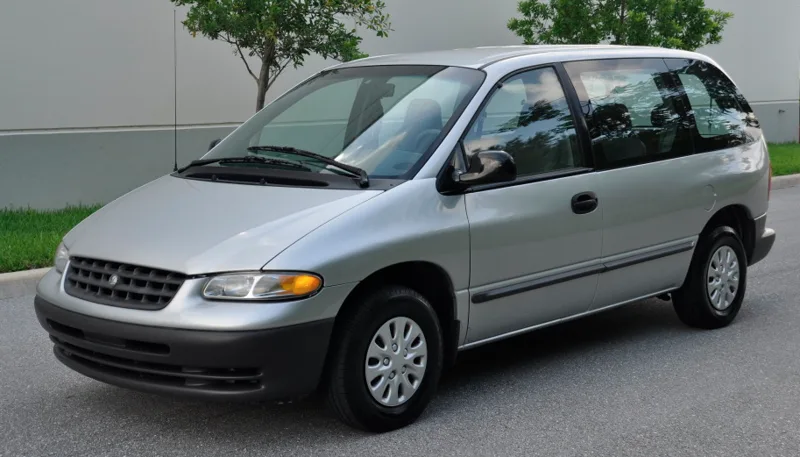
For 1996 the previous Town & Country was renamed the LXi, and a base long-wheelbase model replaced the Plymouth Grand Voyager LE. The short-wheelbase LX took the place of the Plymouth Voyager LX, with the same equipment as the base model.
For 1997 the base long-wheelbase van became the LX, and the short-wheelbase LX was renamed the SX. The Limited arrived in 1999 above the LXi, with chrome wheels, chrome door handles and a distinct third-row seat with individual outer seatbacks.
Power came from a 3.3L EGA V6 producing 158hp from 1996 to 2000, and from a 3.8L EGH V6 rated at 166hp in 1996 and 1997. From 1998 the 3.8L was upgraded to 180hp, which gave the top vans a stronger performance margin.
What did the fourth generation bring?
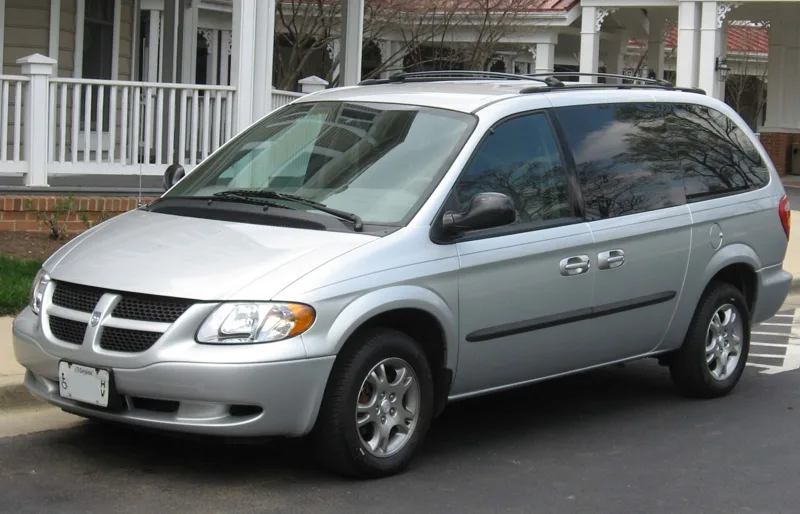
The fourth generation arrived in January 2000, badged as a 2001 model. It used the Chrysler RS platform and was initially available only in long-wheelbase form. The short-wheelbase version was marketed under the Voyager nameplate until the name was dropped after 2003.
The 2005 refresh added Stow n Go, a system that folded the second and third rows into under-floor compartments. Introducing it meant dropping all-wheel drive, and the system became the centre of the model's marketing campaign.
Stow n Go was a $400 million programme. Engineers used an erector set to visualise how the seats and the underfloor parts, including the spare tyre well and fuel tank, would fit together. The system created 12 cubic feet (340 L) of under-floor storage when the second row was deployed.
What did the fifth generation introduce?
The fifth generation reached showrooms in August 2007 as a 2008 model, styled by Ralph Gilles. The short-wheelbase model was discontinued, and a new 4.0L V6 came as standard on the Limited, with a six-speed automatic across the range.
Swivel n Go second-row seats turned to face the third row, and a detachable table could sit between them. Those seats were dropped from the 2011 line-up because of a lack of consumer interest, and the Stow n Go system carried on.
Power windows were fitted to the sliding doors, and the gear selector moved from the steering column to the centre console. Dual rear DVD screens and Sirius Backseat TV were also available for the second and third rows.
Was there a recall on the Town & Country?
On June 3, 2010, Chrysler called back 284,831 2008 and 2009 Town & Country vehicles, citing a wiring harness routed wrongly within the sliding door. A similar recall covered 15,902 Volkswagen Routan vehicles from 2010.
The Routan was a rebadged variant of the Chrysler RT minivan, built at Windsor Assembly and debuting in 2008. It did not feature the Stow n Go or Swivel n Go seats, but it did offer the Easy Out Roller Seats on its second row.
What did the 2011 refresh change?
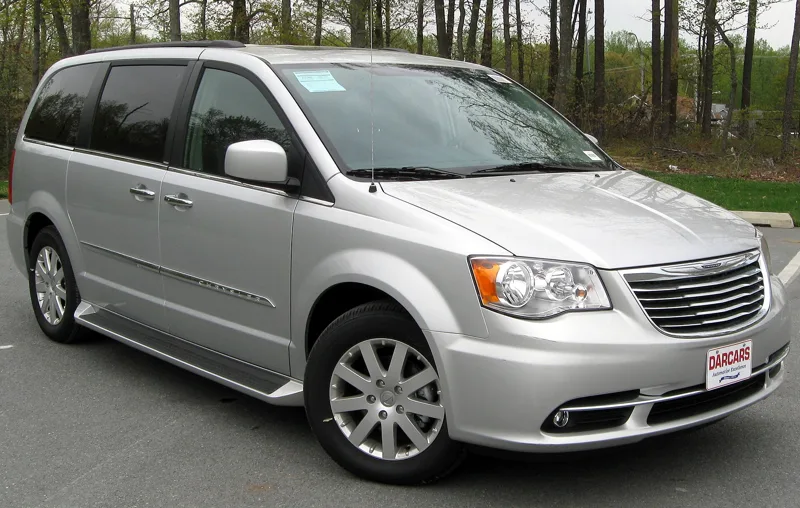
For 2011 the Town & Country gained a restyled exterior and interior, a new wing logo and standard SafetyTec, with blind-spot monitoring and rear cross-path alerts. The Pentastar 3.6L V6 with 283hp (211 kW) replaced the 3.8L and 3.3L engines.
Other changes included a six-speed automatic, a fuel economizer mode and FLO TV, which offered 20 channels of live programming. The chassis was retuned, with a bigger front anti-roll bar and revised steering.
How did the Town & Country sell in Europe?
The European version was sold as the Chrysler Grand Voyager, built in Austria from 1991 to 2007 and later produced in Ontario from 2008. Across Britain, Ireland, South Africa and much of Asia and Oceania it kept the Grand Voyager name, including in the Middle East, China and Russia.
In Continental Europe the model was rebadged as the Lancia Voyager from October 2011, replacing the Lancia Phedra. The Lancia version came with a 3.6L Pentastar petrol or a 2.8L diesel, and it dropped the chrome bodyside mouldings.
Which trims did the later generations offer?
The base LX ran from 2008 to 2010 and was reintroduced for 2015. The Touring was the midrange trim from 2008, and the Touring L added heated front seats, a third-row DVD screen and 18-inch alloy wheels. The S added dark wheels and grille accents from 2014.
The Limited was the top trim from 2008 to 2014, and the Limited Platinum replaced it in 2015. A 30th Anniversary Edition marked the minivan's 30th year in 2014, and a 90th Anniversary Edition marked Chrysler's 90th anniversary in 2016.
What was the plug-in hybrid Town & Country?
A plug-in hybrid prototype appeared in 2008, promising an all-electric range of 40 miles (64 km) before gasoline took over. Fiat disbanded Chrysler's ENVI electric car division in November 2009, and the plan was dropped from future product plans.
From April 2012, 25 flexible-fuel plug-in vans ran in a two-year trial. The project cost US$26 million, and the Department of Energy contributed US$10 million. The vans used a 3.6L Pentastar engine and a two-mode hybrid transmission, and their 12.1 kWh lithium-ion battery gave a total output of 290 horsepower.
In September 2012 Chrysler suspended the programme after battery packs overheated in three separate pickup trucks. As a precaution, 109 Dodge Ram 1500 plug-ins and 23 Town & Country vans were recalled, and no one was hurt. The fleet had covered 1.3 million miles (2.1 million km) by then.
The plug-in minivans reached a fuel economy of 55.0 mpg-US (4.28 L/100 km), and the demonstration was designed to test reverse power flow for building backup power.
Specifications at a glance
| Item | Detail |
|---|---|
| Model years | 1990 to 2016 |
| Generations | 5 |
| First-generation engine | 3.0L Mitsubishi V6, 142hp; 3.3L V6, 150hp from 1990 |
| Second-generation engines | 3.3L EGA V6, 150hp; 3.8L EGH V6, 162hp |
| Maximum cargo | 160.7 cubic feet (4,550 L) with rows folded |
| Stow n Go storage | 12 cubic feet (340 L) under the floor |
| Plug-in hybrid electric range | 40 miles (64 km) |
| First-generation output | 1,789 in 1989 and 3,615 in 1990 |
| Successor | Chrysler Pacifica, 2017 |
Where was the Town & Country built?
The first three generations were built at Saint Louis Assembly in Fenton, Missouri, which handled the Town & Country from 1989 until 2001. Windsor Assembly in Ontario took over in 2001, and the fourth and fifth generations were built there.
Saint Louis closed in October 2008, which left Windsor as the sole producer of the Town & Country and the Dodge Grand Caravan. Taiwanese-market vans were assembled in Yangmei under licence from 2006, and the Philippines sold the model under the Town and Country name from 1991.
Why does the Town & Country still matter?
The Town & Country was produced almost continuously for 75 years, with breaks only during World War II and in 1989. Its nameplate is the longest-produced Chrysler name, and only the Chevrolet Suburban has a longer production run in automotive history.
Chrysler retired the name for 2017, when the sixth-generation minivan became the Chrysler Pacifica. After 2016, the company counted 12 million minivans sold under its three nameplates.