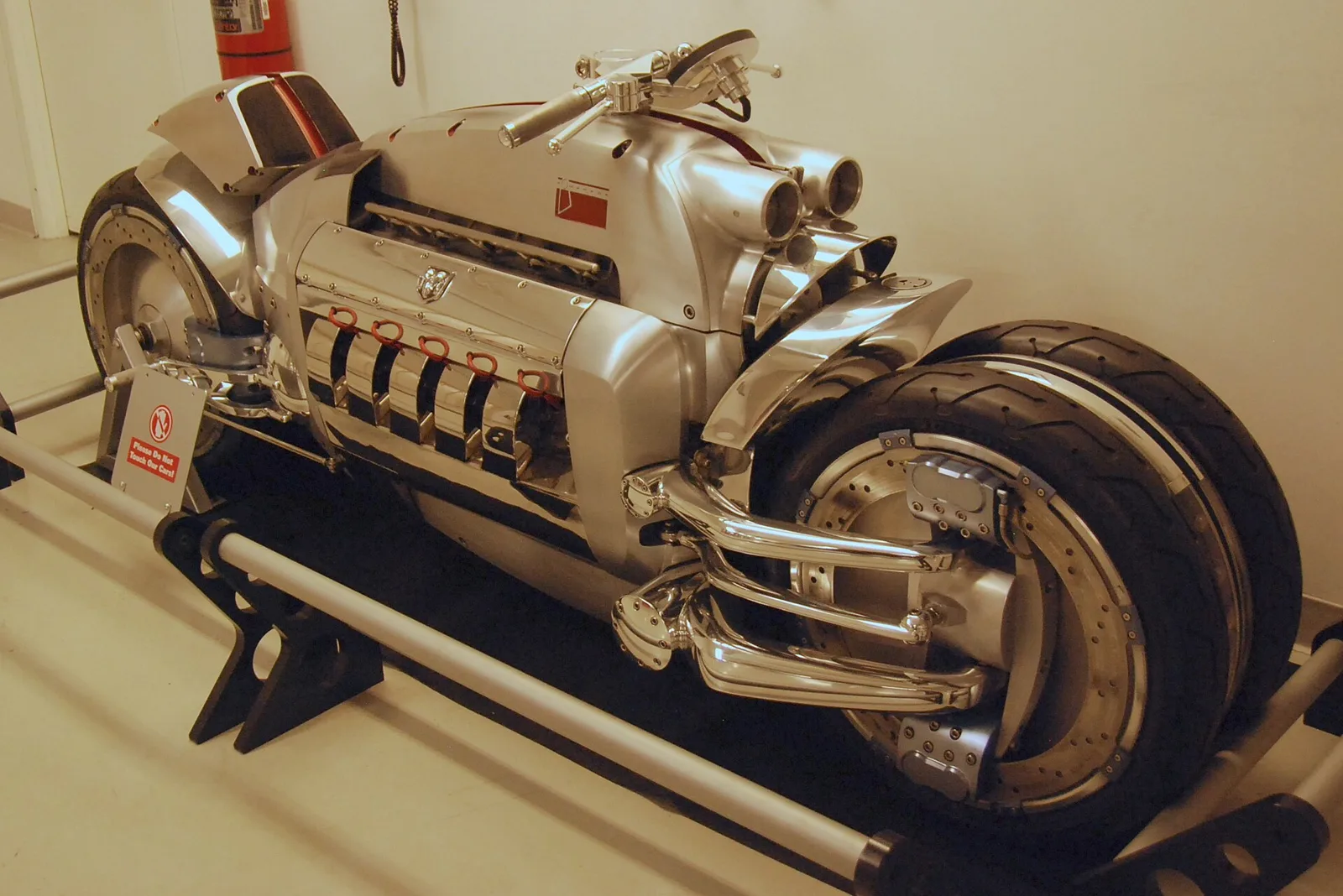
A 500-horsepower V10 on four wheels, shown at Detroit, sold as a display piece and claimed to reach 300 mph on paper.
The Dodge Tomahawk was a one-off motorcycle-style concept unveiled in Detroit in 2003, built around the 8.3-litre Viper V10 with four independently sprung wheels. Dodge sold hand-built display reproductions at US$555,000 and claimed speeds it never verified. Designer Mark Walters led the work.
The Dodge Tomahawk was a non-street-legal motorcycle-style vehicle that Dodge unveiled at the Detroit auto show in 2003 as a one-off concept. It was built around the 8.3-litre V10 from the Dodge Viper sports car, and it rode on four close-coupled wheels that gave it a motorcycle-like profile. Later that year DaimlerChrysler announced it would sell hand-built reproductions to order.
What was the Dodge Tomahawk?
The Tomahawk was a retro Art Deco design whose centrepiece was a 500-horsepower (370 kW) 8.3-litre V10 from the Dodge Viper. It attracted strong press and industry attention for its striking looks and its outsized engine. Experts disagreed about whether it counted as a motorcycle at all.
Its two front and two rear wheels were sprung independently, which was meant to let the machine lean into corners and countersteer like a motorcycle. Dodge sold it as a rolling sculpture, but it was also described as rideable, and that dual message became part of its story.
Industry observers largely saw the Tomahawk as a success. It stole attention at the show, generated plenty of media buzz, and sent a message that Chrysler was a bold company willing to take risks.
A Viper V10 on four wheels that was built to be looked at, and claimed to be ridden at 300 mph.
Where did the Tomahawk idea come from?
The idea began with two lower-level Chrysler employees, Bob Schroeder, a design office modeller and motorcycle rider, and Dave Chyz, a vehicle build specialist and drag racer. Designer Mark Walters framed the question as what would happen if a Viper engine were fitted to a Champion chassis, in the spirit of a Boss Hoss.
The engine would have been several times the displacement of a typical Harley-Davidson. The low-volume Boss Hoss used a 5.7-litre Chevrolet V8, and the largest mass-produced motorcycle, the Triumph Rocket III, had 2.3 litres. Neither came close to the Viper's 8.3 litres.
Schroeder and Chyz pitched the proposal to design chief Trevor Creed, who at first said the firm did not build bikes. Sketches impressed him enough to bring him on board, and the idea then reached Freeman Thomas, DaimlerChrysler's vice president of advanced design, who assigned Walters to the project.
Thomas proposed two wheels at each end, partly because a single wheel would look thin beside the unusually wide engine. The idea drew on the four-wheeled light cycles from the film Tron. Walters expected bikers to object that it was not a motorcycle, but he judged uniqueness to matter more.
By the spring of 2002 Walters had a full-scale presentation, with a sketch wall 20 ft (6.1 m) long and a loaned Viper engine on a stand, fitted with two wheels. Chrysler Group COO Wolfgang Bernhard and CEO Dieter Zetsche approved it immediately.
How was the Tomahawk engineered?
Walters led the design, and the car was built around the Viper's 8.3-litre V10. Once approved as a running concept rather than a mockup, the design and fabrication took six months. The engineering was outsourced to RM Motorsports, a specialty shop in Wixom, Michigan, that makes one-off parts for rare and vintage race cars.
Kirt Bennett at RM turned Walters's sketches into a mechanically sound machine. Early sketches had a front end resembling the hub-centre steering of an Elf-Honda racing motorcycle, and RM developed a patented front and rear swingarm suspension from that idea. The Tomahawk was meant to be a functional runner, and its mechanical parts were left in view.
The V10 needed several changes. Its lubrication moved from a wet sump to a dry sump, with the oil stored in a tank ahead of and to the left of the engine. The single car-style radiator became two smaller radiators fitted into the V above the engine, cooled by a belt-driven fan from a Porsche 911.
How did the Tomahawk handle?
The Tomahawk was designed to let the rider countersteer and lean into turns, much like a tilting three-wheeler. Steering came from hub-centre swingarms on the two front wheels, linked to the handlebar shaft. Lock-to-lock travel was only about 20 degrees either side of centre, so the turning circle was large.
A low centre of gravity came from placing the engine as near the ground as possible, which was meant to give control at low speeds. The saddle was low enough for a rider to put both feet down at a stop. The rear wheels each had an inboard swingarm and an inboard chain drive, and a hydraulic rear suspension lock held the wheels in position, so the machine could stand unaided.
Computer imaging suggested a lean of up to 45 degrees with all four wheels still touching the ground. Cornering at such angles would not be safe at the Tomahawk's 1,500 lb (680 kg) weight. Test rides revealed that stability issues still needed work.
RM's Bud Bennett said the 45-degree lean system worked well and was stable. The main limit was the original 18-degree handlebar turning radius, which made sharp turns impossible. In 2003 RM explored wider handlebars and two or three wheels, which could have made a street-legal version conceivable.
How was the Tomahawk fabricated?
Bennett's team cut the Tomahawk's components from solid aluminium. Two alloy pieces under the seat began as 750 lb (340 kg) billets and were machined down to 25 lb (11 kg) each before being polished to a mirror finish. Even small details such as the hand levers and twistgrip used needle and ball bearings.
Designers who saw the finished car said it looked as if it had been milled out of a raw block of metal, which matched the way it had been made.
Why did the Detroit debut matter?
The Tomahawk debuted at Cobo Hall in Detroit, the home of the North American International Auto Show. Automobile magazine described the period as a high point of extravagance, which began when the show expanded in 1986 and 1987. Newsweek called it a horsepower arms race.
The 2003 show drew a record attendance of 810,699. Concept excess went further with the Ford 427 Concept, a V10 created from a V8 hastily expanded to ten cylinders. The Cadillac Sixteen was also shown, a V16 claimed to make 1,000 hp (750 kW) and able to run on eight or twelve cylinders to save fuel.
Yet the Tomahawk was the surprise of the show. It was unveiled the day after the Cadillac Sixteen, and GM executive Bob Lutz, who had helped conceive the Viper at Chrysler in 1988, was asked where his own V16 motorcycle was. He said he had none and that Chrysler had outmanoeuvred GM again.
AutoWeek named the Ford 427 Best Concept for 2003 and the Cadillac V-16 Best in Show. Its editors said they wished they could give a Best Automotive Sculpture award to the motorcycle they found so likeable. A panel of 35 journalists gave that year's Specialty Concept prize to the GM Hy-wire, passing over the Tomahawk.
How fast was the Tomahawk claimed to go?
Dodge's hypothetical top speeds ran from 300 mph (480 km/h) up to 420 mph (680 km/h). Analysts suspected the numbers came from horsepower and gearing alone, ignoring drag, rolling resistance and stability. Motorcycling and automotive media later dismissed them as implausible or physically impossible.
The January 2003 press release claimed a potential top speed of nearly 400 mph and a 0 to 60 mph time of 2.5 seconds, both marked as estimates. Popular Science reported that Dodge had first given 420 mph and then revised the figure down to 300 mph. Later press releases in 2006 and 2009 repeated the near-400 mph line.
Senior designer Walters said he did not believe 400 mph was possible, but that the bike could reach 250 mph (400 km/h) if it were geared for speed rather than acceleration. Motorcyclist's Jeff Karr estimated that a Suzuki Hayabusa or Kawasaki ZX-12R would need about 460 hp (340 kW) to reach 300 mph. Because drag rises with the square of speed, he said the Tomahawk would need at least 700 hp (520 kW) for the same figure.
Karr added that without wind protection and a secure riding position, approaching 200 mph would be unsafe. Dave Campos, who has set motorcycle land speed records, doubted the bike could reach 200 mph because the rider would be lifted from the seat. Joe Teresi of Easyriders said the top-speed estimate ignored frontal area, drag coefficient and rolling resistance.
Was the Tomahawk ever properly tested?
No independent road test of the Tomahawk has ever been published. Dodge's account is that internal riding never exceeded 100 mph (160 km/h), a figure Wolfgang Bernhard repeated in 2003. Dodge declined offers to test the top-speed claim on a dynamometer, and no one is known to have tried the machine at its maximum speed.
Dodge spokesman David Elshoff said a run at the Bonneville Speedway might happen someday, yet none was made. At the 2003 Goodwood Festival of Speed, Bud Bennett rode the Tomahawk for a single run, which he thought likely reached 70 mph (110 km/h). By then only four riders had ever ridden one.
What were the Tomahawk's main specifications?
| Specification | Published or claimed figure | Status |
|---|---|---|
| Engine | 8.3-litre (510 cu in) V10 SRT10 from the Dodge Viper | Published |
| Power | 500 hp (370 kW) | Published |
| Weight | 1,500 lb (680 kg) | Published |
| Lock-to-lock steering | About 20 degrees either side of centre | Published |
| Maximum lean | Up to 45 degrees, from computer imaging | Estimated |
| 0 to 60 mph | 2.5 seconds | Estimated by Dodge |
| Top speed | 300 to 420 mph (480 to 680 km/h) | Estimated, later revised |
| Highest verified riding speed | 100 mph (160 km/h) internal testing; about 70 mph (110 km/h) at Goodwood | Reported by company and rider |
| Price | US$555,000 through the Neiman Marcus catalog | Published |
| Units sold | As many as nine | Not confirmed |
How did the Tomahawk influence later machines?
The Tomahawk's V10 idea was answered in 2009 by the Millyard Viper V10, a motorcycle built to rival it after Allen Millyard was unimpressed by a Tomahawk speed run at the Goodwood Festival of Speed. The Millyard bike was later timed at 207 mph (333 km/h) with the same 500 hp (370 kW) output.
Industry observers credited the Tomahawk as a branding and marketing coup for Chrysler. Automotive News named it one of the 10 Most Memorable World Debuts in 2014, which kept the concept in the conversation long after the show.
Why did critics take the Tomahawk seriously?
Most of the press treated the Tomahawk as a joke. AutoWeek suggested anyone who rode it was a Darwin Award contender, and a 2015 book called it one of the strangest of the 2003 Dodge vehicles. Glynn Kerr, a freelance motorcycle designer and columnist for Motorcycle Consumer News, wrote an analysis that treated it as a real motorcycle.
Kerr dismissed the top-speed claims as spin, and he criticised the missing fairing and a fuel tank that gave less than 50 mi (80 km) of range. He also said car designers did not understand motorcycle design, and he called the single vertical stalk in the fuel tank incongruous.
Other voices were kinder. Karr called it an ultimate bad-ass ride, and Alan Mudd of Design Continuum argued that it showed Chrysler's passion for creativity. Volvo's Lars Erik Lundin said Volvo would never attempt such craziness, and noted that Volvo had shown a hybrid in 1992 but had not delivered one twelve years later.
Designers from Toyota's Calty studio and from Ford also praised it. Calty's Jin Kim picked it among the standouts of the show, and Ford GT chief designer Camilo Pardo called it brave and well executed.