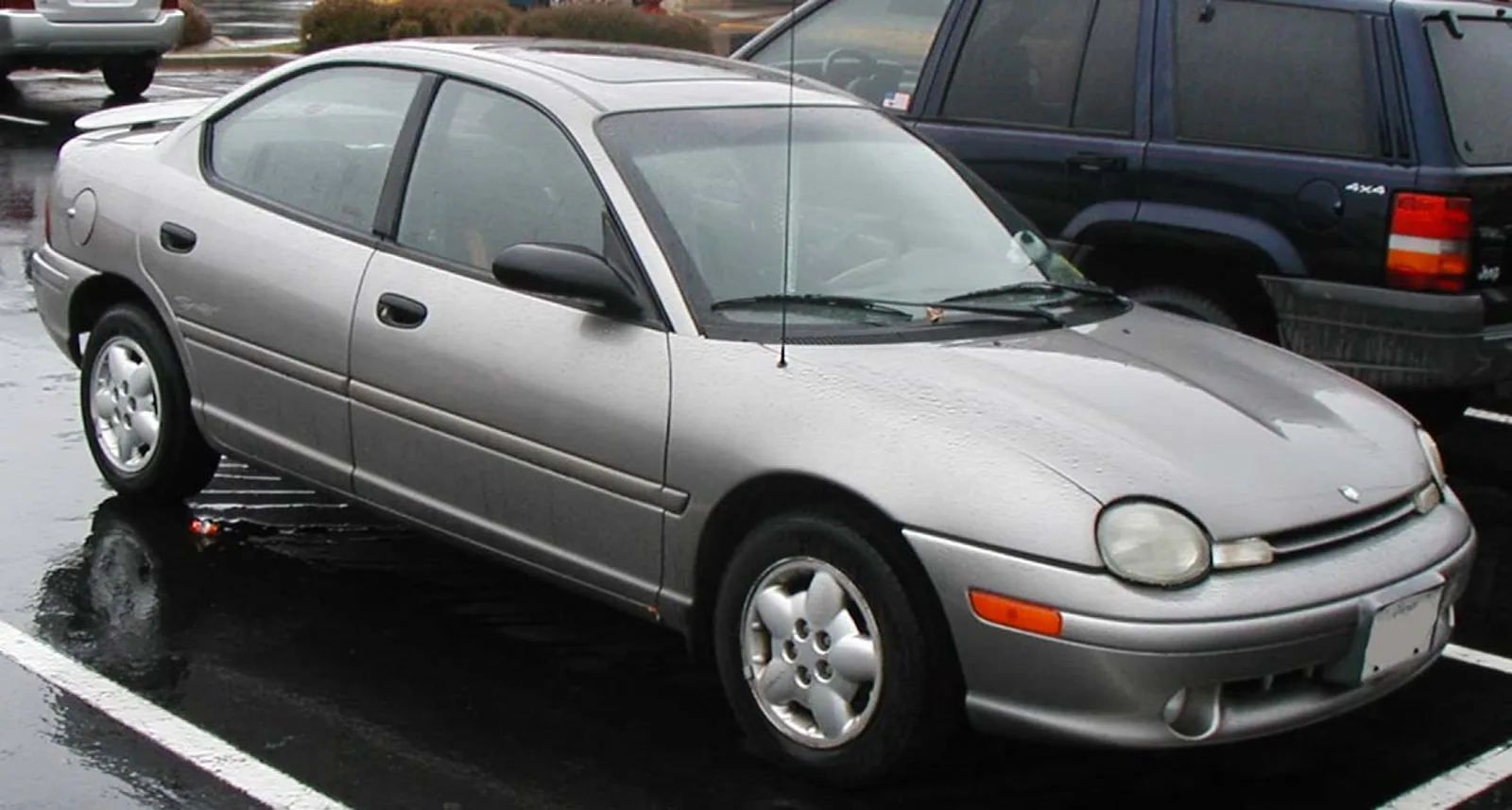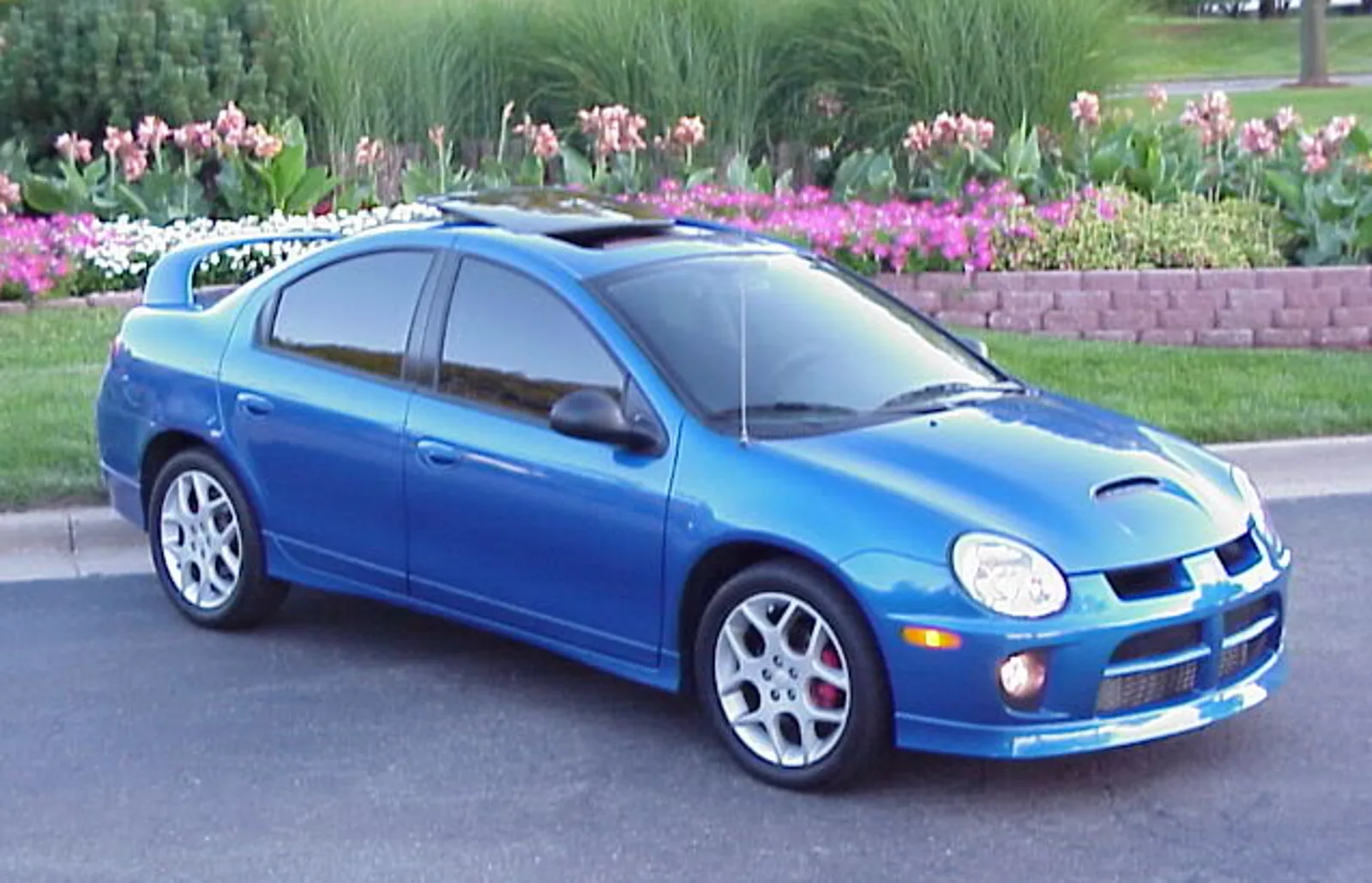
A 2003 to 2005 turbo sport compact from Dodge's performance group, with a five-speed manual, a Viper-inspired seat and a Bonneville record.
The Dodge Neon SRT-4 was a turbocharged sport compact built from 2003 to 2005 by Dodge's performance group. Its 2.4-litre engine, five-speed manual and cast aluminium wheels helped it win rally class titles and set a 2006 Bonneville record for production four-cylinder cars.
The Dodge Neon SRT-4 started life as a concept built in four months in 2000. Its production run from 2003 to 2005 led to rally titles, touring car wins and a Bonneville record for four-cylinder production cars.
The car was a turbocharged Neon, developed by the company's performance group and built in Belvidere, Illinois. Its story is one of a project that was turned down, rebuilt and then approved.
Where did the SRT-4 come from?
The SRT-4 grew out of a 2000 concept that Tom Gale wanted after seeing sport compact features at the 1998 SEMA Show in Las Vegas. Dodge's executive committee turned down the first production plan in fall 2000, and the project was approved in spring 2001.
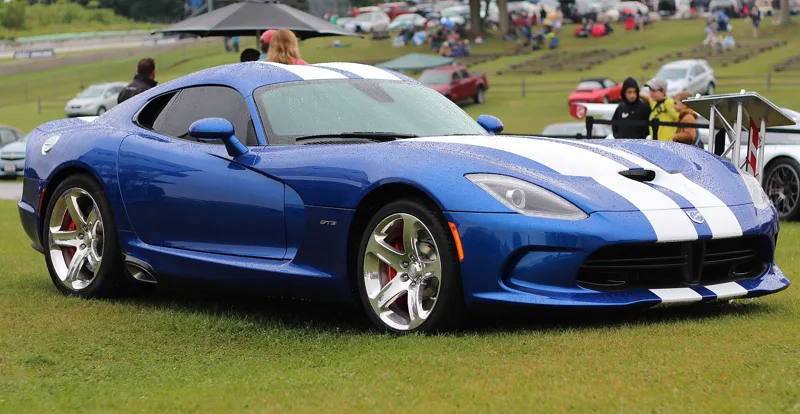
Gale had been design chief on the original Viper concept. He wanted a sport compact that would appeal to younger buyers who had grown up on tuner cars, and he saw the Neon as the right base for it.
A group of young Dodge and Chrysler staff built the 2000 Neon SRT in four months, drawing on their first-hand knowledge of the Neon. The concept had a 2.0-litre 16-valve four with a 45-cubic-inch Eaton supercharger, producing 208 hp (155 kW) and 180 lb ft (240 Nm) at the flywheel on 11 psi (0.76 bar) of boost.
The concept was shown at the SEMA Show in November 1999 and at the Los Angeles Auto Show in January 2000, where it sat centre stage on a turntable. The team had put more than 1,000 miles on the test track in under two weeks, and the SEMA response was glowing. A second car, built with more production parts to lower costs, was parked in Gale's own space to draw attention.
The executive committee rejected the production proposal in fall 2000, and the team worked through its list of objections one item at a time. In January 2002 the Specialty Vehicle Engineering group became Performance Vehicle Operations, or PVO, and it turned the concept into a production car. PVO renamed itself Street and Racing Technology, SRT, in 2004.
The car went on sale to the public in 2003. At the time it was the second fastest stock production vehicle in the Chrysler and Dodge lineup, second only to the Viper.
A turbo sport compact that went from a rejected proposal to a rally class that it dominated.
What engine did the production SRT-4 use?
The production car used a turbocharged 2.4-litre inline-four, engine code A853, that was nearly identical to the unit in the 2003 PT Cruiser. The main difference was the lack of the Cruiser's unique intake manifold, which the SRT-4 did not need.
The block was the same basic casting used by the naturally aspirated 2.4-litre engines, but the SRT-4 version received stronger crankcase webbing, a thicker deck and 11 mm head bolts in place of 10 mm. Its forged connecting rods had cracked caps and 9 mm bolts, and the pistons were eutectic aluminium alloy made specially by Mahle.
The turbo was a reverse-rotation Mitsubishi TD04LR-15Gk with a compressor bypass valve built into its housing. The exhaust manifold and turbine housing were cast as a single piece from high-nickel steel, which improved flow and let the catalytic converter light off quicker. Stock boost reached about 14 psi (97 kPa).
The intercooler was a front-mounted cast aluminium unit made by Valeo. The stock rev limit of 6240 rpm rose to 6500 rpm with MOPAR's Stage 2 and 3 kits.
How did the SRT-4 handle and stop?
The SRT-4 got stiffer springs, SRT-tuned Tokico struts and larger sway bars, along with 280 mm vented front brake discs and 270 mm rear discs. It rode on 17 x 6 inch cast aluminium wheels wearing 205/50/17 Michelin Pilot Sport tyres.
The front discs were vented and thickened to resist warping, while the rear discs were non-vented. Single-piston calipers measured 57mm at the front and 36mm at the rear, and the wheel spokes were patterned to channel air to the brakes.
Other chassis work included PT Cruiser steering knuckles, an updated K member and a unique steering gear. The Tokico struts had reduced travel to make room for the larger wheels.
Inside, the front seats were modelled on the Viper SRT-10 seats, with extra lumbar and side bolsters to hold occupants in performance driving. A faux carbon fibre wheel and a satin silver cue ball shift knob completed the look.
What did the ACR and Commemorative editions add?
The American Club Racer (ACR) package arrived in 2005 with BBS RX racing wheels, Tokico Illumina dampers and racing seats. Only 1,175 ACRs were built, in four colours, while the Commemorative Edition was a numbered run of 200.
The ACR was lowered at both ends through spring seat changes and smaller-diameter tyres. Its 16 x 7-inch (410 x 180 mm) BBS RX wheels with 40 mm (1.6 in) offset carried 225/45/16 BFG KDW2 tyres, and the Viper-styled seats had pass-throughs for a racing harness.
The ACR colours were Flame Red, Orange Blast, Stone White and Black, and the black cars were the largest group. The speedometer gear was changed from 20 to 21 tooth to correct the reading for the different tyre heights.
The 2005 Commemorative Edition was a different idea altogether. It had Electric Blue Viper stripes over Stone White paint, blue stitching, stainless steel SRT-4 sill plates and a numbered metal plaque, and it added no performance extras. Dodge created it to celebrate the SRT vehicles, alongside Commemorative editions of the Viper SRT-10 and Ram SRT-10, and it came with the same booklet those cars received.
What changed for the 2004 model?
The 2004 model brought more power and torque, a torque-sensing Quaife limited-slip differential, larger fuel injectors and new engine management software. Its tyres changed to BF Goodrich g-Force T/A KDW-2 three-season ultra-high performance units, and the paint and trim were revised.
The Quaife unit was a torque-sensing limited-slip design, so it sent drive to whichever wheel could use it. Dodge removed the Neon designation that year, marketing the car simply as the SRT-4.
The 2005 model year then added an American Club Racer package and a numbered Commemorative version.
How many SRT-4s were built?
More than 25,000 Neon SRT-4s were produced over three years, from 2003 to 2005, far above the 2,500 a year that Dodge first expected to sell. Production was based in Belvidere, Illinois, with 84% US content.
Production ended when the PL platform was discontinued after the 2005 model year.
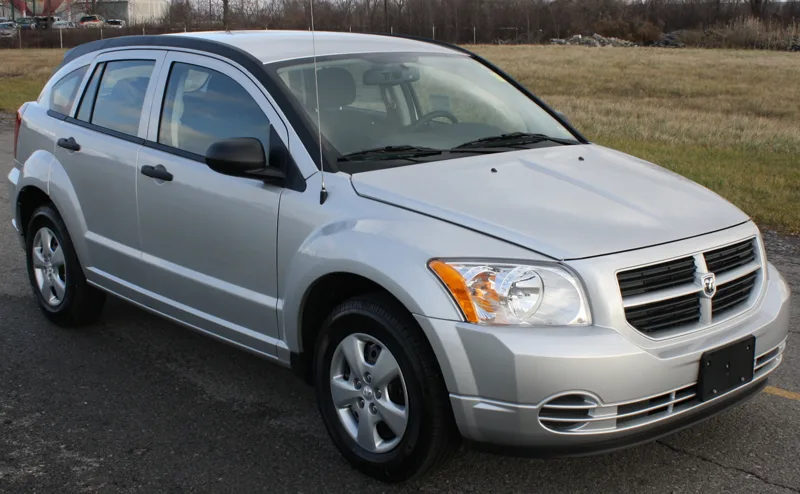
Dodge introduced the Caliber SRT-4 in 2008 as a replacement.
How did the SRT-4 perform in SCCA ProRally?
The SRT-4 dominated the Group 5 two-wheel-drive class in SCCA ProRally from 2003. In 2004 it won every series race and every end-of-season award in that class, which helped Dodge take its first US ProRally Manufacturers Championship in 28 years.
The car ended a long run of front-wheel-drive DSMs and Volkswagens in the class during its first season. With three SRT-4s competing the following year, the car still came out on top, and it has taken every Group 5 and two-wheel-drive class title in US ProRally and Sno Drift since 2003. The ACR version took over that competition role in later seasons.
The SRT-4 had an early result in the same event. Cory O'Brien and Erich Heuschele took one car to a class win and an eighth-place overall finish in 2003.
On circuits, Jeff Lepper scored the car's first national road racing win in 2005, in the NASA US Touring Car Championship at California Speedway in Fontana. In the same year, Dale Seeley, Kolin Aspergren and Jamin Cummings finished first in class and eighth overall in the Tire Rack Cannonball One Lap of America.
Robb Holland took an SRT-4 to third place at Road America in August 2006 in the SCCA SPEED World Challenge Touring Car series. It was Dodge's first podium in that championship, and the first manufacturers' points the company had scored there.
In 2007 Curt Simmons won the US Touring Car Championship in an SRT-4, and Dodge took the manufacturers' points title by 29 points over Honda. George Biskup set the track qualifying record at Road America that year, with a lap of 2:33.922 that stood for several years.
How fast did the SRT-4 go at Bonneville?
In 2006 a car driven by Jorgen Moller averaged 221 mph (356 km/h) at the Bonneville Salt Flats in Utah, making the SRT-4 the world's fastest production four-cylinder car. In 2012 Russ Deane pushed that four-cylinder production record to more than 226 mph (364 km/h).
The 2006 record car was tuned by Dave Harris and Phil Hurst for Racedeck Racing. Deane raced for the Hinckley Automotive team during Speed Week, beating a 224 mph record that had been set for a Class F/PS vehicle. Dave Harris served as the team's chief, alongside Jim Hinckley and Craig Ohlson.
Which awards and comparison tests did the SRT-4 win?
Sport Compact Car named the SRT-4 its 2003 Car of the Year and placed it among its Eight Great Rides in each of the three years it was built. Car and Driver gave it the 2005 John Lingenfelter Memorial Trophy, and several US magazines made it a comparison winner between 2003 and 2005.
The car won Sport Compact Car's shootout in January 2003 and Edmunds' sport sedan comparison in August 2003. Automobile magazine gave it first place in March 2004, and Car and Driver's Serial Thrillers test in May 2004 went the same way.
In November 2005 Car and Driver pitted it against 14 other performance vehicles, and the SRT-4 finished first in the front-wheel-drive division.
What was the 2003 Extreme LightWeight?
Dodge engineers built a one-off Extreme LightWeight SRT-4 for the 2003 SEMA show. It used carbon fibre body pieces and a polycarbonate rear window, and it weighed 2,500 lb (1,134 kg) wet after a 405 lb (184 kg) cut.
The interior was stripped, leaving only the stock dash, a single Recaro seat, a harness and a roll cage. It carried the first stage 3R Mopar engine kit and stage 3R coilovers, and Sport Compact Car's dyno measured 360 hp (270 kW), with 383 lb ft (519 Nm) at the wheels.
On drag slicks it ran an 11.83-second pass at 123 mph (198 km/h). The car was used for media events and Mopar testing, and it was destroyed as an asset reduction move in 2009.
Dodge Neon SRT-4 specifications
| Specification | Detail |
|---|---|
| Years built | 2003 to 2005 |
| Engine | 2.4-litre turbocharged inline-four |
| Turbocharger | Mitsubishi TD04LR-15Gk, reverse rotation |
| Stock boost | About 14 psi (97 kPa) |
| Rev limit | 6240 rpm stock, 6500 rpm with MOPAR Stage 2 and 3 kits |
| Transmission | Five-speed manual, New Venture Gear T-850 |
| Brakes | 280 mm vented front, 270 mm rear |
| Wheels and tyres | 17 x 6 inch cast aluminium, 205/50/17 Michelin Pilot Sport |
| Concept output | 208 hp (155 kW), 180 lb ft (240 Nm) at the flywheel |
| Concept on a dyno | 179 hp (133 kW), 149 lb ft (202 Nm) at the wheels |
| Production | More than 25,000 built |
| Bonneville average, 2006 | 221 mph (356 km/h) |