A Viper born from a delayed US$70 million approval and a V10 that grew to 8.4 litres, plus eight generations of a Charger that kept changing shape.
The Dodge Viper began as a 1989 modern-Cobra concept and became a V10 sports car sold from 1992, growing from 400 hp to 600 hp before production ended in 2017. The Charger has run through eight generations since 1966, from fastback to sedan to Hellcat Redeye.
Chrysler's chairman, Lee Iacocca, held back the US$70 million needed to build the Dodge Viper, uneasy about spending so much without a guaranteed return. That hesitation is the odd start to a story in which a V10 sports car that launched with no airbags and no anti-lock brakes ran for 26 years, and in which the Charger, Dodge's other long-running name, swung between fastback, front-drive hatchback and four-door sedan before ending up with 797 hp.
Dodge Viper history: the idea that nearly stalled
Chrysler's Advanced Design Studios conceived the Viper in late 1988. By February Bob Lutz, then president, was urging Tom Gale of the Chrysler Design Center to look at building a modern Cobra. A clay model reached Lutz a few months later, and metal bodywork by Metalcrafters turned it into the concept shown at the 1989 North American International Auto Show. The crowd response was strong enough that chief engineer Roy Sjoberg was told to prepare a production car.
Iacocca was the obstacle. He delayed signing off the $70 million, calling it a big outlay with no promise of profit. Sjoberg chose 85 engineers for what was named Team Viper, and work began in March 1989. In May the team asked Lamborghini, then a Chrysler subsidiary, to cast a prototype aluminium block. The production body was finished in the autumn, a chassis prototype ran in December, and a test mule called White Mule used a V8 until the V10 intended for the production car was ready in February 1990. Iacocca's official approval arrived in May 1990.
A year later Carroll Shelby led the Indianapolis 500 field in an early example. Dodge had planned to use the Japanese-built Dodge Stealth, but complaints from the United Auto Workers forced the swap. Reviewers received cars in November 1991 and retail shipments began in January 1992 at $52,000. Lutz saw the Viper as a boost for staff who had grown low after being told to build dull, unloved cars. Its success also eclipsed Iacocca's own pet project, the TC, a flop that cost five times as much to develop.
Public reaction was so enthusiastic that Roy Sjoberg was told to turn the concept into a production car, even as the money for it was held back.
Why was the first Dodge Viper so raw?
The original RT/10 Roadster was engineered as a performance car first. It had no exterior door handles, no key cylinders and no air conditioning, although cooling became an option for 1994 and 1995 and its dial carried a snowflake symbol. The roof was canvas, and the vinyl windows opened with zips, much like a Jeep Wrangler. There were no airbags, to save weight. Some comforts survived: leather-trimmed sport bucket seats with manual adjustment, an AM/FM cassette player and carpets. A lightweight fibreglass hard roof came with every new car.
The Dodge Viper V10 weighed 323 kg (712 lb). It was based on Chrysler's LA V8, with Lamborghini helping on the design and chief power engineer Dick Winkles overseeing development in Italy. It made 298 kW (400 hp) at 4,600 rpm and 630 Nm (465 lb ft) at 3,600 rpm. Because of the long gearing the engine allowed, the United States Environmental Protection Agency rated the car at 20 L/100 km in the city and 12 L/100 km on the highway.
Underneath was a tubular steel frame with resin-transfer-moulded fibreglass panels. The car weighed 1,490 kg (3,280 lb) and had neither traction control nor anti-lock brakes. It reached 100 km/h in 4.2 seconds and 161 km/h in 9.2 seconds, ran the quarter mile in 12.6 seconds, crossing the line at 183.1 km/h (113.8 mph), and topped out near 266 km/h (165 mph). Big tyres gave it close to one lateral g in corners. At high speed, though, the car proved tricky for an unskilled driver.
Dodge Viper V10 power, generation by generation
| Generation | Years | Engine | Power |
|---|---|---|---|
| SR I | 1992 to 1995 | 7,990 cc (8.0 L) V10 | 298 kW (400 hp) at 4,600 rpm |
| SR II RT/10 | 1996 to 2002 | 7,990 cc (8.0 L) V10 | 309 kW (415 hp), then 450 hp from 1997 |
| SR II GTS | 1996 onward | 7,990 cc (8.0 L) V10 | 336 kW (450 hp) at 5,200 rpm |
| ZB I SRT-10 | 2003 to 2007 | 8,285 cc (8.3 L) V10 | 373 kW (500 hp); coupe 380 kW (510 hp) |
| ZB II SRT-10 | 2008 to 2010 | 8,382 cc (8.4 L) V10 | 447 kW (600 hp) at 6,100 rpm |
The second generation and the double-bubble GTS
The SR II arrived in 1996. Midway through that model year the exposed side exhausts gave way to a single rear muffler with two large central tailpipes, cutting back pressure and lifting output to 309 kW (415 hp). A removable hardtop with a sliding glass window became available, and aluminium replaced some steel suspension parts, saving 27 kg (60 lb).
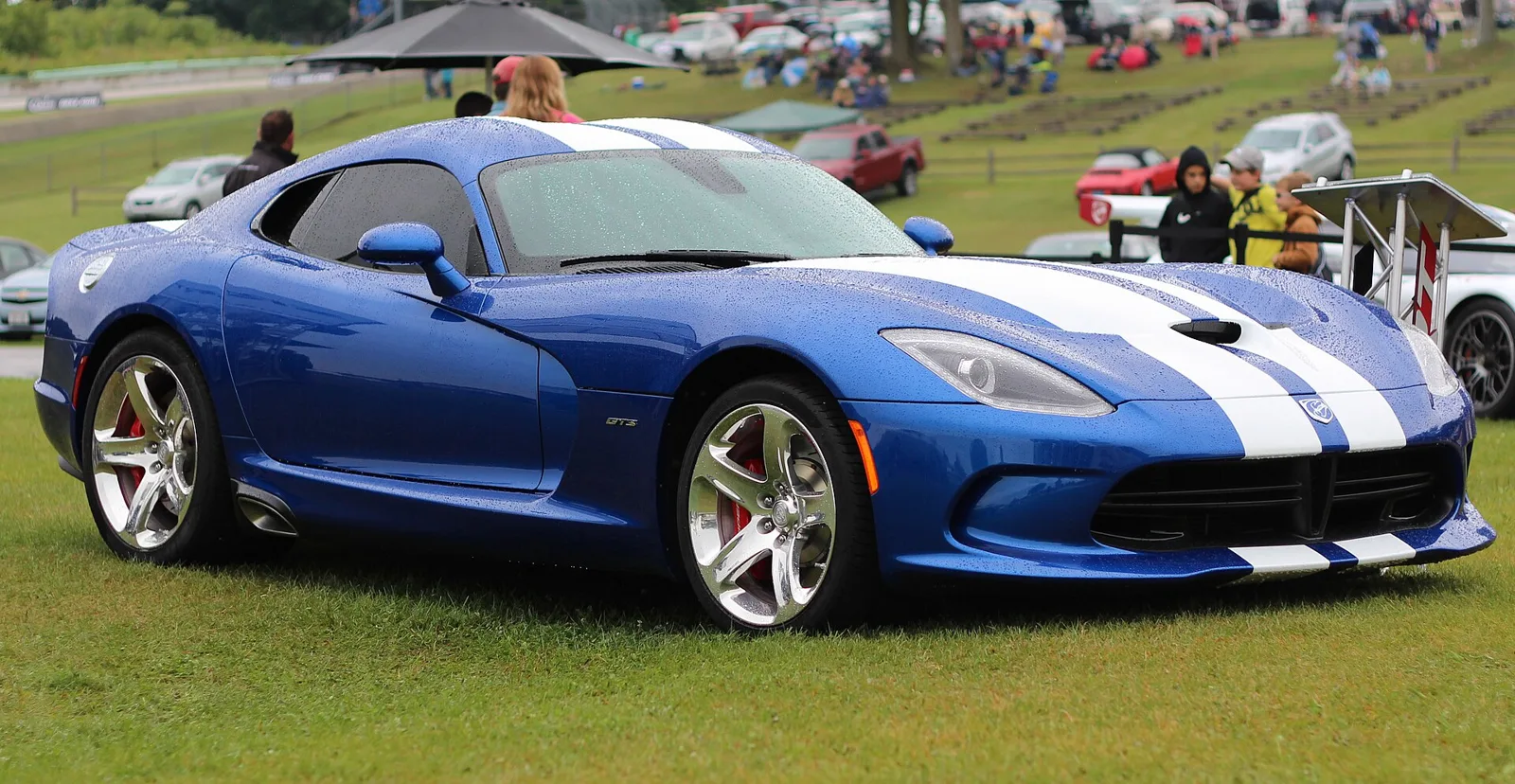
Then came the Viper GTS, a coupe with a roof that rose in two small domes to leave room for helmets. Dodge called it the double bubble, and the shape took cues from the Shelby Daytona drawn by Pete Brock. Over 90% of the GTS differed from the RT/10, despite the similar look. The same 7,990 cc V10 now made 336 kW (450 hp), peaking at 5,200 rpm, and 664 Nm (490 lb ft) of torque came in at 3,700 rpm. The 1996 GTS was the first Viper with airbags, and air conditioning, power windows and power locks were standard. It served as pace car for the 1996 Indianapolis 500.
Revisions continued. The 1997 RT/10 gained airbags, power windows and 450 hp, and 1998 brought second-generation airbags, lighter exhaust manifolds that saved 11 kg (24 lb) and a revised camshaft. In 2000 lighter hypereutectic pistons went in. The new pistons expanded less, yet customers still preferred forged ones for supercharged and turbocharged aftermarket packages. Anti-lock brakes finally arrived for 2001. The SRT-10 roadster replaced the RT/10 in 2003, and the SRT-10 coupe replaced the GTS in 2006.
How the Viper V10 grew to 8.4 litres
A major redesign in 2002 came from DaimlerChrysler's Street and Racing Technology group, drawing on the Viper GTS-R concept of 2000. The SRT-10 had sharp, angled bodywork, a larger 8.3-litre (8,285 cc) engine making 373 kW (500 hp) and 712 Nm (525 lb ft), and a stiffer chassis around 36 kg (80 lb) lighter. The engine itself shed weight to about 230 kg (500 lb). A planned aluminium space-frame chassis, begun by Mercedes, was shelved when Chrysler ran into financial trouble. Daimler later used that work as a starting point for the Mercedes-Benz SLS AMG.
The first SRT-10 was a convertible. In 2004 Dodge offered a limited Mamba package with a black interior, red stitching and about $3,000 on the price; 200 cars carried it. Detroit's 2005 show introduced the SRT-10 Coupe, badged a 2006 model, with 380 kW (510 hp), a double-bubble roof again and side and rear styling from the Competition Coupe concept. No 2007 model was built. Chrysler stretched the 2006 run while it prepared the 2008 car.
That 2008 car got an 8,382 cc (8.4-litre) V10 and 447 kW (600 hp) at 6,100 rpm, with 759 Nm (560 lb ft) at 5,000 rpm. The engine received better flowing heads, bigger valves, dual electronic throttle bodies and exhaust-side variable valve timing from Megadyne in a cam-in-cam design, and its rev limit rose by 300 rpm. McLaren Automotive and Ricardo Consulting Engineers lent outside help, and Continental AG developed a controller with 10 times the processing power of the old one. A Tremec TR6060 gearbox replaced the T56, Michelin Pilot Sport 2 tyres replaced run-flats, and a new exhaust without a crossover under the seats cut the heat that had entered the cabin. That crossover had been added to improve the exhaust note of earlier cars, which people had criticised as lacklustre.
Records, and the end of the ZB II
The Viper ACR returned for this generation. It posted 7:22.1 at the Nurburgring, and Kuno Wittmer took a street-legal 2010 ACR round Miller Motorsports Park in Tooele, Utah, in 1:59.995, the first time a production car dipped below two minutes on the Outer Course, which is 3.048 miles long.
On 4 November 2009 Dodge president and chief executive Ralph Gilles announced that production would stop in the summer of 2010. The final ZB II, finished in gold with orange stripes, left the line on 1 July 2010 at an event run with the Viper Club of America. Five Viper generations were developed in all, between 1991 and 2017, with a brief pause in 2007 and again from 2011 to 2012. The car was discontinued in 2017 after about 32,000 were built over 26 years, and in 2014 Cars.com placed it tenth on its American-Made Index, a list for cars with 75% or more of their parts made in the United States.
Dodge Charger history: a fastback for grown-ups
The Dodge Charger has been sold in eight generations since 1966. The first was a show car in 1964, and the name then went on a trim version of the 1965 Dart with a 273 cu in (4.5 L) V8. A 1965 Charger II concept looked like the production 1966 car. In the United States it has been attached to cars as different as mid-size models and full-size sedans, with personal luxury coupes and subcompact hatchbacks in between.
Dodge wanted an upscale, upsized pony car in 1966. American Motors had already launched something similar in 1965, the Rambler Marlin, and Mercury had succeeded with the Cougar, a larger and more refined take on the Mustang. The Charger was a luxurious fastback hardtop aimed at the segment of the Oldsmobile Toronado and Ford Thunderbird, not at muscle-car buyers.
It reached showrooms in mid-1966, based on the Chrysler B-body intermediate Dodge Coronet and sharing its chassis and much of its front end. Four bucket seats shared a console that ran to the rear, and the gauges were race-inspired. Hidden headlamps sat behind a grille spanning the nose, matched by a taillamp spanning the tail. A 318 cu in (5.2 L) V8 with a three-speed manual gearbox was standard; automatics and floor-shift manuals cost extra, and larger engines went as high as the Hemi, a 426 cu in (7.0 L) V8. Buyers were cool on it. Overhang at each end and a narrow track made the fastback look tall, and AMC's Marlin had already shown the pattern. Dodge sold 37,344 in its first year, then just 15,788 in 1967.
The 1969 Dodge Charger Daytona and the second generation
For 1968 Dodge made the body less daring, added a six-cylinder option, simplified the interior and fitted a conventional trunk. It planned 35,000 cars, but demand was so high that 96,100 were built. The 1968 to 1970 cars changed little beyond trim, moving from a pair of round tail lights to wide horizontal units, and a 3.7-litre (225 cu in) slant-6 joined the list in mid-1968.
On the track the 1968 Charger struggled in NASCAR. A more aerodynamic shape produced the Charger 500, followed by the 1969 Charger Daytona, and in 1970 the Charger won more NASCAR races than anything else, helping Bobby Isaac to the championship. Television did the rest: The Dukes of Hazzard made second-generation Chargers familiar to the American public.
From B-body coupe to front-drive hatchback
The third generation of 1971 modified the B platform for new emissions and safety rules and came in six packages, with a split grille, a ducktail spoiler and a rear window shaped as a semi-fastback. Sales climbed mainly because the Coronet two-door was dropped, leaving the Charger as the only two-door intermediate until the Coronet returned in 1975. In Brazil the Charger name went on a Dart-based performance model from 1971 to 1980.
For 1975 the Charger moved into the growing personal luxury market, sharing its body with the new Chrysler Cordoba. In 1976 the old Coronet coupes took the Charger name, as Charger and Charger Sport, with a Daytona stripe model, and the Magnum joined that segment in 1978.
The 1981 Charger was a different animal: a subcompact hatchback coupe with front-wheel drive, offered with either five manual speeds or three automatic ones and a little larger than the Dodge Omni 024. It used a 2.2-litre SOHC engine, either normally aspirated or turbocharged, and the turbo came only with the manual gearbox. The Shelby Charger followed in 1983, and its 1984 turbo made 106 kW (142 hp) without an intercooler. For 1985 updated electronics allowed more boost, adding 4 hp. In 1987 the intercooled Turbo II went into the Shelby-built Charger GLHS, the last 1,000 L-body Chargers, with 130 kW (175 hp).
The four-door Charger returns, 2006 to 2010
After a twenty-year absence Dodge brought the nameplate back in 2005 for the 2006 model year, on the Chrysler LX platform as a four-door sedan. A 1999 concept had four doors too but little else in common. Versions included SE, SXT, R/T, Police and Daytona R/T, and for the first time the Charger offered a V6 and all-wheel drive. The SE used a 2.7-litre V6 with a four-speed automatic; the 3.5-litre V6 added AutoStick manual shifting, 17-inch wheels and electronic stability control. The R/T carried a 5.7-litre Hemi V8 with a five-speed automatic, and its multiple-displacement system saved fuel by running on four cylinders when cruising. The SRT8 used a 6.1-litre Hemi. From 2009 all-wheel drive extended to the SE and SXT.
Dodge Charger Hellcat and the seventh generation
The 2011 car got new styling, with side scoops, more angular headlights and a wrap-around LED tail light across nearly the full width of the trunk. Driver visibility improved by more than 15%, and the side and rear lines echoed the 1968 to 1970 cars. A 3.6-litre Pentastar V6 with 218 kW (292 hp) replaced the 3.5-litre 250 hp unit. The SRT8 skipped 2011. In 2012 the V6 gained an eight-speed automatic and all-wheel drive, and the SRT8 returned.
From 2012 to 2018 a Super Bee, later called Scat Pack 15+, used a 6.4-litre engine with 350 kW (470 hp), four-piston Brembo calipers, paddle shifters and SRT launch features including a 0-60 timer and drag timers. The 2015 car had a new front end with LED lights, and the 2017 car a bigger 8.4-inch (210 mm) display. For 2019 the Scat Pack and Hellcat grilles gained snorkels feeding a ram air intake, and owners of lower trims could fit the Hellcat lower airbox and inlet tubing themselves.
For 2020 the Hellcat came with a widebody and a new SRT Hellcat Redeye took a 594 kW (797 hp) V8. A 2022 Jailbreak Edition, built on the Redeye Widebody, added ten horsepower for a total of 807 and let buyers choose paint, stripes, wheels, badges and interior trim at the factory.
What this means if you are buying or driving one
A first-generation Viper rewards respect. With no traction control, no anti-lock brakes and a reputation for being tricky at speed, it asks more of the driver than any later car. Anti-lock arrived in 2001, and recalls covered the frames of 1996 to 1999 cars. Pistons matter to modifiers: forged ones were preferred for forced-induction packages. Among Chargers, the 1966 and 1967 fastbacks were a luxury product, while the 1968 redesign sold far beyond Dodge's plan. Later Chargers can be told apart by powertrain: a 2012 V6 has an eight-speed automatic, and from 2021 the V6 police car had all-wheel drive.
Where this goes next
Dodge announced in January 2022 that its Hemi V8 Charger, in 5.7L, 6.4L and 6.2L forms, would end with the 2023 model year. The eighth-generation Charger, a two- and four-door liftback, arrived for the 2025 model year, led by the Charger Daytona EV in R/T and Scat Pack trims. The Charger SixPack followed for 2026 with a 3.0-litre Hurricane twin-turbo inline-six. The Viper, meanwhile, ended in 2017.