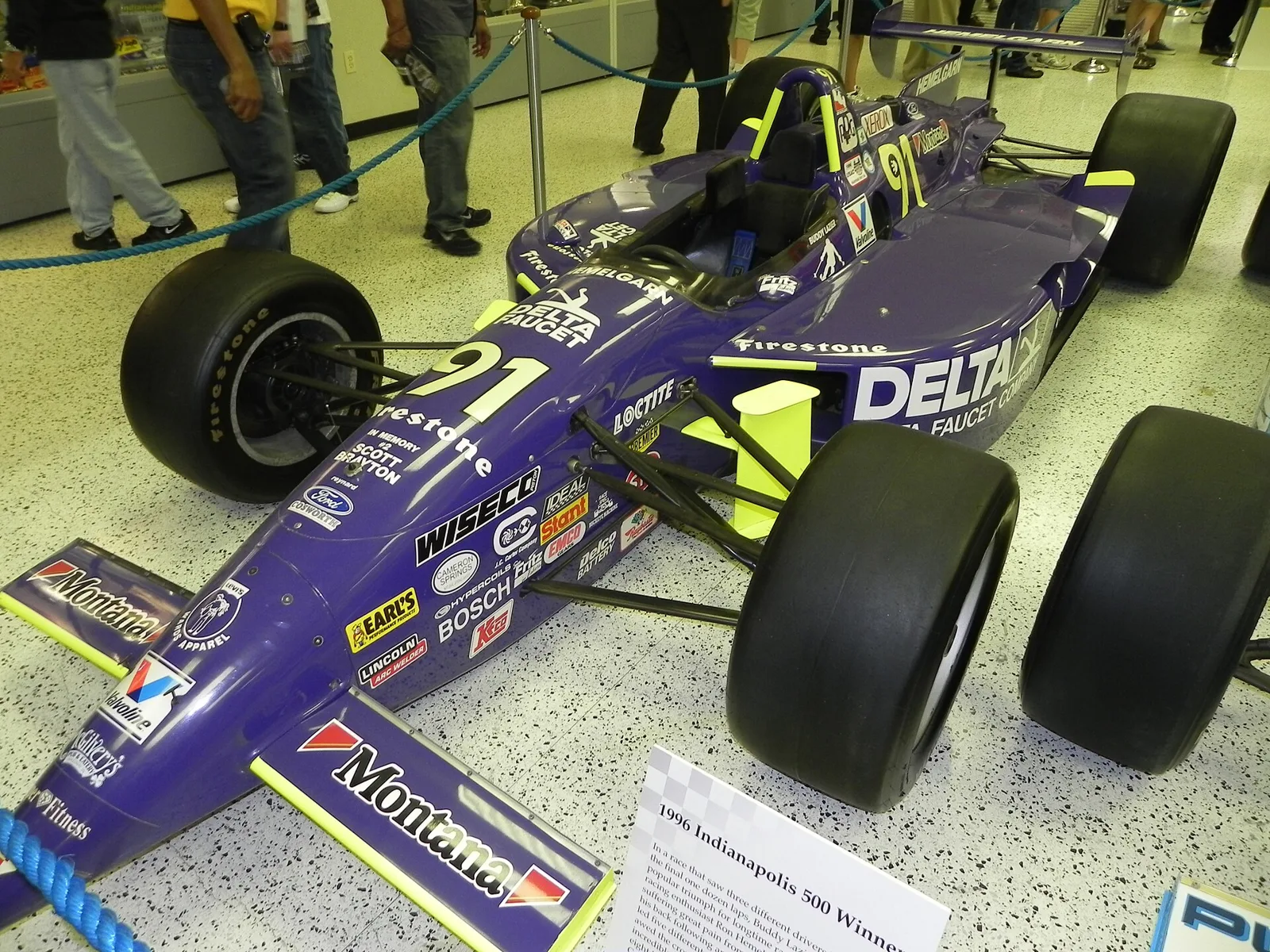
Buddy Lazier won by six tenths of a second in the first Indy 500 run under the Indy Racing League, a race shaped by the CART boycott and a month that began with the death of Scott Brayton.
Buddy Lazier won the 1996 Indianapolis 500 for the Indy Racing League, which ran the race during a boycott by most CART teams. He beat Davy Jones by six tenths of a second after a month shaped by the death of Scott Brayton.
Buddy Lazier won the 80th Indianapolis 500 on Sunday, May 26, 1996, the first race at the Speedway run under the Indy Racing League banner. The race came after a bitter split in American open-wheel racing, which kept most of the CART teams away. Lazier had broken his back in a crash at Phoenix just over two months before he took the flag.
Who won the 1996 Indianapolis 500?
Buddy Lazier won the 1996 race, his first top-level Indy car victory, ahead of Davy Jones and Richie Hearn. He held off Jones by six tenths of a second at the finish. Before this, his best CART result had been seventh at Michigan in 1992.
Lazier was a veteran who had won the American Indycar Series championship, a minor-league series that used older CART machinery. He had never seen the checkered flag in his three earlier Indy 500 starts, and he had failed to qualify for the race four times.
He was the first American to take a maiden Indy car victory at the 500 since Troy Ruttman in 1952. Ford's engine took its eighth Indy 500 win as an engine maker, and Firestone tyres won for the first time since 1971.
Buddy Lazier won the first Indy 500 run under the IRL, six tenths ahead of Davy Jones.
What was the IRL and CART split?
The split was a dispute that began in the 1970s between USAC and CART over how Indy car racing was run. It sharpened in 1994, when the Speedway announced its own series, and it turned the 1996 Indianapolis 500 into the centre of the argument. Most of the sport's top teams sided with CART.
The first USAC and CART split came in 1979, when USAC rejected the entries of six key CART teams for the Indianapolis 500. A court injunction let the teams compete, and the race ran without further major disruption. That year two separate championships were contested, and the Indy 500 paid points towards the CART title.
Tony George, the Speedway's president, joined the CART board in 1992 as a non-voting member and resigned in 1994 over the direction of the series. That summer he announced the Indy Racing League, with the Indy 500 as its centrepiece. The series promised lower costs, an all-oval schedule and new normally aspirated engines from 1997, and CART's 1996 model-year chassis would be excluded from the race.
How did the 25/8 rule shape the field?
The 25/8 rule reserved 25 of the 33 grid spots for the top 25 IRL points entries, leaving eight places for at-large entries. CART teams said they were being locked out, and most of them boycotted the race. They staged their own U.S. 500 at Michigan International Speedway on the same day.
Locked-in entries could not be bumped unless they failed to complete a four-lap run at 220 mph. The grid was still arranged by speed, and the pole went to the fastest car on the first day of qualifying, whatever its locked-in status. The remaining eight places were filled by at-large entries, and bumping could only happen among those.
Only Galles and Walker entered from the CART side, and neither fielded its regular full-time CART driver. Galles ran Davy Jones in an Ilmor Mercedes-Benz 265-D, the only Mercedes entered, while Walker fielded Mike Groff. Of the 33 starters in 1995, only 11 re-entered, and Eliseo Salazar and Arie Luyendyk were the only top-10 finishers from that year.
Defending winner Jacques Villeneuve had switched to Formula One and Williams, so the race was missing its defending champion for a second straight year. The U.S. 500 field carried 109 Indy 500 starts and five wins, compared with just 75 previous 500 starts for the Indy lineup, the lowest since 1932.
What rules applied to the 1996 race?
The 1996 season used a rules freeze, with a package close to the 1995 one. Chassis from the 1992 to 1995 model years were allowed, but 1996 model-year cars were not approved. Many IRL teams bought used 1994 and 1995 chassis from rival CART teams.
Stock-block V-6 engines such as the Buick and Menard kept 55 inHG of turbo boost, and the quad cam V8 engines, including the Ford Cosworth XB and Ilmor D, stayed at 45 inches. The 209 cubic inch pushrod engines of the Mercedes-Benz 500I and Greenfield were formally banned. No entry used Honda's V8, which had first appeared in 1995, and new Toyota and Cosworth engines were not allowed under the freeze.
The minimum driver age was cut from 21 to 18. That change allowed Michel Jourdain Jr., aged 19 years and 267 days, to compete, making him the second-youngest starter in Indy history at the time. Goodyear and Firestone both supplied tyres for the tyre war.
What happened on Pole Day?
Pole Day began cold and rainy, and speeds rose sharply once the afternoon session started. Tony Stewart, a rookie, and Jones also broke the one- and four-lap records, before Scott Brayton took the pole after Arie Luyendyk was disqualified late in the day.
Lyn St. James was the first car to qualify, at 224.594 mph. Buddy Lazier then took the provisional pole at 231.468 mph. Twenty minutes on, Jones went quicker at 232.882 mph, beating Roberto Guerrero's 1992 mark.
Tony Stewart bumped Jones off the pole with a new record of 233.100 mph, becoming the first rookie to hold both records since Teo Fabi in 1983. Luyendyk then recorded a top lap of 234.742 mph and a 233.390 mph four-lap average, which looked good enough for pole.
Team Menard then withdrew its qualified car, and Scott Brayton hurried out to requalify in a back-up car he had driven only 13 laps that morning. He averaged 233.718 mph over four laps and took the pole, setting another four-lap record. Luyendyk's one-lap mark still stood at that point.
At 7:45 p.m. USAC's chief steward announced that Luyendyk's car had failed post-qualifying inspection and that his attempt was disallowed. The Byrd/Treadway crew had not weighed the back-up machine after changing its engine. Stewart moved up to second, and Brayton's 233.851 mph became the official one-lap record.
How did Scott Brayton's death affect the month?
Scott Brayton was killed on May 17 while running a back-up car in practice. His right-rear tyre deflated on his 53rd lap, and the car hit the outside wall in turn two. It was the first of two fatal open-wheel crashes that year.
The official report was not released until 4 p.m., so that his family could be notified. Some drivers kept practising until then, and Luyendyk set the fastest lap of the day at 234.870 mph. When the news came out, nearly all of the participants stopped for the day.
Team Menard asked Danny Ongais to drive the car, which was entered under the number 32. The car was moved to the back of the grid, and Tony Stewart inherited the pole. Ongais drove one memorial parade lap alone before the start, and Al Unser had recommended him for the seat.
Dan Drinan crashed heavily in turn one during practice on May 18, in a similar manner to Brayton's accident. He suffered a concussion and fractures and was ruled out of qualifying.
How did the race unfold?
Tony Stewart led the start and the first 31 laps, but his engine let go on lap 81 and he retired. Davy Jones then led the field, with Buddy Lazier and Alessandro Zampedri closing in. Lazier passed Jones with eight laps to go and won by six tenths of a second.
The start was ragged. Stewart kept the lead into turn one, Eliseo Salazar moved past Jones for second, and Roberto Guerrero passed Eddie Cheever and Lazier for fourth. Mark Dismore spun in turn one and kicked up mud, which brought out the caution on lap 3. Scott Harrington then came up too quickly on the tail of the field and spun into the warm-up lane.
Paul Durant's engine blew on lap 11, and Danny Ongais spun on the lap 18 restart. The first long green-flag period did not begin until lap 21. Luyendyk, starting 20th, had already reached 11th place before that first caution.
Stewart became the first rookie to lead the first 31 laps before pitting, and Guerrero led the chase seven seconds behind. Eddie Cheever dropped out of fifth because of a bad air wrench. Jones had a slow stop that dropped him to eighth, and Galles chose a different fuel plan for him.
Salazar regained second on lap 47, and Luyendyk touched the wall twice while battling a push condition. A caution on lap 70 brought in most of the top six. Lazier left the pits first, while Jones stayed out and led until a green-flag stop on lap 87.
Stewart's engine developed boost pressure problems before the race resumed, and it let go on lap 81. He called USAC's pop-off valves junk and garbage, and he was still recognised as the rookie of the year. Eddie Cheever later spun in front of his car when leaving the pits.
Luyendyk was in close pursuit of Lazier when a caution came out on lap 94 for Brad Murphey's crash in turn two. In the pits he stalled, and after restarting he rejoined just ahead of Salazar. Salazar turned into him, sending his own car spinning. Luyendyk lost five laps for repairs and retired with 50 laps to go.
The race restarted on lap 105 with Jones in front, and Guerrero passed Lazier on the restart. A fire in Fermin Velez's car on lap 119 brought another caution, and Mike Groff's broken oil line spilled into his cockpit. A caution on lap 132 caused by Mark Dismore's broken engine let Lazier, Zampedri and Richie Hearn pit for fuel.
On lap 150 Buzz Calkins retired after a right rear upright broke. Guerrero stopped on lap 160 and Jones a lap later, and Jones's faster stop put him ahead. Scott Harrington crashed into Lyn St. James on the inside of turn one, and St. James broke a wrist. A fuel spill caused a fire during Guerrero's stop on lap 167, but the car kept racing.
On the lap 169 restart Salazar blocked Jones as they exited turn four. Jones tried to pass on the frontstretch, and Salazar swept to the inside, forcing Jones into the inside wall. The Scandia owner later admitted the move was intended to help Zampedri, who took advantage and passed Jones on the outside of turn one.
Jones stayed within a second of Zampedri for about 20 laps, despite low fuel and suspension damage. On lap 189 Zampedri understeered in turn three, and Jones took the lead. Lazier then went around Zampedri and attacked, and he passed Jones for the lead with eight laps to go.
With six laps to go Eddie Cheever's car smoked in turn two and left fluid on the track. Two laps later Scott Sharp spun into the inside wall, bringing a late caution. The race was restarted with one lap to go, and Lazier lapped Michel Jourdain Jr. before the caution. Jones lagged too far behind to make an early move, and Lazier held him off by six tenths of a second.
As the leaders crossed the line, a serious crash occurred in turn four. Roberto Guerrero, running fifth, spun and slid in front of Salazar and Zampedri. Zampedri's car was lifted into the catch fence, and Salazar wrecked into the outside wall. Zampedri suffered serious foot injuries, which led to the amputation of three toes, but he made a remarkable comeback a year later.
What were the main race results?
Lazier won, Davy Jones was second and Richie Hearn was third, with Alessandro Zampedri fourth and Hideshi Matsuda eighth. Arie Luyendyk, the only former Indy 500 winner in the field, was out of contention after his collision with Salazar.
| Finish | Driver | Note |
|---|---|---|
| 1st | Buddy Lazier | First top-level Indy car win; six tenths of a second ahead |
| 2nd | Davy Jones | Led several laps; best Indy car result of his career |
| 3rd | Richie Hearn | Rookie; six seconds behind the winner |
| 4th | Alessandro Zampedri | Best Indy car result; injured in the final-lap crash |
| 8th | Hideshi Matsuda | Best result of his Indy car career |
| Pole | Scott Brayton | 233.718 mph four-lap average; killed May 17 |
Lazier's previous best in CART competition had been seventh place. With Luyendyk out, the race had a first-time winner for the second year in a row, the first time that had happened since 1990.
What did the race mean for the championship and broadcast?
Scott Sharp and Buzz Calkins finished tied for the inaugural IRL championship. There was no tie-breaker in the regulations, so the two drivers were declared co-champions. Calkins would have taken the title on a tie-breaker because of his win at Walt Disney World Speedway.
Calkins went on to score the most points among IRL drivers in the calendar year 1996. Ford had supplied engines to the IRL for its five 1996 races while generally siding with CART, and it chose not to build engines to the 1997 normally aspirated specification.
ABC's ratings for the 1996 telecast fell from a 9.4/28 share in 1995 to a 7.1/23. The network linked the drop to the split and to the rival U.S. 500 broadcast, which overlapped slightly on ESPN.