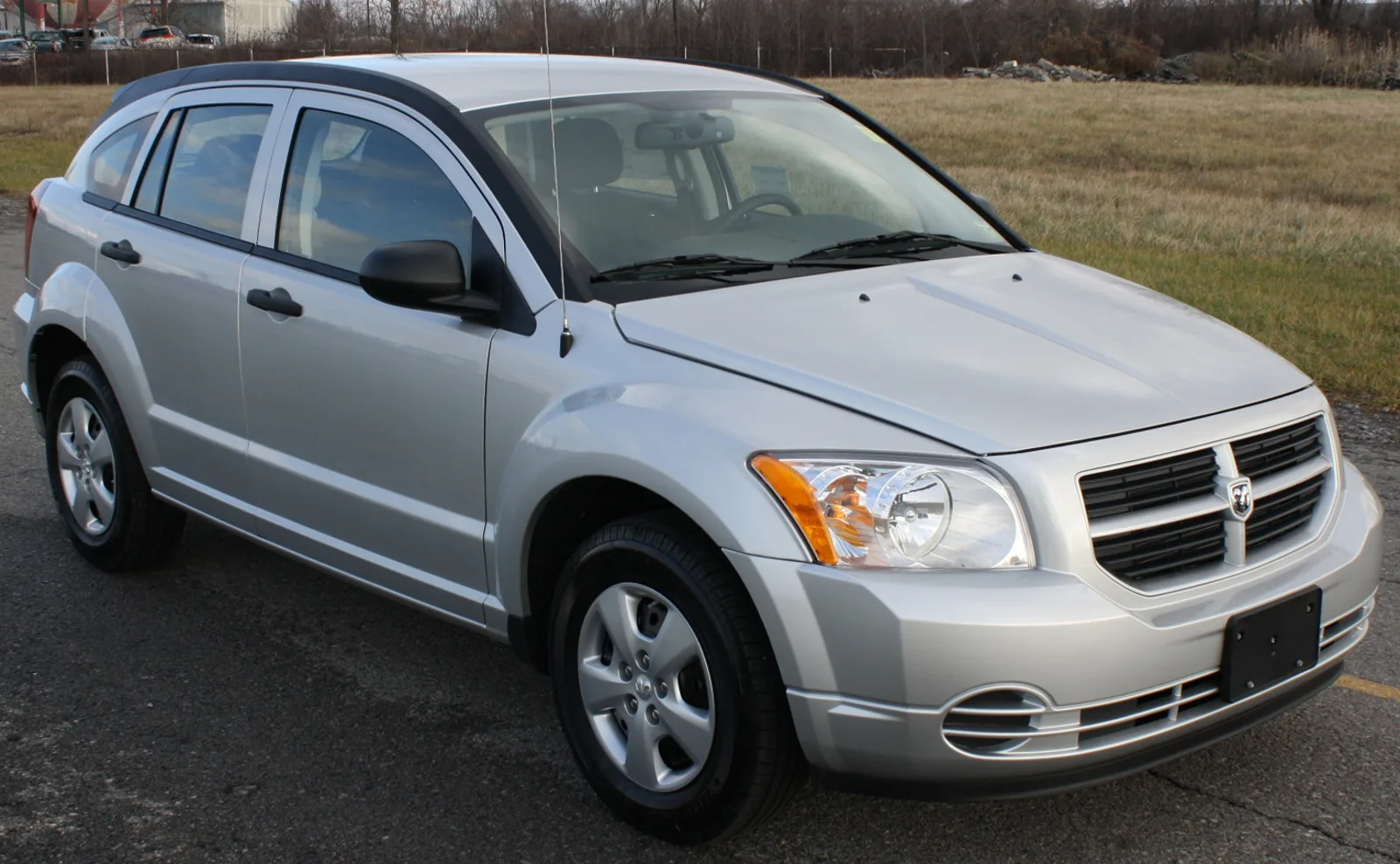
A Chrysler-era hatchback with a CVT option, optional all-wheel drive and a hot SRT4 that took on the Volkswagen GTI.
Between 2007 and 2012, Chrysler's Dodge division sold the Caliber, a compact hatchback built at Belvidere, Illinois. Buyers could choose a CVT, optional all-wheel drive or the 285 hp SRT4 hot hatch that competed with the Volkswagen GTI in its class.
The Dodge Caliber was a compact hatchback sold by Chrysler's Dodge division from the 2007 to 2012 model years. It took the place of the Neon and PT Cruiser in the line-up, and just over 400,000 were built at the Belvidere Assembly plant in Illinois. Engines ranged from a 1.8 L four making 148 hp to a turbocharged SRT4 rated at 285 hp.
Where did the Caliber come from?
The Caliber began as a concept at the 2005 Geneva Motor Show, and a pre-production version followed at the 2006 North American International Auto Show. Market launch came in March 2006, and Dodge produced the car at its Illinois plant in Belvidere. The model took over the compact slot from the Neon and PT Cruiser.
Dodge also pushed the car abroad. It was one of the brand's first modern offerings in Europe and in Asian markets such as Japan, South Korea and Singapore. A China launch followed in 2008 as the brand's second modern model there, and in Australia the car marked Dodge's return after a gap since the early 1970s.
A compact hatchback with a CVT option, optional all-wheel drive and a 285 hp SRT4 hot hatch.
What platform did the Caliber use?
The Caliber used a heavily modified GS platform co-designed with Mitsubishi Motors. Chrysler named the updated design JS for mid-size cars and PM/MK for compacts, and it is closest to the Jeep Compass and Jeep Patriot despite sharing some parts with the Mitsubishi Lancer.
Wheels used a five-hole pattern with a 114.3 mm bolt circle. The SE had a body-colour grille surround, while the other models had chrome.
What engines and gearboxes did the Caliber offer?
The Caliber started with a 1.8-litre four-cylinder making 148 hp (110 kW) and a five-speed manual, with a 2.0-litre option of 158 hp on a continuously variable transmission. The R/T used a 2.4-litre engine with 172 hp and the CVT2 unit, and the SRT4 used a turbocharged 2.4-litre.
The CVT2 unit came from Jatco, a Nissan subsidiary. The Caliber was the second DaimlerChrysler model to use this type of gearbox, after the Mercedes-Benz A-Class. The four-cylinder World engine was designed jointly by Chrysler, Mitsubishi and Hyundai.
Could the Caliber be bought with all-wheel drive?
Yes, as an option. An electronically controlled all-wheel drive system with variable torque worked between 40 and 105 km/h (25 and 65 mph). On the R/T it was offered until 2009, and only with the automatic transmission. The system was designed for optimal handling at those speeds.
Front-wheel drive was the standard layout across the range, so all-wheel drive was an extra rather than a base feature.
What made the SRT4 different?
The SRT4 was the performance version of the Caliber. It was introduced at the Chicago Auto Show in February 2006 to replace the Neon-based SRT-4, and it used a turbocharged 2.4-litre DOHC four rated at 285 hp (213 kW) at 6,400 rpm with 265 lb-ft of torque at 5,600 rpm.
Edmunds tested one on a chassis dynamometer and measured 281 hp and 261 lb-ft at the wheels, calling the manufacturer's rating conservative. The car used a Getrag six-speed manual driving the front wheels, four-wheel ABS and 19-inch painted aluminium wheels.
The SRT4 took on the Volkswagen GTI and the Mazdaspeed3 in its class and stayed in the range until 2009.
How did the Caliber perform in crash tests?
The Insurance Institute for Highway Safety gave the Caliber an overall Good rating in frontal crash testing but scored it Marginal overall in its side impact test. Side curtain airbags were standard, while torso side airbags were an option. The tested car did not have that option.
The side result therefore describes a car without the extra torso airbags, so buyers comparing safety equipment should check whether that option was fitted on the car they are considering.
What changed during the Caliber's production?
The 2009 update replaced black base-model door handles with painted ones and made the trunk lid lighter. For 2010, Dodge unveiled an interior refresh at the 2009 Frankfurt Motor Show, with an 8-way power driver seat and automatic climate control, which had previously been R/T only.
The 2010 US line-up was renamed: SE became Main Street, SXT became Heat and R/T became Rush. Uptown and Express joined the range, and Express was the only model without the automatic climate control option. The names reverted to SE, SXT and SXT Plus for 2012.
What replaced the Caliber?
The Dart replaced the Caliber in Dodge's compact range. It went on sale in June 2012 as a 2013 model-year car and was based on the Alfa Romeo Giulietta platform. Caliber production in the United States ended on 23 November 2011, and the 2010 model was the last sold in Europe.
Remaining cars were sold as 2012 model-year Calibers in the US and Canada, so the final model run overlapped with the Dart's arrival in showrooms.
How was the Caliber marketed?
Dodge put 20% of its first-year budget into online advertising, print and television commercials. The brand used that money to build new distribution channels in Europe and Asia, where the Caliber was one of its first modern cars. The first-year plan was built around that push.
In Japan the Caliber joined the local line-up in 2007 alongside the Chrysler PT Cruiser.
What did each trim include?
The SE was the stripped entry car, with no standard air conditioning, power windows, door locks or mirrors. The SXT added air conditioning, power windows and locks, remote keyless entry and a tachometer, while the R/T brought standard ABS and a leather-wrapped steering wheel with audio and speed controls.
The SXT could also be specified with 17-inch aluminium wheels in place of its standard steel set. The R/T's 18-inch aluminium wheels came as standard, and chromed versions were an option for buyers who wanted a brighter look.
What did the 2011 update change?
The 2011 model brought six new paint schemes and stability control as standard on every version except Express. Uptown buyers could take 18-inch chrome-clad wheels, while Rush and Heat received new shocks and a thicker rear anti-roll bar. Sirius traffic information came with navigation-equipped cars.
The Caliber and the Nitro were the only two Dodges that still carried the Ram logo on the front fascia, the rear and the steering wheel. The logo had been removed from the floor mats on Calibers from the 2009 model.
What options came with the SRT4?
The SRT4 offered polished aluminium wheels, Goodyear Eagle F1 Supercar tyres, SIRIUS satellite radio with Kicker SRT audio and an EVIC with performance pages. Its standard kit already included four-wheel ABS and the 19-inch wheels, so the options were largely about finishing and sound.
What are the Dodge Caliber specifications?
| Specification | Detail |
|---|---|
| Model years | 2007 to 2012 |
| Built at | Belvidere Assembly, Illinois |
| Base engine | 1.8 L four, 148 hp (110 kW), five-speed manual |
| Optional engine | 2.0 L, 158 hp, with CVT2 |
| R/T engine | 2.4 L, 172 hp, with CVT2 or AutoStick |
| SRT4 engine | 2.4 L turbocharged DOHC four, 285 hp (213 kW) at 6,400 rpm |
| SRT4 torque | 359 N m (265 lb-ft) at 5,600 rpm |
| European diesel | 2.2 L, 163 hp (122 kW), 320 N m (236 lb-ft) |
| Diesel economy | 5.79 L/100 km (40.6 mpg-US; 48.8 mpg-imp) combined |
| Wheel bolt circle | 114.3 mm |
| Production | Just over 400,000 |
| US production end | 23 November 2011 |