The fifth and final Viper, from its 2013 redesign to the 2017 end of production, and the crowdfunded bid to reclaim a Nurburgring lap record.
Built from the 2013 model year until August 2017, the Dodge Viper VX I was the last version of the Viper sports car. Its 8.4-litre V10 made 645 hp (481 kW) from 2015, and the model is best remembered for a crowdfunded bid on a Nurburgring lap record.
In 2017 a volunteer-led group raised money to try to reclaim a Nurburgring lap record set by a Dodge Viper. The car was the VX I, the last of five Viper generations, redesigned for 2013 and built until August 2017.
The engine was an all-aluminium 8,382 cc V10, and its output rose only once in the car's life. In 2015 Dodge raised it by 5 hp to 645 hp (481 kW), and that figure became the headline number for the later cars.
Where did the Viper VX I come from?
The VX I's story starts in 2010. Sergio Marchionne, then running Chrysler and Fiat, showed a rolling 2012 prototype at a dealer conference in Orlando, Florida, and the car was later sold under SRT, Chrysler's separate performance brand. In 2014 SRT was folded back into Dodge.
Chrysler saw SRT as a brand of its own, and the Viper was the halo car that carried it. Ralph Gilles, an SRT executive, announced the next generation in autumn 2011 and said it would reach the public through a New York show in April 2012. The schedule slipped, and the SRT Viper GTS was unveiled in 2013 in New York instead.
The brand change came quickly after that. In May 2014 SRT returned to Dodge, with Gilles staying on as a senior VP for product design and also heading Motorsports as its chief. From 2015 the car carried the Dodge Viper name again.
The last Viper ended its run with a fight for a Nurburgring lap record rather than a farewell.
What changed in the VX I's design?
The VX I was rebuilt rather than refreshed. Dodge added anti-lock brakes, electronic stability control and traction control, bringing the car into line with modern safety standards. Inside, a four-inch reconfigurable TFT display came with a Track Mode that included its own timer and a stoplight countdown.
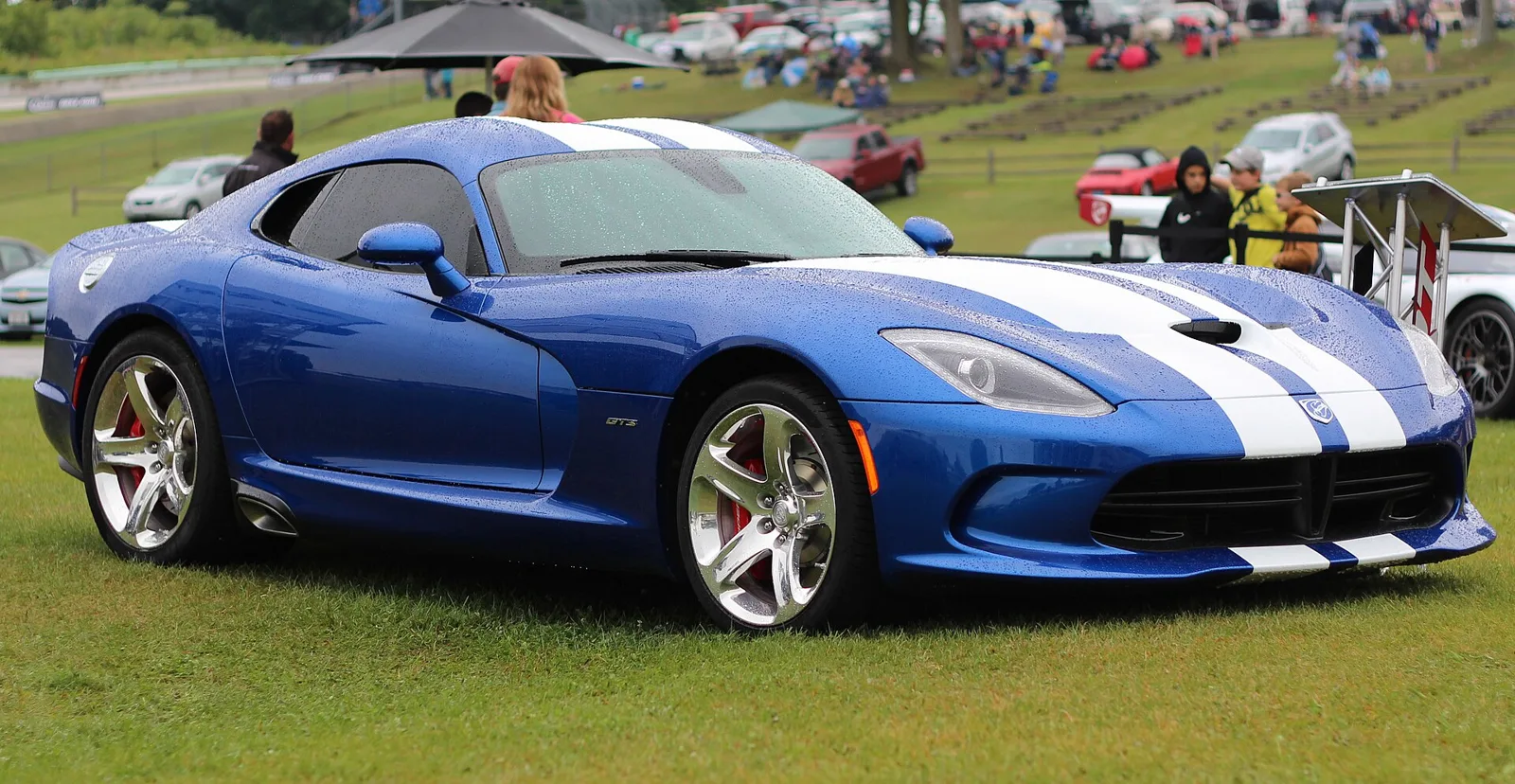
The base SRT Viper and the GTS are easiest to tell apart from the front. The base car's hood has six functional vents, and the GTS has only two. The GTS also brought leather upholstery, Sabelt racing seats with Kevlar and fibreglass shells, and a carbon-fibre hood, roof and decklid, and its split six-spoke forged Venom wheels were standard.
The rest of the equipment list was practical. The stereo was an Alpine surround system with an 8.4-inch screen, and Garmin navigation, Sirius-XM and HD radio were options. Power seats, keyless entry and heated seats were added to the options list, and a built-in hard drive stored music and photos.
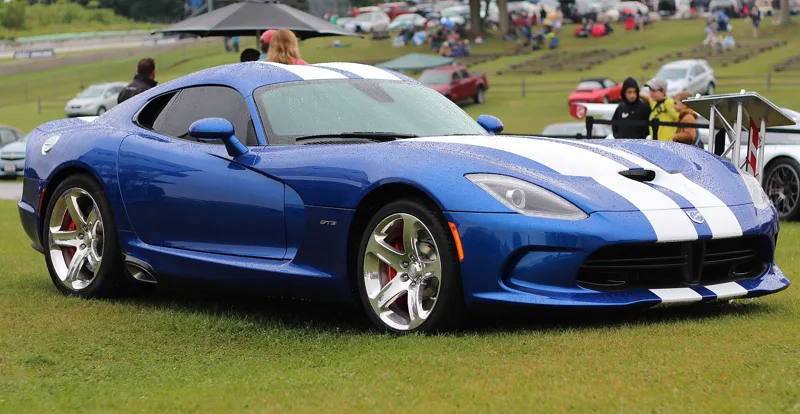
The launch edition came first. Only 150 GTS models in 2013 carried the package, finished in Viper Blue with a pair of white stripes, and each had a serialised dash plaque and Black Laguna leather inside.
How much power did the V10 make?
When the car arrived, its all-aluminium 8,382 cc V10 was rated at 6,150 rpm for 640 hp (477 kW; 649 PS). Torque was 600 lb ft (813 N m), reached at 4,950 rpm. Dodge raised the rating by 5 hp in 2015 to 645 hp (481 kW), and 645 hp is the figure quoted for the 2016 ACR.
Dodge quoted 3.5 seconds for 0-60 mph (0-97 km/h), with a maximum of 206 mph (332 km/h). The track-focused models gave up top speed in exchange for downforce.
The SRT Track Package brought Pirelli P Zero Corsa tyres, slotted StopTech brake rotors in two pieces, and lightweight wheels finished in Hyper Black or matte black. For 2015 Dodge also introduced a GT package that sat between the base car and the GTS. It brought the GTS's two-mode adjustable suspension and five-mode stability control, and Nappa leather seats trimmed with Alcantara came with it.
Time Attack, ACR and GTC models
The Time Attack, or TA, was the track-focused model of 2013. The TA 1.0, sold by SRT for GTS cars, added an Advanced Aerodynamic Package of carbon-fibre splitters and a carbon decklid spoiler, Sidewinder II wheels in matte black, and firmer Bilstein dampers. The engine stayed at 645 hp, but the aero pulled the top speed down to 193 mph (311 km/h), and downforce of 200 lb (91 kg) arrived at 100 mph (160 km/h).
Just 159 TA 1.0 cars were made, and the colour split was 33 Venom Black, 33 Bright White and 93 TA Orange. MotorTrend tested one at Mazda Raceway Laguna Seca on March 18, 2013, and set a production car lap of 1:33.62, quicker than the 1:33.70 that a Chevrolet Corvette ZR1 had recorded there.
The TA 2.0 came for 2015 with a larger rear wing, revised dive planes at the front and a carbon-fibre splitter. Downforce rose to 400 lb at 150 mph from 278 lb for the 2014 TA 1.0, and the car kept the 206 mph top speed of the standard Viper. The TA 1.0 stayed on sale through the 2017 model year.
The ACR was a different proposition. Dodge showed a concept at SEMA 2014 and put the production car on sale for the 2016 model year at US$121,395 in the US and CA$159,995 in Canada. Downforce from its carbon-fibre aero kit reached 1,533 lb (695 kg). The brakes were the first carbon ceramic set fitted to a Viper, with 391 mm (15.4 in) front discs clamped by six-piston calipers and 360 mm (14.2 in) rear discs with four-piston units.
Kumho Ecsta V720 ACR tyres were made for the car, measuring P295/25R19Z at the front and P355/30R19Z at the rear. The optional Extreme Aero Package added a removable front splitter extension, an adjustable dual-element rear wing, dive planes and removable diffuser strakes. It helped the car break 13 track lap records, with downforce up to 1,710 lb (776 kg), but its top speed fell to 177 mph (285 km/h). The drag coefficient rose to 0.54, against 0.37 for the standard Viper.
The GTC, introduced in 2015, took customisation furthest. Buyers could choose from 8,000 colours and 24,000 hand-painted stripes, then 10 wheel designs, 16 interior trims and 6 aero options, a set that Dodge put at 25 million build combinations. Orders went through the Viper Concierge programme, where a 1:18 model in the buyer's colours confirmed the build before it was locked.
Why did production end in 2017?
Sales of the Viper were weak in 2013 and 2014. Production was cut by a third in October 2013 and halted for two months in April 2014. In October 2015 Fiat Chrysler said the car would end in 2017, and it first cited poor sales as the reason.
Other sources have argued that the car could not meet FMVSS 226, the federal standard that requires side-curtain airbags. In July 2017 the company said it would close the Conner Assembly Plant permanently on August 31, 2017. Production of the VX I stopped that August, after 2,427 fifth-generation Vipers had been built from 2013 through 2017.
Chrysler announced five special editions for that final model year, and the Conner plant closed soon after the last cars left the line.
Could the ACR take back the Nurburgring record?
The 2017 group fell short of its target, which was second place among street-legal cars behind a Lamborghini Huracan Performante at 6:52.01. Its fastest lap was 7:01.30, and the run ended when one ACR crashed after a tyre failure. The group still ranked the car fifth among street-legal vehicles for 2017.
The idea began with a lap that SRT never recognised. In October 2015 an ACR fitted with the Extreme Aero Package ran the Nurburgring Nordschleife in 7:01.67, driven by SRT test driver Dominik Farnbacher. SRT called the lap unofficial, and a volunteer, Russ Oasis, started a crowdfunding campaign on GoFundMe in 2017 to pay for another attempt.
The campaign reached as high as $198,000 and drew 377 supporters. Farnbacher, a former Nurburgring record holder, returned to drive alongside Mario Farnbacher, Luca Stolz and Lance David Arnold. Tyre maker Kumho, parts supplier Prefix Performance, ViperExchange, which provided loan cars, and Fox Pro Films, which shot the laps, all helped the effort.
Their three lap times were 7:03.45, 7:03.23 and 7:01.30. Even without the record, the team could claim the Viper ACR as the fastest American, rear-wheel drive car with a manual gearbox to lap the circuit.
Viper VX I specifications
| Specification | Detail |
|---|---|
| Generation | Fifth and final Viper, 2013 to 2017 |
| Engine | 8,382 cc all-aluminium V10 (8.4 L; 511.5 cu in) |
| Power | 645 hp (481 kW) from 2015; 640 hp (477 kW; 649 PS) at launch, peaking at 6,150 rpm |
| Torque | 600 lb ft (813 N m) at 4,950 rpm |
| 0-60 mph | 3.5 seconds (0-97 km/h) |
| Top speed | 206 mph (332 km/h); TA 1.0 193 mph (311 km/h); ACR Extreme Aero 177 mph (285 km/h) |
| ACR base price | US$121,395 (United States); CA$159,995 (Canada), 2016 model year |
| Production | 2,427 built, 2013 to 2017 |