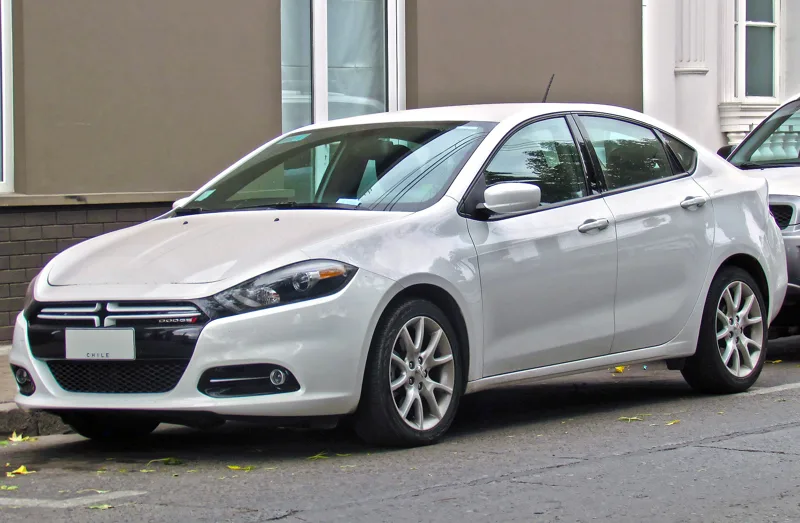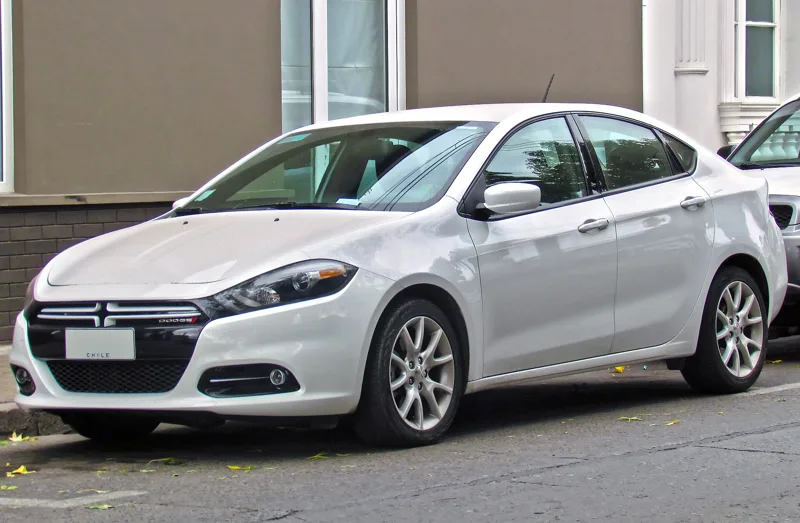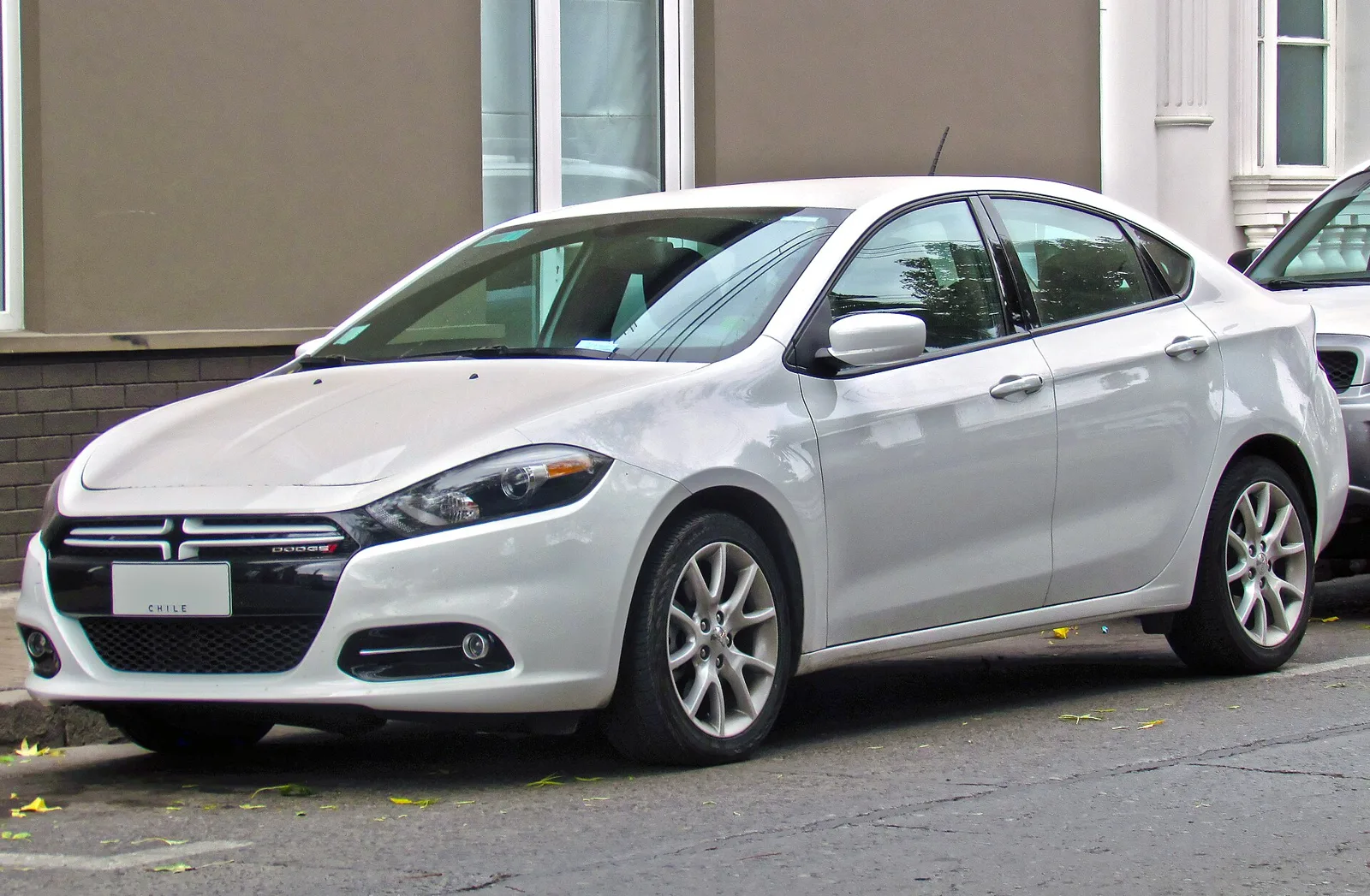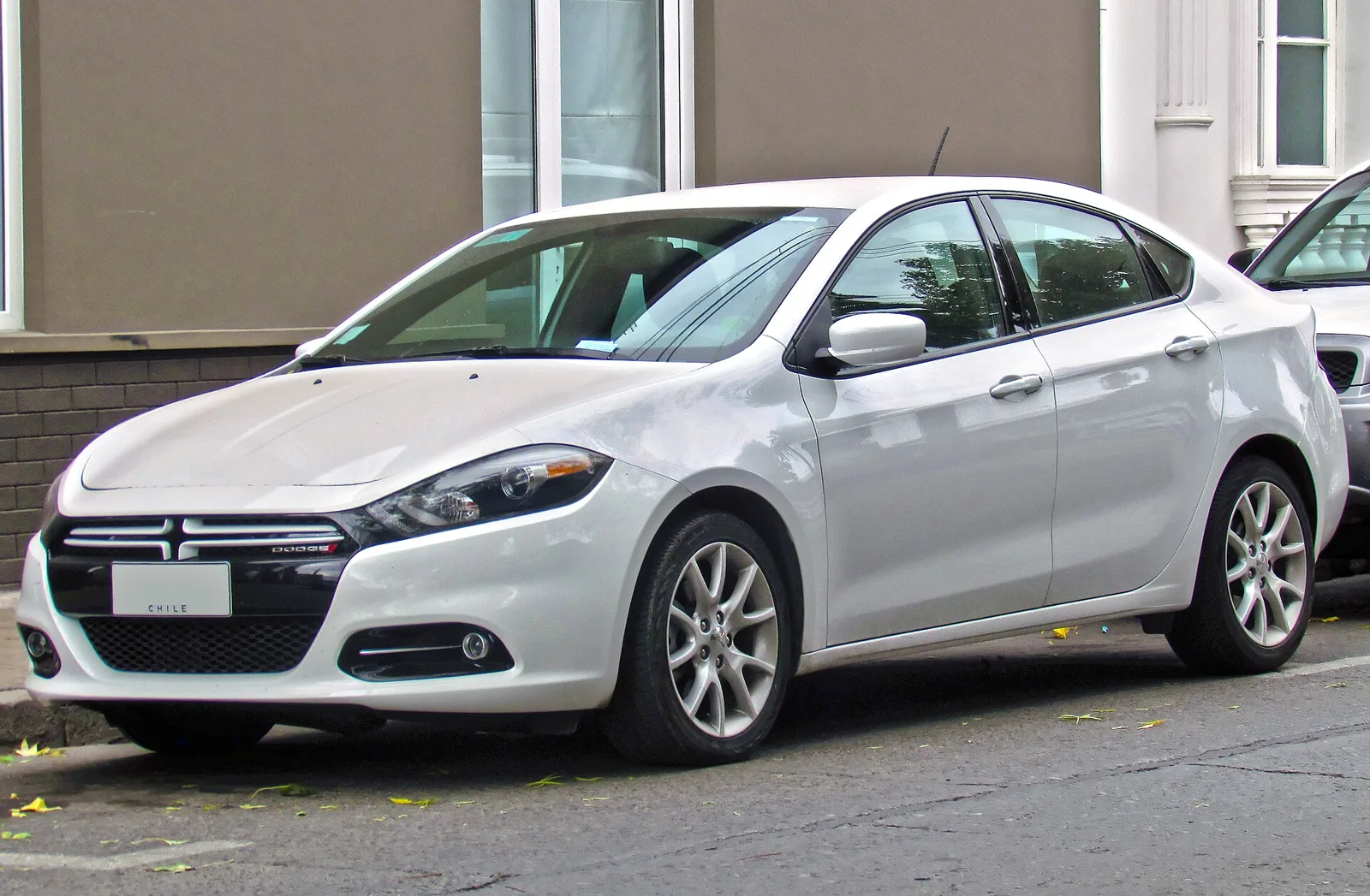
From a 2006 Hornet concept to a 2016 end, the Dart brought Alfa-derived running gear, a turbo engine and a rally car to Dodge's compact line.
The Dodge Dart (PF) was a front-wheel-drive compact sedan built at Belvidere from 2012 to 2016. It sat on a modified Fiat platform, offered 160 hp and 184 hp engines, and was sold in China as the Fiat Viaggio, and production ended in September 2016.
Dodge's compact Dart of the early 2010s was a four-door, front-wheel-drive sedan, sold from 2012 to 2016 and known as the Fiat Viaggio in some markets. After the Neon left in 2005, the brand had no compact sedan, and the Dart filled that gap. Its story runs from a 2006 concept to a 2016 closure, with a rally car and a short-lived hatchback idea along the way.
How did the Dart begin life as the Hornet?
Chrysler designed a mini MPV concept, the Dodge Hornet, which it revealed in 2006 for sale only in Europe. It was the brand's first try at a vehicle this small, and it was expected to reach customers in 2010. The Great Recession and a reorganised Chrysler ended that plan.
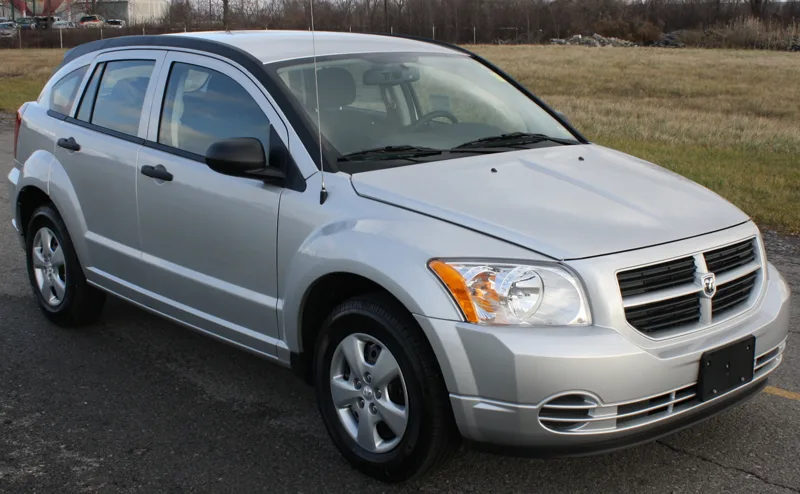
When Chrysler merged with Fiat in late 2010, the small Hornet concept was reshaped to share a Fiat platform. The company announced the new small sedan's name, Dodge Dart, in December 2011, and it was meant to replace the Dodge Caliber.
U.S. dealer sales were first scheduled for late June 2012. In the third quarter of that year the Aero went into production, and the GT followed in the second quarter of 2013.
At the Geneva Motor Show in early March 2014, Sergio Marchionne floated a hatchback for North America. He suggested buyers might be offered alternatives close to the same price, such as the Fiat 500X or the Jeep Renegade.
A short-lived compact sedan that tried hard on tech and efficiency, then ended in 2016 after four model years.
What was the Dart's design and suspension?
The Dart was a front-engine, front-wheel-drive sedan whose suspension was closely related to the Alfa Romeo Giulietta's. It used MacPherson struts with coil springs at the front and an independent multilink arrangement at the rear.
The chief engineer said the set-up was slightly softer than the Alfa's, and he described the car as fun to throw around.
Inside, buyers could pick from 12 colour and fabric combinations, with optional ambient lighting and leather seats. A 7-inch (178 mm) colour TFT display carried a trip computer and navigation, and the trunk held 13.1 cu ft (370 L).
Storage included a glove box, a centre console with auxiliary jacks and console map pockets. The power steering was electrically boosted, with the motor mounted on the rack itself. The rear suspension used independent multilink geometry, while the front struts carried twin-tube dampers and a stabiliser bar.
Which trims did the Dart offer?
The Dart ran in five trims over its short life: SE, SXT, Limited, Aero and GT, each with its own equipment. The SE was the base model until mid-2016, when the SXT Sport took over that role.
The SE came with a 160 hp 2.0-litre Tigershark four and a six-speed manual, plus a heater, a four-speaker stereo and fifteen-inch steel wheels with plastic covers. Air conditioning was not standard, but the SE Popular Equipment Group added it along with Bluetooth and a six-speaker system. In 2014 all Darts except the SE received standard U Connect Bluetooth telephone.
The SXT was the mid-level trim. From 2014 it gained sixteen-inch aluminium wheels, U Connect Bluetooth, SiriusXM, a six-speaker audio system and air conditioning. Options included a 506-watt Alpine system with nine speakers, remote start and the 1.4-litre MultiAir turbo rated at 160 hp. The SXT also offered a power-adjustable driver's seat and a seven-inch TFT cluster as options.
The Limited was the up-level car, adding seventeen-inch aluminium wheels, an 8.4-inch infotainment system, Nappa leather from 2014, dual heated front seats, GPS navigation and Keyless Enter-'n'-Go. A 184 hp 2.4-litre Tigershark became standard on later models. Nappa leather was optional on 2013 models only.
The Aero was an SXT variant focused on fuel economy. It had a 160 hp 1.4-litre MultiAir engine, an 8.4-inch touchscreen and a six-speed dual-clutch automatic, and the EPA rated it at 41 mpg on the highway. Standard extras included alloy wheels and remote start.
The GT sat at the top, with Nappa leather, keyless entry, eighteen-inch Granite Crystal alloys, the Alpine nine-speaker system and a 184 hp 2.4-litre engine. Its extra options were eighteen-inch Hyper Black alloys, a six-speed automatic and remote start. It was renamed the GT Sport in the final months of production.
How efficient was the Dart?
One unadjusted combined figure, for a particular version, came to 16.94 km/L (about 40 miles per US gallon). That result helped Fiat win an extra 5 per cent share of Chrysler Group.
The Dart was also the first compact sedan to offer a rear obstacle sensor and blind-spot watch.
What engines and gearboxes were on offer?
Dart buyers had three engines: a 2.0-litre Tigershark, a 2.4-litre MultiAir Tigershark and a 1.4-litre MultiAir turbo borrowed from the Alfa Romeo Giulietta. A six-speed manual came with every engine.
Buyers could also order an automatic with six gears on the 2.0 and 2.4 engines, while the 1.4 turbo used a six-speed dual-clutch. Marchionne said a nine-speed automatic would follow, but the Dart ended production first.
The 1.4-litre turbo was shared with the Giulietta and had been retuned for American use, including a change to the oil grade required. It was also the engine that gave the Aero its economy rating.
For 2014 the SXT and Limited took the 2.4-litre engine with more power, leaving the 2.0-litre to the base SE. Every Dart engine was built in Dundee, Michigan. The Dart had three transmission choices in total, and the six-speed manual was the one fitted as standard.
How safe was the Dart?
The Dart carried 10 airbags as standard, and its front seats had reactive head restraints. The IIHS gave the 2013 model a five-star rating in its frontal offset, rollover and side impact tests.
The Giulietta, on which the Dart was based, achieved the highest Euro NCAP rating for a compact car. Standard features included brake assist, traction control, electronic stability control, hill-start assist, a backup camera and rear park assist.
The IIHS also gave the Dart a Top Safety Pick for 2012. Optional extras included rear cross path detection, along with blind-spot monitoring.
How did the Dart race?
A turbo four-wheel-drive Dart rally car was shown at the 2012 New York International Auto Show, and it entered the 2012 Global RallyCross Championship. Four-time Rally America champion Travis Pastrana drove it with his teammates.
The engine was a 2.0 L turbocharged four with 16 valves, rated at 600 hp (447 kW), and it made over 550 lb ft (746 N m). With four-wheel drive, it was a very different machine from the road car. Drive went through a Sadev four-wheel-drive transmission.
Pastrana placed tenth in the driver's standings in both years, and Dodge pulled out of the series. He went back to Subaru's rally team in 2014, having already competed through the 2013 season.
An SRT 4 version was planned for production from December 2016, under the 2014 five-year plan of Fiat Chrysler Automobiles. It was cancelled once the Dart was ended over poor sales.
What was the Fiat Viaggio?
The Viaggio was a sedan version of the Dart for China, designed by the Fiat Style Centre in Turin. It appeared first at the Beijing show in 2012, and sales began in the third quarter of that year.
The 1.4-litre T-Jet produced either 88 kW (120 PS) or 110 kW (150 PS), and buyers chose between a five-speed manual or a six-speed dual-clutch in 2012 and 2013. From 2015 to 2017 a seven-speed dual dry clutch was standard.
The Ottimo was a five-door hatchback version of the Viaggio, introduced at the 2013 Guangzhou Auto Show and designed by Roberto Giolito. It used the same engines and gearboxes as the Viaggio. Both cars sat beside the American Dart in Fiat's wider line-up, sharing its basic architecture.
Where was the Dart built, and how was it engineered?
The Dart was built at Chrysler's Belvidere Assembly Plant, which also made the Dodge Caliber, Jeep Compass and Jeep Patriot. The plant had built the first and second generation Dodge Neon from 1995 to 2005, and the Neon SRT4 from 2003 to 2005. It rode on a modified Fiat Compact Platform, shared with the Giulietta, which was widened and lengthened into the CUSW platform and later called PF.
The platform was made 38 mm (1.5 in) wider and its wheelbase 94 mm (3.7 in) longer, and it was adapted to American requirements. The design took roughly 18 months and cost about US$1 billion to develop.
What did the marketing do?
The Dart's first television advert aired in July 2012 during the Major League Baseball All-Star Game. It borrowed a bassline from a Kanye West track, spoofed the Reliant Robin and featured an NFL cameo by Tom Brady.
In May 2013 the car was used as a tie-in for the film Fast & Furious 6, although the Dart did not appear in it. The car did show up in the game Fast & Furious 6: The Game.
Why did the Dart end?
Fiat Chrysler announced on 27 January 2016 that the Dart and the Chrysler 200 would end, as the company shifted towards crossovers. Dart production finished on 2 September 2016, after the car failed to meet sales expectations.
A plan to move production from Belvidere to Mexico was considered and later scrapped. Sergio Marchionne told the 2017 Detroit Auto Show that the Chrysler 200 and the Dart had been the least financially rewarding ventures in the company's last eight years.
The end was attributed to falling passenger-car sales, especially in the compact segment, and to a shift in buying towards SUVs and trucks. Customers were looking at higher-priced Jeeps with high-end trims, while the Dart had to be propped up with interest-free financing.
The Chevrolet Cruze and Ford Focus also lost sales steeply, while the Honda Civic and Toyota Corolla declined more gradually. Ford later dropped most non-truck vehicles in North America apart from the Mustang, a move announced in 2018.
What happened to the Dart after production ended?
Dodge reported selling one new Dart in September 2024, eight years after production ended, and six more in the third quarter of 2025. Some remaining Darts were also sold during the COVID-19 pandemic in 2020, when other models were short.
The Viaggio and Ottimo had stopped selling in September 2017. In their final year the Viaggio sold 1,623 units and the Ottimo 650.
What were the Dart's core specifications?
| Specification | Detail |
|---|---|
| Model years | 2013 to 2016 (PF generation) |
| Body | Four-door compact sedan, front-engine, front-wheel drive |
| Reveal | 2012 North American International Auto Show, Detroit |
| Engines | 2.0 L Tigershark I4, 160 hp; 1.4 L MultiAir turbo I4, 160 hp; 2.4 L Tigershark I4, 184 hp |
| Trunk | 13.1 cu ft (370 L) |
| Airbags | 10 as standard |
| Combined economy | About 40 mpg US (16.94 km/L) for one unadjusted version |
| Built at | Belvidere Assembly Plant |
| Production end | 2 September 2016 |
The Dart used a platform modified for the American market, and its three engines ran from 160 hp to 184 hp. Production stopped in September 2016, after a four-year run that covered the 2013 to 2016 model years.