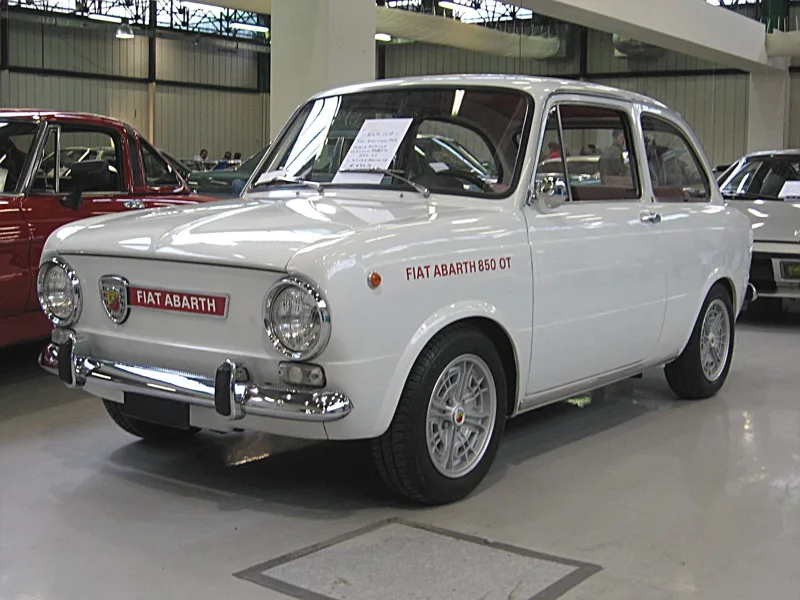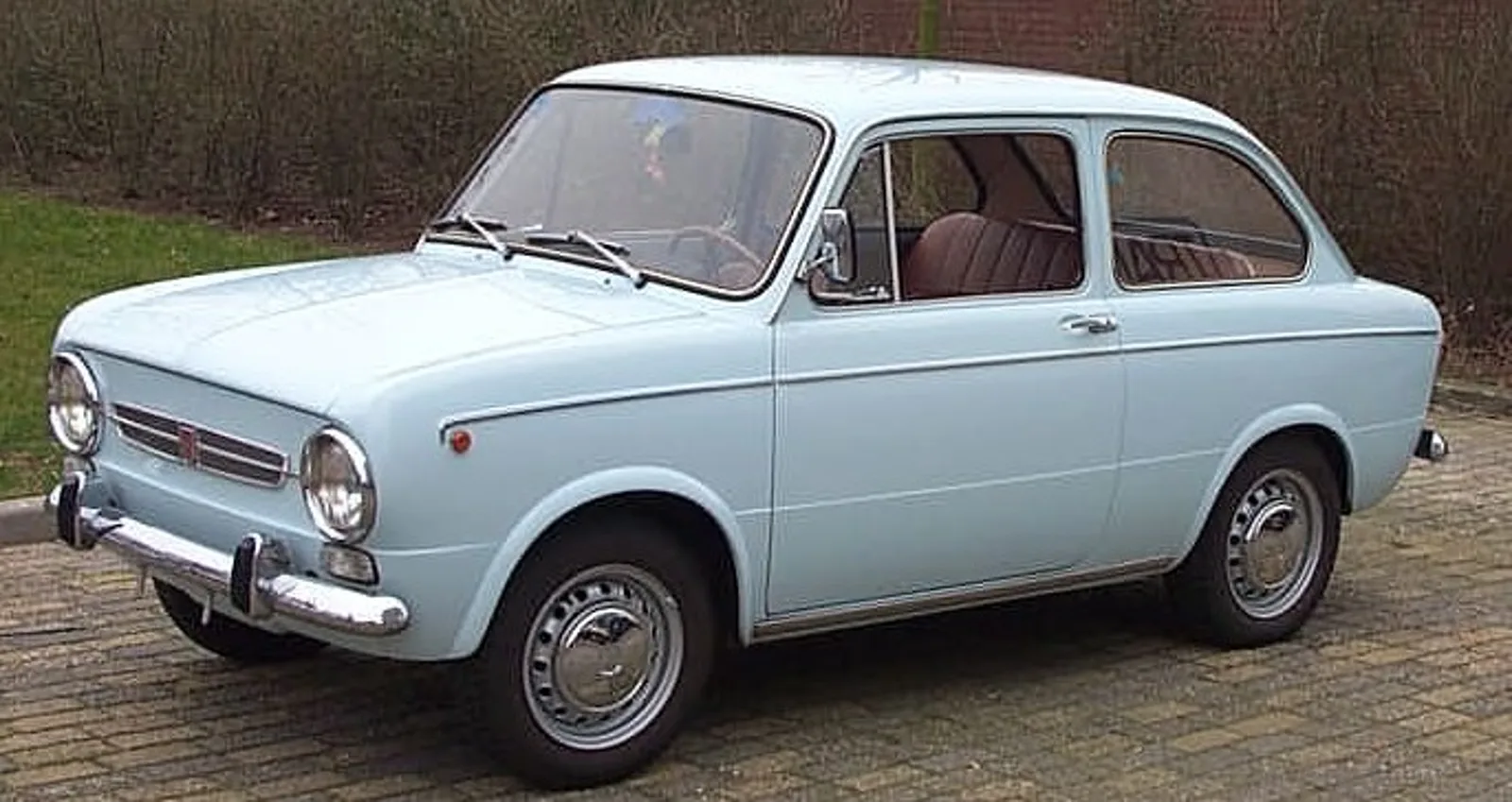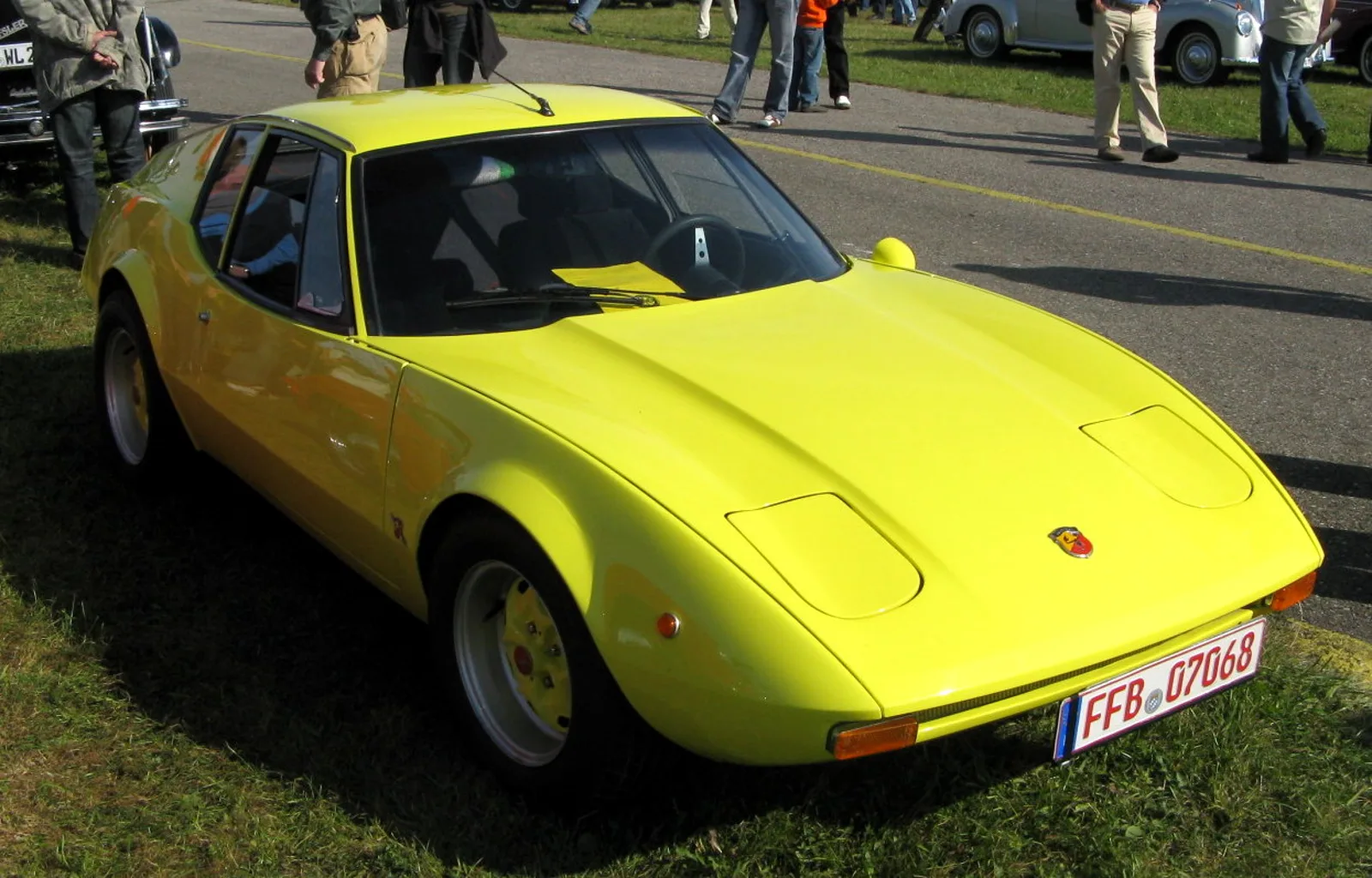
A radial-headed Abarth that may not have reached its homologation total, and a Lombardi coupe that wore Giannini, OTAS and Abarth badges.
The Fiat Abarth OTR 1000 was a very rare Fiat 850-based sports coupe built from 1964 to 1969, with Abarth's Radiale cylinder head. The Lombardi Grand Prix was a small rear-engined sports car on the Fiat 850 Special, built from 1968 to 1972 and sold as a Giannini, OTAS and Abarth Scorpione.
On 30 April 1966 the FIA's homologation form number 230 recorded that Abarth had reached the minimum of fifty identical OTR 1000 cars. Many assume the real total was nearer 35, believing that Abarth, like other makers of the day, presented some individual cars twice for inspection. Only eight of those are thought to have gone to the United States. The OTR 1000 is one of two small, rear-engined sports cars built on the Fiat 850 that are covered here. The other, the Lombardi Grand Prix, was sold under so many names, from Giannini to OTAS to Abarth Scorpione, that it almost needs a family tree.
Fiat Abarth OTR 1000, the 850 with a Radiale head
The Fiat Abarth OTR 1000 is a sporting subcompact built by Abarth between 1964 and 1969 in various versions and very small numbers, with a special engine called the Radiale. It belongs to the wide Fiat Abarth OT family, made from 1964 to 1970, and among the OT models with a one-litre engine and a standard Fiat body, it was the top one. Its closest relatives were the Abarth OT 1000 (1964 to 1970), notably the OTS 1000 and OT 1000 SS Corsa coupes, all listed internally as Abarth Tipo 102, and the Abarth OTR 850 (Tipo 103). Underneath was the rear-engined, rear-wheel-drive Fiat 850.
The best-known version is the OTR 1000 Coupe, which had road approval from 1965 to 1969. In the model name, OT stands for Omologata Turismo, meaning homologated touring car. The R points to the special cylinder head, and it does not mean race or racing.
The idea was to enter a series-based touring car category in the sports car world championship, which was being restructured for 1965. Motorsport homologation was delayed by a year for further development work. Then the Commission Sportive Internationale, the approval body of the FIA, put the car into a non-series category until 1969 because of that radial head. Abarth turned to the OTS 1000 Coupe, which used a modified standard Fiat 850 head, and later, for Group 5, to the Fiat Abarth 1000 TCR with the Radiale head on the lighter, more compact base of the Fiat 600 D.
The paperwork said fifty OTR 1000s existed in April 1966, but about 35 are thought to have been built.
How the OTR 1000 engine and its Radiale cylinder head worked
The OTR 1000 is the only model that used the Abarth Sigla 200 engine, a one-litre, water-cooled, in-line four-cylinder. Its Radiale cylinder head was developed and made by Abarth, and this car was where it first appeared. Touring-car rules meant that the head kept the pushrod valve control of the original, but it differed from Fiat's head in several ways.
In a normal pushrod head, intake and exhaust valves stand parallel in a row along the engine. In the Radiale head, one intake and one exhaust valve per cylinder were inclined towards each other in a V, and they were set across the engine instead of along it. The combustion chambers were bi-spherical, each formed by two intersecting hemispheres: the smaller around the inlet valve and the larger around the outlet valve. With a bore and stroke of 65.0 and 74.0 mm (2.56 and 2.91 in), displacement was 982 cc (59.9 cu in). Abarth quoted 74 hp DIN (54 kW) at 6500 rpm for the production car, fed through two Solex C32PHH double carburettors, with a top speed of over 170 kilometres per hour and fuel consumption of 9 litres per hundred kilometres. The racing version, which had no road approval, reached up to 106 hp DIN (78 kW).
Which gearbox the cars had is not entirely clear. Every surviving car known today has the standard four-speed from the Fiat 850. The factory data sheet and FIA homologation sheet, however, name a five-speed from Abarth, which was available at least as an extra, probably the Abarth Tipo 102 gearbox. An Abarth six-speed, the Tipo 132, may also have been an option at extra cost.
OTR 1000 chassis, wheels and body
The OTR 1000 used the independently sprung chassis of the Fiat 850, modified for higher power like every OT car. Factory wheels were 13-inch Abarth steel rims with a chrome-plated cover bearing the Abarth logo, and 13-inch light-alloy wheels from several makers cost extra. Standard tyres were 145 x 13 (Michelin and Pirelli) or 155 x 13 (Kleber Colombes). As on all OT 1000 versions, the front wheels had disc brakes. The factory data sheet says the OTR 1000 should also have had rear discs as standard, although some surviving cars have rear drums. The wheelbase of 2027 mm and the tracks of 1150 mm front and 1160 mm rear matched the Fiat 850, and FIA homologation permitted wider tracks of 1230 and 1248 mm.
The body was the stock Fiat 850 shell, with many small differences. On the tail an "OTR" badge sat below the chrome "Fiat Abarth" and "1000" lettering, replacing the chrome "OT" logo. The coupe shared a slightly trapezoidal grille, narrower at the bottom, with the OTS 1000, which fed the front-mounted water radiator, and a narrow chrome strip above it read "Fiat Abarth 1000". On street-legal cars, two chrome fixings below the bumper marked the oil cooler hidden behind the panel, whereas only racing versions had a separate opening for it.
OTR 1000 versions, from Berlina Corsa to Bertone Berlinetta
Abarth built several variants at the factory. The OTR 1000 Berlina Corsa (Tipo 100) was a near-series racing version with the Sigla 200A engine and the two-door Fiat 850 Berlina body, made one at a time from 1964 for the firm's own testing, with no road approval. Abarth planned it for a series-based touring car class in the 1965 championship, then switched to the aerodynamically better coupe body from autumn 1965.
The OTR 1000 Berlina (Tipo 100/B) was offered in 1964 as a small series or individual pieces on request, possibly road legal up to 1966, to support Abarth's hunt for FIA approval. The OTR 1000 Coupe (Tipo 100/C), developed in 1964 and sold from autumn 1965 to 1969 in limited series, was a 2+2 coupe. Cars up to 1968 used the Fiat 850 Coupe body, and it is unclear whether any had the facelifted Fiat 850 Sport Coupe body of 1968 and 1969. In 1965 Abarth and Bertone, which had designed and built the Fiat 850 Spider's body, built a Berlinetta for display, with a fixed coupe roof on a Spider shell, an OTR 1000 engine and the upgraded interior of the Bertone 850 CL Spider. That shape reached production in 1968 as the Bertone 850 Racer Berlinetta, though it used the Fiat 850 Sport Coupe's ordinary engine. Individual coupes were also converted to Corsa racing versions with accessory kits.
Where the OTR 1000 came from and what followed
Abarth's ties with Fiat were close. The Fiat 850 Berlina was shown in March 1964, and the coupe and spider at the Geneva Motor Show in spring 1965, giving Abarth pre-series cars on which to develop the OT line. Abarth saw the OTR 1000 as the sporty top model of the one-litre class. The racing version would run in touring car sport close to series production, while road-legal variants would earn homologation and promote the Abarth image. In 1964 chief engineer Mario Colucci and engine development head Luciano Fochi developed the Sigla 200 road engine and the Sigla 200A racing version, both of which fitted the sedan, coupe and spider.
The OTR 1000 made its public debut as a road-legal coupe on 9 September 1965 at the International Motor Show in Frankfurt am Main, with the OT 1000 Coupe and Spider. On 3 November 1965 Abarth showed the coupe at the Turin Motor Show, while a Spider-based OTR 1000 Berlinetta appeared on Bertone's stand but stayed a prototype.
Abarth continued to develop the Radiale head until 1971, latterly for racing versions of the Autobianchi A112 and Fiat 127. The OTR 850, a smaller-displacement version, was offered only in 1966, only as a sedan. A further development of the head, extremely successful in motorsport, went into the Fiat Abarth 1000 TCR Berlina Group 5 (Sigla 210G engine) from 1967, built on the lighter Fiat 600 D.
How many Fiat Abarth OTR 1000s were made
Production of the only series version, the OTR 1000 Coupe, began in autumn 1965 alongside the OT 1000 Coupe and Spider. Abarth took starting vehicles one by one from Fiat's production line, kept their chassis numbers and added the prefix "100GC", so an exact count is impossible. Whether the coupe got a facelift at the start of 1968 is disputed. Cars from 1968 and 1969 would show round extra headlights set into the front, a modified grille, a more distinctive tail with a thin chrome frame, twin tail lights on each side and bumper guards. The fact that the model was officially listed until 1969 supports that, but the surviving cars and test photographs all show the first Fiat 850 Coupe series.
Production ended by 1969 at the latest, together with the OTS 1000 Coupe. Only the OT 1000 Coupe and the OT 1300 Coupe carried on for another year. Buyers could have Rosso red paint with a black interior, or one of two successive off-white tones, called camoscio, with red and black interiors. As mentioned, form 230 shows fifty identical vehicles on 30 April 1966, but about 35 are thought to have been built, with only eight for the US market. PBS Engineering later made more cylinder heads in the OTR style, used to repair and restore original cars and to build replicas.
Lombardi Grand Prix, a small sports car on the Fiat 850 Special
The Lombardi Grand Prix is a compact rear-engined sports car that rides on the mechanicals of the Fiat 850 Special. Carrozzeria Francis Lombardi developed it from an in-house design by Giuseppe Rinaldi, and it was built from 1968 to 1972. It was shown internationally at the Geneva Motor Show in March 1968. The body had a Kammback rear, a very low nose with electrically powered flip-up headlights and a large single windscreen wiper. Most of it was steel, but the doors and rear panel were glass-reinforced plastic and the engine cover was aluminium to save weight. At Turin in 1969 Lombardi showed a targa version called the Monza, with a roll bar and a compartment just behind it for the removable roof panels. Its upright rear window could be wound down by a handle between the seatbacks. Beyond a pair of show cars, it is not known whether any more were built, but at least one survives.
As presented, the Grand Prix had the 843 cc engine of the Fiat 850 Special, with 47 hp (35 kW) DIN at 6400 rpm and a four-speed gearbox. With little drag and a weight of 630 kg (1,390 lb), that was supposedly good for 160 km/h (99 mph), but a German test of the period measured 153.8 km/h (95.6 mph). Luggage space was limited to a small space next to the spare wheel up front and a tiny area behind the seats. If the electric winder for the headlights failed, a mechanical lever under the bonnet raised them. The round tail lights were Fiat 850 Coupe units, and the suspension combined a transverse leaf spring and upper A-arms at the front with coil-sprung semi-trailing arms at the rear.
Early cars had glass-reinforced plastic doors with a three-piece window, which was soon replaced by a more conventional layout with a front vent window and a single fixed piece behind. Steel doors were an option, and on those the rear window could be wound only halfway down. The Series II of 1970 had a louvered black metal engine cover for cooling, front wings reshaped for wider wheels, 5 1/2 inch in place of 4 1/2 inch, and a bonnet with a raised central rib to fit a larger spare wheel.
A Cypriot casino-owning millionaire, Frixos Demetriou, also took an interest around the time of launch. He intended to sell the car in the United Kingdom, began planning an order of 1000 cars and considered swapping the Fiat parts for those of the British Hillman Imp Sport, which would have cut the UK price by about 15 percent. The venture failed, with only a handful of cars sold, and a few unsold ones were sent back to Cyprus in 1970 to avoid pending customs bills.
Giannini, OTAS and the OTAS 820
The Rome engine tuner Giannini Automobili was quick to offer faster versions. A Giannini-engined example appeared at the Turin Racing Car Exhibition in March 1968, a fortnight ahead of the official launch at Geneva. The Giannini 1000 Grand Prix had a tuned Fiat 850 engine, stroked to 982 cc (65 mm x 74 mm) for a claimed 84 hp SAE. At Turin a few months later came the even sportier 1000 Bialbero Grand Prix, with Giannini's own 994 cc (64.6 mm x 76 mm) twin overhead camshaft engine, claimed to make 104 hp SAE at 7500 rpm.
After the death of Giannini's founder, Domenico Giannini, his son Franco left in 1969 to concentrate on OGT (Officina Giannini Torino) in Turin. Seeing a chance in America, OGT developed a Grand Prix for US standards, shown at the 1969 Turin Motor Show as the OGT 1000. It had the central bonnet rib and louvered engine cover of the coming Series II, and a new 903 cc engine (65 mm x 68 mm) with a fuel-injection system of Franco Giannini's own devising. It replaced the carburettor's venturi with a mechanical fuel metering device, and reportedly gave a significant power gain while still meeting US emission limits. Lombardi also wanted to export it to Australia.
The American importer Siata International of Newark, New Jersey, which sold the Siata Spring, ordered three hundred. Giannini Automobili objected to the OGT name, so Franco Giannini founded OTAS (Officina Trasformazioni Automobili Sportive) to fill the order. Siata displayed the car, renamed the OTAS Tigre, at the New York International Automobile Show in April 1970. Soon afterwards Siata went bankrupt, and its American distributor dropped the plan. OTAS had already converted one hundred cars, and a deal with John Rich of Glendale, California, followed, but by then emission rules had tightened and the cars could not comply. Engines under 50 cubic inches were exempt, so OTAS converted all one hundred again, cutting capacity to 817 cc (49.9 cu in). Those cars, which kept their Fiat 850 chassis numbers, were sold in the US from 1971 as the OTAS 820. How many reached North America is given as sixty-five or as many as a hundred.
Abarth 1300 Scorpione
Carlo Abarth wanted to work his magic on the Grand Prix too. The result, the Abarth 1300 Scorpione, debuted at the Paris Motor Show in October 1968. Its engine was Abarth's 1280 cc (75.5 mm x 71.5 mm) take on the Fiat 124 unit, first made for the 1966 Fiat-Abarth OT 1300 Coupe, and a special Abarth bell housing joined it to the four-speed 850 gearbox. The basic model kept the Fiat 850's suspension and brakes, while the Scorpione S added Abarth's own suspension and four-wheel disc brakes. Both had a front-mounted radiator, and the air inlets and an external fuel filler told the Abarth from its Lombardi counterpart.
Power jumped to 75 hp (55 kW) DIN for a weight increase of just 65 kg (143 lb). Auto, Motor und Sport tested one in 1970 and recorded 175.6 km/h (109.1 mph), against 153.8 km/h (95.6 mph) for the Lombardi, and cut the 0 to 100 km/h (0 to 62 mph) time from 16.7 to 12.7 seconds. The heavier engine added to a rearward weight bias of 39/61, yet the handling seems to have suffered only modestly, with some lightness at the front end at higher speeds.
In 1969 the Scorpione SS became the ultimate version. It had the S model's suspension and brakes and an option of twin 32 DCOF Weber carburettors, taking output to around 100 hp (74 kW). It was the last iteration of Abarth's final independently developed car. Fiat took over the company in 1971, and the Scorpione was quickly cancelled.
Lombardi Grand Prix family at a glance
| Name | Engine | Power and notes |
|---|---|---|
| Lombardi Grand Prix | 843 cc Fiat 850 Special | 47 hp DIN at 6400 rpm |
| Giannini 1000 Grand Prix | 982 cc tuned Fiat engine | 84 hp SAE |
| Giannini 1000 Bialbero | 994 cc twin overhead camshaft | 104 hp SAE at 7500 rpm |
| OGT 1000 | 903 cc with fuel injection | Reported significant gain |
| OTAS 820 | 817 cc | Under the 50 cubic inch US exemption |
| Abarth 1300 Scorpione | 1280 cc Fiat 124 based | 75 hp DIN |
| Abarth Scorpione SS | 1280 cc, twin 32 DCOF Webers | Around 100 hp |