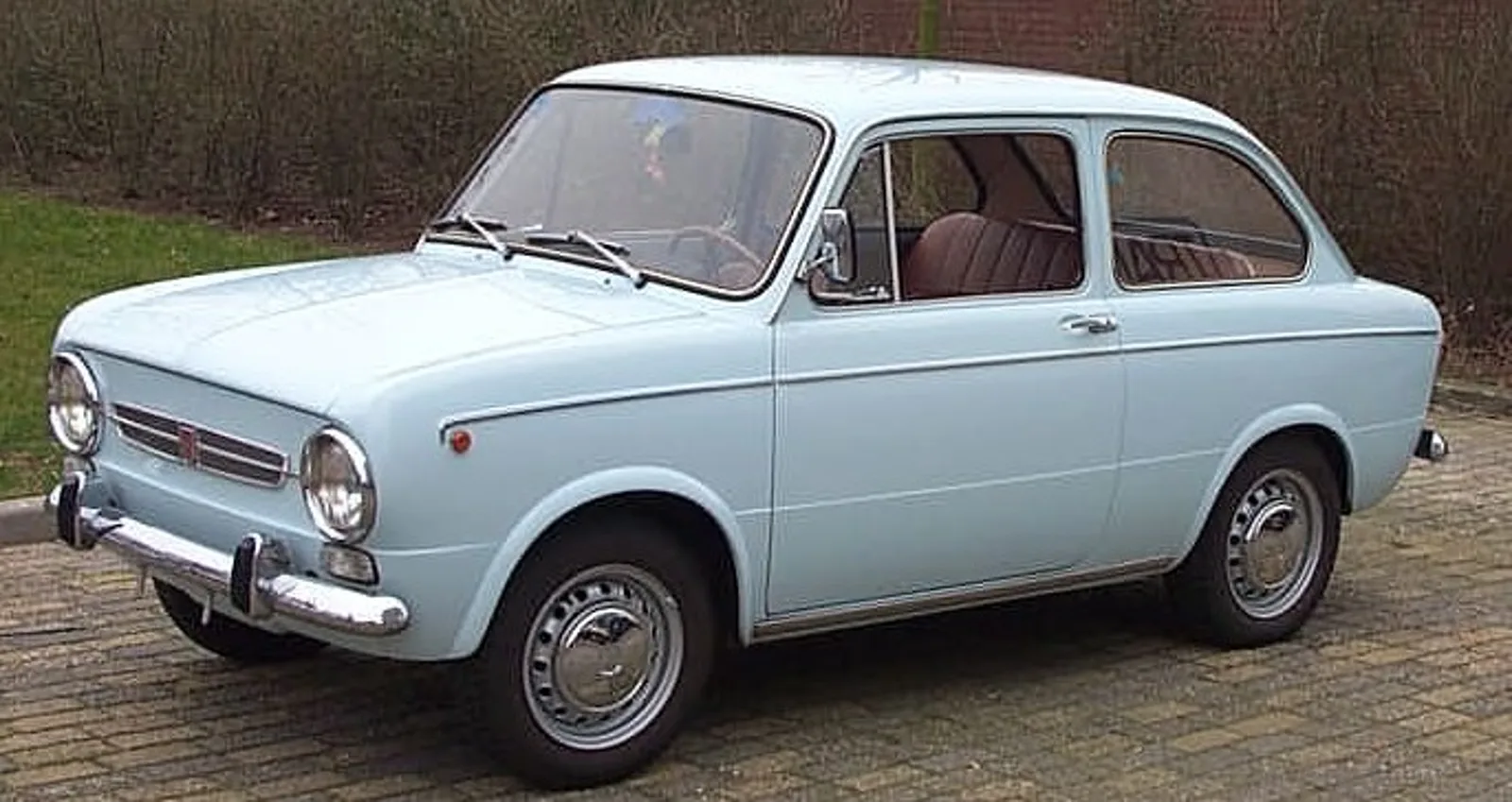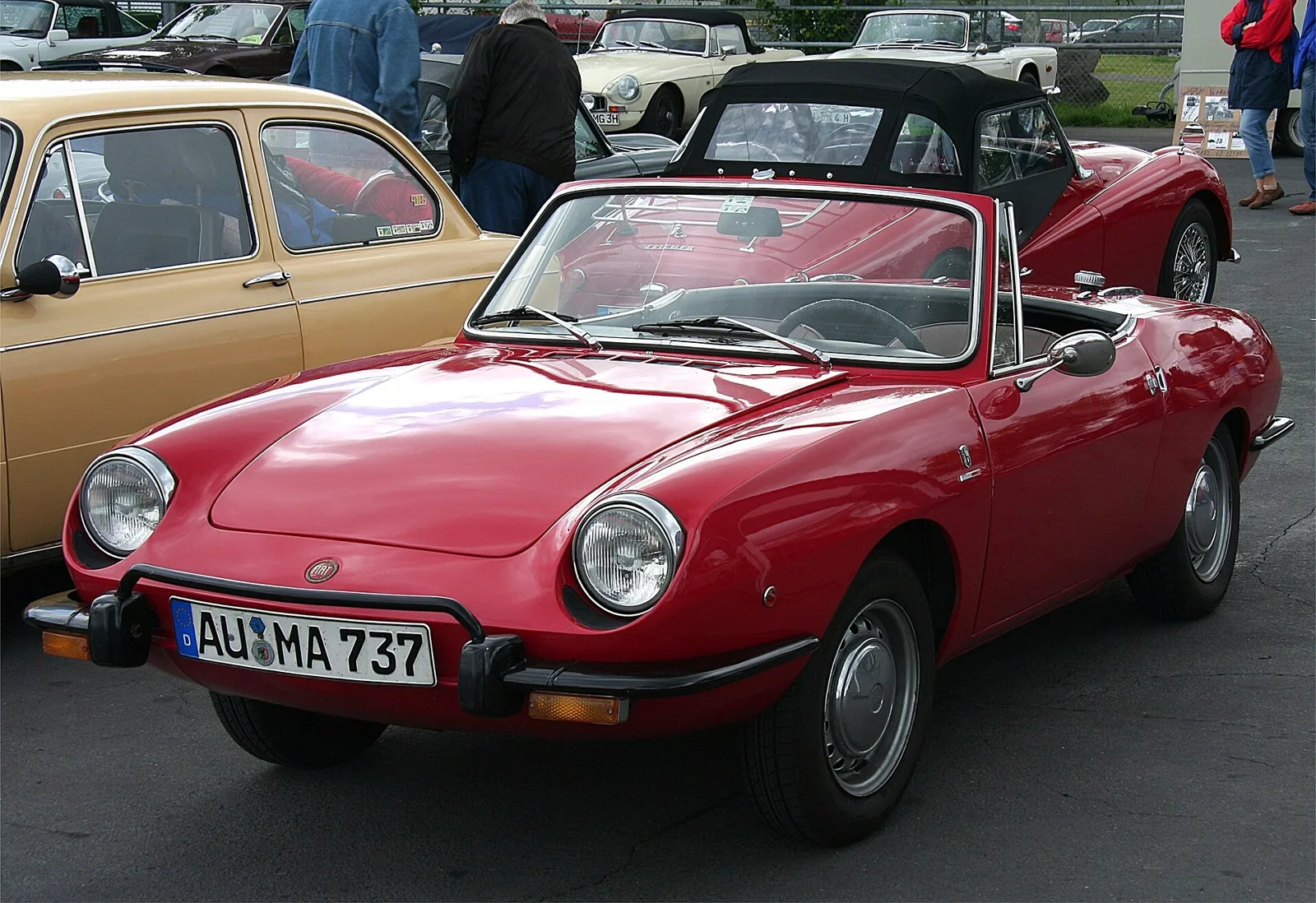
Bertone bodies on 850 saloon mechanics, a second series shaped by US safety and lighting rules, and the CL, Racer and Abarth OT 1000 variants.
The Fiat 850 Spider was a small convertible sold by Fiat between 1965 and 1973. Its bodies came from Bertone on the mechanics of the 850 saloon, Giorgetto Giugiaro drew it, and the United States knew it as the Little Ferrari.
Fiat's small 850 Spider was sold from 1965 to 1973. Its bodies came from Bertone's Grugliasco workshops and sat on the mechanics of the 850 saloon, and the United States made it a hit under the name Little Ferrari.
Where did the 850 Spider come from?
The 850 Spider began as an original idea from the Italian coachbuilder Bertone, and Giorgetto Giugiaro, then very young, drew the car. It made its debut in Geneva in March 1965 and was in showrooms by that summer. Bertone built the bodies in its Grugliasco workshops near Turin.
Some critics at the time said the front end, with its sloping headlamps, had been taken from the Chevrolet Corvair Bertone Testudo, a prototype the same coachbuilder had built in 1963. The Spider sold strongly in Italy and across Europe, and especially well in the United States, where it arrived with the nickname 'Little Ferrari'.
A small convertible on saloon mechanics that crossed the Atlantic as the Little Ferrari.
How did the saloon's mechanics shape the first series?
Bertone kept almost the whole mechanical base of the 850 saloon and changed only the engine. That unit was rated at 49 PS (36 kW; 48 hp) DIN, enough for 145 km/h (90 mph). Against the saloon, the Spider also carried powerful front disc brakes.
Headlamps track the steep line of the bodywork with no extras, in line with Bertone's maxim that a body should be simple and free of superfluous additions. Two Ferrari 275 GTB4 Daytona prototypes took the same lamps, and the Lamborghini Miura carried them laid back towards the rear.
The truncated tail, a fashion of the day, carried lights set into a band of moulding across the entire body width. That treatment reappeared on the De Tomaso Mangusta and on the first Lamborghini Miuras.
Interior, luggage and dashboard
There was room for two adults. Luggage went at the front, with 115 litres under the bonnet, while 100 litres fitted behind the seats in the space beneath the canvas roof housing, giving 215 litres in all. The rear compartment had no back seat, and its rear opening recalled the interwar spiders that gave the model its name.
The dashboard was richer than those of rival cars. Drivers had a speedometer and rev counter, plus gauges for water temperature, fuel with a reserve warning lamp, and oil pressure. Total and trip odometers, a dimmer for the instrument lighting and two-speed wipers completed the set.
Bertone also offered a rigid hard top to replace the soft top in winter, which could be detached from the body.
Fiat 850 Spider specifications
| Specification | First series (1967) |
|---|---|
| Engine | 843 cc (51.4 cu in), 4-cylinder in-line, rear-mounted |
| Bore x stroke | 65 x 63.5 mm |
| Power | 49 PS (36 kW; 48 hp) DIN |
| Torque | 59 Nm (43.5 lb ft) |
| Gearbox | 4 speeds plus reverse |
| Drive | Rear-wheel drive, monocoque steel body |
| Unladen weight | 725 kg (1,598 lb) |
| Top speed | 145 km/h (90 mph) |
| 0-100 km/h | 17.7 seconds |
| Average fuel use | 7.2 l/100 km (39.2 mpg-imp; 32.7 mpg-US) |
| Tank | 30 litres |
| Tyres | 5.20 x 13 in |
What changed for the second series?
US rules from 1968 forced Bertone to fit vertical headlamps, larger side lights and reversing lights, so the second series came early as the 850 Sport Spider. European cars also gained the 903 cc engine from the 127, rated at 52 PS (38 kW; 51 hp) DIN.
American cars registered after 1 January 1968 received vertical sealed-beam headlamps, and large rectangular side-marker lights, recessed into the panels and edged in chrome, went at each end. On the second series the position lights and indicators moved below the front bumper, and both bumpers gained two chrome-plated guards covered in rubber.
The European second series also swapped its dynamo for an alternator, and its top speed passed 150 km/h (93 mph).
How did the American market reshape the car?
From mid-1967, Nuccio Bertone pushed Fiat to sell the car in the United States, not only through the FIAT USA network but also through Roosevelt Motors. To dodge a surcharge and strict anti-pollution limits, the capacity fell from 843 cc to 817 cc (49.9 cu in), just under the 819 cc (50.0 cu in) threshold.
Franklin Delano Roosevelt Jr., the former president's son, ran Roosevelt Motors, which sold the cars and handled after-sales service. The first American cars looked much like the European second series, but the number plates soon changed size, so the bumper had to be cut and a chrome tube added to join the bumper guards.
The interior was adapted as well. It gained integrated headrests and inertia-reel seat belts, brushed aluminium replaced the wood trim, and a brake failure light and a hazard light button went on the dash. Speedometer and distance readings showed both miles and kilometres.
Reversing lights were banned in France at the time. Customs officers at Modane, on the Savoie border, broke open the rear lights of Alfa Romeo Giulias to check for bulbs. Years later, Volvo 144s that carried hazard lights met the same treatment, and in France such lights only became compulsory from 29 June 1979, because a European directive required them.
Which variants followed the spider?
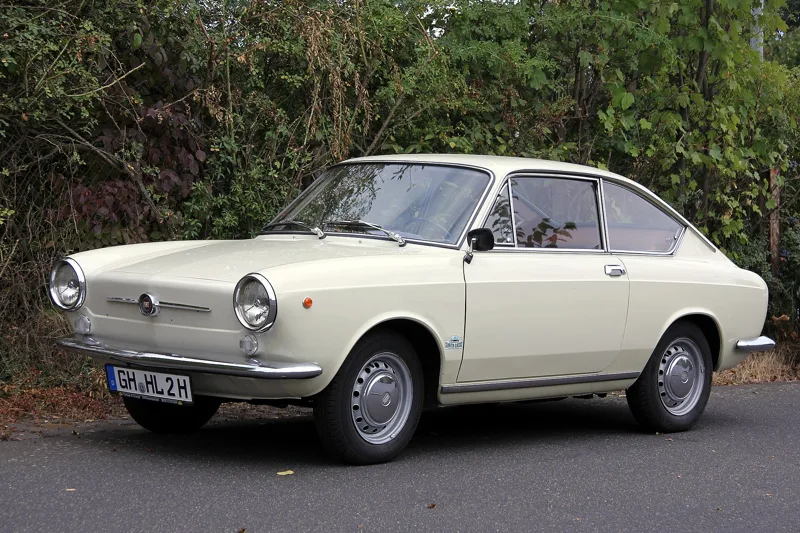
Bertone sold two versions under its own name: the CL, short for Convertibile Lusso, sold from 1965 to 1968, and the Racer, a steel-roofed coupe made from 1968 to 1971. Only 1,474 CL cars were built, and the Racer was not a success.
The CL had higher trim, with better materials and a near-endless choice of body colours, so it did not compete head-on with the FIAT model. The bodywork changes were small: chrome strips on the wheel arches, none between the rear lights, and a large CL logo on the painted body.
The Racer shared the mechanics of the 850 Sport Spider. Its hard top was fixed to the body with bolts and trimmed in black vinyl, and black vinyl replaced the wood on the dashboard. FIAT's French network never sold it. An importer, G A M in Monaco, handled it instead. Across the four production years, the Racer family totalled 3,641 cars plus 763 Racer Teams.
How fast was the Abarth OT 1000 in racing?
Abarth's OT 1000 was a derivative of the Bertone spider. Its engine grew to 982 cc (59.9 cu in) and, in competition it could reach 103 PS (76 kW; 102 hp) by the 1970 season.
Abarth built 200 examples of the OTS Coupe to meet homologation rules for racing cars, with slightly fewer OTSS models, and a very small number of OTR cars with sophisticated mechanics. 1970 was the last year these cars raced with engines under one litre. Every one went to American amateur drivers who ran them in open-track events, so finding one today is almost impossible.
Where was the spider built?
Production took place at Bertone's Grugliasco factory, near Turin, for the first and second generation spiders and the SEAT 850 Sport. Bare shells were shipped to SEAT in Spain, while Abarth received its shells in Turin.
SEAT's 850 Sport was strictly identical to the Italian second-series FIAT. It went on sale in Spain in 1970, and Bertone supplied its bodies until 1972.
Fiat and Bertone: the business behind the spider
The partnership was not always smooth across the forty years that Fiat and Bertone worked together. Nuccio Bertone believed strongly in the 850 Spider, perhaps more than Fiat's management did. He had put money into a dedicated workshop and an assembly line at Grugliasco, on the southern edge of Turin.
Fiat treated the car as a niche model and would not commit to a fixed volume. It confirmed production in batches, matched to customer orders, which was a hard blow for Bertone. Through regular dealings with Gianni Agnelli, who led the Fiat group, he won the right to sell the car under his own name too. That is how the CL and Racer came to carry the Bertone badge.
The 903 cc engine taken from the 127 went into many FIAT models until 1990. It was one of the best FIAT engines of its capacity.