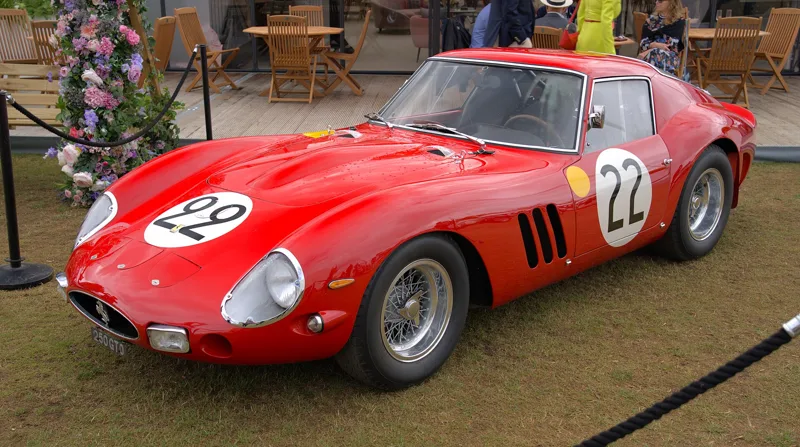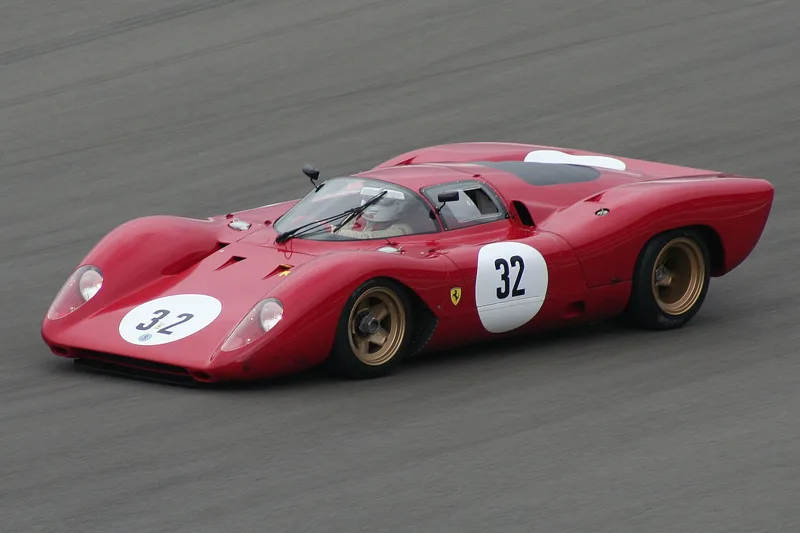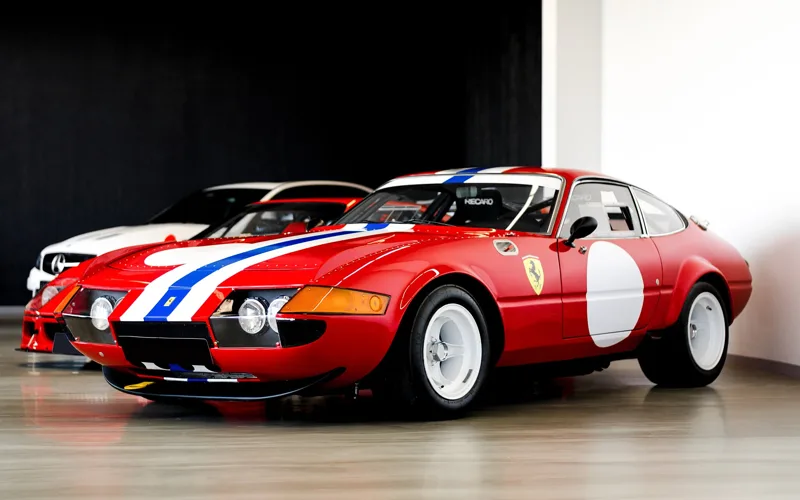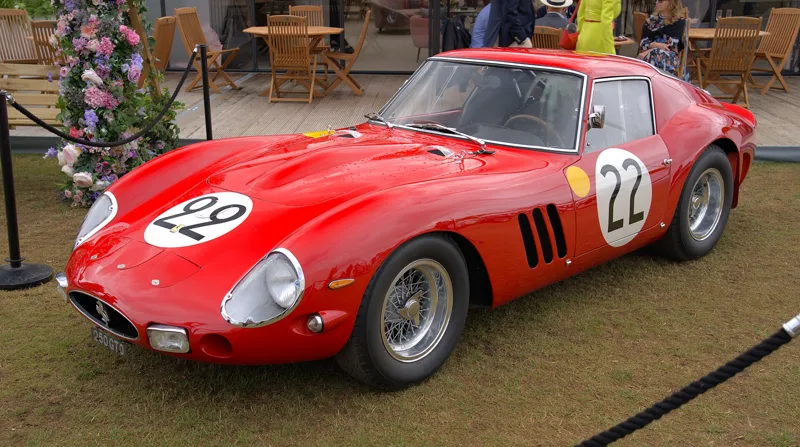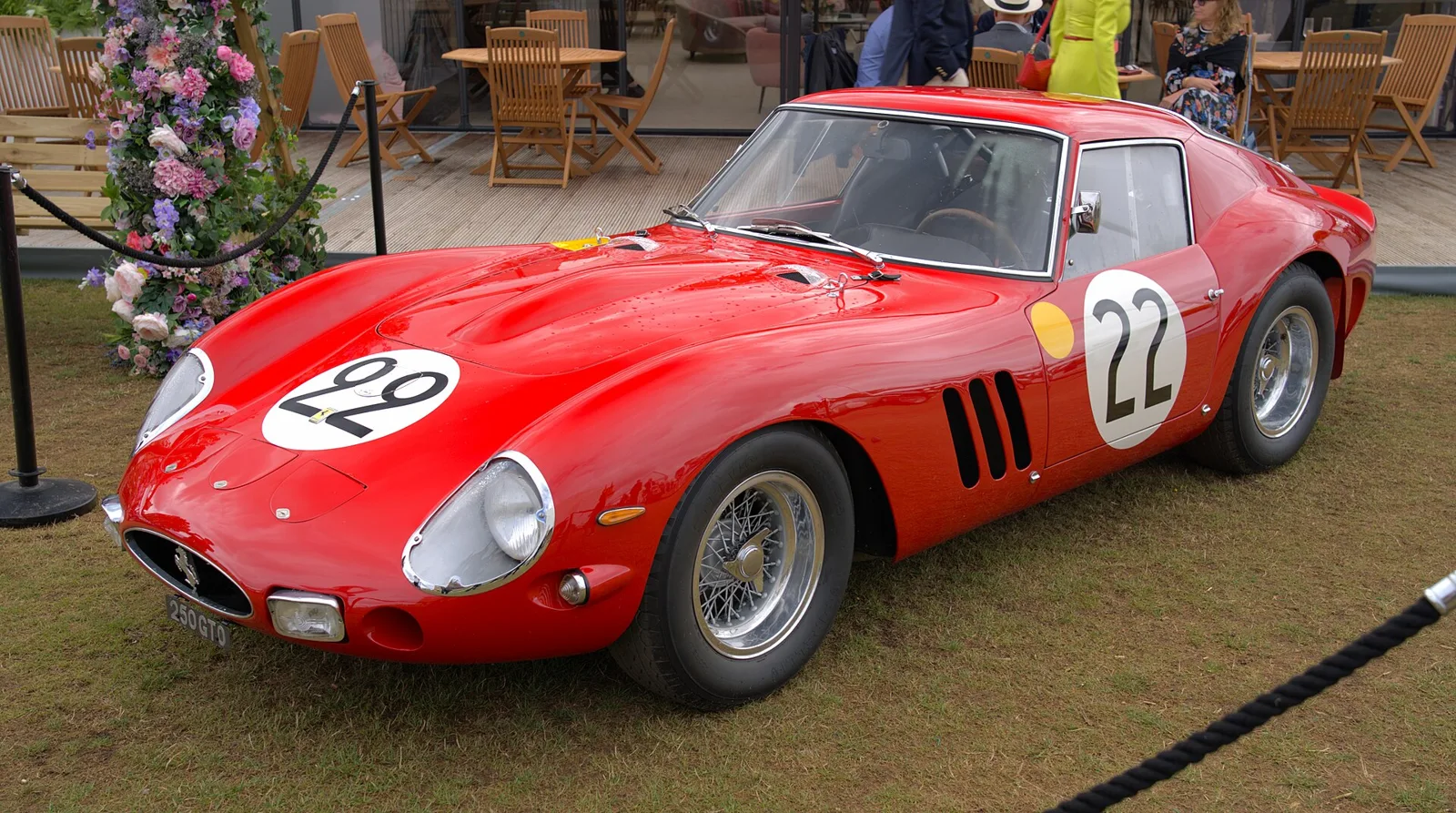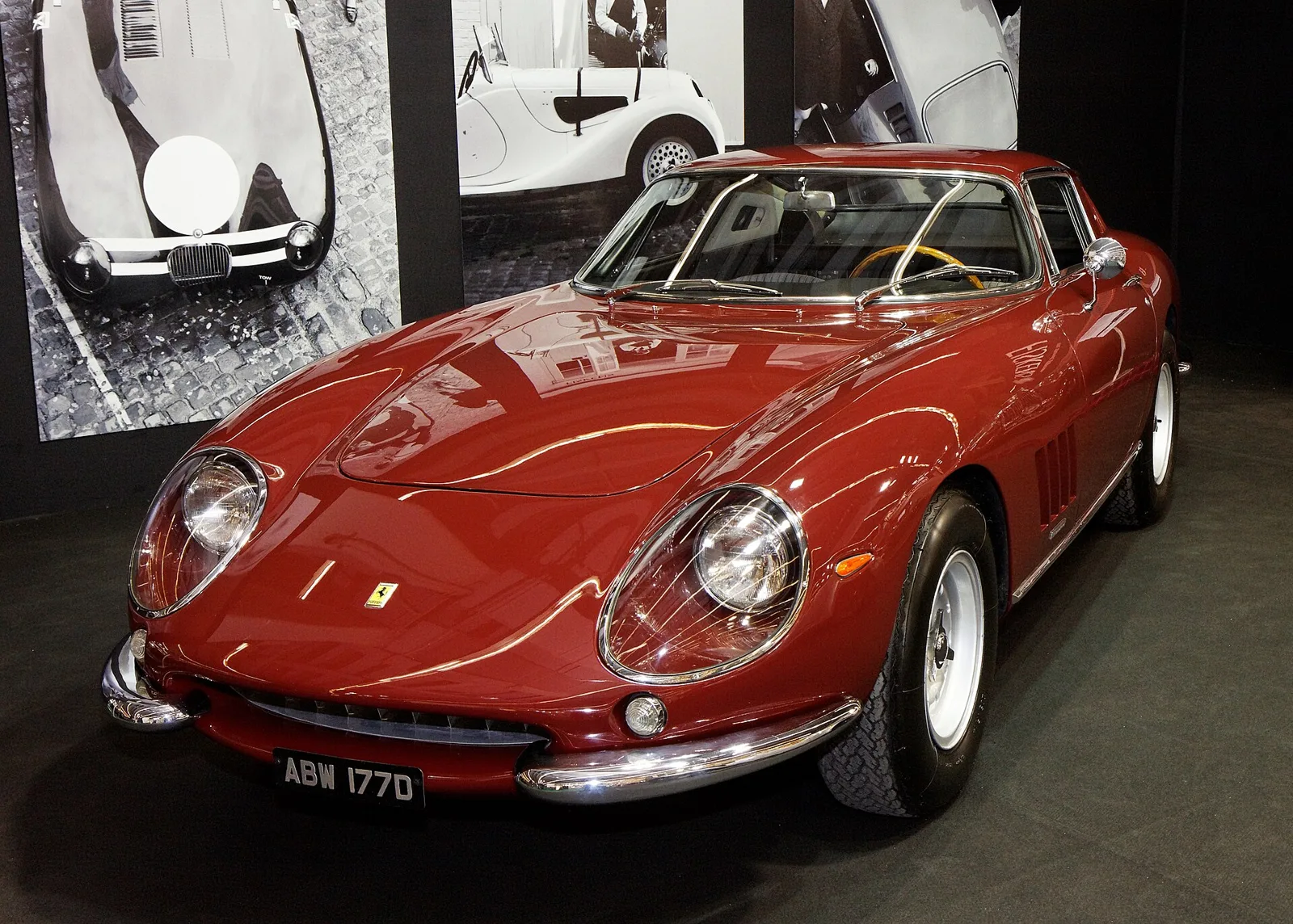
Built from 1964 to 1968 in coupe and spider form, the 275 gave Ferrari its first transaxle road car and went on to race at Le Mans and in the Targa Florio.
Ferrari's 275 series ran from 1964 to 1968 as front-engined V12 grand tourers in coupe and spider form. Pininfarina styled the coupe and spider bodies, and the later 275 GTB/4 used a four-cam engine producing 300 hp, ending the line with a limited run of NART Spiders.
The Ferrari 275 was a series of front-engined, V12-powered grand tourers built in both coupe and spider form between 1964 and 1968. It was the first Ferrari road car with a transaxle and independent rear suspension, and it set the pattern for the marque's later front-engined grand tourers.
Where did the 275 come from?
The first 275 cars were powered by a 3.3-litre overhead camshaft Colombo 60 degree V12 of 3286 cc, producing between 260 and 320 hp (190 to 240 kW). Pininfarina designed the coupe and spider bodies, and the car was named for its engine's per-cylinder displacement of 275 cc.
The name also carried the Italian designation Gran Turismo Berlinetta, which described the two-seat coupe's purpose.
Motor Trend Classic placed the 275 GTB coupe and GTS spider third on its list of the ten Greatest Ferraris of all time. Sports Car International ranked the later 275 GTB/4 seventh on its 2004 list of Top Sports Cars of the 1960s.
Ferrari's first road car with a transaxle, four-wheel independent suspension and a racing career that outlived the coupe.
What was new about the 275's engineering?
The 275 was the first road-going Ferrari with a transaxle, which put the five-speed gearbox at the rear, joined to the differential. Ferrari had used transaxles before on competition models such as the 250 Testa Rossa, but the 275 was the first production road car to carry one.
The chassis was a conventional ladder frame made from oval-section steel tube. Double wishbone independent suspension was used at all four wheels, with Koni shock absorbers and coil springs, and this was a first for a Ferrari road car, which had previously used live rear axles.
Mike Parkes had a major role in developing the 275's suspension, and it drew on technologies tested in earlier racing cars such as the 250 TR and 250 LM. Dunlop disc brakes were fitted at all four wheels, although they were considered inadequate by the mid-1960s because of their small size and lack of ventilated discs.
How did the 275 GTB engine work?
The 275 GTB used the Tipo 213 engine, a double overhead cam 3.3-litre Colombo-designed 60 degree V12 with a stroke of 58.8 mm and a bore of 77 mm. It was the final development of the Colombo V12, and its internal parts were derived from the 250 GTE 2+2, the 250 Lusso and the 250 GTO.
Three twin-choke Weber 40 DCZ 6 carburetors were standard. Ferrari claimed 280 hp (210 kW) at 7600 rpm, although the car produced nearer 240 to 250 hp (190 kW) in use. A factory option of six twin-choke Weber 40 DCN carburetors was claimed to give 320 hp (240 kW) at 7500 rpm, but the real gain was probably only 20 to 25 hp.
Four mounts held the engine, with rubber pads on road cars and aluminium spacers in competition versions. The transaxle used three mounts, and together the engine and gearbox acted as stressed chassis members. That added rigidity at the cost of noise and vibration.
What were the Series I and Series II 275 GTB?
At the end of 1965 the driveshaft was revised with CV joints at each end, which allowed flexibility between the engine and transmission. That fix was retrofitted to some earlier cars and fitted to some early 1966 cars before the torque tube arrived.
The Series II long-nose car arrived in 1966 with a torque tube between engine and transaxle. The engine and transaxle became a rigid unit flexibly mounted at four points, the chassis became slightly softer, and noise and vibration improved. The front bodywork was lowered and lengthened, with a smaller front air intake that reduced high-speed instability.
The Series I and Series II cars became known informally as short-nose and long-nose. Luggage room improved on the Series II because the fuel filler, fuel tanks and spare tyre were moved, and the trunk hinges were changed to external mounts.
Production totalled 442 275 GTB road cars between fall 1964 and summer 1966. That included 236 short-nose Series I cars and 206 long-nose Series II cars.
How did the 275 GTB body get built?
The coupe body was designed by Pininfarina and built by Scaglietti. The standard body was steel, with aluminium doors, hood and trunk lid. Lightweight all-aluminium bodies were an extra-cost factory option, and at least 72 cars received one.
The Series II front was lowered and lengthened, and the rear window was enlarged to improve visibility. Many of these details separate the two series at a glance.
What did the 275 GTS spider offer?
The 275 GTS was a two-seat grand touring spider built from 1964 to 1966. It was introduced alongside the GTB and shared its 3.3-litre V12, transaxle, chassis and fully independent suspension. Ferrari reported 260 bhp (190 kW) for its engine, against the 280 bhp claimed for the GTB.
Pininfarina built the all-steel GTS body, which had a shorter front hood, smaller uncovered headlights and balanced proportions that recalled earlier 250 Pininfarina cabriolets. Every car had a folding cloth top, and a removable hard top was a factory option.
Production reached 200 GTS spiders from late 1964 to early 1966, and 19 of them were right-hand drive. The 330 GTS replaced it in 1966, and no 3.3-litre spider remained in the range until the 275 GTB/4 NART Spider.
What changed with the 275 GTB/4?
The 275 GTB/4 and GTS/4 NART Spyder formed the final production run of the 275 series, from 1966 to 1968. They used a four overhead cam 3.3-litre V12, the Tipo 226 with a capacity of 3285.72 cc, derived from the earlier Tipo 213 engine.
The engine had two valves per cylinder, four overhead camshafts and six Weber 40 DCN carburetors as standard, and it produced a claimed 300 hp (220 kW). The valve angle was reduced to 54 degrees for a more compact head, and the dry sump held 17 qt (16 L) of oil.
The 275 GTB/4 kept the torque tube from the Series II car and had improvements to its cooling system, exhaust and suspension. It was introduced at the Paris Motor Show in October 1966 with Campagnolo magnesium wheels of 14x7 as standard, and its claimed top speed was 268 km/h (167 mph). A total of 330 were built from 1966 to 1968.
What was the NART Spider?
The 275 GTB/4S NART Spider was a roadgoing two-seat spider version of the GTB/4. Ferrari's North American dealer, Luigi Chinetti, wanted a successor to the 250 California Spider series and asked Sergio Scaglietti and Enzo Ferrari to build one. He bought the cars for about $8,000 each and listed them at $14,400.
Chinetti intended to order 25, but low sales meant only ten were built in 1967 and 1968. The name NART was never part of the factory designation, although a cloisonne badge with the team's logo was fitted to the rear of each car.
Road and Track published a road test of a new NART Spider in its September 1967 issue, recording 0-60 mph in 6.7 seconds, a quarter-mile in 14.7 seconds and a top speed of 155 mph (249 km/h). The magazine called the NART Spider the most satisfying sports car in the world.
The first NART Spider, chassis 09437, raced at the 1967 12 Hours of Sebring with Denise McCluggage and Marianne Rollo, finishing 17th overall and second in the 5-litre GT class. It was then repainted from yellow to burgundy for an appearance in the 1968 film The Thomas Crown Affair, where Faye Dunaway's character drove it.
How did the Competizione Speciale come about?
Ferrari's first racing 275 was the 275 GTB Competizione Speciale, also known as the 275 GTB/C Speciale. Designed under Mauro Forghieri, it was meant to succeed the 250 GTO in the 1965 GT class. Four were built, three in late 1964 and early 1965, and the fourth in 1966.
These cars used Tipo 213 engines tuned to 250 LM specification, producing roughly 290 to 305 bhp (227 kW). The bodywork was extra-thin alloy, designed by Pininfarina and built by Scaglietti, with a more streamlined shape similar to the 250 GTO. Each car had slightly different hand-built bodywork, probably because of ongoing aerodynamic experiments.
Weight was cut with holes drilled in interior panels, Plexiglas windows and magnesium castings for parts of the engine and transaxle. The owner of chassis 6885 estimated its curb weight at about 1,900 pounds (860 kg).
Why did the 275 GTB/C race in only limited numbers?
The Federation Internationale de l'Automobile at first refused to homologate the model for the GT class, but it settled on a compromise after Enzo Ferrari threatened to abandon GT racing. The delay meant only one 275 GTB/C Speciale, chassis 6885, raced in 1965.
That car failed to finish at the 1965 Targa Florio, driven by Bruno Deserti and Giampiero Biscaldi, and placed 13th overall at the 1965 1000km Nurburgring. It then finished third overall at the 1965 24 Hours of Le Mans, driven by Willy Mairesse and Jean Blaton for Ecurie Francorchamps, and won the 1965 Nassau Tourist Trophy.
Because of its role as a 250 GTO successor, the Speciale is sometimes called the GTO '65, although that was never an official factory name. A 1964 example, chassis 06701, sold for $26,400,000 at RM Sotheby's California in 2014.
How did the customer competition cars differ?
After the homologation struggles, Ferrari built ten less radical competition 275 GTBs for private teams. They differed from the road car only in their alloy bodywork, extra venting, added exterior fuel fillers and larger fuel tanks.
They kept the Tipo 213 engine with six carburetors, the same as the production 275 GTB. These cars were a test of the market for GT racing machines and a gesture of compliance to the FIA in hope of helping the homologation process.
What was the 275 GTB/C built to do?
For 1966 Ferrari built a new series of 12 lightweight 275 GTB/C racing cars. They looked like the road car, but Mauro Forghieri and the Scuderia Ferrari engineering team revised them thoroughly, changing every panel of the body and making substantial mechanical changes.
The chassis was a super-lightweight steel and aluminium version of the 275 GTB frame, designated Tipo 590 A. The suspension was the production design with different shock valving and stiffer springs, and the brakes used quick-change racing pads.
The body was built by Scaglietti from aluminium panels 0.71 mm (.028 in) thick, riveted together so that panels could be replaced easily after an accident. Those panels were about half as thick as those on the 250 GTO and the Shelby Cobra, which made the body light but fragile. The rear section was reinforced with fibreglass.
Fully equipped, a 275 GTB/C tipped the scales at 2,452 lb (1,112 kg). Stripped for racing, without spare and tools, it could drop below 2,350 lb (1,070 kg), which saved over 150 kg (331 lb) against the alloy road cars.
How did the 275 GTB/C engine and transaxle differ?
The 275 GTB/C used a Tipo 213 V12 tuned to 250 LM specification, with a special crankshaft, pistons, camshaft, connecting rods and sodium-filled Nimonic valves. Many castings were made from the lightweight magnesium alloy Elektron.
Ferrari had not told the FIA that the production 275 GTB had a six-carburetor option, so only the three-carburetor engine could be homologated. Weber therefore built the 40 DF13 carburetor, unique to the 275 GTB/C, to recover the lost power. A dry sump was also added, which let the engine sit lower in the chassis, and the race engine produced 275 to 282 hp (210 kW) at 7500 rpm.
Its magnesium case housed close-ratio gears, a reinforced ZF limited-slip differential and needle bearings in place of plain ones on the mainshaft.
Why did competition Ferraris stop using wire wheels?
The 275 GTB/C had specially made Borrani wire wheels, sized 7 by 15 inch at the front and 7.5 by 15 inch at the rear, shod with Dunlop's latest M series racing tyres. That combination proved to be the car's weak spot, because the tyres had so much grip that they could overstress and break the spokes.
Several crashes resulted. After the 275 GTB/C, no competition Ferrari was fitted with wire wheels again. Two of the twelve cars built were sold for street use, with the standard alloy wheels and Pirelli tyres.
How did the 275 GTB/C race in 1966?
Independent teams raced the 275 GTB/C, including NART, Maranello Concessionaires, Scuderia Filipinetti and Ecurie Francorchamps. Three were entered in the 1966 24 Hours of Le Mans, and two finished.
The Maranello Concessionaires car, chassis 09035, driven by Roy Pike and Piers Courage, finished eighth overall and first in class. The Ecurie Francorchamps car, chassis 09027, driven by Claude Dubois and Pierre Noblet, finished tenth overall and second in class.
Tullio Sergio Marchesi won a class victory at the 1967 Targa Florio, and he went on to win the 1966 and 1967 Italian GT Championships in chassis 09007.
What did the 275 cars fetch at auction?
In August 2005 the NART Spider chassis 09437 sold for $3.96 million at Gooding and Company's Pebble Beach auction. In August 2013 chassis 10709, a 1967 NART Spider, sold for US$25 million, or US$27.5m after commissions, at RM Sotheby's Monterey auction.
Chassis 10709 had one owner, Eddie Smith of Lexington, North Carolina, who bought it new in 1968 and drove it regularly until his death in 2007. The winning bid came from Lawrence Stroll, a collector and part-owner of the Aston Martin Formula One team, and the Smith family said the proceeds would go to charity.
What are the Ferrari 275 specifications?
| Model | Engine | Output or performance |
|---|---|---|
| 275 GTB (1964 to 1966) | 3.3-litre Tipo 213 V12, three Weber 40 DCZ 6 | 280 hp (210 kW) claimed; 240 to 250 hp (190 kW) in use |
| 275 GTB six-carburetor option | Tipo 213 V12, six Weber 40 DCN | 320 hp (240 kW) claimed |
| 275 GTS (1964 to 1966) | 3.3-litre V12 | 260 bhp (190 kW) |
| 275 GTB/C (1966) | Tipo 213 tuned, Weber 40 DF13 | 275 to 282 hp (210 kW) at 7500 rpm |
| 275 GTB/4 (1966 to 1968) | Tipo 226 3285.72 cc V12, four overhead camshafts | 300 hp (220 kW); top speed 268 km/h (167 mph) |
| 275 GTB/4S NART Spider | Four-cam V12 | 0-60 mph in 6.7 seconds; 155 mph (249 km/h) |