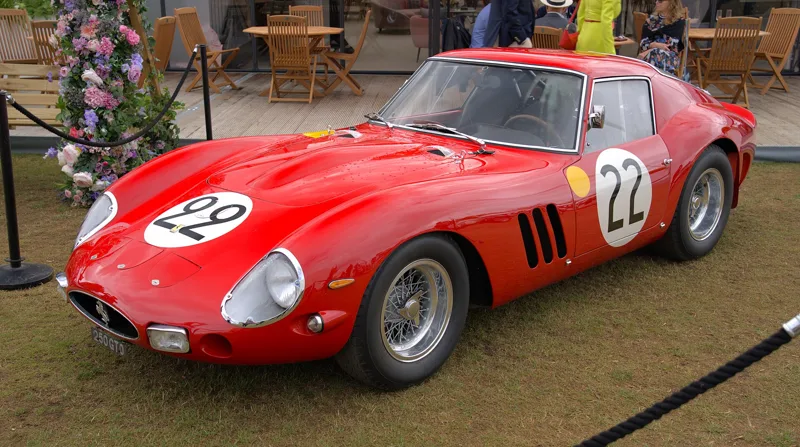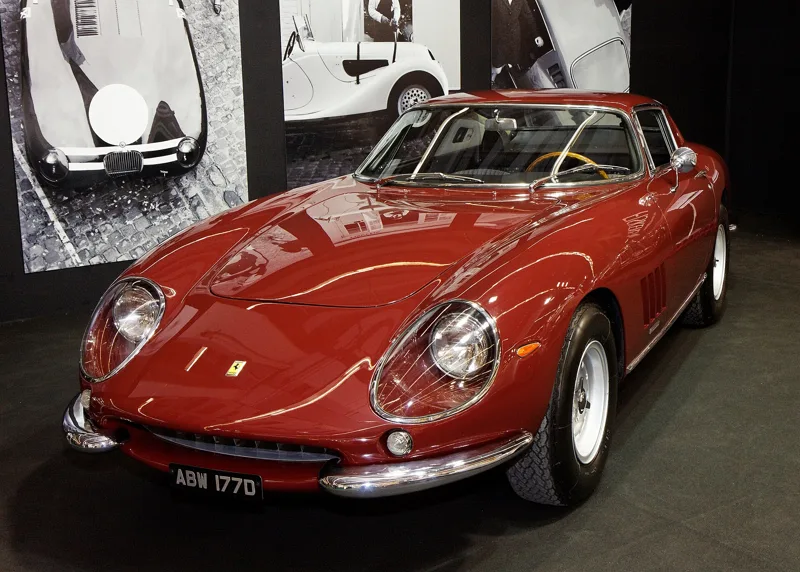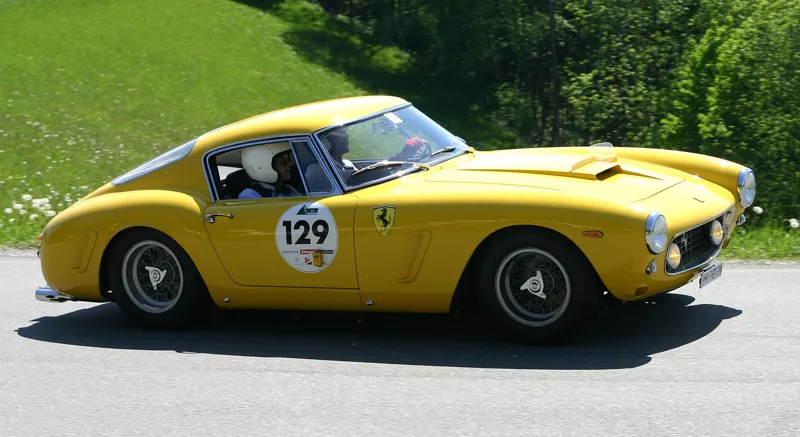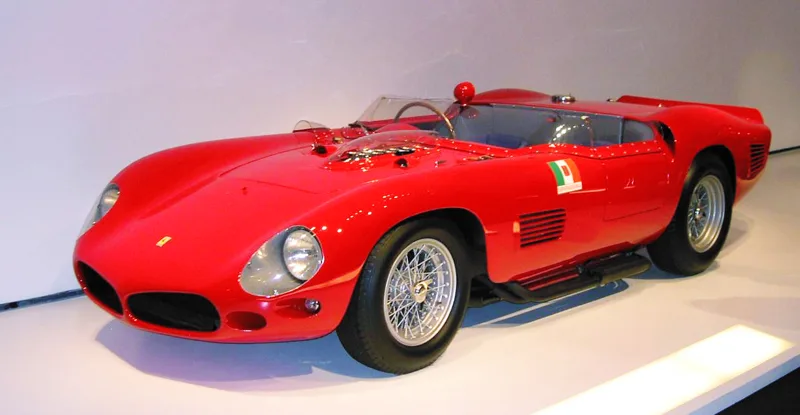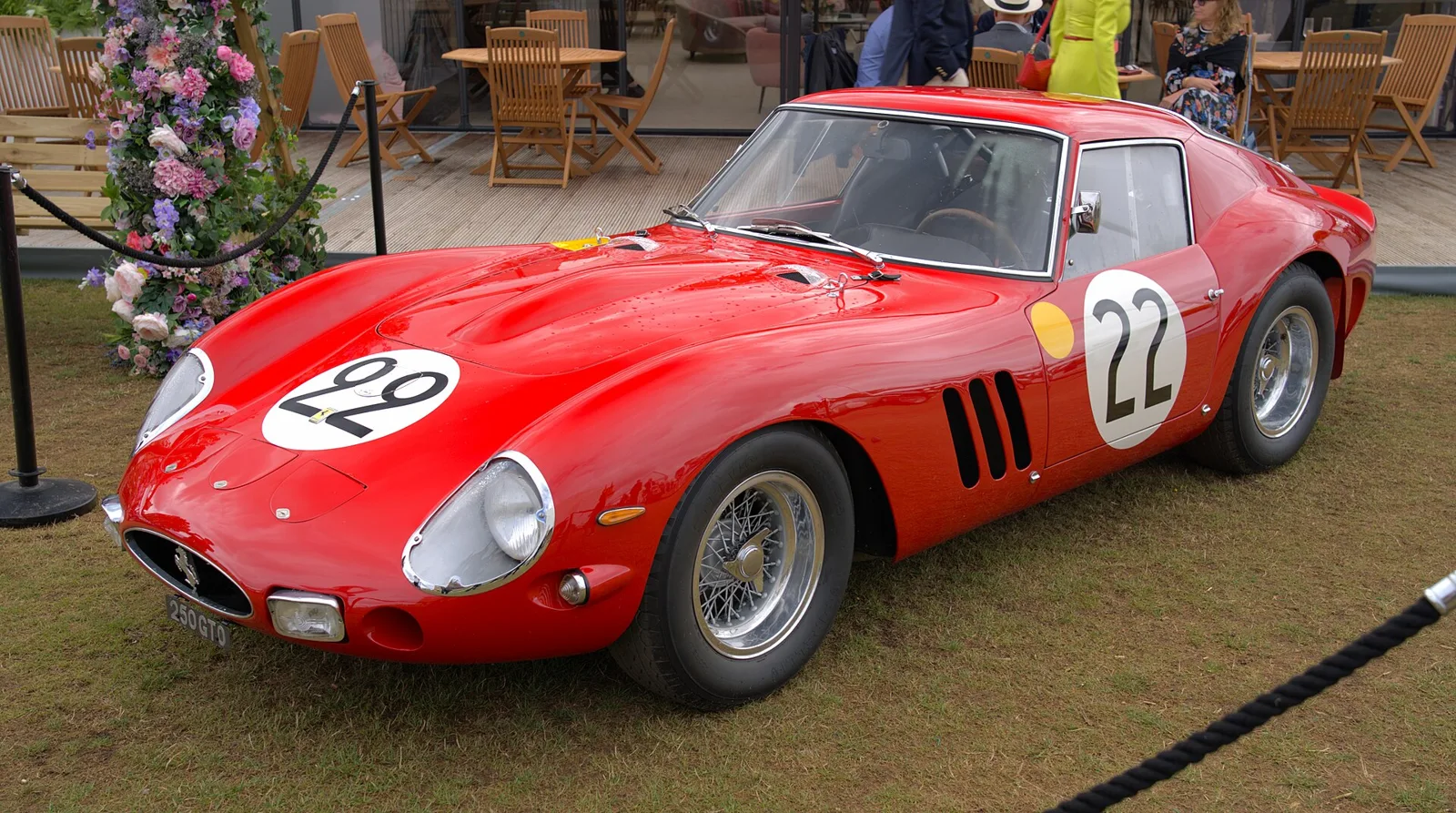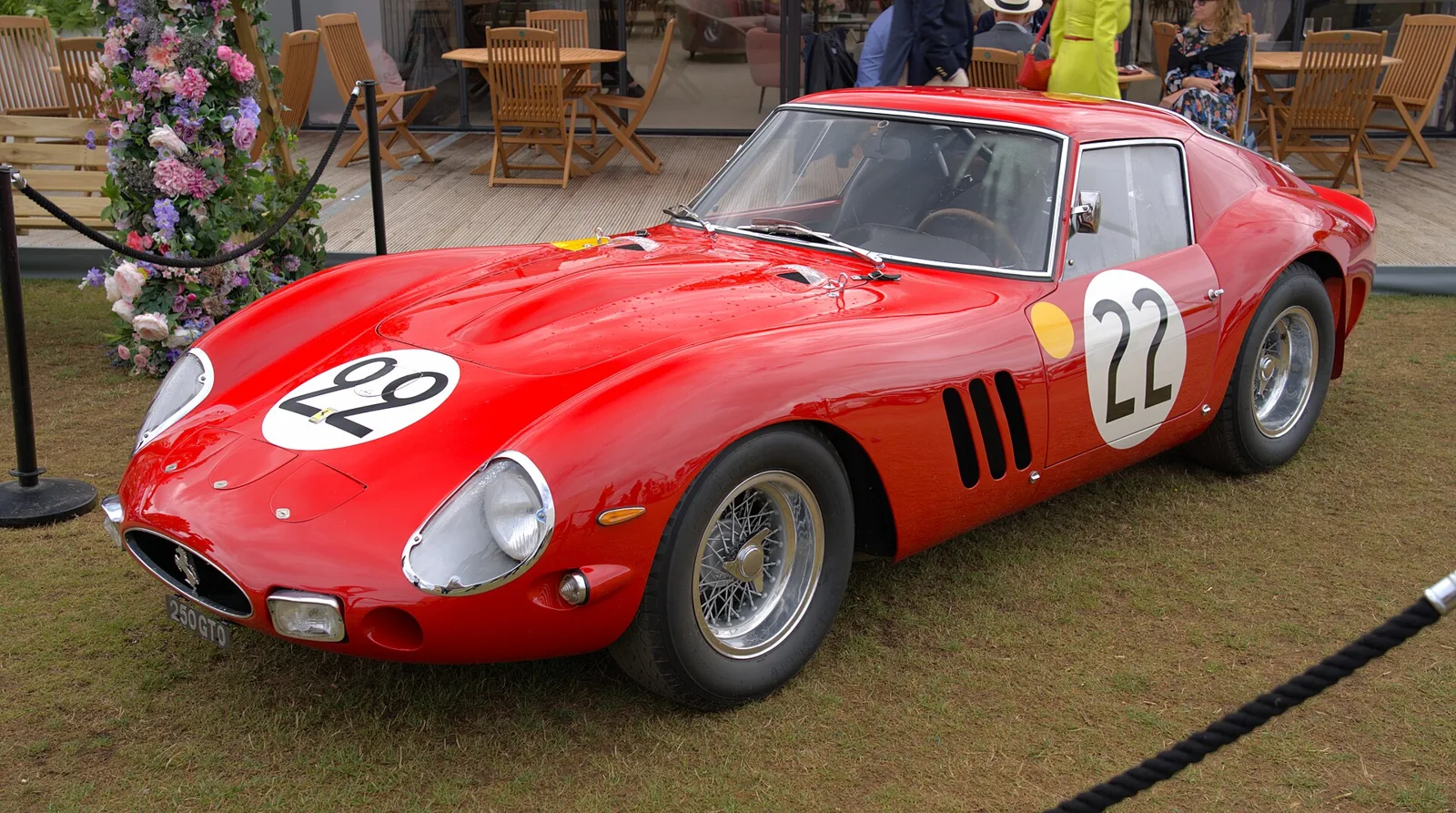
A front-engined Ferrari built to win homologation battles against a British sports car that became a design icon for road buyers.
The Ferrari 250 GTO was a front-engined V12 grand tourer built from 1962 to 1964 for racing homologation, with 36 made. The Jaguar E-Type was a British sports car built from 1961 to 1974 that became one of the most celebrated designs of its era.
The Ferrari 250 GTO and the Jaguar E-Type were built for the same era of sports and grand tourer racing, but they answered it in different ways. The GTO was a V12 racer in road clothing, built in tiny numbers to win homologation battles. The E-Type was a British sports car whose design became a benchmark for road buyers. Set side by side, they show how two makers turned racing know-how into very different products.
When did the GTO and the E-Type arrive?
The 250 GTO was built from 1962 to 1964 to meet the Group 3 homologation rules, which demanded at least 100 cars within 12 months. Ferrari persuaded the rule makers to count earlier 250 GT SWB cars, so only 36 GTOs were needed to qualify the design.
The E-Type was introduced on 15 March 1961, and it was built by Jaguar Cars Ltd until 1974. It was based on the D-Type racer, which had won at Le Mans for three consecutive years from 1955, and its first cars were offered as a fixed-head coupe and an open two-seater.
A 2+2 coupe with a longer wheelbase followed in 1966, which gave the E-Type a practical variant. The GTO never received a comparable family-oriented body, because it was a homologated racing car first and a road car second.
A front-engined Ferrari built to win homologation battles against a British sports car that became a design icon for road buyers.
What engines powered the two cars?
The GTO used the Tipo 168/62 Colombo V12, a 3.0-litre unit with 2,953 cc of capacity that had been proven in the 250 Testa Rossa that won at Le Mans. It was an all-alloy engine with a dry sump and six Weber carburettors.
The GTO's V12 produced about 300 PS (296 bhp; 221 kW) at 7,500 rpm and 294 N m (217 lb ft) of torque at 5,500 rpm. A new five-speed gearbox with Porsche-type synchromesh handled that output.
The E-Type's engine was Jaguar's XK six, which started as a 3.8-litre unit and grew to 4.2 litres in 1965. The larger engine gave around 10% more torque, rising from 240 to 283 lb ft, while its power output stayed at 265 bhp (198 kW).
Jaguar's claims for the E-Type were striking, with a top speed of 150 mph (240 km/h) and a 0 to 60 mph time under seven seconds. Those figures set the standard for what a road sports car could do in its day.
How were the two cars built and styled?
The GTO was built around a hand-welded oval tube frame with an A-arm front suspension and a rear live axle on Watt's linkage. Its all-aluminium bodywork was made by Scaglietti, with a long low nose, a small radiator inlet and distinctive air intakes.
Giotto Bizzarrini focused the GTO's design effort on aerodynamics, testing prototypes in a wind tunnel at Pisa University. Early testing added a rear spoiler, and the underside of the car was covered by a belly pan that helped reduce drag.
The E-Type used a front subframe carrying the engine, front suspension and front bodywork bolted to a central body tub. That approach avoided a traditional ladder chassis, and it kept the first cars to 1,315 kg (2,899 lb).
The E-Type's independent suspension, inboard rear disc brakes and rack-and-pinion steering were treated as industry-changing features. Its sleek body was widely admired, and the Daily Telegraph later ranked it first among the world's most beautiful cars. That combination kept it in the public eye for decades.
How did the GTO perform on the track?
The GTO made its racing debut at Sebring in 1962, when Phil Hill and Olivier Gendebien finished second overall. Ferrari went on to win the over-two-litre class of the FIA's GT manufacturers' championship in 1962, 1963 and 1964, with the GTO in each of those seasons.
Privateers also raced GTOs in large numbers, which meant that drivers often competed against other GTOs. The 1963 and 1964 Tour de France Automobile was won by GTOs, which extended the car's record in long-distance events.
The 1964 Series II redesign borrowed aerodynamic ideas from the 250 LM, and a Series II won the Daytona overall race that year for NART. The GTO was among the final front-engined cars to stay competitive at the top of sports car racing.
How did the E-Type fare in racing and on the road?
The E-Type was competitive in GT racing alongside the GTO from 1962 to 1964, and it was one of the few cars consistently able to challenge the Ferrari. Its road reputation grew quickly, so the racing record was only one part of its story.
Jaguar planned to build 18 Lightweight competition E-Types, but only about a dozen were completed. One 1963 Lightweight sold for US$7,370,000 at a 2017 auction in Scottsdale, which shows how highly the cars are now valued.
Road tests were strong. Autocar recorded a 4.2 fixed-head coupe at 153 mph and 0 to 60 mph in 7.6 seconds in 1965, while Motor recorded 150 mph in 1964 and called the 4.2 the fastest car it had tested.
How do the Series 1 variants and values compare?
The 4.2-litre Series 1 roadster with matching numbers sold for US$467,000 in 2013, and a 3.8-litre flat-floor Series 1 sold for US$528,000 in 2014. Series 1 roadsters often command higher values than the Series 2 and 3 cars that followed.
The early Series 1 cars had flat floors and external bonnet latches, which makes them rare. The 1968 Series 1.5 swapped triple SU carburettors for twin Zenith-Stromberg units, which lowered claimed power from 265 to 246 hp.
The Museum of Modern Art in New York added a blue Series 1 roadster to its permanent design collection in 1996. It was one of only six automobiles to receive that distinction, which confirmed the E-Type's place in design history.
How do the GTO and the E-Type compare side by side?
| Feature | Ferrari 250 GTO | Jaguar E-Type |
|---|---|---|
| Built | 1962 to 1964, 36 cars | 1961 to 1974 |
| Engine | 3.0 L V12, 2,953 cc | 3.8 L then 4.2 L XK six |
| Output | About 300 PS (296 bhp; 221 kW) | 265 bhp (198 kW) for both engine sizes |
| Torque | 294 N m (217 lb ft) at 5,500 rpm | 283 lb ft for the 4.2 L |
| Claimed top speed | Not given | 150 mph (240 km/h) |
| Price when new | US$18,000 in the United States | Not given |
| Record sale | US$70 million for a 1963 car, June 2018 | US$4,957,000 for the E2A prototype, 2008 |
| Ranking | Hottest Car of All Time (Popular Mechanics) | First on the 1960s top sports cars list, 2004 |
What did the GTO's cabin and bodywork look like in detail?
The GTO's minimalist interior reflected its racing intentions. There was no speedometer, the seats were cloth upholstered, and neither carpet nor a headliner was fitted, while cockpit ventilation came from external air inlets.
The exposed metal gate that defined the shift pattern became a Ferrari tradition, and it stayed in production models until paddle shifters replaced it in later years. The gate was a visible link between the racing cars and the road cars.
The bodywork came in many colours, and the best known was the bright red Rosso Cina. Because the cars were built by hand, individual GTOs differ in air intake and vent details, and modifications after crashes or race team requests left further variations.
How did the E-Type's later cars differ from the first Series 1?
Series 2 and 3 E-Types received a larger grille, wider wheel arches and bigger bumpers to meet North American safety and emissions rules. They also carried a bigger radiator and cooling system, because the Series 1 cars were notorious for overheating.
The move to the 4.2-litre engine brought a new alternator in place of the dynamo, an electrical system switched to negative earth and reclining seats. Those changes made the later Series 1 cars more practical, although the styling stayed the same.
The first Series 1 cars are identified by their glass-covered headlights and the small mouth opening at the front. Those details disappeared as the car evolved, which is one reason early cars are sought after by collectors.
How did the GTO's racing career end?
By the end of the 1964 season the 250 GTO was gradually becoming obsolete, and Ferrari withdrew it from racing by 1965. The car was overtaken by newer prototypes and by the Series II cars that tried to keep it competitive.
Independent teams and private owners kept the GTO going in endurance races, rallies and hillclimbs. By 1967 it was almost absent from international racing, though its record remained one of the strongest of its decade.
The GTO's competitive window was short but intense, and its story has been retold many times since. Its position in Ferrari history rests on that brief spell at the front of world sports car racing. Few cars of the period combined that much race success with such a small production run.
Which buyer suits each car?
On the facts given, the GTO suits a collector who values a rare front-engined racer with a famous record, while the E-Type suits a buyer who wanted a striking British sports car with a long production run.
GTO buyers needed the approval of Enzo Ferrari and his North American dealer, and the car's price in the United States was US$18,000 when new. Its value has since reached record levels, although the market for it is far from typical.
E-Type buyers could choose a fixed-head coupe, an open two-seater or, from 1966, a 2+2 coupe. The first-generation car's light weight and independent suspension made it a capable car on road and track.
Neither car is shown to be better overall, and the sales figures for the E-Type are not given. The choice depends on whether a buyer prefers Italian racing heritage or the design influence of a British classic.