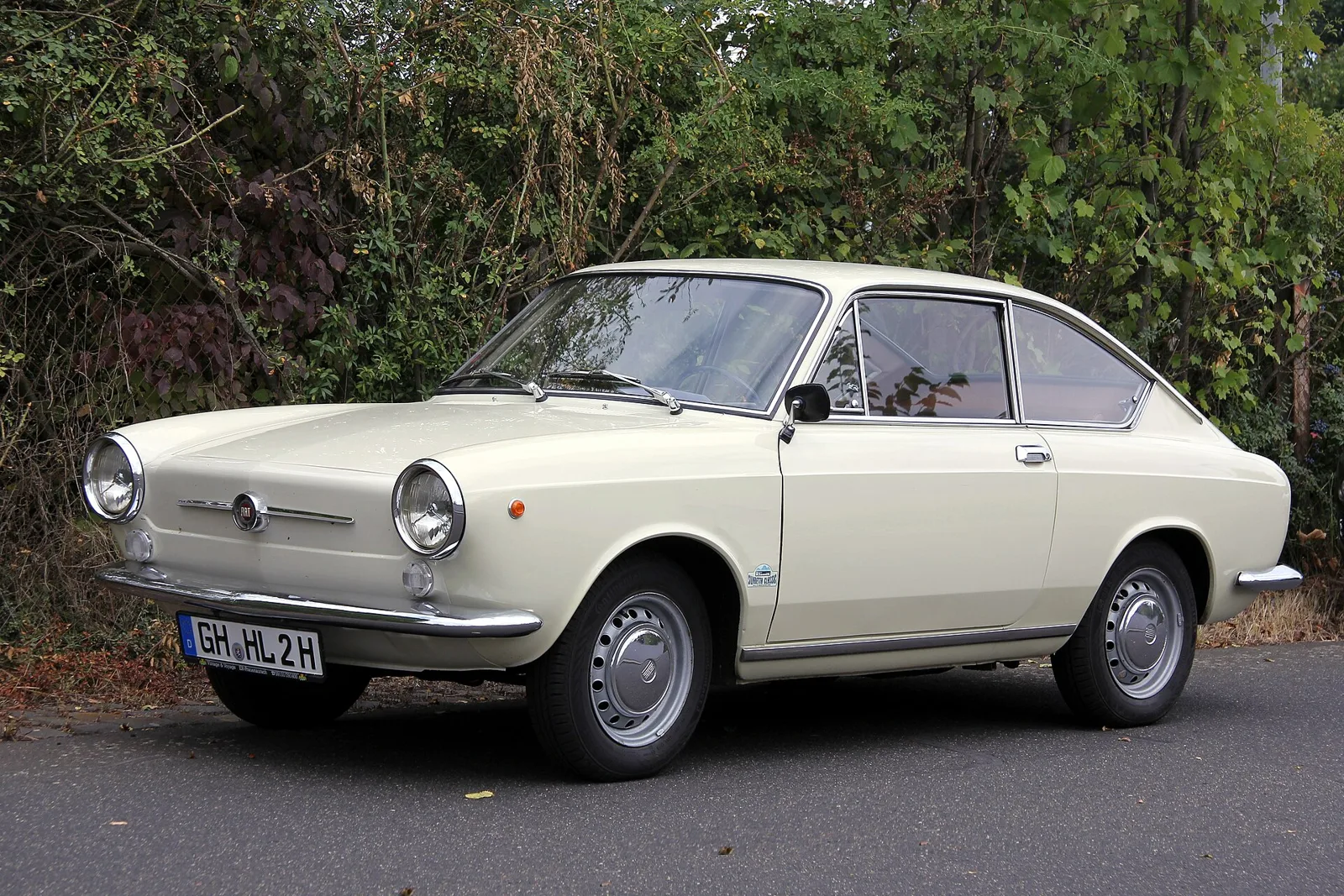
Built on the 850 saloon's floor, the coupe reached about 180,000 units in under three years and spawned Abarth and Giannini tuned versions.
Fiat's 850 Coupe was a sports coupe made from 1965 to 1971 and sold in large numbers. About 180,000 had been built within three years of launch, and it received a 903 cc Sport Coupe version in 1968 and was built under licence by SEAT in Spain.
Fiat's 850 Coupe appeared at the 1965 Geneva show as a sports car built on the floor of the 850 saloon. It sold in large numbers, and its arrival, together with the 850 Spider, marked the start of a decline that closed many Italian Special car makers over the following decade.
Why did Italian Special cars matter before the 850 Coupe?
After the war Italy offered few small cars, with only the Fiat 600 and 500 widely available. Imported rivals faced high customs duties, so coachbuilders in Piedmont and Lombardy filled the gap with Specials built on mass-market chassis at a moderate premium over the base price.
Within months of the 850 saloon going on sale, the Turin Motor Show displayed dozens of Specials on its chassis. The range ran from coupes and spiders to berlinettas, four-door saloons and beach cars, from makers such as Savio, Vignale, Michelotti, Siata and Zagato. The number showed how large the potential market was.
Built on a saloon's floor, the coupe arrived in 1965 as the start of a decline for Italy's Special car makers.
How FIAT returned to small sports cars
Once the structural and organisational problems left by the war had been overcome, and sales of the mass-market small cars had refilled the company's coffers, FIAT tried small sports cars again. It had explored the field before with the Balilla Sport. The 850 Coupe and Spider were presented together at Geneva in March 1965, and their arrival marked the start of a downturn for the Special makers.
How much of the 850 saloon did the coupe keep?
Dante Giacosa ordered that the saloon's general layout, floor pan and much of its mechanics stay in place, so the coupe's changes had to fit within strict limits. The FIAT design studio under Mario Boano arrived at a restrained, well-proportioned shape with an aerodynamic K-profile, a four-person cabin and a front luggage compartment of useful size.
The only blemish was the tall grille, forced on the design because the spare wheel could not lie flat. Larger headlamps helped to soften its visual effect.
Inside, wood trim graced the dashboard, and a racing-style cluster with two big dials echoed the Ferraris of that era. Sporty leatherette covered the seats, which still suited long journeys, and each backrest folded in either direction to let people reach the rear bench.
Mechanical changes: brakes, steering and engine
Many small changes went into the mechanics, starting with the moving parts. Front discs came with the braking upgrade, larger-diameter tyres went on, the steering column gained a flexible coupling, and the wiring was rebuilt from scratch.
The engine, type 100 GC 000, had larger inlet and exhaust valves with double return springs, along with revised connecting rods, piston crowns and camshaft. The camshaft now ran on a double-row chain. A new inlet manifold and a twin-barrel carburettor with a supercharging device improved the fuelling, and four separate exhaust pipes replaced the old manifold.
What did the 850 Coupe cost, and how fast was it?
The 850 Coupe reached showrooms in March 1965, priced at 950,000 lire at the dealer. Buyers could add a rev counter for 15,000 lire, while a steering lock cost 4,500 lire and whitewall tyres 6,500 lire. Its declared top speed was over 135 km/h (84 mph), and in practice it reached 139 or 140 km/h (86 to 87 mph).
Demand beat expectations, and FIAT doubled its planned output, from 100 cars a day to 200. Buyers liked its looks, its economy, its reasonable price and its performance, which let it hold its own against cars of far greater capacity and cost. Fewer than three years after launch, about 180,000 had been built.
The coupe found favour with women drivers for its elegant line and easy handling, and it attracted famous owners as well. Princess Alexandra of Kent bought one in 1967, and the purchase drew complaints and protests from the British trade body SMMT. Enzo Ferrari also wanted one as personal transport in place of his Mini, using it for short trips in place of the more demanding 275 GTB.
The Sport Coupe and its 903 cc update
In 1968 the 850 Special, fitted with the coupe's 47 PS engine, narrowed the gap in acceleration to the saloon, which made an update necessary. The Sport Coupe shown at Geneva that year had a new under-floor engine, type 100 GBC 000, enlarged to 903 cc (55.1 cu in) by lengthening the stroke to 68 mm and keeping the bore unchanged.
Power rose to 52 PS (38 kW; 51 hp), helped by better valve and seat material, a revised carburettor setting, radial tyres and a bigger sump. An alternator replaced the dynamo, to cope with extra spotlights and reversing lights.
Up front sat twin headlamps, two units of 170 mm, plus two 130 mm spotlights, all built into the middle of the grille. The position and indicator lights moved under the bumper, which now carried rubber overriders. Along the sides the waistline rose slightly over the rear wheels, and the roof took a slimmer form. At the back, two reversing lights sat beside the existing lamps.
The interior was reshaped too. The rear bench changed, a storage console appeared on the tunnel, the rev counter became standard, carpet covered the floor, and a generous amount of sound-absorbing material was fitted to cut engine drone. The list price barely moved, and road and track tests by specialist magazines recorded figures well above those the maker had quoted.
A restyle in 1971, a few months before production ended, changed the grille panels. The dipped beams were made smaller, and the spotlights kept their diameter but were raised. The change met rules that increased the minimum headlamp height, which applied to the British market.
How did SEAT build the coupe in Spain?
From 1967 SEAT, then FIAT's Spanish subsidiary, built the 850 Coupe under licence and sold it as the SEAT 850 Coupe, with the same success. The SEAT 850 Sport Coupe followed in December 1969 and ran until 1972, and both versions were almost identical to the Italian cars in engineering and looks.
Fiat 850 Coupe specifications
| Version | Engine | Power |
|---|---|---|
| 850 Coupe, 1965 | Type 100 GC 000 | 47 PS (35 kW; 46 hp) |
| 850 Sport Coupe, 1968 | 903 cc (55.1 cu in), type 100 GBC 000 | 52 PS (38 kW; 51 hp) |
| Abarth Coupe 1000 OT | 982 cc (59.9 cu in) | 62 PS (46 kW; 61 hp) |
| Abarth Coupe 2000 OT | Two-litre twin-cam four | 185 PS (136 kW; 182 hp) DIN |
Rallies, economy runs and the Abarth and Giannini versions
SEAT's small coupes were used heavily in rallies, by official crews and private drivers alike. In 1967, the year of its first sales, the crew of Sutil and Moran won the Oviedo Rally. A long run of national and international events followed, and there the car proved its agility, robustness and power. The final major outing was the 1974 Costa Brava Rallye, where the outdated Sport Coupe finished third in class and 20th overall.
Economy also paid off. Bussolino-Pallisca and Bussolino-Barbera, in an 850 Sport Coupe, took first place overall in the 14th and 15th French economy runs, held at Le Mans in 1969 and at Marseille in 1970. In 1970 they averaged 98.11 km/h over the course, using 7.976 l/100 km on average.
What did Abarth build from the 850 Coupe?
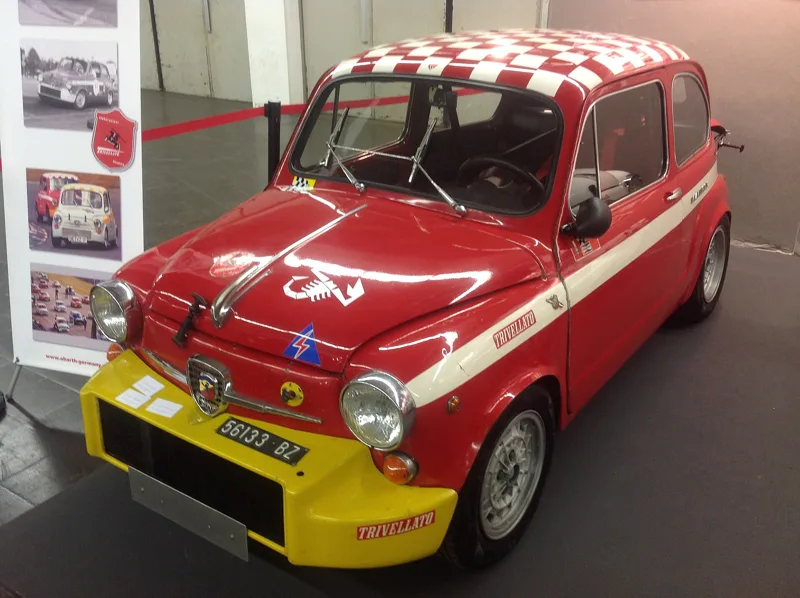
Abarth built the Coupe 1000 OT with a 982 cc (59.9 cu in) engine producing 62 PS (46 kW; 61 hp). Alongside it came the OTR with 74 PS (54 kW; 73 hp) and a top speed of 172 km/h (107 mph). Finally came the 2000 OT, which used a two-litre twin-cam engine rated at 185 PS (136 kW; 182 hp) DIN.
The 2000 OT was shown at a competition car exhibition at the Biscaretti Museum, which opened on 25 February 1966. Carlo Abarth wanted an affordable car that could still compete for private drivers in international rallies. Reinforced, with new brakes and suspension, it was detuned to only 185 PS but still passed 240 km/h (149 mph), and it cost 3,850,000 lire.
FIAT's management balked at providing the 500 bodyshells required to homologate the 2000 OT in Touring class. Its sales office worried that cars sold for ordinary use might end up with inexperienced drivers, which could damage the brand after accidents. Abarth was keen to race the car, since its power-to-weight ratio, very short wheelbase and small size promised good results.
Gianni Agnelli, the FIAT president, settled the argument after driving the 2000 OT on a circuit. He praised its performance, agreed that management's fears were well founded, and the prototype never went into production.
To console Abarth, FIAT let him develop the new 124 engine, limited to 75 PS (55 kW; 74 hp), for the Coupe 1300 OT, presented at the Turin show in November 1966. The 2000 OT itself was built in very small numbers, perhaps five, mainly for promotion, and it went to customers abroad, chiefly in Germany and Spain, where rules allowed it to be homologated for the road.
Giannini took a much milder approach, offering two versions with a new single-overhead-camshaft head. One kept the production power, and the other made 58 PS (43 kW; 57 hp) from a 950 cc (58.0 cu in) engine. Its conversion leaned towards show, with careful finish, extra gauges and wire wheels.