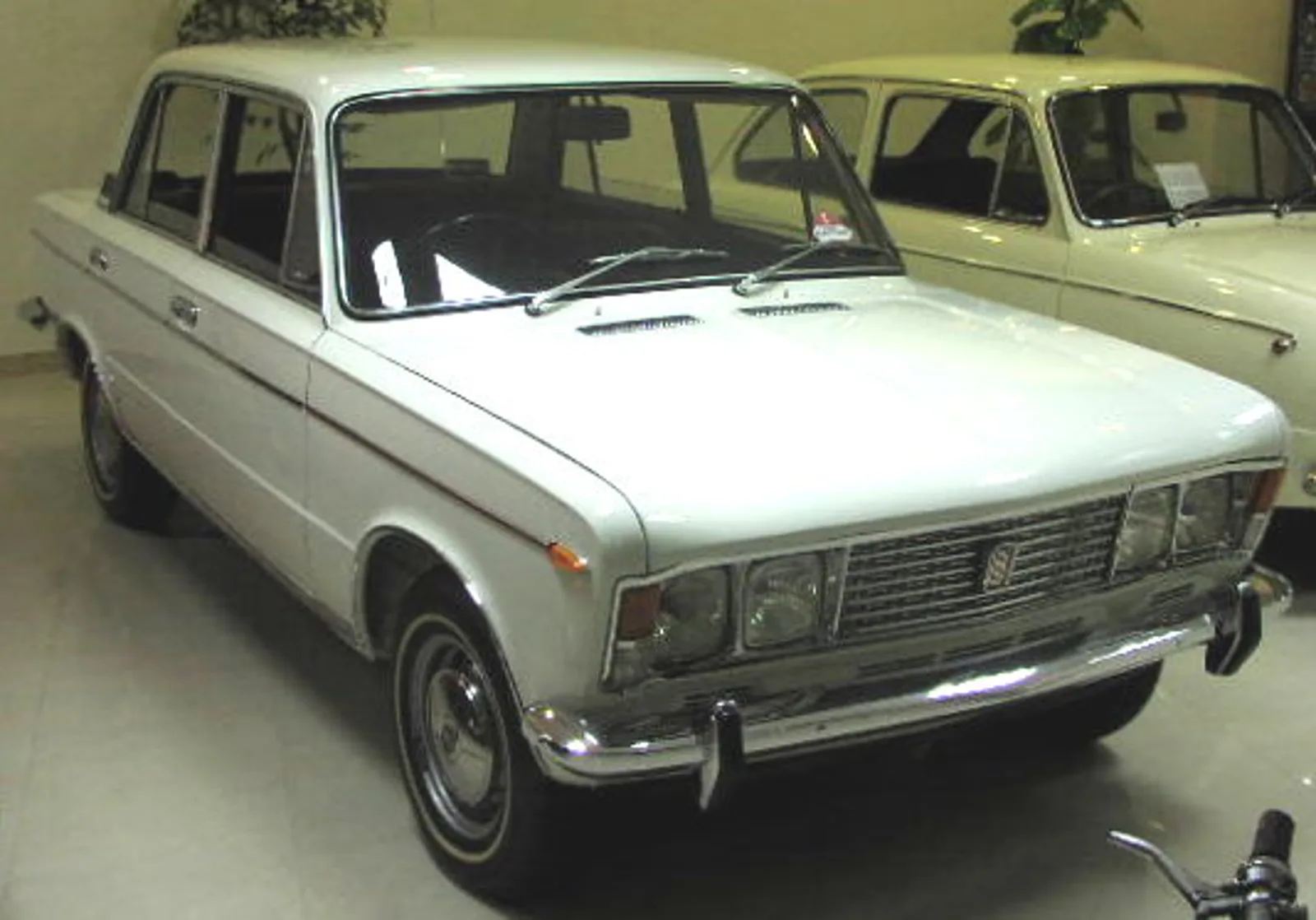
A 1967 saloon built from proven Fiat parts, with a twin-cam engine, the faster 125 S and licence builds across several continents.
The Fiat 125 was a 1967 Italian saloon built from existing Fiat parts, with a 1,608 cc twin-cam engine, four disc brakes and a roomy interior. Licence factories in Poland, Argentina and Yugoslavia continued variants of the design for years.
The Fiat 125 was a large family saloon that Fiat built in Italy from 1967 to 1972. Few cars of its time blended comfortable passenger space with sports car performance quite so openly, and licensed factories kept the design alive long after the Italian line closed.
Where did the Fiat 125 come from?
Engineer Dante Giacosa proposed a stopgap that combined the 1500 platform, the central body of the 124 and new front and rear sections. The car was introduced at the 1967 Geneva Motor Show, and Fiat formally presented it that spring, three months ahead of schedule.
In the mid-1960s the company's 1500 and 1800 mid-size models were ageing, and their intended replacement, Project 132, was still at an early stage. The 125 was the interim answer, built largely from components already in production, and the first prototypes were running as early as the winter of 1966.
The model used an updated twin-cam engine from the 124 Sport. Its interior was spacious and well finished, and the bodywork had been reworked to add presence. The passenger compartment was one of the few in its class without exposed sheet metal, which set the car apart from many rivals.
A saloon with the room of a family car and the performance of a sports car, built from parts Fiat already trusted.
How did the 125's engine and running gear work?
The 125 used a 1,608 cc inline four with four disc brakes, a vacuum brake servo and a four-speed gearbox with Porsche-type synchronizers. Together these parts gave the car the balance of handling and braking that made it popular with enthusiasts from the start.
The engine was a square design, achieved by lengthening the stroke from 71.5 mm to 80 mm. The first version produced about 90 horsepower at 5600 rpm, compared with the 6500 rpm of the earlier 1,438 cc unit, and that lower peak spread the torque more evenly and made delivery smoother.
The gear ratios were chosen with heavy use in mind, including long motorway runs. Third gear alone reached 125 km/h, compared with around 100 km/h for the 1500 C, which gave the 125 a useful advantage on open roads.
The rear layout had come from the Dino and was later reused on the 131, 132 and Argenta. The axle remained rigid, but the anti-roll bar was removed and replaced with a pair of longitudinal rods that tied the axle to the floorpan. Fiat promoted this arrangement in its brochures as a wishbone layout.
Was there a faster version of the 125?
Yes. The 125 S arrived in 1968 with 100 PS (74 kW; 99 bhp), a five-speed gearbox, servo-assisted twin-circuit brakes and optional magnesium wheels. It narrowed the gap to the Alfa Romeo Giulia, the model's main performance rival.
Demand for more performance led to a version with roughly 10 extra horsepower, obtained through engine work inspired by the 124 Sport, along with dual carburettors. The S also received upgraded equipment, from Cromodora alloys to tinted glass, plus a richer interior with a new centre console.
The S gained dual braking circuits, a mechanical brake-level corrector and a new steering box derived from the Dino Coupe. Its radial-ply tyres were standard, and its body was slightly shorter and slightly wider than the standard saloon. Those changes made it a sharper car in both corners and braking.
The trade-off came in luggage space. The trunk shrank from 400 to 380 litres when the fuel tank grew from 45 to 50 litres. In Germany the 125 faced competition from cars such as the BMW 1600 and 1600 TI, and the S was one of the few Fiats that could hold its own against them.
How did the 125 handle its gearbox options?
Buyers could choose a four-speed manual, a five-speed manual or, on later Specials, a three-speed automatic. The Idroconvert semi-automatic was offered briefly in 1968 and 1969, and it is now regarded as a very rare option.
The standard four-speed manual was fitted to every 125 built between 1967 and 1972, while the S and Special versions came with a five-speed manual as standard. The extra ratio was a notable step, because the rival Giulia Super already offered that gear and customers had complained about its absence.
The Special could also be ordered with a three-speed GM Trimatic transmission. From 1970 a three-speed GM automatic joined air conditioning, a sunroof and a rear window defroster on the option list, which broadened the car's appeal in markets that wanted comfort features.
The Idroconvert worked through an electric clutch operated by a switch on top of the gear lever. Starting was possible from any of the first four gears, and at a red light the driver could keep it in gear with a foot on the brake. Pressing the accelerator then moved the car away, much as a conventional automatic does.
The option was never listed in the driver's manual or the workshop manual, so period magazine articles are the main evidence that it existed. That scarcity makes the Idroconvert one of the more intriguing details in the car's history.
How did the 125's interior and handling impress reviewers?
The 125's cabin was spacious, well finished and fitted with circular instruments that had returned after years of absence. The car was one of the first to offer intermittent windscreen wipers as standard, and an electronic rev counter became an option from late 1967.
The cabin used high-quality materials, and the restyled panels looked more prominent without losing family-car practicality. Both the public and critics responded well when the car was introduced, and the praise for its ride and comfort carried through the model's life.
Options available on request included an anti-theft steering lock, white sidewall tyres, a car radio and the Idroconvert transmission, so buyers could tailor the car to their needs. Each choice added a little to the price while giving the owner a more personal car.
Autocar, which tested the car, reported slight understeer. The magazine found the tendency could be easily cured by adjusting the front camber, a simple fix that reviewers noticed. The handling was praised when the car was new and remained a point of discussion among enthusiasts for years afterwards.
What changed in 1970, and why did the 125 end?
The 1970 facelift, shown at the Turin Motor Show, renamed the 125 S as the 125 Special. Production continued until 1972, when the Fiat 132 replaced the 125, and enthusiasts later formed clubs in Italy to preserve the model.
The Special received new headlights, a revised grille, new wheel covers and interior refinements. It also gained an articulated steering column in three parts, designed to stop the wheel from recoiling dangerously toward the driver in a head-on collision. The base car changed much less than the performance version.
The end of the model drew mixed reactions from customers. Later, the company's chairman Gianni Agnelli reportedly admitted dropping the 125 had been a mistake. Its lasting reputation rests on the balance it struck between comfort and performance.
Italian production ended in 1972 after 603,877 cars had been built, although the 125 continued in many other markets for years. That total is the figure most often quoted when the model's commercial record is discussed.
How did the 125 spread to other countries?
Licence production took the 125 far beyond Italy. Polski Fiat built it in Poland from 1967 until 1991, while Argentina, Egypt, Morocco and Yugoslavia each produced variants or assembled cars for their own markets.
Fabryka Samochodow Osobowych built the Polish car as the Polski Fiat 125p. Polish cars were simpler than the Italian originals, with 1300 cc or 1500 cc engines taken from older Fiat models, and four round headlights replaced the square units. An estate and a pickup followed.
Zastava began making the 125p in 1969 as the 125pz, using Polish body panels and chassis with 1300 cc engines, and the nickname pezejac followed. From 1972 Zastava imported complete Polish cars as the 125p, which used the 1500 cc engine until 1983.
In Egypt the car continued as the Nasr 125 until 1983. In Argentina it was built between 1972 and 1982, with Fiat-Concord as the first builder and Sevel Argentina taking over later, with a station wagon, a pickup called the Multicarga and a 125 Sport coupe based on the Fiat Coupe 1500 Vignale.
SOMACA assembled 125s in Casablanca in Morocco, and a few copies were made in Colombia before the Polish version took over there. Each of these operations adapted the design to local roads, fuel and tax rules.
In Chile a car close to the 125 Special restyling of March 1970 was manufactured locally. That detail shows how far the design travelled, because the Italian original was rarely the only version a buyer could find in a given market.
How did the 125 perform in motorsport?
The 125 earned a reputation for durability in rallying and endurance events, and its reliability produced strong results with few mechanical retirements. Racing specification engines reportedly produced about 145 horsepower, which helped Fiat's wider motorsport effort.
At the 1969 24 Hours of Nurburgring, a Fiat crewed by Ratazzi, Luca Montezemolo and Ceccato came ninth overall. It was reported to be close to standard specification, which made the result a strong demonstration of the road car's basic strength.
In New Zealand, Torino Motors built the 125T for the six hour Benson and Hedges 500 production car race. It had larger valves, twin carburettors, modified camshafts and lowered, stiffer suspension, producing around 125 bhp. Between 84 and 89 cars were modified before the venture was dropped.
In South Africa, Alconi Scorpion of Pretoria turned the Italian chassis into the OTS Scorpion. Its engine made 125 DIN hp at 6,300 rpm, and the company offered tuning options to reach 190 DIN hp for track use, with a lowered steering column for a sportier driving position.
Which special-bodied 125s were built?
Several coachbuilders and tuners produced special-bodied 125s, including Moretti's 125GS 1.6, Zagato's GTZ and Vignale's two-door Samantha coupe. Each drew on the Italian car's mechanical base but gave it a different look and character.
Moretti's 125GS 1.6 took styling cues from the Dino Spider. Zagato built the 125 GTZ, while Savio produced a coupe and a station wagon, and Bertone built a 125 Executive to a design by Marcello Gandini. Each was a small-run product rather than a volume model.
Vignale's Samantha, a two-door coupe with pop-up lamps, came from a design by Virginio Vairo. OSI built another station wagon to a design by Sergio Sartorelli. The variety shows how readily the 125 platform lent itself to coachbuilders looking for a practical base.
What are the Fiat 125 specifications?
| Specification | Detail |
|---|---|
| Type | Large family saloon, front engine, rear-wheel drive |
| Production | 1967 to 1972 in Italy; 603,877 built |
| Engine | 1,608 cc DOHC inline four |
| Output | 90 PS (66 kW; 89 bhp) at 5600 rpm |
| 125 S output | 100 PS (74 kW; 99 bhp), from 1968 |
| Transmission | Four-speed manual; five-speed on the S and Special |
| Brakes | Four discs with vacuum servo; dual circuits on the S |
| Wheelbase | 85 mm (3.3 in) longer than the Fiat 124 |
| Boot | 400 litres, reduced to 380 litres with the 50-litre tank |
| Third-gear top speed | 125 km/h |
| Successor | Fiat 132 from 1972 |