A front-wheel-drive family car from 1978 that won a European award, spawned Abarth hot hatches and a cabriolet, and sold 1,790,000 copies.
The Fiat Ritmo was a front-wheel-drive small family car built from 1978 to 1988, sold in Britain and North America as the Strada. Its Abarth 130 TC hot hatch and Bertone cabriolet extended the range, and 1,790,000 were produced in total.
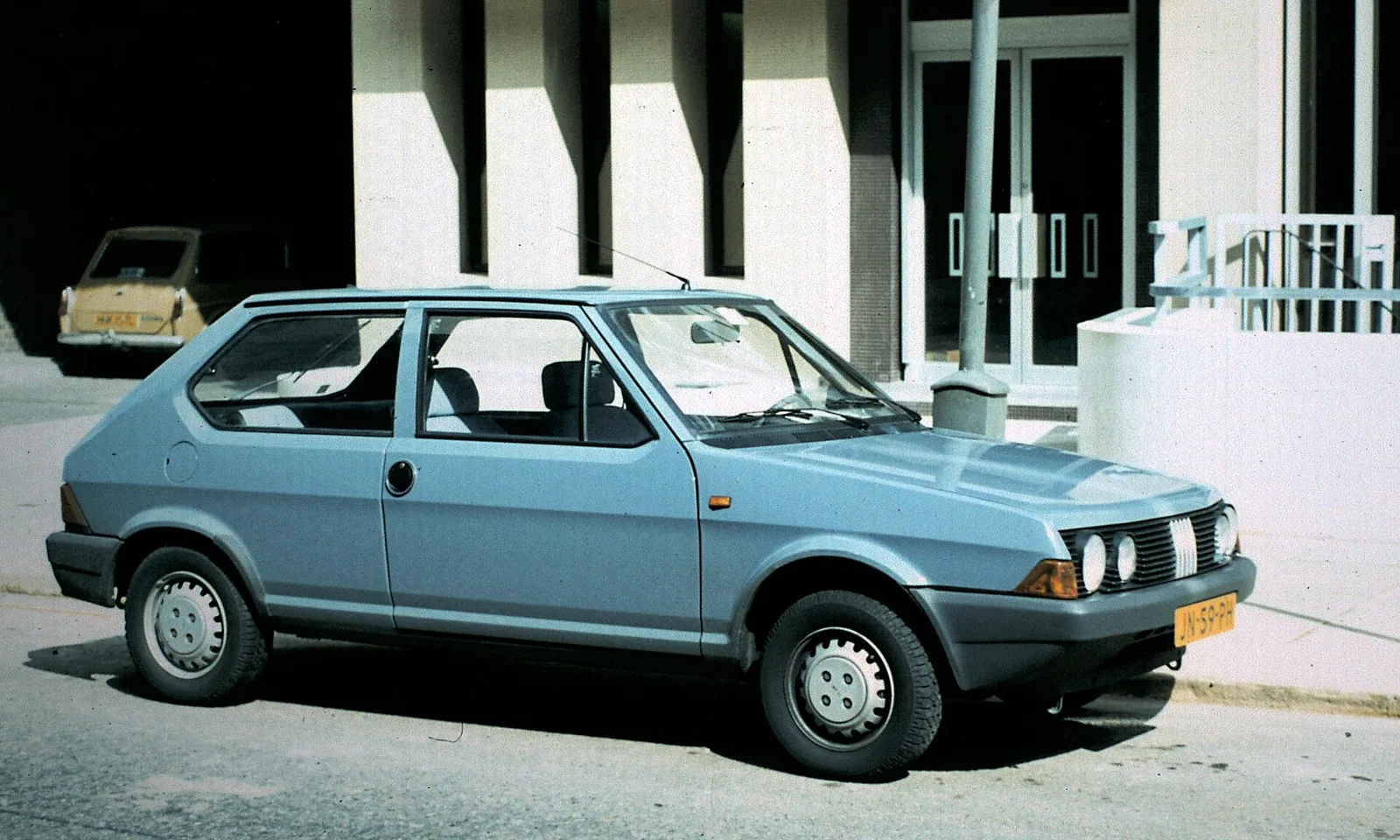
The Ritmo was a small family car that Fiat manufactured and marketed from 1978 to 1988. It used a front-engined, front-wheel-drive layout, came as a three or five-door hatchback, and could be had as a two-door cabriolet. Export cars were sold as the Strada, and the total production reached 1,790,000.
When did the Ritmo launch and what was its name?
Sergio Sartorelli styled the car at Fiat's Centro Stile in Turin, and it was launched at the Turin Motor Show in April 1978. The name comes from the Italian word for rhythm, while the export name Strada comes from the Italian word for road.
Fiat began designing the hatchback in 1972 as a replacement for the 128 saloon. Its body followed the style of the 127 supermini, at a time when European makers were beginning to launch small family hatchbacks, with the Volkswagen Golf arriving in 1974 as a notable example.
Before the launch the press had speculated that the project codename 138 would become the production name. Fiat chose the Ritmo name instead, departing from the three-digit numbering that many of its cars used.
The car was built at the Cassino plant using Robogate, an automated bodyshell system developed by Fiat's subsidiary Comau. Television advertising showed robots assembling the bodies to Rossini's The Barber of Seville, under the slogan Handbuilt by robots.
Handbuilt by robots, the Ritmo became a cabriolet, a hot hatch and a Strada that Americans could buy.
What engines and suspension did the first Ritmo use?
The first Ritmo used 1.1, 1.3 and 1.5 litre four-cylinder petrol engines inherited from the 128, with independent suspension all round and 13-inch wheels. Gearboxes were a four-speed manual, a five-speed on the CL models, or a three-speed automatic.
Power outputs were 60 PS (44 kW) for the 1.1, 65 PS (48 kW) for the 1.3 and 75 PS (55 kW) for the 1.5. Buyers noticed how much calmer the engines sounded, thanks to better insulation than the 127 had offered, which was one of the new car's selling points.
The brakes were discs at the front and drums at the rear. The three-speed automatic was a unit derived from Volkswagen, and luggage space varied between 330 and 1,100 litres, depending on how far the rear seats were folded.
The plastic bumper fascias were integrated into the styling, which combined round shapes with overall sharp lines. The car achieved a drag coefficient of 0.38, and the bumpers were designed to resist impacts at speeds of up to 6 km/h (3.7 mph).
How did the Ritmo sell in its early years?
The Ritmo was runner-up in European Car of the Year voting, narrowly behind the Simca-Chrysler Horizon, a car similar in concept. That placing gave the new Fiat a strong start in its launch year, and the praise for its engineering carried into its first showroom season.
The CL range was the better-equipped set, and the 60 CL made up 80% of total initial sales in Italy. Buyers could order many options that Fiat had not offered before, including a rev counter, a stereo, safety belts with headrests, tinted windows and a sunroof.
Criticism focused on the basic interior, which had no fabric on the door panels. Fiat responded in 1979 with revisions and a Targa Oro range that used gold striping, dark bumper bars and velour trim inside.
The interior colour was tied to the external paint. Beige interiors went with light blue, red and green paint, blue interiors with white, royal blue and silver, and brown interiors with orange, grey and copper paint.
What changed with the 1981 Super and sports versions?
In 1981 the Targa Oro gave way to the five-door Super, which came with 75 PS and 85 PS engines and 14-inch wheels. The same year brought the 105 TC sports model and a cabriolet, widening the appeal of the range.
The Super carried higher specification from chrome trim to fuller instrumentation and optional central locking. It used a twin carburettor and twin exhaust, Pirelli P8 low-profile tyres and a close-ratio five-speed gearbox, which made it sharper than the earlier cars.
The 105 TC was launched in May 1981 as a three-door with a 1,585 cc DOHC engine of 105 PS (77 kW). It had front fog lamps set into the bumper, a front spoiler with wheel arch extensions, a black mesh intake, and a spoiler sat at the base of the rear glass.
The Abarth 125 TC was shown at the Frankfurt Motor Show in September 1981. The engine was a 1,995 cc twin-cam four giving 125 PS (92 kW), and it came with ventilated discs at the front and a five-speed ZF gearbox. The car reached 190 km/h (118 mph), and the sprint from 0 to 100 km/h took 8.7 seconds.
The Abarth cars were the last Ritmos built on a separate Abarth production line, which had existed since the Fiat buyout of the company in 1971. Their unusual exhaust routing meant they were not offered for right-hand drive export markets.
Why was the 1982 second series a bigger change?
The October 1982 reengineering cut 70 kg (154 lb) from the chassis and improved noise and vibration control. Suspension mounts were revised, and the spare tyre moved from the engine bay into the boot, which freed up space under the bonnet.
The fuel tank moved ahead of the rear axle, and the filler cap went to the right side under a lid. The round headlamps were moved into a separate grille, and the bonnet lost its air scoop, while the flat roof replaced a design that had caused vortices and let dust and water collect over the rear window.
Better aerodynamics, lower weight and engine changes together raised fuel economy by around ten percent across most of the range. The 1,049 cc Brazilian engine was discontinued at the same time, leaving the rest of the line-up to carry the work.
In advertising in Britain the car was named Strada II, while the badge still read Strada. Seven-spoke alloys replaced the earlier Speedline wheels on the 105 TC there, a small change that marked the second series in British showrooms.
The 1983 range completion added the energy-saving Ritmo ES, along with a hot hatch called the Abarth 130 TC. The 130 TC was powered by a 1995 cc engine producing 130 PS (96 kW), with twin carburettors on a side-draught manifold and electronically controlled ignition timing.
How fast was the Abarth 130 TC against its rivals?
The 130 TC reached 195 km/h (121 mph) and its 0-100 km/h sprint took 7.8 seconds. It kept carburettors when many of its rivals had moved to fuel injection, and it stood out among hot hatches of the decade for that reason.
Its polished four-spoke alloys, aerodynamic door deflectors and lower hatchback spoiler set it apart from the restyled 105 TC. Recaro bucket seats were fitted in Britain and Ireland, and they were available as an option across the rest of Europe.
Ignition timing was controlled electronically, and the twin-cam engine was matched to a close-ratio five-speed ZF gearbox. Its performance was superior to rivals such as the Volkswagen Golf GTI, the Ford Escort XR3i, the Vauxhall Astra GTE and the MG Maestro.
Austria and Switzerland received a second-series 125 TC in 1983, with a single carburettor that reduced power to meet local tax rules. It looked like the 130 TC from the outside, which made the lower-powered version easy to mistake for its more potent sibling.
How did the Ritmo cabriolet come about?
The Ritmo cabriolet was first unveiled in 1979 as a study at Frankfurt and went on sale in mainland Europe in 1981. Bertone assembled it, and from the 1982 facelift it carried Bertone badging rather than Fiat's.
It competed with the Volkswagen Golf cabriolet, which Karmann built, but the Ritmo never matched Volkswagen's standards of quality or ability. Its petrol engines ranged from 75S to 100S, some with fuel injection, and the car stayed on sale until 1988.
A right-hand-drive version was built for Britain and Ireland, sold as the Superstrada Cabrio in the UK and as the Ritmo Cabrio in Ireland, both in 85S guise. Special editions included the Chrono and an all-white Bianco model.
What was the Strada's North American story?
Fiat introduced the Strada in North America in January 1979, using a 1.5 litre SOHC engine with 69 hp (51 kW). A 1981 fuel-injection update lifted power to 75 hp (56 kW), but sales fell sharply, and the model was withdrawn in 1982.
The American car was reworked with extended plastic bumper bars to meet strict collision standards. It came as a three-door or five-door hatch with a five-speed manual, and a three-speed Volkswagen automatic was available as an option.
Fiat had set a target of 30,000 cars a year. Sales reached 12,285 in 1979, the best year, followed by 12,253 in 1980, 6,888 in 1981 and 4,478 in 1982. A total of 36,477 were sold over four model years before the car was withdrawn.
Barack Obama is among the recorded owners, and a Strada was his first car. In 1980 US Electricar also converted Strada models into electric vehicles called the Lectric Leopard 946A, with 16 lead-acid batteries and a 17.2 kW motor.
The electric conversion reached a top speed of 65 mph (105 km/h) and a range of 60 miles (97 km) at a steady 50 mph. Its weight rose to 3,288 lb (1,491 kg), about 65% more than the original Strada.
How did SEAT and other makers build the Ritmo?
SEAT began life as a Fiat licensee in 1948, making clones of Italian cars under licence. From 1979 to 1982 it built a Spanish version of the Ritmo, which relied on pushrod engines carried over from the old Fiat 124 before the SEAT Ronda replaced it.
In 1982 SEAT introduced a new logo and the Ronda, which used a System Porsche engine. Fiat believed the Ronda's styling was very close to its own car, and the Arbitration Chamber of Paris ruled in 1983 that the two were sufficiently different.
The Ritmo name was revived in Australia in 2008, when the Fiat importer Ateco sold the new Bravo with Ritmo badging. Mazda was already using the Bravo name for its pickup there. The car sold slowly and was discontinued in 2009.
What happened in the third series and the final years?
The 1985 facelift gave five-door cars new rectangular door handles and shared lower door panels with the Regata saloon. The rear bumper now carried the number plate at low level, and the 1,697 cc diesel from the Uno 60D replaced the earlier unit with 60 PS (44 kW).
The three-door 105 TC gave way to the five-door 100 S, which kept the 1,585 cc, 105 PS (77 kW) DOHC engine. The 130 TC Abarth received the same external updates, along with new wheels and interior trim.
In 1986 a 1,929 cc intercooled turbodiesel with 80 PS (59 kW) arrived as the Ritmo Turbo DS, a five-door model only. The 100 S and the Turbo DS were sold across continental Europe, but neither reached Britain or Ireland.
Sales were falling outside Italy by then, held back by the reputation for unreliability and rust. Fiat launched two limited editions in 1986, the Ritmo Team and the Ritmo Super Team, but production ended in early 1988, when the Tipo took its place.
What are the Fiat Ritmo specifications?
| Specification | Detail |
|---|---|
| Type | Small family hatchback and cabriolet, front engine, front-wheel drive |
| Production | 1978 to early 1988; 1,790,000 built |
| Launch | Turin Motor Show, April 1978 |
| First-series petrol | 1.1 (60 PS), 1.3 (65 PS) and 1.5 (75 PS) fours |
| Super, 1981 | 1.3 at 75 PS (55 kW); 1.5 at 85 PS (63 kW) |
| 105 TC | 1,585 cc DOHC, 105 PS (77 kW) |
| Abarth 125 TC | 1,995 cc DOHC, 125 PS (92 kW), 190 km/h (118 mph) |
| Abarth 130 TC | 1,995 cc, 130 PS (96 kW), 195 km/h (121 mph), 0-100 km/h in 7.8 seconds |
| Diesel | 1.7 litre at 60 PS (44 kW) from 1985; turbodiesel at 80 PS (59 kW) from 1986 |
| Drag coefficient | Cd 0.38 |
| Boot | 330 to 1,100 litres, depending on rear seat position |
| US Strada | 1.5 SOHC, 69 hp (51 kW); 75 hp (56 kW) from 1981 |
| Successor | Fiat Tipo, from early 1988 |