Abarth's sporty 1964 entry model on the Fiat 850 Berlina, sold in a few versions with up to 53 PS while Fiat's own models competed with it.
The Fiat Abarth OT 850 was Abarth's sporty entry model, built on the Fiat 850 Berlina in several versions from 1964 to 1966. Its 843 cc Sigla 201 engine produced 44 PS in the basic car and 53 PS in the stronger one, and production figures fell short of Abarth's expectations.
The Fiat Abarth OT 850 was the sporty entry model of Abarth's OT range, built on the Fiat 850 Berlina between 1964 and 1966. In its basic form it had an 843 cc four-cylinder producing 44 PS (32 kW; 43 hp), and a stronger version with 53 PS (39 kW; 52 hp) followed later in 1964. Production figures fell well short of expectations, and series production ended in early 1965.
Where did the OT 850 come from?
Abarth built the OT 850 on the Fiat 850 Berlina, which Fiat presented in March 1964. Abarth saw it as a sporty entry model for larger series production, and also for amateur near-series motorsport in the class up to 850 cubic centimetres. Production began in May 1964.
Abarth and Fiat had long-standing close ties, so pre-production 850 Berlina cars were available early for developing the wider OT programme. Chief engineer Mario Colucci and engine development head Luciano Fochi led the work, and in spring 1964 they produced the Sigla 201 road engine and the Sigla 201A racing version.
The OT 850 was meant to follow the Fiat Abarth 850 TC, a smaller and lighter car that was still based on the Fiat 600. It was aimed at buyers who wanted good performance together with better family usefulness.
The OT 850 belonged to the wide and confusing family of Fiat Abarth OT passenger cars, which Turin built between 1964 and 1970. Within that family it was the entry model in engine capacity, output and price until 1966, when sales of the 850 variant ended.
A sporty Abarth on a Fiat 850 saloon body, with a 0.85-litre engine and production figures that fell short of expectations.
What did the OT 850 look like?
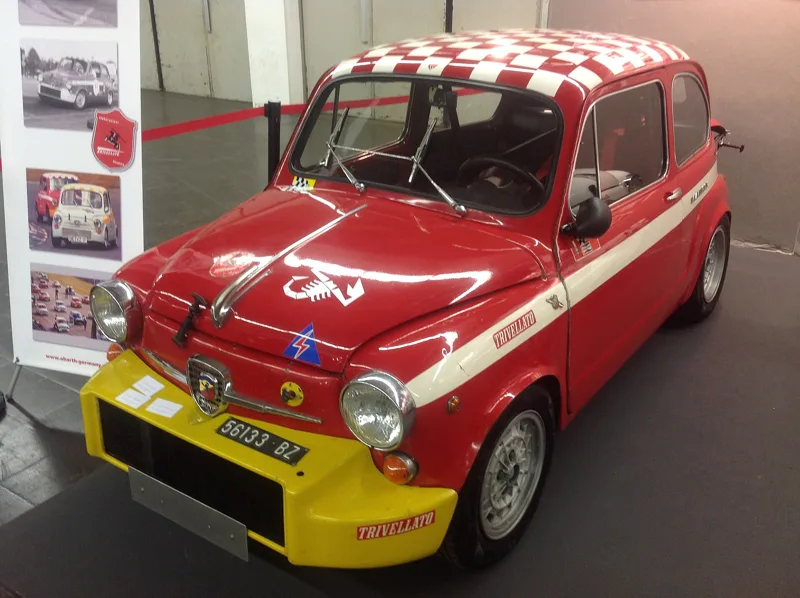
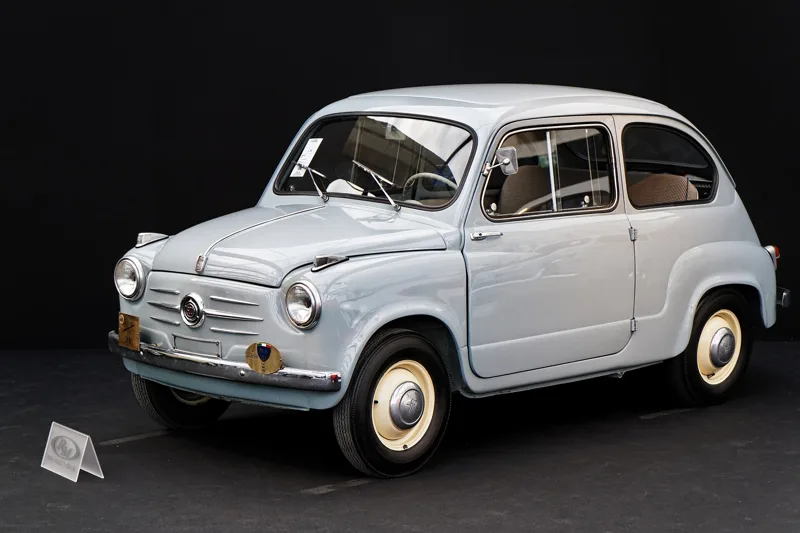
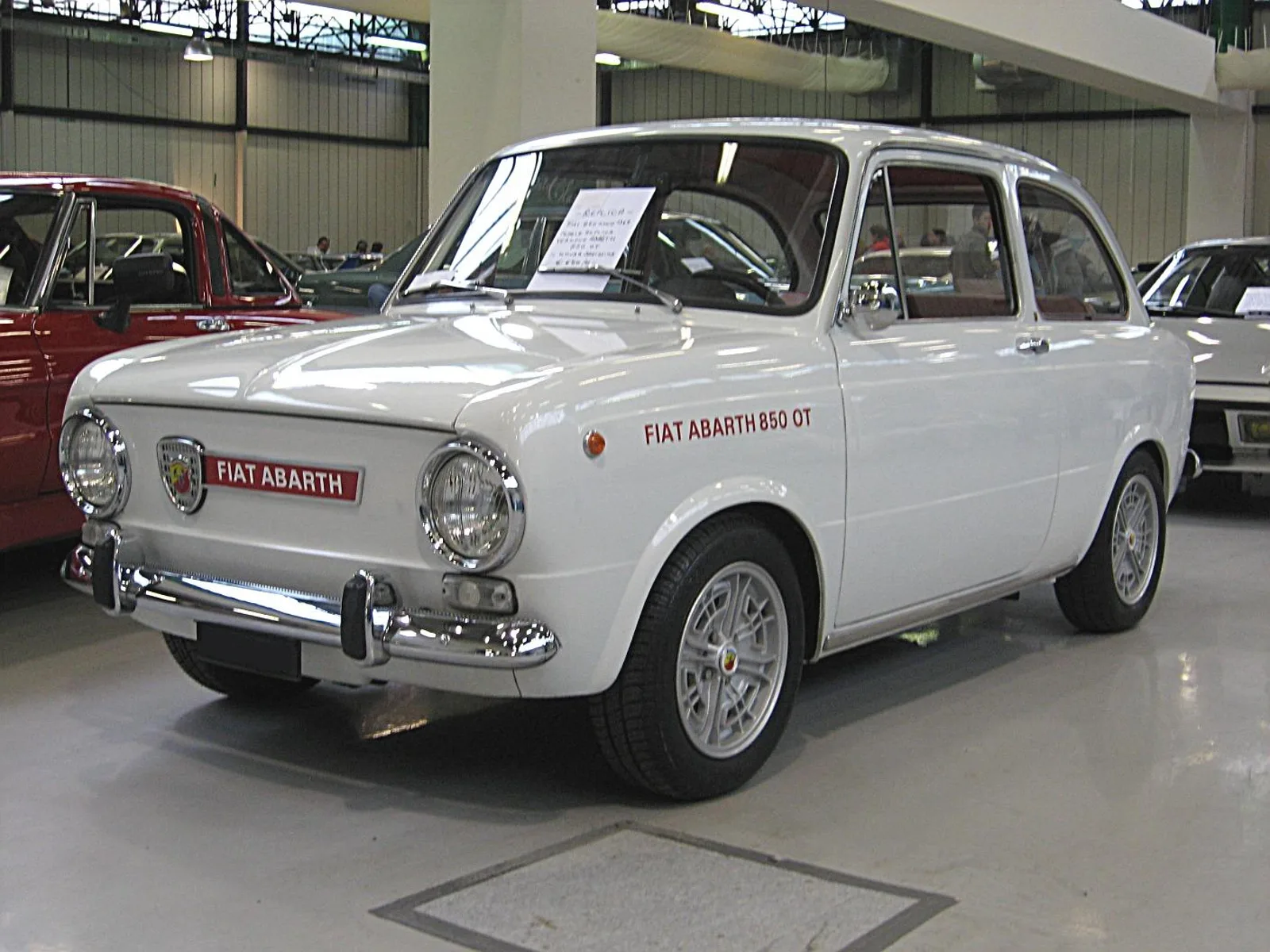
Apart from its Abarth details, the OT 850 looked much like the standard Fiat 850 Berlina. It was offered only as a two-door saloon, with no coupe or spider bodies, and at the front a large Abarth logo sat asymmetrically on the left.
Abarth logos also appeared on the front wings, the wheel trims and the dashboard, and there was lettering on the tail. The standard steel wheels had oval ventilation openings, and the sports exhaust had two tailpipes. An oil sump of aluminium alloy was fitted. Unlike the OT 1000, there were no outward references to engine capacity.
Which versions did Abarth build?
Abarth produced the following variants of the OT 850 at the factory:
- OT 850 (Tipo 101): from May 1964, the basic road car with the saloon body of the Fiat 850 Berlina and the Sigla 201 engine at 44 PS, allowing 130 km/h.
- OT 850/Oltre 130: a slightly revised version from November 1964, with small changes to the oil circuit, the same engine code and output, and a slightly higher top speed.
- OT 850/Oltre 150: from November 1964, the stronger road-approved version with 53 PS (39 kW), also designated as engine Sigla 201.
- OT 850 Corsa (Tipo 101A): a racing version built from 1964 in single examples, without road approval, with the further boosted Sigla 201A engine.
The addition Berlina, German for saloon, sometimes appears on every variant, although with no other body types the word is unnecessary.
How was the Sigla 201 engine built?
The Sigla 201 was a water-cooled 0.85-litre four-cylinder in line, with a 65.0 mm bore and a 63.5 mm stroke, giving 843 cubic centimetres (51.5 cu in). It used OHV valve control and a single Solex carburettor of type 34PBIC, and in the basic version it produced 44 PS (32 kW; 43 hp) at 5,400 rpm.
The stronger version produced 53 PS (39 kW; 52 hp) at 6,000 rpm. Abarth first quoted a top speed of 130 km/h (81 mph) for the basic car. The weaker version was later given as over 130, or 135 km/h (84 mph), and the stronger one as over 150, or finally 150 km/h (93 mph).
Much of the power gain over the Fiat 850 Berlina came from a better carburettor, Abarth-specific add-on parts and classic tuning. The inlet manifold, exhaust manifold and twin-pipe sports exhaust were all Abarth parts. The crankshafts of both Abarth engine types turn in opposite directions, as the Fiat originals do.
What were the key specifications?
| Item | Specification |
|---|---|
| Body | Two-door saloon, Fiat 850 Berlina bodywork |
| Engine | Abarth Sigla 201, 0.85-litre, four-cylinder in line, OHV |
| Displacement | 843 cubic centimetres (51.5 cu in) |
| Bore and stroke | 65.0 mm and 63.5 mm |
| Carburettor | Single Solex 34PBIC |
| Basic output | 44 PS (32 kW; 43 hp) at 5,400 rpm |
| Stronger output | 53 PS (39 kW; 52 hp) at 6,000 rpm |
| Top speed | 130 km/h (81 mph), later 135 km/h (84 mph) and 150 km/h (93 mph) |
| Wheelbase | 2,027 mm (79.8 in) |
| Track | 1,150 mm front, 1,160 mm rear |
| Tyres | 145 x 12 |
| Brakes | Drums front and rear on the basic car, front discs on the stronger one |
| Launch price | 870,000 lire |
How was the chassis set up?
The OT 850 used the independent-suspension chassis of the Fiat 850, modified for its higher output. Its standard wheels were 12-inch high, four-and-a-half-inch wide Abarth steel wheels with chrome trim caps. Factory alloys in 13-inch size were available at extra cost.
The weaker version used drum brakes at both ends, and only the stronger one had front discs. At the rear axle the track could be widened to 1,220 mm.
Which related Abarth models came from the OT 850?
The saloon of the OT 850 gave rise, in November 1964, to the larger and more powerful OT 1000 Berlina (Tipo 102), with 982 cc. Experimental vehicles followed, first the OT 1600 Berlina (Tipo 135) in December 1964, then the 2000 Berlina (Tipo 136) at the start of 1965.
In 1966 the Fiat Abarth OTR 850 followed, built in single examples with a special cylinder head that Abarth had developed. That radial head had premiered on the OTR 1000 Coupe in 1965.
Why did production stop so early?
Production stayed well below what Abarth had hoped for, and series production ended in the first months of 1965. The OT 850 still appeared in Abarth price lists until the 1966 model year, though it is unclear whether Abarth only sold off remaining stock or still built cars to order. Complete OT 850 production ended in 1966. Customers could still assemble OT 850 cars from Abarth conversion parts in later years.
To some buyers the price premium over the standard 850 Berlina looked too high for the gain in performance and top speed. Fiat added the competing 850 Super in 1964, which on premium petrol produced 37 DIN PS (27 kW) and cost the same as the basic model. Many Abarth customers simply chose the larger OT 1000 Berlina.
Fiat had also moved to quoting higher SAE PS figures, which European buyers found harder to judge. Against Fiat's 40 SAE PS for the 850 Berlina, the OT 850's 43 DIN PS disappointed some. From spring 1965 Fiat's 850 Coupe and Spider, at 47 and 49 DIN PS, offered more appealing bodies at an attractive price.
Did the OT 850 race?
Only individual cars of the OT 850 Corsa, also called the Competizione, were built, for works testing. They were compared with the proven 850 TC models, and the TC cars held their own because they were about 40 kg lighter, more compact and better in aerodynamics. No works entries of the Corsa are documented.
No special homologation was obtained from the Commission Sportive Internationale, the approval body of the FIA. Customers could buy the racing parts individually and fit them. The racing versions produced about 64 PS (47 kW) at 7,000 rpm in 1964, and about 70 PS (51 kW) at 8,000 rpm in 1965 and 1966.
What did the OT 850 cost when new?
On the Italian home market the OT 850 launched at 870,000 lire, while the basic Fiat 850 Berlina sold for 798,000 lire. The OT 850/Oltre 150 cost 1,100,000 lire, exactly as much as the OT 1000 Berlina, and both offered front disc brakes as standard in place of the drums of the basic model.
Popular factory options included alloy wheels from Amadori or Campagnolo for 23,500 lire, and sports steering wheels with wooden or leather rims at prices between 17,000 and 22,000 lire.
What came after the OT 850?
The Fiat 850 Special, built in large series from early 1968 with the 47 PS engine of the Fiat 850 Coupe, is regarded as the indirect successor. Giannini Automobili of Rome also produced a rival from 1965 into the early 1970s, the Fiat Giannini 850 SL Berlina, whose engine made 48 PS (35 kW) at 5,500 rpm.
How many original cars survive today?
Only a few original OT 850 cars have survived, and many were worn out in racing. Because of their unassuming looks, the survivors long attracted little attention, even among collectors. Today they are sought-after pieces among Abarth enthusiasts, and prices vary widely with condition and history.