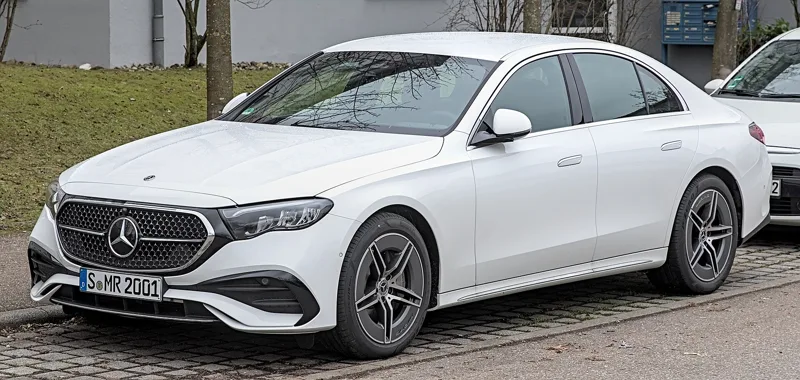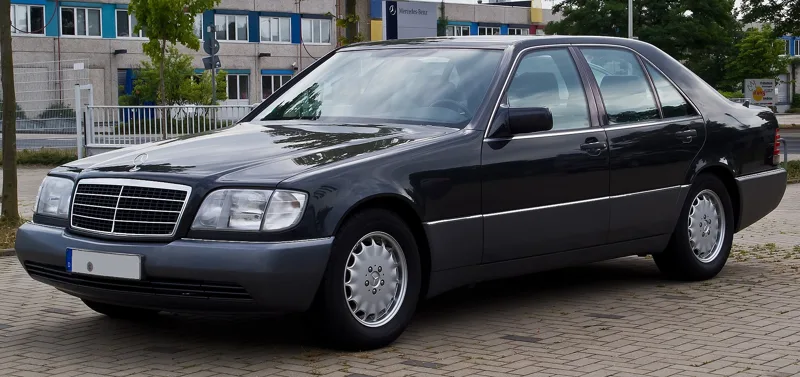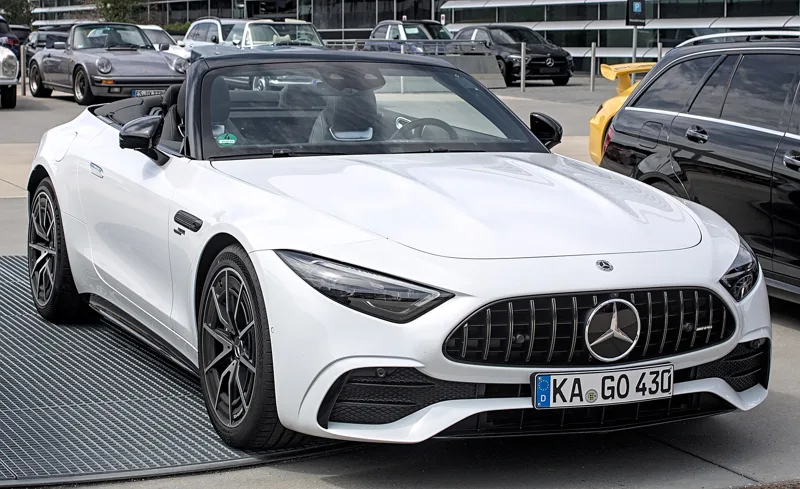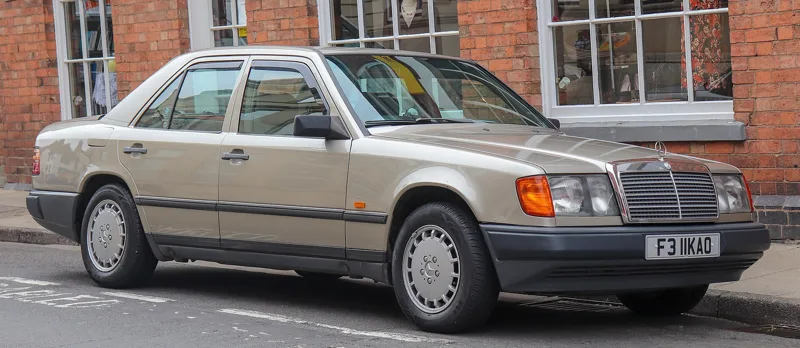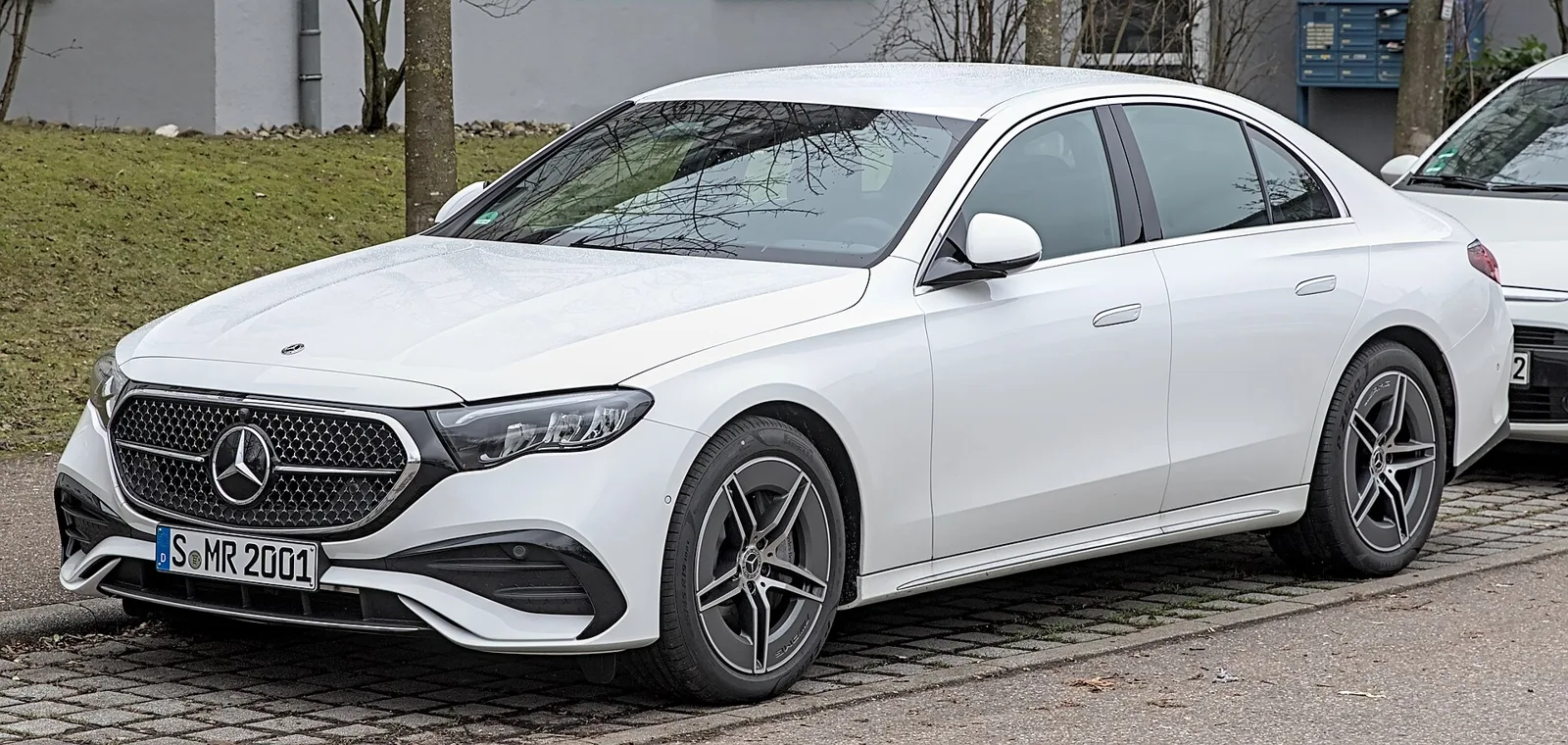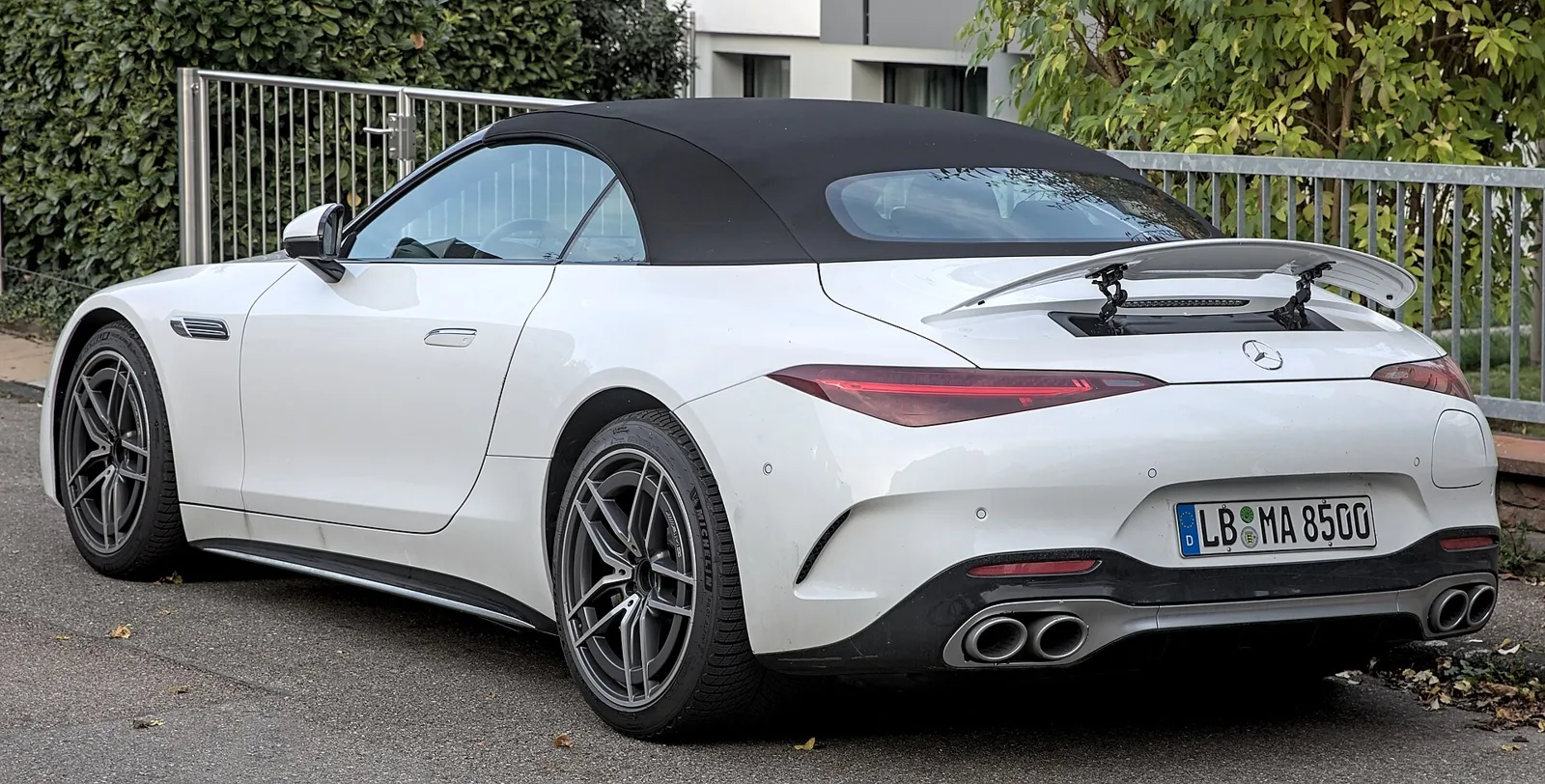
From the 300E Hammer and its V8 to the W210 E55 and the W211, the sporty E-Class models that took on the BMW M5.
The Mercedes-Benz E-Class AMG began as a sporty E-Class from 1986, with the W124 Hammer V8 the most dramatic early model. Later generations, from the W210 E55 to the W211, were aimed at beating the BMW M5 on performance.
The Mercedes-Benz E-Class AMG is the sporty version of the E-Class, offered from 1986 as a rival to the BMW 5 Series M and the Audi A6 RS. Its story runs from the W124 Hammer, with a V8 that Mercedes had never planned for the car, through the W210 E55 and E60 to the W211 of 2002. Each generation tried to beat the BMW M5 on performance.
How did AMG change the W124 before the Hammer?
The W124 replaced the W123 in 1984, and the best model was the top 300E with a 3.0 litre six-cylinder engine. The W124 appeared as the fuel crisis arrived, and it was never meant to receive a V8. Tuners soon took an interest, and AMG did what it did best in the eighties, lifting performance well clear of standard Mercedes models.
Other firms modified the car in their own ways. One built a two-door convertible, another stretched the W124 into a six-door saloon, and AMG added spoilers for better aerodynamics, along with wheels and wider tyres that suited the higher power. Early models had V8 engines in a V configuration, while six-cylinder in-line engines came later.
A V8 the W124 was never meant to receive, fitted by AMG with four valves per cylinder.
Why was the W124 Hammer so special?
The most dramatic change was moving the V8 from the W126 S-Class into the W124 engine bay, in place of the 3.0 litre in-line six. The engine used four-valve technology, which set it apart from the ordinary 5.0 engine of the W126, and every W124 AMG with a V8 wore the nickname 'Hammer'.
The first Hammer used a 32-valve DOHC V8 of 5.0 litres, which could be enlarged to 5.4 litres, drawn from the first generation of the W126 AMG. By then AMG had worked on and improved Mercedes cars for years.
Which Hammer engines were fitted?
The Hammer engines were modified V8s of 5.0, 5.4 and 5.6 litres, built on the M 117 block, and AMG's code for the family was M 117/9, taken from the 560 SEC. Power ran from 340 PS (250 kW; 335 hp) on the 5.0 to 360 PS (265 kW; 355 hp) on the 5.6, both peaking at 5,500 rpm.
Torque reached 510 Nm (376 lb ft) at 4,000 rpm. Displacement rose again in 1986, and the most popular car, the 300E 5.6 Hammer, appeared around the turn of 1986 and 1987. Its 5.6 litre engine was a newer unit from the second generation of the W126, the same engine used in the top 560SE and SEL and in the 560SEC.
Why did the first Hammers lack Mercedes badges?
The first 300E AMG 5.0 Hammers had no Mercedes-Benz badges and no bonnet star, because Mercedes had not authorised the V8 engine. The company cared a great deal about the prestige and reliability of its products, and it kept its name off a car it had not approved.
How fast was the 300E 5.6 Hammer?
The 300E 5.6 AMG reached 100 km/h in 5.4 seconds and 200 km/h from a standing start in 18.1 seconds, with a top speed of 303 km/h (188 mph). In August 1987 the magazine Road & Track called it 'a sedan that drives like a Ferrari Testarossa' in a test.
The 5.6 car was fitted with a four-speed automatic gearbox from the S-Class, along with AMG suspension that had shortened springs and stiffer dampers. It ran 17-inch aluminium alloy wheels and tyres sized 215/45VR-17 front and 235/45VR-17 rear. Spoilers at both ends and on the sides brought the drag coefficient down to 0.25.
What did the 6.0 litre Hammer add?
In 1988 the M 117 could be enlarged to 6.0 litres on special request, giving 385 PS (283 kW; 380 hp) at 5,500 rpm and 566 Nm (417 lb ft) at 4,000 rpm. The most powerful version reached 100 km/h in about 5.0 seconds and a top speed of 306 km/h (190 mph).
Customers could fit various extras to any Hammer. The 6.0 litre engine was one option, and AMG then fitted a four-speed gearbox tuned to suit it. The car also came with a Torsen limited-slip differential, a stronger rear subframe and a full set of spoiler and trim parts. A special hardened suspension was also available, changing the handling of the W124 completely.
How many Hammers were built?
The exact number of Hammer models is unknown, even to AMG, which did not keep detailed production records at the time. Estimates put the total at about 30 Hammers in various versions and capacities, mostly sedans, with one coupe and one estate ordered by a customer from Chicago known to exist.
The Hammer found its greatest success in the United States, which was the largest market for these models. Another well-known AMG car of that period was the 300E AMG 6.0 Hammer Widebody coupe, released in 1988.
What were the 3.4 AMG and E 36 AMG versions?
A 24-valve M104 engine producing 220 PS (162 kW; 217 hp) came with the new model, and a modernised 3.4 AMG version was also offered. From 1988 the 300E 3.4 AMG saloon, the 300TE-24 3.4 AMG estate, and the 300CE-24 3.4 AMG coupe and cabriolet were built in limited numbers with 3,314 cc (202.2 cu in) M 104 E 34 engines.
Output ran from 185 to 200 kW (252 to 272 PS) at 6,500 rpm, with 330 Nm (243 lb ft) at 4,500 rpm. The 252 PS version was offered only in the cabriolet. Dials were white inside, the speedometers carried the AMG logo and ran to 300 km/h, and the rev counters went up to 8,000 rpm.
From 1993 to 1996 the E 36 AMG T succeeded the 300TE 3.4 AMG. It used a 3.6 litre M 104 E 36 engine of 3,606 cc (220.1 cu in), equal to 195 to 200 kW or 265 to 272 PS, at 5,750 rpm, and its 385 Nm (284 lb ft) of torque arrived between 3,750 and 4,500 rpm.
How many 3.4 AMG cars were built?
Of the 3.4 AMG versions, the 3.4 CE coupes based on the 300CE-24 were adapted for left-hand traffic, and 25 were built between 1988 and 1993. Beyond the coupes, seven cabriolets and eleven saloons were made, plus probably a few estates, two of them for the German motoring press to test.
For the E 36 AMG, the T estate was intended mainly for the Japanese market, and 171 were built. The E 36 cabriolet run totalled 68, with 54 for left-hand traffic and 14 for right-hand traffic. The E 36 saloon was offered only in right-hand-drive markets.
How did the 500E 6.0 and E 60 differ from the standard 500E?
The 500E 6.0 AMG arrived in 1992, with its 5.0 litre M 119 enlarged by boring, and it was built on the standard W124 500E. It made 374 PS (275 kW; 369 hp). It had lowered and slightly stiffened suspension, and it was far stronger than the BMW M5 equivalent.
Beyond the extra power, the 500E 6.0 AMG differed in three-piece OZ wheels outside and richer equipment inside. The E 60 of 1993 used an enlarged M 119 of the same family, with 381 PS (280 kW; 376 hp), and an E60 Limited could also be ordered.
Hammer and AMG specifications by version
| Model | Engine | Output | Torque | Notes |
|---|---|---|---|---|
| 300E 5.0 Hammer | 5.0 litre V8 | 340 PS (250 kW; 335 hp) at 5,500 rpm | 510 Nm (376 lb ft) at 4,000 rpm | Four-valve V8 from the W126 |
| 300E 5.6 Hammer | 5.6 litre V8 | 360 PS (265 kW; 355 hp) at 5,500 rpm | 510 Nm (376 lb ft) at 4,000 rpm | Top speed 303 km/h (188 mph) |
| 300E 6.0 Hammer | 6.0 litre V8, on special order | 385 PS (283 kW; 380 hp) at 5,500 rpm | 566 Nm (417 lb ft) at 4,000 rpm | Top speed 306 km/h (190 mph) |
| 300E 3.4 AMG | 3,314 cc (202.2 cu in) | 185 to 200 kW (252 to 272 PS) at 6,500 rpm | 330 Nm (243 lb ft) at 4,500 rpm | Limited run from 1988 |
| E 36 AMG T | 3,606 cc (220.1 cu in) | 195 to 200 kW (265 to 272 PS) at 5,750 rpm | 385 Nm (284 lb ft) | Estate, from 1993 to 1996 |
| 500E 6.0 AMG | Bored-out 5.0 litre M 119 V8 | 374 PS (275 kW; 369 hp) | - | From 1992 |
| E 60 (W124) | Enlarged M 119 V8 | 381 PS (280 kW; 376 hp) | - | From 1993 |
| E55 (W210) | M113 V8, based on the E430 | 354 PS (260 kW; 349 hp) | 530 Nm (391 lb ft) at 3,000 rpm | From late 1997 |
| E60 (W210) | 6.0 litre, 6.2 litre option | 380 PS (280 kW; 375 hp), up to 405 PS (298 kW; 399 hp) | - | From 1996 |
What was the W210 E55?
The E55 arrived at the end of 1997 to replace the E50, whose sales had disappointed. It was sold for the 1998 model year, and a new V8 based on the E430, the M113, replaced the M119.
The M113 made 354 PS (260 kW; 349 hp), with 530 Nm (391 lb ft) of torque at a low 3,000 rpm. That wide flexibility earned the car the nickname 'Conqueror of the motorways', and the E55 also had strong brakes that could stop it from 100 km/h in just under 36 metres (118 ft).
How did the E55 brakes and drivetrain work?
The front brake discs were much larger than on standard W210 models, while the rear brakes stayed unchanged, although the rear used front discs from standard E-Class cars. The gearbox came from the E, SL, S and CL models, and the W140 and W220, where it had been fitted to V8 and V12 engines.
Only the E55 could be ordered with 4MATIC all-wheel drive. The system, based on the ML off-roader, was less complicated and cheaper to run, and it made the E55 the first mid-size AMG model with four-wheel drive. Official figures from the Affalterbach line show just under 15 cars built in that configuration.
What was the W210 E60?
Bored out from the 5.0 litre unit to 6.0 litres, the 1996 E60 made 380 PS (280 kW; 375 hp), matching the first-generation Audi RS4 of 2001. A 6.2 litre option with 405 PS (298 kW; 399 hp) could be ordered.
Apart from power, the two E60 versions looked the same, with the same boot badges, so the engine under the bonnet could not be told from the outside. This version was the only one originally fitted with a speedometer calibrated to 300 km/h.
What changed with the W210 facelift in 2000?
The W210 was facelifted in 2000 with a new front and indicators integrated into the outside mirrors, a refresh the AMG models shared with the rest of the range. The rear lights were refreshed: they were fully red before, and afterwards they were lightly smoked or, in later versions, clear.
Inside, the car gained a bigger on-board computer, satnav and a steering wheel with multifunction buttons. The speed digits on the dashboard were made smaller to fit the computer. Around 1,500 further novelties and minor improvements arrived after 2000.
Is a used W210 AMG a sound buy?
Used W210 AMG models can be affordable to run if the car is in good condition, lightly used and low in mileage. Its V8 engines were among the most modern of the late nineties, aimed at fuel economy compared with the older M 119, although that engine often had problems with overheating and a long timing chain.
The E55 gave up four valves per cylinder in favour of three, and the M 113 chain is shorter than the M 119 chain, so servicing it is cheaper and easier. The gearbox needs only regular oil changes and is otherwise practically maintenance-free. The five-speed gearbox that replaced the four-speed is more economical and responds better to sudden throttle.
Corrosion is the notorious problem across the W210 range, and it often appears on the tailgate, the bonnet, the sills and the wheel arches. AMG models generally have fewer corrosion problems, mostly because owners garaged them and avoided bad weather. Cars from Spain, Switzerland, Italy, Japan and the western United States often show very good bodies.
Wear parts cost more than on the standard W210 models with smaller engines. Front discs and pads, a complete exhaust system, the sills, the front bumper with its fog lamps, the rear bumper and the dampers all add to the bill. The gearbox and engine can reportedly run for around half a million kilometres without a major repair.
What did the W211 bring?
The AMG sports division built the W211 E-Class AMG, presented in 2002 as the successor to the W210. Its main rivals were the older BMW M5 and the Audi RS6, and it was the quickest of the three on pure performance.
On the classic E-Class body the AMG team fitted aggressive wheels and strong brakes, plus air conditioning, satnav, a phone and leather seats. The model could compete with both the M5 and the RS6 on road.
What was standard on the W210 AMG?
The W210 AMG had a sport parametric steering system, which made town manoeuvring easier at low speeds and stiffened once higher speeds were reached. The car came with a long standard list, from safety systems and climate control to comfort features and styling, and the main items were these:
- ABS, ASR and ESP
- Automatic air conditioning, front airbags and front side airbags
- Electrically adjustable, heated door mirrors and an external temperature display
- Electric windows at all four positions and leather upholstery, or two-tone on request
- 18-inch AMG II Monoblock alloy wheels, and a steering wheel adjustable electrically in two directions
- Rain sensor, metallic paint, front fog lamps and an R/C radio
- Headlamp cleaning, heated front and rear seats, a heated windscreen and rear window
- AMG styling package and a speedometer calibrated from 280 to 300 km/h
What did the W210 AMG cost in 1999?
In March 1999 the basic W210 AMG cost 149,000 DM. Options included front airbags for the head at 754 DM and side airbags for the rear at 754 DM, bi-xenon front lamps at 1,850 DM and an alarm from 580 DM.
Others were a ski rack at 406 DM, a glass electric sunroof at 2,285 DM and removal of the speed limiter at 4,000 DM.