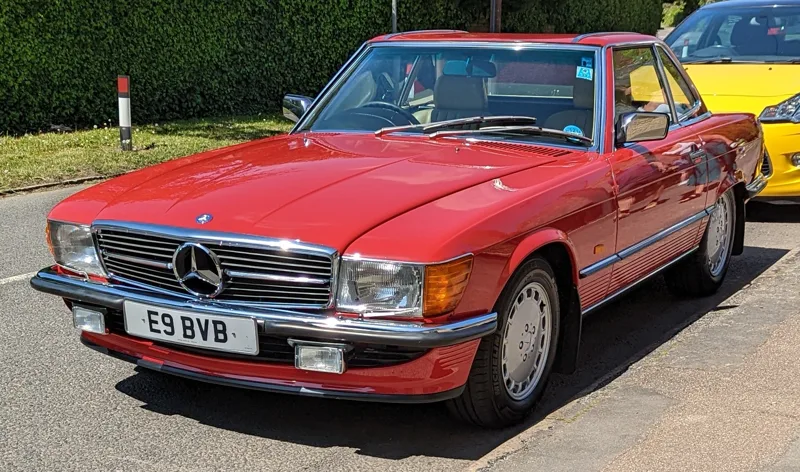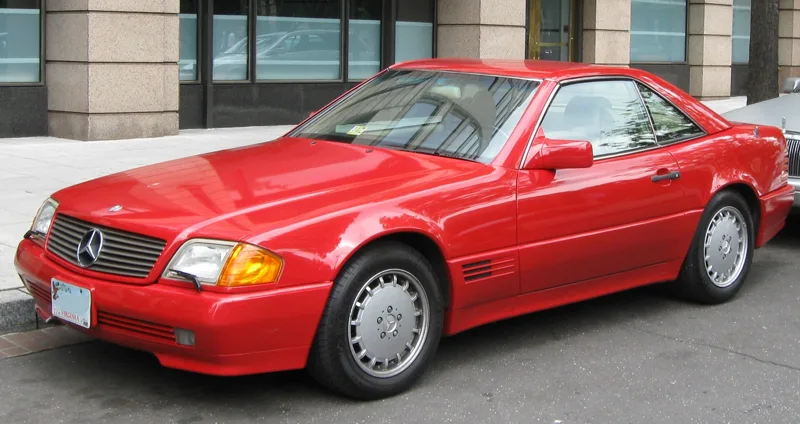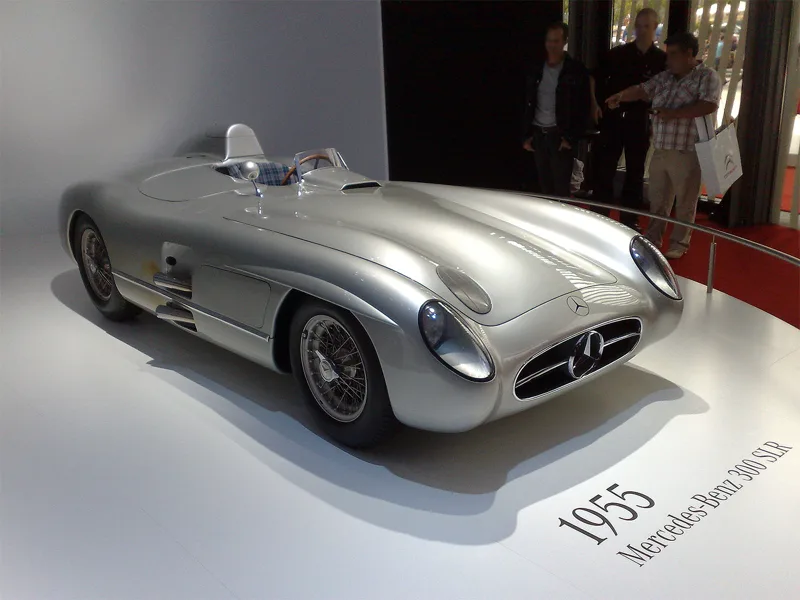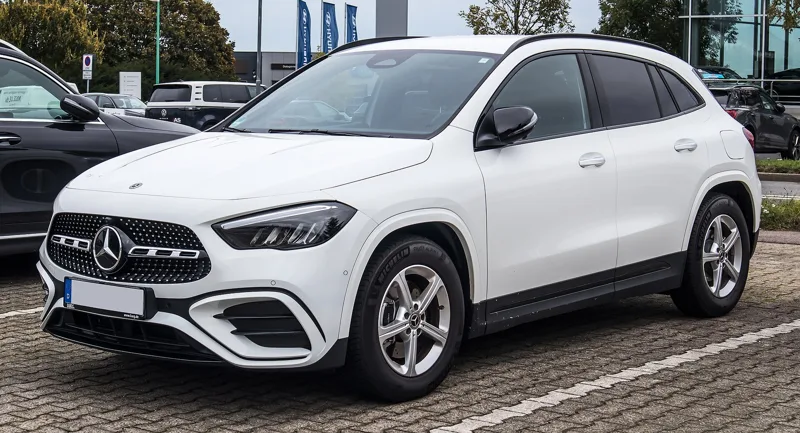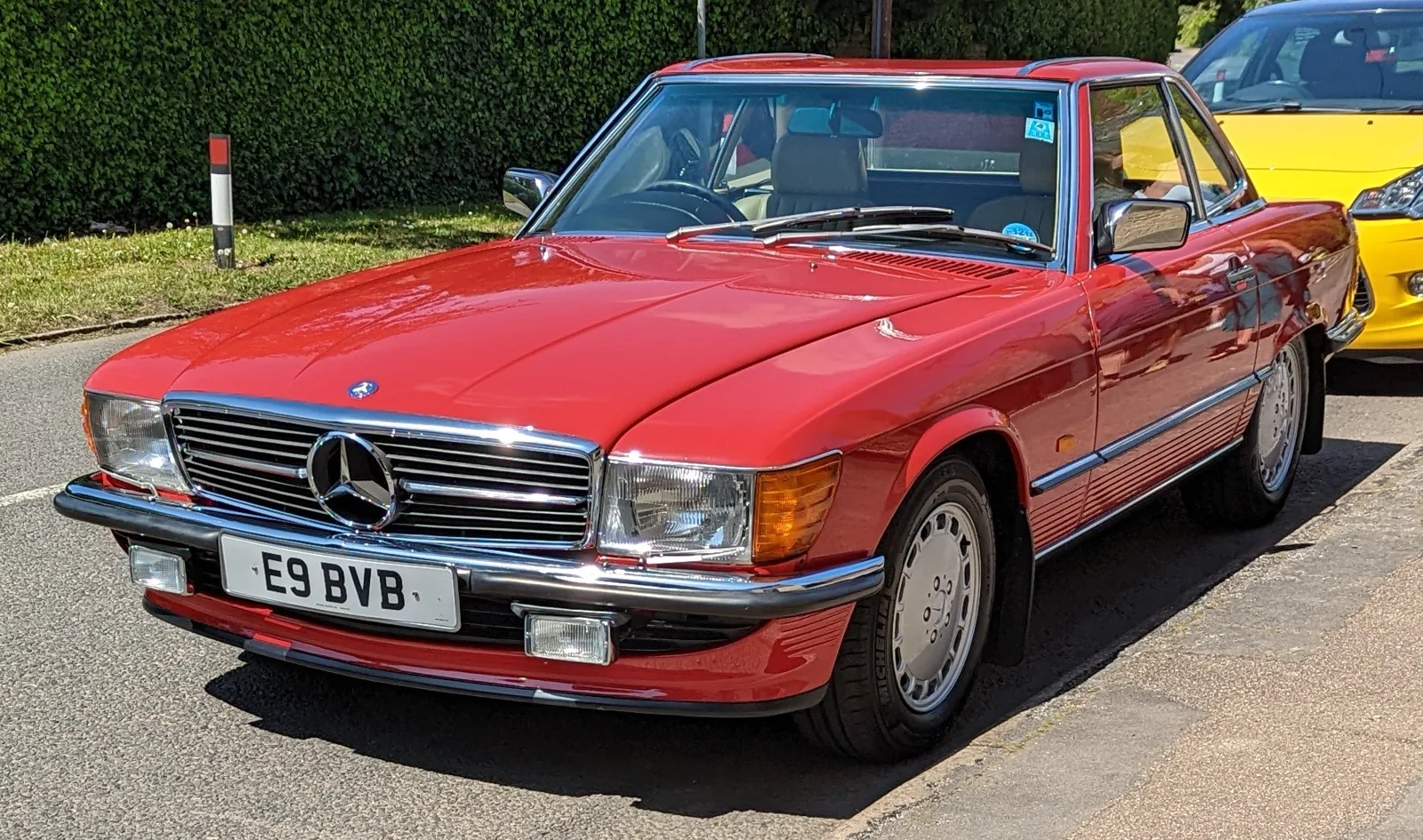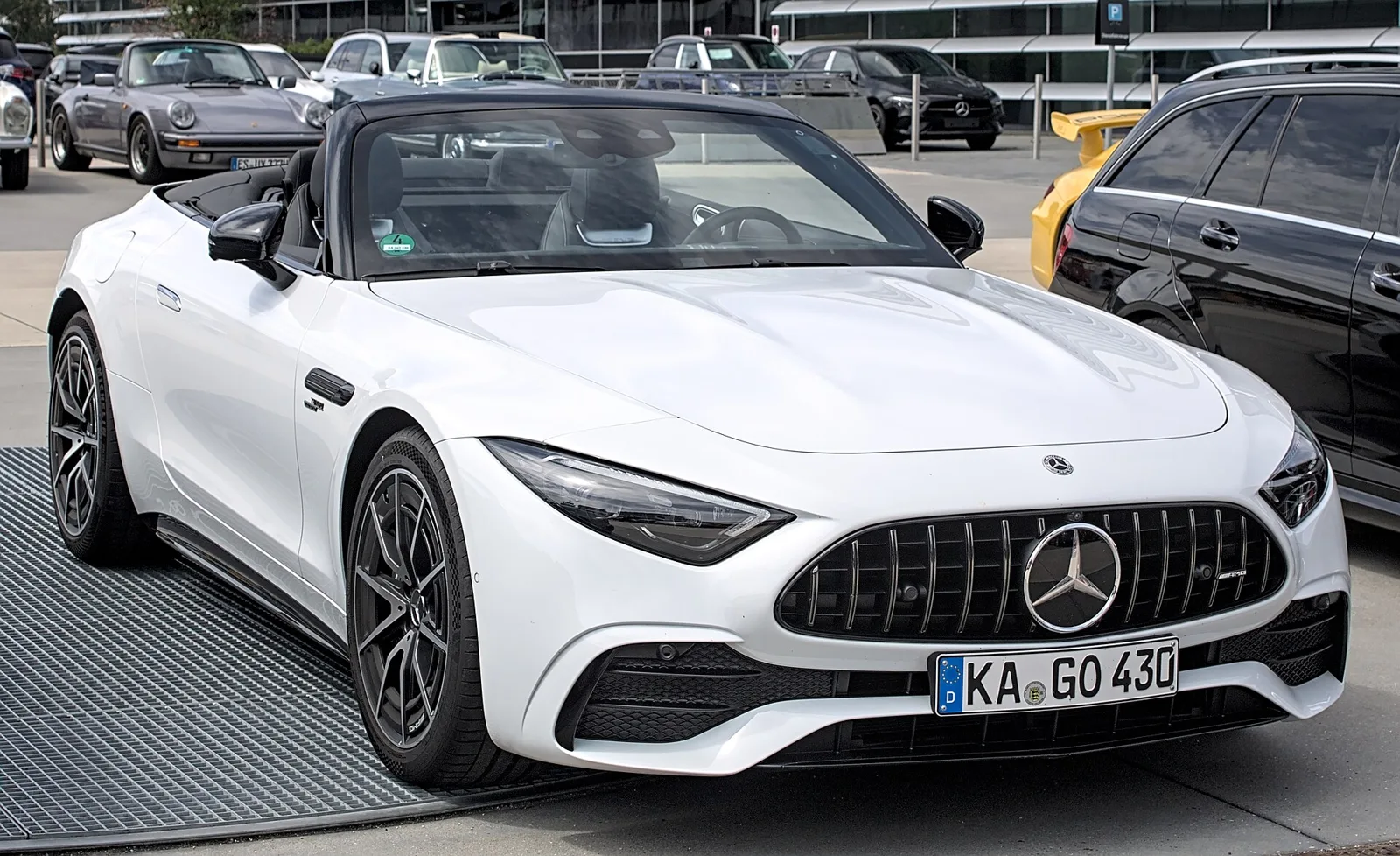
From the 1954 gullwing 300 SL and the 190 SL to the R107, R129, R230 and R231, a nameplate that is now an AMG-only roadster with a fabric roof.
The Mercedes-Benz SL-Class has been built since 1954, starting with the 300 SL gullwing coupe. SL stands for Super-Leicht, meaning super light, and the car has passed through seven generations to the AMG-only R232 of 2021.
Nobody at Mercedes-Benz planned to sell the 300 SL to the public. The car existed in 1952 as a racer, and it took an American importer with a feel for rich customers to turn it into the gullwing coupe of 1954. That accident of history started a nameplate that has now run for seven generations, from a spaceframe sports car to the AMG-only SL of today.
Where does the SL name come from?
SL is short for Super-Leicht, which translates as super light. When the 300 SL was shown publicly in 1952 Mercedes-Benz did not say what the letters meant, and the question stayed open for decades. A 2012 special issue of Auto Motor und Sport cited a notarised letter from Rudolf Uhlenhaut in favour of Super Leicht. Engelen, Riedner and Seufert, who worked with Uhlenhaut, had proposed Sport Leicht instead.
The name may also have echoed the 1931 Mercedes-Benz SSKL, short for Super Sport Kurz Leicht. Whether that link was intended is not known. For years the company used Sport Leicht and Super Leicht interchangeably, and its website carried Sport Leicht until 2017.
The argument ended in 2017, when a chance find in the corporate archive settled it for the 300 SL in favour of Super Leicht. Auto Motor und Sport then published, on 15 March 2021, a photocopy of an undated 1952 press release giving the same definition.
The letters stand for Super Leicht, a name Mercedes-Benz argued over for decades.
How did the 300 SL become a road car?
The 300 SL grew out of the W194, an endurance racer Daimler-Benz developed in 1951. It used the 3.0-litre straight-six M186, an engine it shared with the 300 saloon known as the Adenauer and with the 300 S grand tourer. With 175 hp (130 kW), the W194 gave away power to the Ferrari and Jaguar entries, but low weight and low drag kept it quick enough to win. Its successes in 1952 included Le Mans and the Carrera Panamericana.
For 1953 the engineers fitted direct fuel injection, 16-inch wheels and a gearbox on the rear axle, and gave the car a body of magnesium alloy that saved 85 kg (187 lb). Mercedes-Benz decided not to race it, choosing to enter Formula One in 1954.
The road car came from Max Hoffman, who imported Mercedes-Benz and other European makes to the United States. At a directors' meeting in Stuttgart in 1953 he argued that wealthy American enthusiasts, in a post-war market hungry for personal luxury cars, would buy a toned-down Grand Prix machine. Fritz Konecke, the new general director, accepted Hoffman's commitment to buy 1,000 cars, which underwrote the production run.
The 300 SL made its debut at the New York International Auto Show in February 1954, not at Frankfurt or Geneva where the company usually showed new cars. Production began at Sindelfingen in August of that year. The coupe cost DM 29,000 in Germany and $6,820 in the United States. The roadster that followed was dearer: DM 32,500 and $10,950, ten per cent more in Europe and over 70 per cent more in the US.
What made the 300 SL so quick?
The coupe was a road-going W194 with extensive body changes. Its steel tubular frame was so tall between the wheels that normal doors would not fit, and the same problem on the racer was why the gullwing door appeared at all. The frame also let the roofline sit well inside the body on each side, which cut frontal area.
The body was mainly sheet steel, with aluminium for the bonnet, boot lid, doors, dashboard and sill. An all-aluminium body could save another 80 kg (176 lb), but only 29 were made.
The M198 engine displaced 2,996 cc and replaced the racer's three twin-choke carburettors with Bosch mechanical direct fuel injection. Output climbed from 175 hp to 240 hp (179 kW; 243 PS), measured SAE gross at 6,100 rpm, with compression of 8.55:1. Dry sump lubrication kept oil flowing in fast corners and lowered the engine, which was also tilted 50 degrees toward the driver's side to fit under a low bonnet. Buyers of the coupe could specify, at no charge, a sports camshaft and 9.5:1 compression; the roadster had that engine only in 1957.
Depending on axle ratio, camshaft and bumpers, the 300 SL could reach 260 km/h (162 mph), which made it the fastest production car of its day. Fuel consumption was 17 litres per 100 km (14 mpg US; 17 mpg imperial).
In North America the coupe dominated the D Production class of the SCCA, winning titles in 1955 and 1956. When the class limit rose from 3.0 to 3.5 litres, Mercedes-Benz skipped a bigger engine and built two 300 SLS roadsters for 1957 instead. They lost the bumpers and the full windscreen, gained a roll bar and a solid cover over the passenger seat, and dropped from 1,420 kg (3,130 lb) to 1,040 kg (2,290 lb). With 235 hp (175 kW), the car driven by Paul O'Shea took the title again.
What was the 190 SL for?
Hoffman's order for 1,000 also covered a smaller roadster, and the 190 SL appeared as an affordable alternative to the 300 SL. Shown as a prototype at the 1954 New York show, it was built from May 1955 to February 1963. It shared the look, the engineering and the fully independent suspension of its sibling, with double wishbones in front and swing axles behind.
Rather than the costly tubular spaceframe, the 190 SL sat on a floorpan cut down from the W121 saloon's unitary structure. Its engine was the Type M121 BII, a 1.9-litre overhead-camshaft four based on the 300 SL's six: it kept the 85 mm bore and had a stroke cut to 83.6 mm, with twin-choke Solex carburettors. Output was quoted at 105 PS (77 kW; 104 hp), or 120 hp (89 kW; 122 PS) gross, and a detuned version later powered the W120 180 and W121 190 saloons.
The soft-top cost DM 16,500 (US$3,998) and the hardtop version DM 17,650 ($4,295). A small transverse third seat was optional. A sports-racing version in the early years had a small perspex screen, leather-covered bucket seats and aluminium doors, and the hardtop's rear window was enlarged in 1959.
Performance was the weak point. It topped out near 170 km/h (105 mph) and needed about 14 seconds to reach 100 km/h. Porsche's 356 1600S had 87 hp (65 kW; 88 PS), 30 hp less, but weighed only 850 kg (1,874 lb) and cost DM 3,000 less, which made it an equal on the road. Uhlenhaut wanted a six-cylinder car in response. A few prototypes were built in 1956, one with a 300 SL block in a 190 SL body for that year's Alpine Rally, and two others with fuel-injected 220SE engines that became the W127, or 220SL.
Two W127s driven by Uhlenhaut and Karl Kling in June 1956 beat a regular 190 SL round the Nordschleife by 25 seconds. The board decided on 12 April 1957 to build the six-cylinder 220SL alongside the 190 SL, yet production problems delayed it until the 230 SL overtook it.
Specifications by generation
| Model | Years | Engine |
|---|---|---|
| 300 SL Gullwing (W198) | 1954 to 1957 | 3.0 L inline-six, 240 hp gross |
| 300 SL Roadster | 1957 to 1963 | 3.0 L inline-six |
| 190 SL (W121) | 1955 to 1963 | 1.9 L four-cylinder, 105 PS |
| 230 SL (W113) | 1963 to 1967 | 2.3 L inline-six |
| 250 SL | 1967 to 1968 | 2.5 L inline-six |
| 280 SL (W113) | 1968 to 1971 | 2.8 L inline-six |
| 350 SL (R107) | 1971 to 1980 | 3.5 L V8 |
| 450 SL (R107) | 1973 to 1980 | 4.5 L V8 |
| 500 SL (R107) | 1981 to 1989 | 5.0 L V8 |
| 560 SL (R107) | 1986 to 1989 | 5.5 L V8 |
| 300 SL (R129) | 1989 to 1993 | 3.0 L inline-six |
| 600 SL (R129) | 1992 to 1993 | 6.0 L V12 |
| SL 500 (R129) | 1993 to 1998 | 5.0 L V8 |
| SL 73 AMG (R129) | 1995 and 1998 to 2001 | 7.3 L V12 |
| SL 350 (R230) | 2003 to 2011 | 3.7 L then 3.5 L V6 |
| SL 500 (R230) | 2001 to 2006 | 5.0 L V8 |
| SL 65 AMG (R230) | 2004 to 2011 | 6.0 L V12 |
| SL 400 and SL 450 (R231) | 2014 to 2020 | 3.0 L V6 |
| SL 500 and SL 550 (R231) | 2012 to 2020 | 4.7 L V8 |
| SL 65 AMG (R231) | 2012 to 2018 | 6.08 L V12 |
| SL 43 (R232) | 2022 onward | two-litre four-cylinder mild hybrid, 280 kW |
| SL 55 and SL 63 (R232) | 2022 onward | 4.0 L twin-turbo V8, 350 kW and 430 kW |
Why did the W113 get a pagoda roof?
The W113 of 1963 replaced both the 300 SL and the 190 SL. The 230 SL took its nickname from a concave roofline, which looked like the top of a pagoda. It had a low waistline, big curved windows and a detachable hardtop, with a new 2.3-litre straight-six.
The engine grew to 2.5 litres for 1967, and the car became the 250 SL. Inside there was new dashboard padding, switches and knobs, a new steering wheel and, on US cars only, door pockets. A year later, in 1968, it went to 2.8 litres and the 280 SL name.
How long did the R107 last?
The R107 of 1971 set a new design direction and introduced safety ideas that later Mercedes-Benz models adopted. It was the first SL with V8 engines. Production ran until 1989, among the longest runs the company has had.
Changes came slowly. A very minor update in 1972 brought rubber-edged mirrors from the W116. For the 1981 model year new aluminium V8s from the W126 S-Class, introduced in 1979, took over while the 2.8-litre six carried on. The bigger revision followed in 1985 for 1986, when a 3.0-litre six from the W124 appeared, together with V8s enlarged to 4.2 and 5.5 litres, while the 5.0 carried over.
The 1985 update added a deeper front air dam, larger brake discs with four-piston calipers and a driver's airbag, standard in the United States and an extra-cost option in Europe, where a catalyst was also offered. US cars stayed with their big 5-mph bumpers and the four round sealed-beam headlights, even after American rules allowed 2.5-mph bumpers from the 1982 model year and form-fitting lamps from 1983. US cars gained a third brake lamp on the boot lid in 1986. The 560 SL went only to North America, Japan and Australia.
The SLC coupe was much rarer, built from 1971 to 1981 as the 280, 350, 380 and 450 SLC. At the end of the 1970s Daimler-Benz put the 450 SLC, a 5.0-litre 450 SLC and the 500 SLC into major rallies: the 30,000 km Vuelta a America del Sud in 1977, the Safari Rally in 1979 and the Bandama Rally.
What did the R129 bring?
The R129 of 1989 was a two-seat convertible with a removable hardtop, and it packed a lot of firsts. It was the first Mercedes with a fully automatic, hydraulically operated fabric roof, its V8 and later V12 engines had four valves per cylinder, and an automatic rollbar rose by itself in a rollover. A console switch could raise or lower that bar by hand. Projector-lens HID headlamps came in 1995.
In 1992 the R129 became the first SL with a V12, the 600 SL, and the first to be offered in official AMG forms, starting with the 500 SL 6.0 AMG, then the V8 SL 60 AMG and SL 55 AMG and the V12 SL 70 AMG and SL 73 AMG. It was the last SL offered with a manual gearbox. In the US it was also the first SL with an inline-six, the 300 SL-24, since 1971.
The 1994 revision brought small cosmetic and technical changes and a new naming system. The 3.0-litre sixes, first sold with a 12-valve head in the 300 SL and a 24-valve head in the 300 SL-24, became one engine in two sizes, 2.8 and 3.2 litres, both with 24 valves. The 300 SL and 300 SL-24 turned into the SL 280 and SL 320, and the 500 SL and 600 SL into the SL 500 and SL 600. A larger 3.2-litre engine reached the SL 320 for 1995, and it left the US market in 1998.
The 1998 update was a major one. Engines came from the new W220 S-Class, in V6, V8 and V12 form, each with twin spark plugs and three valves per cylinder.
How did the R230 and R231 differ?
The R230 appeared in 2001 as the fifth generation, carrying on the R129 with smoother bodywork and peanut-shaped headlamps. It had a Vario Roof retractable hardtop, as first used on the 1996 SLK, along with Active Body Control, the Keyless Go smart key and Sensotronic Brake Control. The brake system proved troublesome, since the effort was hard to modulate, and Mercedes-Benz later disabled it in a large recall.
A minor cosmetic update and revised engines came in 2006. The 2008 facelift went further, with new and revised engines, a front end recalling the original 300 SL, with a big grille and two power domes on the bonnet, new headlamps that could be had with an Intelligent Light System, and speed-sensitive steering. The SL 63 AMG took the SL 55 AMG's place, and the SL 65 AMG Black Series came as a coupe alone.
Production of the R230 totalled 169,433 cars. The most common was the SL500, at around 100,000 units, and the rarest was the SL65 AMG with 3,055, of which 350 were Black Series cars. The SL 500 grew from 5.0 to 5.5 litres in 2006 and was sold as the SL 550 in North America.
The R231 debuted in January 2012 at the North American International Auto Show. It brought aluminium bodywork, though the weight saved was offset by extra safety and convenience equipment. It was longer and wider than the R230, with elbow room up 28 mm (1.1 in) and shoulder room 37 mm (1.5 in).
FrontBass, the car's sound system, turned hollow sections of the aluminium structure in front of the footwells into resonance chambers for the bass speakers. The wipers also fed washer fluid through the blade itself. Semi-active damping was standard and Active Body Control cost extra.
The update of 2016, for the 2017 model year, brought a revised nose and grille, larger non-functional vents behind the front wheels, adaptive LED headlights and new tail lights. It also fitted the nine-speed 9G-TRONIC Plus automatic to the SL 400, SL 450 and SL 500 for the first time, and the SL 350 became the SL 400 (SL 450 in North America). The Vario Roof could now operate at speeds up to 40 km/h (25 mph). Engines ranged from the 3.5-litre V6 of the SL 350 to the 4.7-litre V8 of the SL 500 and SL 550, the 5.5-litre V8 in the SL 63 AMG and the 6.08-litre V12 of the SL 65 AMG.
What is the R232?
The seventh generation, presented on 28 October 2021, is confirmed as an AMG model only, and it effectively replaces the AMG GT Roadster. It was sold solely as a Mercedes-AMG until the Mercedes-Maybach SL arrived in August 2024. There are three powertrains. The SL 43 has a two-litre mild-hybrid four-cylinder producing 280 kW (381 PS; 375 bhp) with 480 Nm (354 lb ft), the first inline-four in an SL since the 190 SL. The SL 55 and SL 63 share a 4.0-litre twin-turbo V8. The SL 55 makes 350 kW (476 PS; 469 bhp) with 700 Nm (516 lb ft); the SL 63 gives 430 kW (585 PS; 577 bhp) with 800 Nm (590 lb ft).
Both V8 models come only with all-wheel drive, the first time the SL has offered it, using the fourth generation of 4Matic. Rear-axle steering is fitted as well. The car sits on an aluminium spaceframe developed by AMG, rated 50 per cent stiffer across the car and 40 per cent along it than the GT roadster platform. AMG's technical chief Jochen Hermann has said the shell weighs 270 kg (595 lb).
The folding metal roof is gone. The R232 reverts to a fabric roof worked by electric motors rather than hydraulics, which saves 21 kg (46 lb), lowers the centre of gravity and allows a more sloping tail. The car also brings 2+2 seating as standard rather than as an option, with rear seats suited to people up to 1.5 metres tall. A symmetrical dashboard carries a digital instrument cluster of 12.3 inches and, in the centre, an 11.9-inch touchscreen. The cluster sits in a binnacle against sun reflections, and the screen tilts electrically to the vertical.