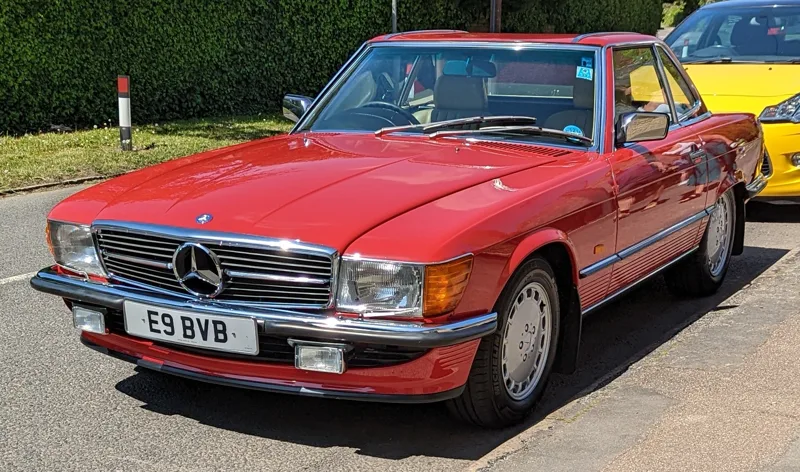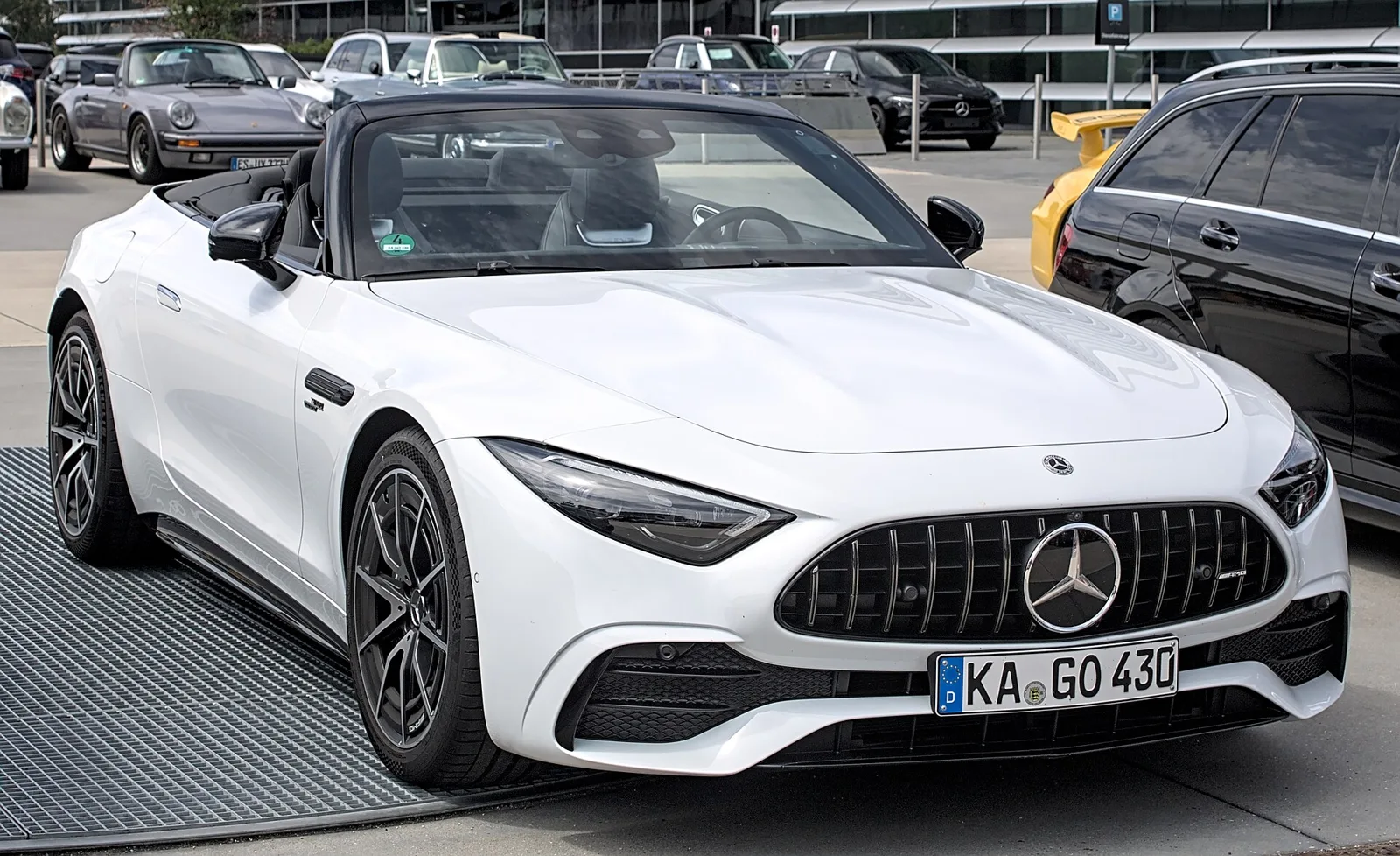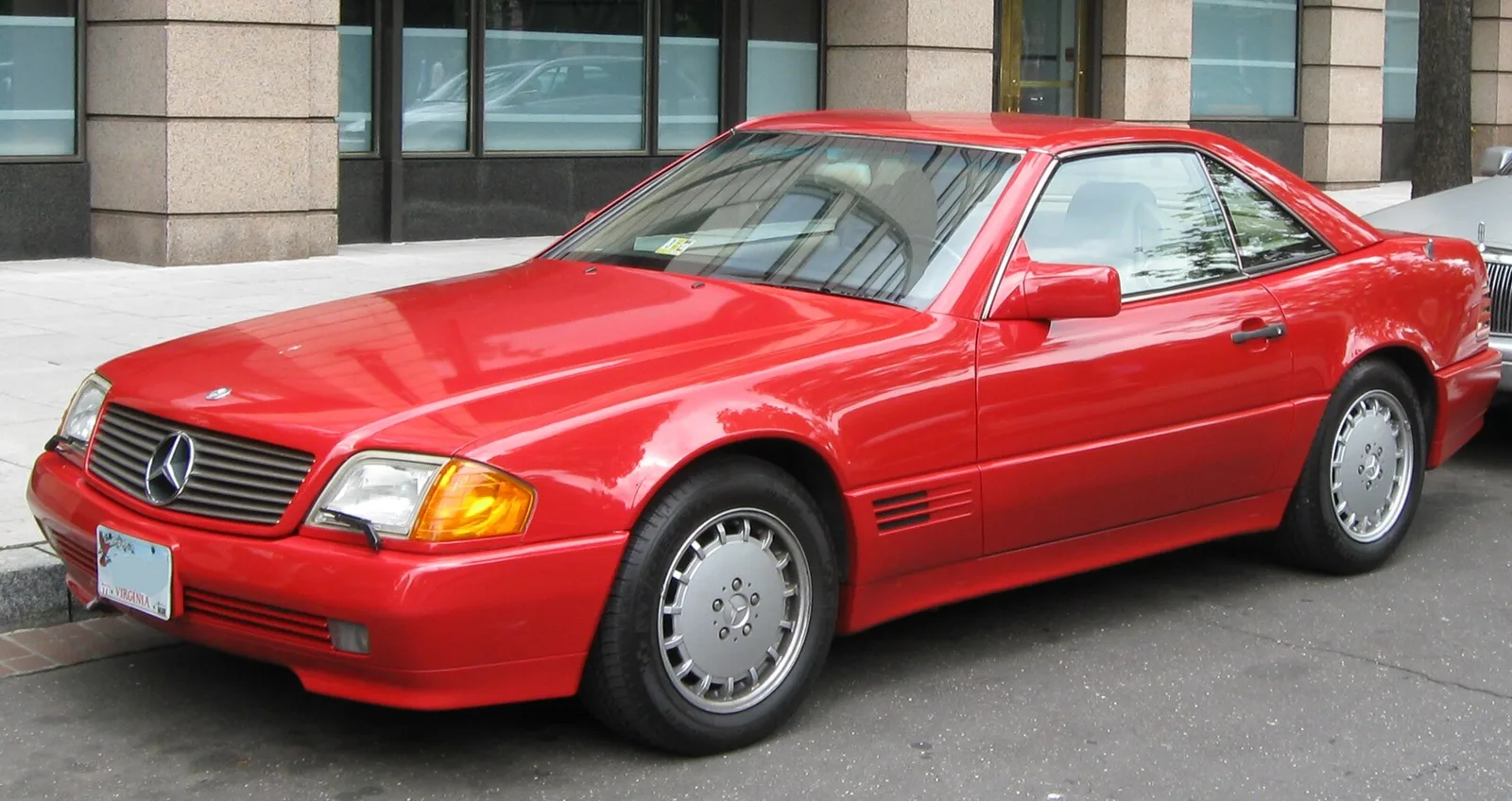
Designed in 1984 on a shortened W124 floorpan, the R129 SL ran from 1988 to 2001 with a fabric roof, a detachable hardtop, a V12 option and AMG models up to 518 hp.
Built from 1988 to 2001, the Mercedes-Benz R129 SL offered six-cylinder, V8 and V12 engines, a fabric roof with a detachable hardtop and seats with integrated seat belts. AMG versions reached 518 hp, and the range was revised in 1995, 1996, 1997 and 1999.
The R129 was the fourth-generation Mercedes-Benz SL, a two-door roadster built from 1988 to 2001. It arrived with an automated fabric roof, a hidden roll-over bar and a range of six-cylinder, V8 and V12 engines. It was also the first passenger car with seat belts integrated into its seats.
Where did the R129 SL come from?
The R129 was designed in 1984 on a shortened floorpan from the Mercedes-Benz W124 saloon. It replaced the R107 in 1989, when it was presented at the Geneva show in March 1989. Left-hand drive cars went on sale that summer, and right-hand drive followed in the autumn.
The car finished runner-up for European Car of the Year, behind the Citroen XM. Its engineers also modernised the rear end, replacing the earlier semi-trailing arms with a multi-link axle.
The roof was electro-hydraulic and fully automated. A colour-matched tonneau cover sat over the stored fabric roof, and a manually detachable hardtop could be fitted on top of both.
A roll-over bar was hidden in the body and extended automatically when needed. The seat belts were mounted in the seats themselves, rather than being anchored to the floor, the B-pillar and the transmission tunnel.
A fabric roof, integrated seat belts and a V12 option defined the R129 SL roadster.
Which engines did the R129 use?
The launch line-up had three engines: the 300 SL with a 188 hp (191 PS; 140 kW) six, the 300 SL-24 with 228 hp (231 PS; 170 kW), and the 500 SL with a 322 hp (326 PS; 240 kW) V8. The 600 SL V12, with 389 hp (394 PS; 290 kW), joined in July 1992.
Six-cylinder cars could be ordered with a five-speed manual or a four- or five-speed automatic, while the V8 and V12 came only with a four-speed automatic. The 500 SL's 5.0-litre V8 drew most of the attention in North America.
In the autumn of 1993 the six-cylinder cars were renamed. The SL 280 used a 2.8-litre six making 190 hp (193 PS; 142 kW), the SL 320 a 3.2-litre six making 228 hp (231 PS; 170 kW), and only the 280 offered a manual gearbox.
The 1998 facelift brought new V6 engines: the SL 280 made 201 hp (204 PS; 150 kW) and the SL 320 made 221 hp (224 PS; 165 kW). The SL 500 V8 rose to 302 hp (306 PS; 225 kW), and the V12 stayed unchanged.
How did the R129 change through its run?
The updates came in steps across the model's life, and the 1995 cars were the first to receive them. The 1995 cars gained an electronic odometer and a portable phone with voice dialling as an option. A Bose stereo with rear speakers and a subwoofer became standard, and US models received clear front indicators.
The 1996 facelift brought body-colour bumpers and new front wing vents with two rounded slots. The V8 and V12 moved from a hydraulic four-speed to a five-speed electronic gearbox, side airbags were added, and Xenon headlamps became standard on the SL 600.
In 1997 a panoramic roof arrived, along with rain-sensing wipers and a HomeLink transmitter in the rear-view mirror. A Sport package was also offered, and a passenger occupant sensor could switch off the passenger airbag when a light load sat in the seat.
The 1999 refresh was the biggest change of the run. The SL 500 swapped its M119 V8 for the M113, Nappa leather replaced the perforated seats, and the taillights gained curved faces. Tip-start, a one-touch starter, also arrived.
Why did the SL names change in 1994?
For the 1994 model year Mercedes reversed the alphanumeric naming so that the class letters came before the number. It was the first major change to the naming convention in decades, and the 500 SL became the SL 500 in the new order.
Depending on the engine, the 300 SL turned into either an SL 280 or an SL 320, and the 300 SL-24 went through the same renaming. The V12 car kept its SL 600 name under the new format, and the 1994 change applied to the whole SL range, from the 1994 model year onwards.
What were the AMG SL models?
AMG sold a family of special SLs through Daimler-Benz dealers, and the most numerous was the SL 60. It used a 6.0-litre V8 producing 375 hp (380 PS; 280 kW), reached 100 km/h in 5.4 seconds and its top speed was capped at 250 km/h (155 mph).
The SL 72 AMG was extremely rare, with 35 examples built in 1995. Its 7.1-litre V12 produced 510 PS (375 kW; 503 hp), the most powerful V12 fitted to an SL up to that point.
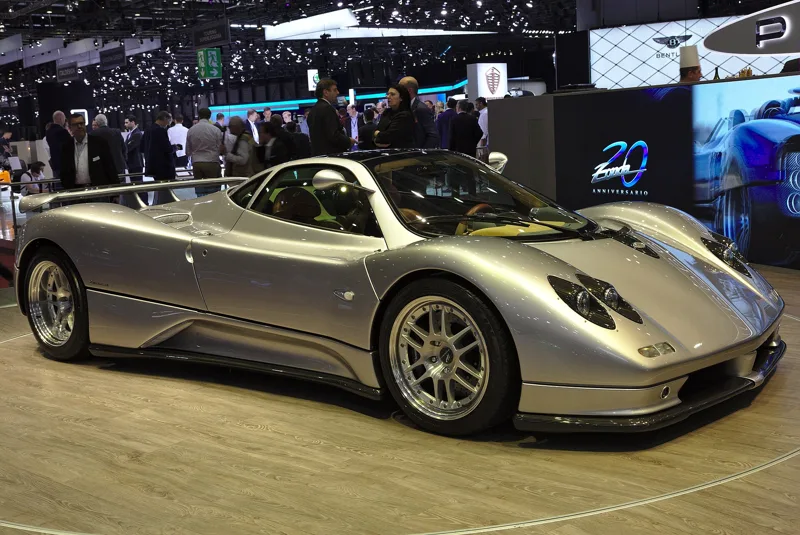
The SL 73 AMG, built from 1997 to 2001, used a 7.3-litre V12 that made 518 hp (525 PS; 386 kW), reached at 5,500 rpm, along with 750 Nm (553 lbf ft) of torque. It could reach 100 km/h in no more than 4.5 seconds and topped 320 km/h (199 mph), and only 50 cars were made. Its engine was later used by Pagani in the Zonda.
The SL 70 AMG had a 7.1-litre V12 with 496 PS (365 kW; 489 bhp), and 150 units were built in 1996 and 1997. The SL 55 AMG followed from 1998 to 2001 with a 5.4-litre V8 producing 349 hp (354 PS; 260 kW), and only 65 cars were made.
Limited and special editions
The Mille Miglia edition of 1995 marked the 40th anniversary of Stirling Moss's win in the 1955 race. The edition was planned at 600 units, but only 40 were built, and Stirling Moss was handed the first SL 500 built.
The Silver Arrow Edition of 2002 celebrated the pre-war Silver Arrow racers with 777 metallic paint, a full AMG body and two-piece BBS wheels. The US received 1,550 units, 100 SL 600 and 1,450 SL 500, while the UK received 100 SL 500 models.
Other editions included a 40th Anniversary Roadster and La Costa in 1997, a Special Edition in 1998, a Final Edition and an SL Edition in 2000, Designo Slate Blue and Black Diamond cars in North America for 2000 and 2001, and an F1 Edition in 2001.
How did the SL sell in Australia and North America?
The 500SL reached Australia in May 1990, the 600SL followed in May 1993, and a six-cylinder SL arrived with the SL280 in October 1995. Only 38 600SL cars were delivered to Australia. Australian buyers therefore had the V8 first, with six-cylinder cars arriving years later.
In North America the base car was the 300 SL with 228 hp in 1990, but the 322 hp 500 SL made the headlines. The 600 SL arrived for model year 1993, and the manual gearbox was dropped after only 397 examples had been imported over four model years.
In 1994 the SL 320 took over from the 300 SL in the US, and the six-cylinder SLs were dropped from the American range in 1998. That left only the V8 and V12 cars on sale.
Media attention in 1991 and 1992
In 1991 the car drew wide coverage after Diana, Princess of Wales, gave up her Jaguar XJS for a metallic-red 500 SL on lease. The choice of a foreign car by a British royal sparked a media storm, and the pressure eventually forced her to hand the car back to Mercedes-Benz in 1992.
The car now resides in the Mercedes-Benz Museum.
Specifications at a glance
| Specification | Detail |
|---|---|
| Production | 1988 to 2001 |
| Designed | 1984, on a shortened W124 floorpan |
| Predecessor and successor | R107, then R230 SL-Class |
| 300 SL | 3.0-litre six; 188 hp (191 PS; 140 kW) |
| 500 SL | 5.0-litre V8; 322 hp (326 PS; 240 kW) |
| 600 SL | 6.0-litre V12; 389 hp (394 PS; 290 kW) |
| Fuel capacity | 79.8 L (21.1 US gal) on 500 SL and 600 SL |
| Curb weight | 2020 kg (4,455 lb) for the 600 SL |
| Brakes | Power-assisted four-wheel discs with ABS |
| Tyres (1990 to 1995) | 225/55 ZR 16 steel-belted radials |