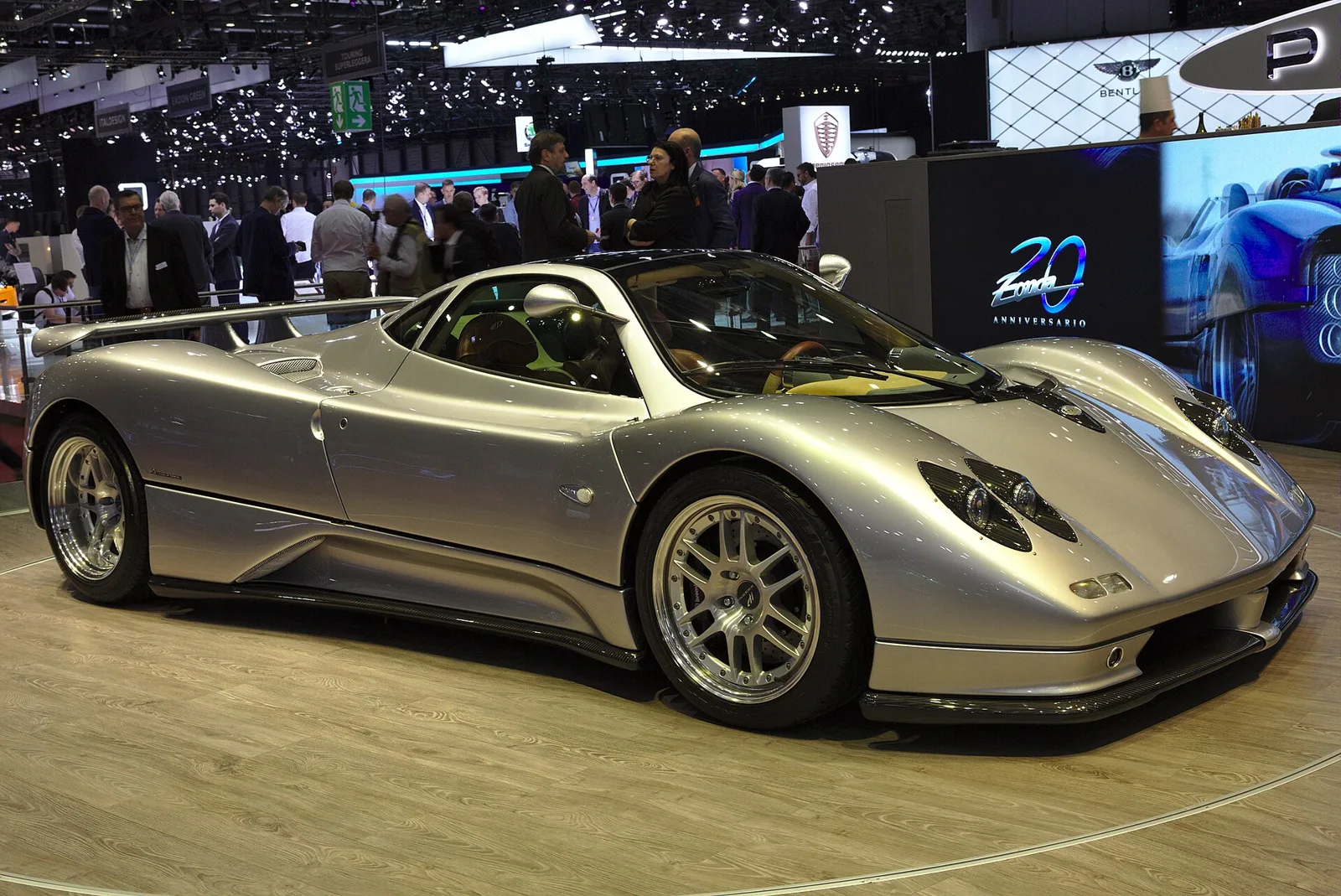
An Italian hypercar maker founded by a former Lamborghini composites engineer, built on Mercedes-AMG V12s and an unusually personal bespoke programme.
Pagani is an Italian hypercar maker founded in 1992 by Horacio Pagani, a former Lamborghini composites engineer. It built the Zonda, Huayra and Utopia on Mercedes-AMG V12 engines, set a 6:47 Nurburgring record in 2010 and limits its output to small, bespoke runs.
Pagani is a hypercar maker from near Modena in Italy, founded in 1992 by Horacio Pagani, an engineer of Argentine and Italian background. Its reputation rests on carbon construction, V12 power and very small production runs. From the Zonda through the Huayra to the Utopia, each generation has been built in limited numbers, often with bespoke commissions for individual buyers.
Where did Horacio Pagani get his start?
Before the company existed, Pagani ran the composites group at Lamborghini. In 1988 he founded Pagani Composite Research, a business that did contract work for Lamborghini on projects including a restyled Countach 25th Anniversary Edition, the LM002, the P140 concept and the Diablo.
That contract work gave him a grounding in carbon and composite construction, which later became the core of his own cars. His first personal project was internally called the C8, and he wanted to rename it the Fangio F1 in honour of his friend, the Argentine driver Juan Manuel Fangio.
From a Lamborghini composites engineer's own project to the Utopia, Pagani has built its reputation on carbon, V12 power and bespoke craft.
How did the Fangio prototype become the Zonda?
In 1991 Pagani set up Modena Design to handle a growing workload in design, engineering and prototyping. The new firm gave him the capacity to take his own car from paper to hardware, and it became the base for the work that followed.
In 1992 work started on a Fangio F1 prototype; in 1993 that prototype underwent testing at the Dallara wind tunnel, with encouraging results. That testing gave him the aerodynamic confidence to push toward a production car.
A major step came in 1994, when Mercedes-Benz agreed to supply V12 engines. The engine deal became the foundation of the performance that customers would later associate with the marque, and it shaped every car that followed.
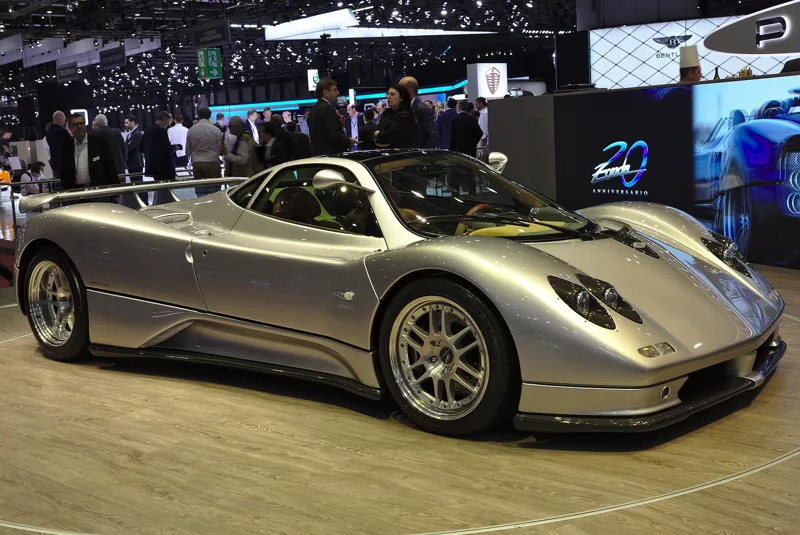
The production car took the name Zonda C12. The Fangio name was retired out of respect after the driver's death in 1995, and the Zonda made its public debut at the 1999 Geneva Motor Show as the first car in what became a family.
What shaped the look and engineering of the Zonda?
The Zonda's shape owed something to jet fighters and to the Sauber-Mercedes Group C racing cars. A circular arrangement of four exhaust pipes became one of its most recognisable details, a visual link to its racing inspiration.
Its mid-mounted DOHC V12 was produced by the AMG division of Mercedes-Benz, a supplier that has stayed central to the company's engine strategy for decades. The original C12 used a 6.0 L engine of 5,987 cc, while the C12-S grew to 7.0 L, or 7,010 cc.
The Zonda S took the family to 7.3 L, or 7,291 cc, the largest of the early V12 options. Each step up in capacity gave the line a stronger identity and told the story of the company's rising ambitions.
How ambitious was the company in the 2000s?
In 2005 Pagani said it planned to triple production within three years and to enter the American market in 2007. Those targets reflected confidence in demand, and they set a higher bar for a small workshop that had built its reputation through craft.
The engineering credentials were tested on track as well. On 30 June 2010 a Zonda R completed the Nurburgring in 6:47, a production-based record that beat the Ferrari 599XX and gave the company a notable performance credential.
Which Zonda variants should enthusiasts know?
The Roadster opened up the coupe's silhouette. The F, Roadster F, F Clubsport and Roadster F Clubsport formed a more focused group of versions, while track-oriented cars such as the Zonda GR and the track-only Zonda R sat at the sharp end of the range.
Other production versions included the Revolucion, the HP Barchetta and the Revo Barchetta. Only three HP Barchetta cars were produced, and one stayed in the founder's personal collection while the other two were priced at US$15M.
What was the Zonda Cinque?
Introduced as a 2009 model, the Cinque came from the track-only Zonda R but carried a 669 hp output (678 PS; 499 kW) from an M297 V12 built by Mercedes-Benz. It also had active aerodynamics and bodywork in carbon-titanium fibre, a material the company said was stronger and lighter than ordinary carbon.
Its figures were striking. The car reached 0-60 mph in 3.4 seconds and 0-124 mph in 9.6 seconds, topping out at 217 mph (349 km/h). Brembo carbon-ceramic brakes hauled it down from 62 mph in 3.1 seconds, and the body generated 750 kg (1,653 lb) at 186 mph (300 km/h) in aerodynamic load.
Only five Cinque coupes were built, and all were already spoken for. A Cinque Roadster followed in July 2009, with five built, using the same M297 V12 but a structure made lighter and stronger to keep the open car rigid.
How did the Tricolore come about?
The Tricolore arrived at the 2010 Geneva show as a tribute to the Frecce Tricolori, the Italian Air Force's display squadron, marking the fiftieth anniversary of the team's formation. It was originally meant to be a single car, but three were eventually built.
Based on a top-specification Cinque, the Tricolore used a carbon titanium chassis, a sequential transmission and titanium exhausts. Its 7.3 L M297 V12 produced 661 hp (670 PS; 493 kW), enough for 0-60 mph in 3.2 seconds.
Why do the Zonda bespoke editions matter?
Pagani has a long tradition of one-off commissions. The 2004 C12 S Monza was a track day machine built on the GR and ordered by King Moka, and the 2009 PS, originally finished in white with gold contrast, was ordered by Peter Saywell.
Others carried more colourful schemes. A sky blue HH from 2011 belonged to the programmer David Heinemeier Hansson, a purple 760LH from 2012 was the work of F1 driver Lewis Hamilton, and a 2017 Fantasma Evo combined red-tinted carbon with Italian flag stripes. A snow white Riviera followed in 2018 with bare carbon and blue accents.
Each commission was tailored to its owner. The list of editions shows how far the company was willing to go to match a client's taste, and why its cars are so often treated as individual works of art.
What did the Huayra introduce?
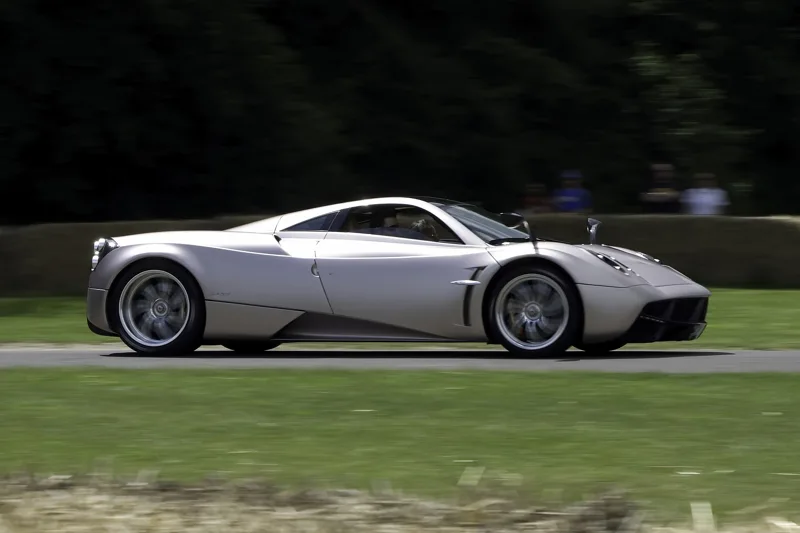
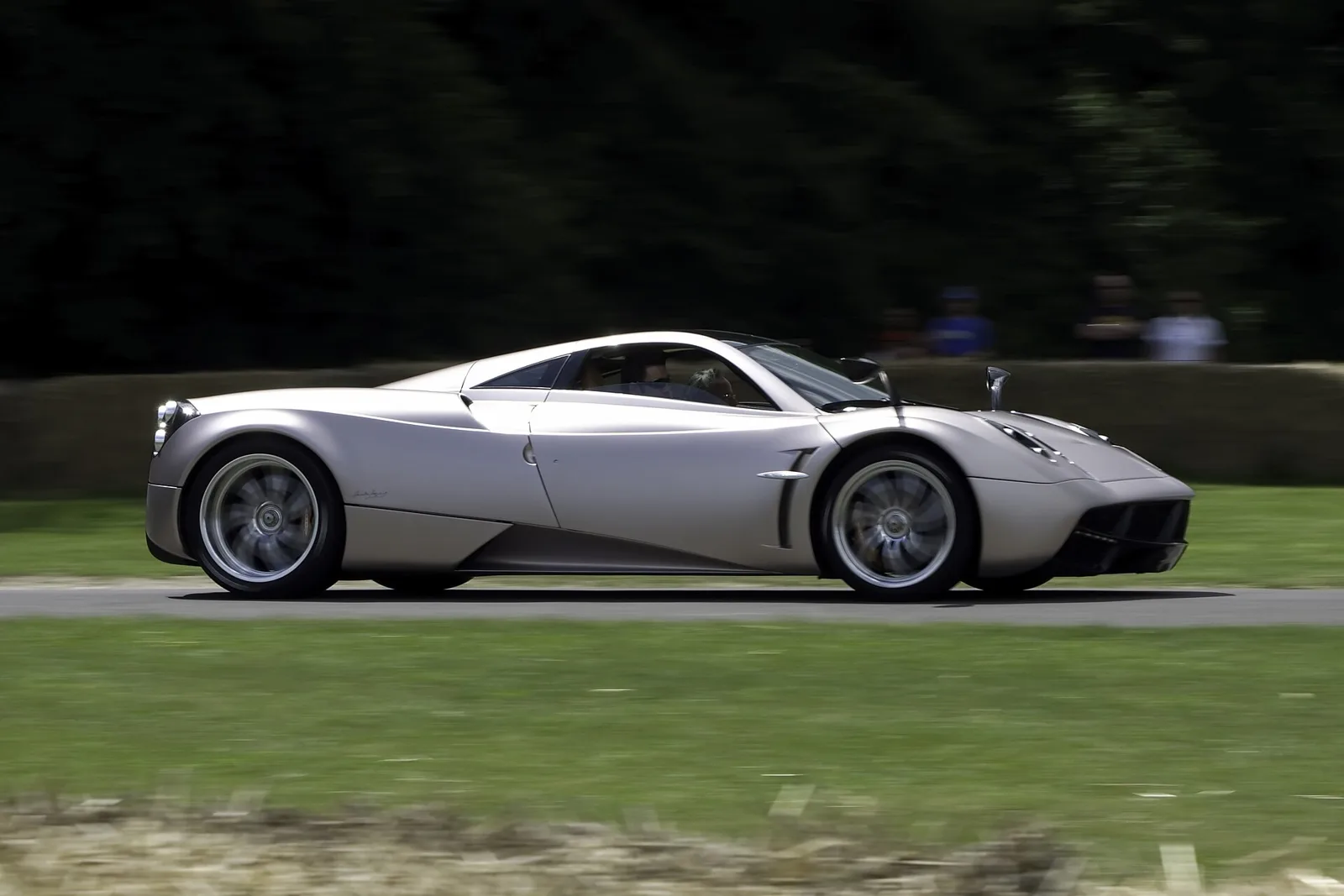
The Huayra's name comes from Huayra-tata, a Quechua wind deity. Its first public appearance came through an online announcement dated 25 January 2011, and it was formally shown at the 2011 Geneva Motor Show. Although the car was rebuilt from the ground up, its styling kept a family resemblance to the Zonda.
Under the bodywork sat a 6.0-litre twin-turbo M158 V12 from Mercedes-AMG. Its output was 730 hp, or 740 PS, reached at 5800 rpm, with 544 kW on the same peak. Torque peaked at 1,000 N m, and the body was made of carbotanium, a blend of carbon fibre and titanium.
Quoted performance included 0-60 mph in 3.2 seconds and 235 mph (378 km/h) flat out. Only 100 cars were built, and each cost 1,000,000 pounds (1.05 million US dollars) before options.
What are the Huayra's main dimensions?
The coupe measured 4,605 mm (181.3 in) in length, with a wheelbase of 2,795 mm (110.0 in), a width of 2,036 mm (80.2 in) and a height of 1,169 mm (46.0 in). Its dry weight was 1,350 kg (2,976 lb), split 44 percent to the front and 56 percent to the rear.
Its drag figure ranged from .31 to .36 depending on configuration. The gearbox was a 7-speed sequential manual with an automated robotic system and several driving modes, which kept the car accessible to a wider range of drivers.
What made the Huayra BC special?
The Huayra BC arrived at the 2016 Geneva Motor Show as a track-focused car named for Benny Caiola, a close associate of Horacio Pagani and the company's first customer. Its engine delivered 764 PS (562 kW; 754 hp), while torque was 1,000 N m.
Weight fell by 132 kg (291 lb), to 1,218 kg (2,685 lb). The company credited a new material, carbon-triax, which it said was 50 percent lighter and 20 percent stronger than standard carbon fibre, and the car reached a power-to-weight ratio of 1.62 kg per hp (3.57 lb per horsepower).
The BC used a single-clutch Xtrac 7-speed sequential unit, which Pagani kept because it weighed 40 percent less than double-clutch units. The company had claimed a cap of 20 cars, but 30 were made, and each cost more than 2.1 million euros (2.21 million US dollars). A Roadster BC followed in a run of 40 units.
What is the Huayra Roadster?
The Roadster was shown at the 2017 Geneva show after two years of development. Its designers gave it conventional doors, since gull-wing doors would not suit an open-top body, and they revised the rear with new flaps, vents over the engine and new wheels.
The twin-turbo V12 was tuned to 764 PS, 562 kW and 754 hp, peaking at 6,200 rpm. The car weighed 1,280 kg (2,820 lb), 70 kg (154 lb) below the coupe, which made it the first roadster in the line lighter than its coupe counterpart.
Pagani said the Roadster could sustain 1.8 G of lateral acceleration. Only 100 were made, and all sold before production ended.
Which Huayra one-offs were built?
The Huayra family continued the bespoke tradition. A Carbon Edition left the car in bare carbon, a White Edition used snow white paint with carbon details, and the La Monza Lisa combined bare carbon with tri-colore pinstriping for its commissioning owner, Kris Singh.
Further commissions included a tinted blue Da Vinci version with gold accents, first ordered by Alejandro Salomon, and a Kingtasma in tinted red carbon with a roof scoop. The Pearl used a split rear wing, and the Dinastia trio was made for Chinese customers. Five Codalunga longtails were built, and one Hermes coach-built edition was a one-off.
What is the Utopia?
Revealed on 12 September 2022, the Utopia succeeded the Huayra. Plans called for 99 closed coupes, with open and track versions possible later. All 99 were spoken for before the first car reached a customer in October 2023.
The Utopia keeps the Huayra's twin-turbo V12, designed with Mercedes-AMG, but its output rises to 852 hp, or 864 PS and 635 kW, at 6000 rpm. Torque reaches 1,100 N m (811 lb-ft) across 2800 to 5900 rpm.
The 7-speed transverse unit was developed with Xtrac and can be specified with a traditional manual shift or a robotised version. It links to an electro-mechanical differential through a triple plate clutch.
How closely is Mercedes-AMG tied to Pagani?
Mercedes-AMG is the usual engine partner. Pagani's cars often carry a V12 developed in collaboration with AMG, from the Zonda's engine through to the Huayra and Utopia units.
The partnership lets a small maker focus on body and chassis while relying on a larger manufacturer's engine expertise. It is a common route for specialist builders that need proven powertrains.
How has the company's story been recorded?
A book, Pagani: The Story of a Dream, was published in 2010 by Roberto Morelli and Hugo Racca. It offers a published account of the company's early years and the ambitions behind the Zonda.
Pagani's own craft has long been central to that story. The company's carbon work, its one-off commissions and its small runs all reflect a builder who treats each car as a personal project rather than a volume product.
What are the key figures for Pagani?
| Specification | Detail |
|---|---|
| Founded | 1992, by Horacio Pagani |
| Headquarters | San Cesario sul Panaro, near Modena |
| Zonda C12 engine | 6.0 L (5,987 cc) V12 |
| Zonda S engine | 7.3 L (7,291 cc) V12 |
| Zonda Nurburgring time | 6:47, 30 June 2010 |
| Huayra engine | 544 kW (740 PS; 730 hp), 6.0-litre twin-turbo |
| Huayra units | 100 |
| Huayra BC weight | 1,218 kg (2,685 lb) |
| Huayra Roadster weight | 1,280 kg (2,820 lb) |
| Utopia coupes | 99 |