A limited-run Mercedes-AMG twin-turbo V12 hypercar that spawned a family of coupe, roadster, track and one-off models between 2016 and 2025.
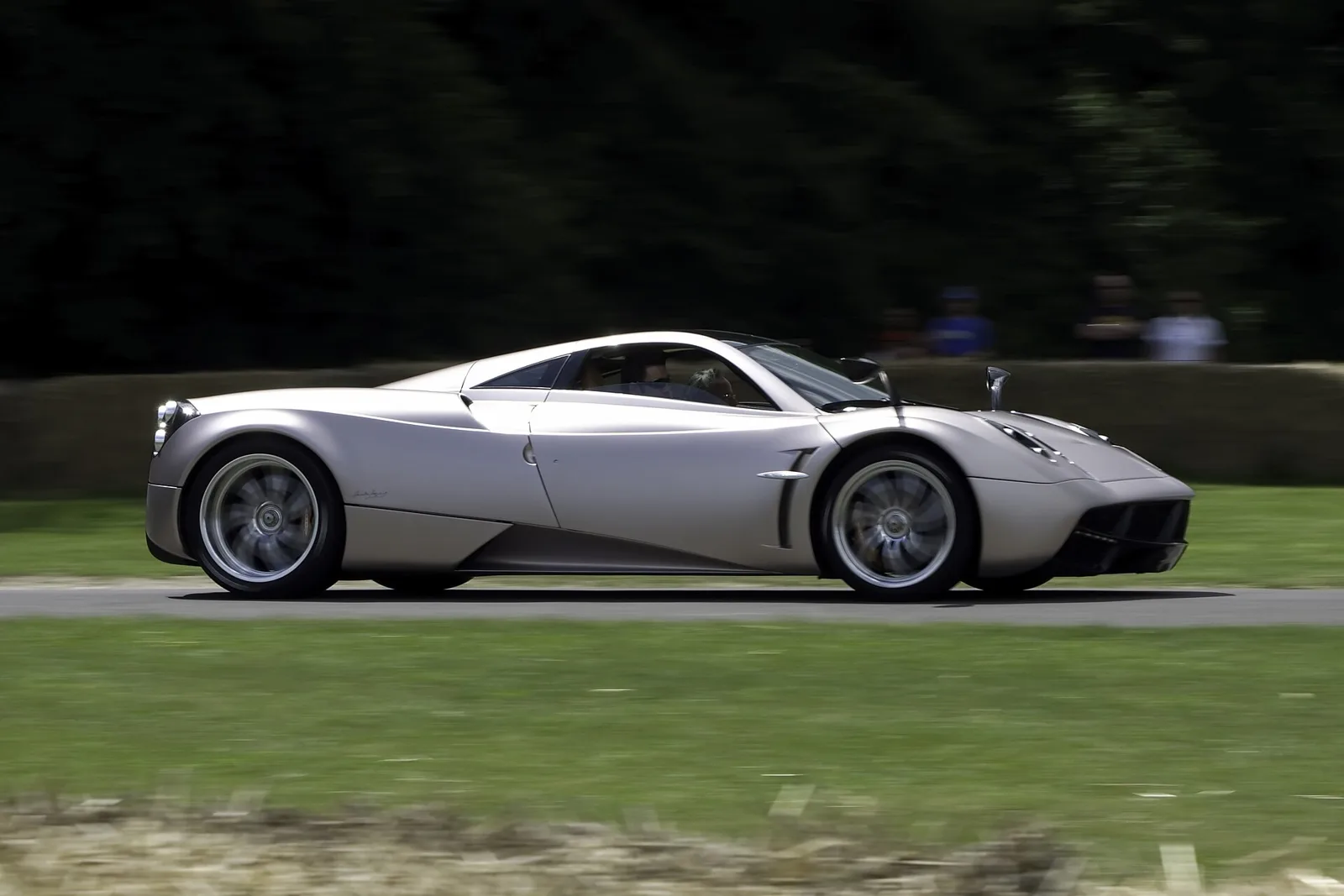
The Pagani Huayra is a mid-engined Italian hypercar that replaced the Zonda. It uses a twin-turbo 6.0-litre Mercedes-AMG V12 making 740 PS, a seven-speed sequential gearbox and active aerodynamics, and its original run was capped at 100 units.
Pagani developed the Huayra as the successor to the Zonda, and the name comes from Wayra Tata, the Quechua wind god. Over the years that followed, the name grew into a family of coupe, roadster, track and one-off models, all built around a Mercedes-AMG twin-turbo V12.
Where did the Huayra come from?
The Huayra replaced the Zonda as Pagani's flagship. It was first shown in pictures on 25 January 2011, and its official world debut took place at Pirelli's headquarters in Milan that February. Top Gear later named it Hypercar of the Year 2012.
Pagani took the name from Wayra Tata, the Quechua wind god of South America's indigenous peoples. The choice tied the car to the Andes rather than to the racing history of Italy.
The car was reported sold out on 11 February 2015. Its production was limited to 100 units under an agreement with the engine supplier Mercedes-AMG, so the Huayra stayed a small-volume model from start to finish of its original run.
A lot of the story sits in the variants that followed. The original coupe became the base for the BC, the Roadster, the Imola, the R and several one-offs, which together gave Pagani a range built on one foundation.
A Mercedes-AMG V12 in a 100-unit hypercar that started a family of track, roadster and one-off models.
How much power does the Huayra make?
The standard Huayra's twin-turbocharged 6.0-litre V12 makes 740 PS (544 kW; 730 hp) at 5,800 rpm, with 1,000 newton-metres (738 lb ft) of torque. Mercedes-AMG supplies the engine, known as the M158, which displaces 5,980 cc.
Pagani quotes a top speed of about 383 km/h (238 mph) and a 0-97 km/h (60 mph) time of 2.8 seconds. Those are the figures that define the standard car, and they remain the reference point for the variants that came after it.
Lubrication uses a dry sump, which keeps oil flowing under lateral loads. That choice suits a car designed to corner hard, because the oil supply does not depend on the car sitting level.
The EPA rating is 10 mpg-US in the city and 14 mpg-US on the highway. Those are the figures for a 6.0-litre twin-turbo V12 that is driven to its limits, and buyers of a car like this were not buying it for economy.
How does the active aero work?
The Huayra uses active aerodynamics that change the front ride height and operate four flaps at the front and rear. Designer Horacio Pagani has quoted a variable drag figure that changes with the flap positions. Flaps on the inside of a corner rise to add load to that side of the car.
The rear flaps double as an airbrake when the car brakes hard. The flaps therefore do two jobs, reducing drag on a straight and adding braking load when the car needs to slow sharply.
Side intakes behind the front wheels create a low-pressure zone that adds downforce. Together with the adjustable ride height, that zone helps the car keep its balance at speed.
Braking comes from Brembo, with six pistons at the front and four at the rear. The discs are drilled carbon ceramic, 380 mm (15.0 in) across and 34 mm (1.3 in) thick, which matches the performance the rest of the car is built to deliver.
Pirelli tyres allow the Huayra to reach 1.66 g of lateral acceleration. That figure, combined with the active aerodynamics, is what gives the car its reputation for cornering.
The titanium exhaust was designed and built by MHG-Fahrzeugtechnik, and the whole system weighs less than 10 kg (22 lb). Weight was a constant concern across the car's components, and the exhaust is one clear example of that focus.
Why did Pagani choose a single-clutch gearbox?
Pagani kept a seven-speed sequential gearbox with a single disc clutch because a double-clutch design added over 70 kg (154 lb). That extra mass would negate the faster shifts a double-clutch unit provides, so the single clutch made the better package.
The transmission itself weighs 96 kg (212 lb). Keeping the gearbox light was part of a broader effort to hold the car's weight down while its power grew through the variant range.
The BC uses a 7-speed Xtrac sequential gearbox, which is lighter than a double-clutch unit. The same logic carried into the later track-focused cars, so the sequential layout became a defining feature of the family.
Which variants followed the original?
The BC, Roadster, Roadster BC, Imola, Tricolore, R, Codalunga and Imola Roadster all followed the original coupe. Each one took the platform in a different direction, from track focus to open-top styling and one-off builds.
The BC, unveiled at the 2016 Geneva Motor Show, is the track-focused version. It produces 764 PS (562 kW; 754 hp) at 5,900 rpm, and its dry weight falls by 132 kg (291 lb) to 1,218 kg (2,685 lb). Its power-to-weight ratio works out at 1.62 kg (3.57 lb) per horsepower.
The BC uses carbon triax, a material that Pagani claims is 50% lighter and 20% stronger than regular carbon fibre. The company used the same material on the Roadster as well, which shows how central it was to the lightweight strategy.
The Roadster arrived at the 2017 Geneva Motor Show with a removable top and eyelid-style rear flaps. It makes 764 PS (562 kW; 754 hp) at 6,200 rpm and weighs 1,280 kg (2,820 lb), which is 70 kg (154 lb) lighter than the coupe. The coupe's gull-wing doors give way to conventional doors on the open car.
The Roadster BC was introduced in July 2019 with 802 PS (590 kW; 791 hp). It weighs 1,250 kg (2,756 lb), and its production was limited to 40 units. It has a large fixed rear wing and aerodynamic elements, which set it apart from the road-going roadster.
The Imola, introduced in February 2020, is named after the Enzo e Dino Ferrari circuit, where the car underwent 16,000 km of high-speed testing. It makes 838 PS (827 hp; 616 kW) and weighs 1,246 kg (2,747 lb) dry, and six were built in total.
The Tricolore was introduced on 16 December 2020 and celebrated the Frecce Tricolori aerobatic team. Pagani priced it at 5,500,000 euros plus taxes, and the production run was limited to three customer cars.
The R, introduced in March 2021, is a track-only car and the successor to the Zonda R. It produces 850 PS (625 kW; 838 hp) from a naturally aspirated 6.0-litre V12 built by HWA AG, and its dry weight is 1,050 kg (2,315 lb). A planned run of 30 cars was priced at 2.6 million euros plus applicable taxes.
The Codalunga, introduced on 16 June 2022, was a homage to 1960s racecars such as the Porsche 917. Five units were built, and all five were sold before the car was unveiled.
The Imola Roadster, introduced on 23 November 2023, was limited to eight units. The R Evo Roadster followed in February 2024, and the Codalunga Speedster, introduced on 8 July 2025, is the open-top version of the Codalunga, limited to 10 units.
Special editions and one-offs
The one-off Huayra Lampo was inspired by the 1954 Fiat Turbina concept. It stands as one of the more unusual examples in a family built around limited runs and bespoke work.
The Huayra Epitome is a one-off built by Pagani Grandi Complicazioni, and it produced 852 horsepower. It was paired with a seven-speed manual transmission, which made it an unusual choice in a line that had mostly used sequential gearboxes.
In March 2025 a manual version of the Huayra Roadster Executor was delivered in California, and the car sold for 6.9 million dollars. The price marked one of the highest figures recorded for a single car in the family.
How many Huayra cars were built?
Pagani capped the original Huayra at 100 units. The BC was planned at 20 units, but around 30 were built, and the Roadster was also planned at 100 units, all sold before its unveiling. The Roadster BC was limited to 40 units.
The BC overproduction irritated some owners, who had been expecting a smaller run. The gap between the planned and actual numbers became one of the model's better-known stories.
The Imola run was smaller still. Six cars were built, five for customers and one prototype. The Tricolore followed the same pattern with three customer cars.
The Codalunga was limited to five units, and the Imola Roadster to eight. The Codalunga Speedster is capped at 10, which kept the open-top range small by design.
Which Huayra was built for the track?
The Huayra R is the track-only model and the successor to the Zonda R. Its naturally aspirated 6.0-litre V12 was built by HWA AG and redlines at 9,000 rpm, and the production run was planned at 30 cars.
The R weighs 1,050 kg (2,315 lb) dry, and it produces 850 PS (625 kW; 838 hp). Those figures separate the R from the road-going Huayra, even though the two share a family resemblance in their bodies.
How was the Huayra received?
Top Gear named the Huayra its Hypercar of the Year for 2012, and the car appeared in the 2014 film Transformers: Age of Extinction as the Decepticon Stinger. Electronic Arts held the exclusive video game rights to the Huayra in 2011, and that licence expired on 31 December 2011.
Pagani's own claim for the Roadster's lateral acceleration, 1.8 g, is unproven. That figure would be notable if it were confirmed, so it is worth reading alongside the verified numbers for the other variants.
Huayra specification by variant
| Variant | Introduced | Output | Units |
|---|---|---|---|
| Huayra | World debut, February 2011 | 740 PS (544 kW; 730 hp) at 5,800 rpm | Capped at 100 |
| BC | 2016 Geneva Motor Show | 764 PS (562 kW; 754 hp) at 5,900 rpm | Planned 20; about 30 built |
| Roadster | 2017 Geneva Motor Show | 764 PS (562 kW; 754 hp) at 6,200 rpm | 100 planned, all sold |
| Roadster BC | July 2019 | 802 PS (590 kW; 791 hp) | 40 |
| Imola | February 2020 | 838 PS (827 hp; 616 kW) | Six built |
| R | March 2021 | 850 PS (625 kW; 838 hp) | 30 planned |
| Imola Roadster | 23 November 2023 | Open-top variant of the Imola | Eight |
| Codalunga Speedster | 8 July 2025 | Open-top variant of the Codalunga | 10 |