Audi's high-performance A4 has moved from a 2.7-litre biturbo V6 to a 4.2-litre V8 and back to a 2.9-litre twin-turbo V6, always with quattro.
The RS 4 is Audi's top-performance A4, sitting above the S4 and offered in every generation since 1999, though not continuously. It has come as an Avant and a saloon, and every version uses quattro four-wheel drive. The engine has changed several times, from a V6 biturbo to V8s and back to a V6.
Audi's RS 4 is the high-performance version of the A4 range, sitting above the S4 on the A4 platform. It has been offered in every A4 generation since 1999, although production has stopped and started, and each version uses Audi's quattro four-wheel drive. The engine has moved from a biturbo V6 to a V8 and back to a twin-turbo V6.
What does RS mean on an Audi?
RS stands for RennSport, the German for racing sport. It is Audi's highest trim level, placed above the S models in the company's line-up. The RS 4 carries that badge on the A4 platform.
Torsen-based quattro permanent four-wheel drive is the only drivetrain offered on the RS 4. Its main rivals have included the BMW M3, the Mercedes-Benz C 63 AMG and the Cadillac ATS-V.
Production has come in stages. The RS 4 was built from 1999 onwards, with gaps in production between 2001 and 2006, between 2008 and 2012, and between 2015 and 2018.
A quattro A4 performance car that has moved from a biturbo V6 to a V8 and back to a V6.
Where did the first RS 4 come from?
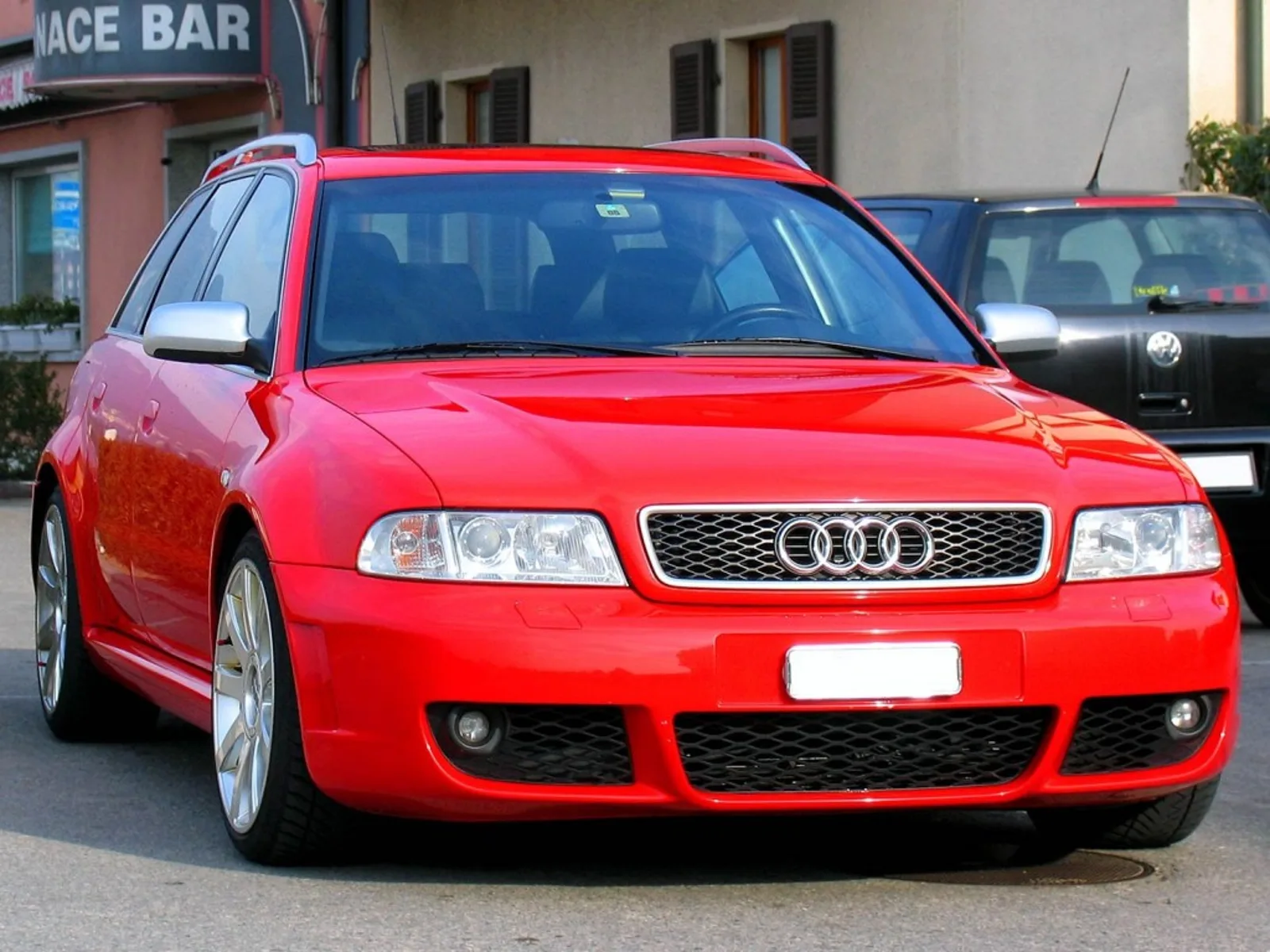
The original B5 RS 4 Avant quattro, known as the Typ 8D, was introduced in late 1999 for production and sale from 2000. It succeeded the RS2 Avant, which had been developed by Porsche and Quattro GmbH as a joint venture. Audi built 6,030 units of the B5 between 1999 and 2001.
The B5 was only available as an Avant, Audi's name for an estate car. It was built on the B5 platform that the A4 and S4 shared, and its retail price at launch was around DM 103,584.
The B5 body had a drag coefficient of 0.34. Wider arches and unique bumpers gave the body its own shape.
How much power did the B5 RS 4 make?
The B5 engine was a 2,671 cc 90-degree V6 biturbo with five valves per cylinder, considerably smaller in capacity than the V8 that followed in the B7. Its output rose to 381 PS (280 kW; 375 bhp) at 7,000 rpm, and torque rose from 400 N-m to 440 N-m at 6,000 rpm. Cosworth Technology developed and built the engine in the UK.
Two BorgWarner K04-series turbochargers provided the boost. The car used a six-speed manual gearbox with a final drive ratio of 4.111, and its Torsen T-1 centre differential set a 50:50 default bias between the axles.
The B5 had 390 litres of luggage space with the seats upright, rising to 1,250 litres with the seats folded flat.
How quick was the B5 RS 4?
The B5 weighed 1,620 kg (3,571 lb) and reached 100 km/h in 4.9 seconds. It took 17.0 seconds to reach 200 km/h, and the top speed was electronically limited to 250 km/h (155 mph).
Braking was handled by 360 mm floating cast iron discs at the front, with double-piston calipers, and 312 mm discs at the rear with single-piston calipers. Audi's figures say the car could stop from 110 km/h in less than 50 metres (160 ft).
What changed with the B7 RS 4?
The B7 RS 4 was the first RS 4 offered as a four-door saloon, with the Avant following a short while later. A cabriolet was sold in Europe from late 2006 to 2008. Quattro GmbH built the cars at Neckarsulm, Germany.
The B7 was unveiled in February 2005 at Audi's quattro Night in Ingolstadt. Production ran from 2006 to 2008, and about 10,000 were built, of which around 2,000 were in the USA.
The saloon had a drag coefficient of 0.31 and a frontal area of 2.17 m2. Its body was a fully galvanised steel unibody, with aluminium front wings and bonnet, and the saloon's kerb weight started at 1,650 kg (3,638 lb).
Saloon luggage space was 460 litres with the seats upright and between 720 and 833 litres with them folded, depending on the specification.
What engine did the B7 RS 4 use?
The B7 used a 4.2-litre (4,163 cc) 32-valve V8 with FSI direct injection. Its redline was 8,000 rpm and the rev limit 8,250 rpm, and it produced 309 kW (420 PS; 414 bhp) at 7,800 rpm.
Specific output was 74.2 kW (100.9 PS; 99.5 bhp) per litre. At a kerb weight of 1,680 kg (3,704 lb), the power-to-weight ratio was 0.184 kW per kg.
The engine had four valves per cylinder and two overhead camshafts per bank. The same engine base was shared with the Audi R8 V8.
The B7 RS 4 was the only naturally aspirated RS model until the RS 5 arrived in 2010.
How did the B7 RS 4 handle?
The B7 used the third generation of Audi's quattro system, with a Torsen centre differential set to a 40:60 default split between the front and rear axles. The torque bias ratio was 4:1, where standard A4 models used 2:1.
Dynamic Ride Control used dampers made for Audi by KW, with central reservoirs and valves made by KYB. The car sat 30 mm lower than a standard A4, and the Sports Suspension Plus option lowered it a further 10 mm.
The front track was widened by 37 mm to 1,559 mm. Front brakes were 365 mm discs with Brembo eight-piston monobloc calipers, and an optional ceramic front brake system was offered from the 2007 model year with 19-inch wheels only.
What were the B7 RS 4 specifications?
The B7 was a more complete car than the B5, with a larger engine and more power. The table covers the main figures for the RS 4 across its generations.
| Specification | B5 (1999 to 2001) | B7 (2006 to 2008) | B8 (from 2012) | B9 (from 2018) |
|---|---|---|---|---|
| Body | Avant only | Saloon, Avant and cabriolet | Avant | Avant |
| Engine | 2,671 cc V6 biturbo | 4.2 litre (4,163 cc) V8, FSI | 4.2 litre FSI V8 | 2.9 TFSI twin-turbo V6 |
| Output | 280 kW (381 PS; 375 bhp) at 7,000 rpm | 309 kW (420 PS; 414 bhp) at 7,800 rpm | 450 PS (331 kW; 444 hp) | 450 PS (331 kW; 444 bhp) |
| Torque | 440 N-m at 6,000 rpm | Not given | 430 N-m (317 lbf-ft) | 600 N-m (443 lbf-ft) |
| Transmission | Six-speed manual | Six-speed Getrag manual | Seven-speed S-tronic dual-clutch | Eight-speed Tiptronic automatic |
| Kerb weight | 1,620 kg (3,571 lb) | 1,680 kg (3,704 lb); saloon from 1,650 kg (3,638 lb) | Not given | Not given |
| 0-100 km/h | 4.9 seconds | 4.8 seconds (saloon) | 0-60 mph in 4.2 seconds | Not given |
| Top speed | 250 km/h (155 mph), limited | Not given | Not given | Not given |
| Cars built | 6,030 | About 10,000 | 7,000 | Not given |
The B5 and B7 entries carry the most complete data. Where a figure is not given for a generation, the table marks it so the reader can see the gap.
Was there a manual gearbox in the B7 RS 4?
Yes. A six-speed Getrag manual was the only transmission offered on the B7.
How did the B7 RS 4 perform in motorsport and awards?
The B7 was used in the American Le Mans Series Vitesse Program. The program highlighted the link between race cars and production road cars.
Gianni Morbidelli won the Superstars Series championship in 2007 and again in 2008.
Top Gear named the RS 4 its Most Surprising Car of the Year in 2005. The car also took a 2007 prize in the performance class of the World Car of the Year awards.
How did the B7 A4 perform in crash tests?
The Insurance Institute for Highway Safety crash-tested the B7 A4, the RS 4's sibling, and awarded it Double Best Pick for frontal and side crashes. The result refers to the A4 rather than the RS 4 itself, since the RS 4 was not the car that the institute tested.
What changed with the B8 RS 4?
The B8 RS 4 Avant was unveiled at the 2012 Geneva Motor Show, and like the B5 it was offered only as an Avant. It was based on the B8 A4 Avant and used the Volkswagen MLB platform, and it shared its powertrain with the RS 5 Coupe. The engine was a 4.2-litre FSI V8 producing 450 PS (331 kW; 444 hp).
Visually the B8 had a honeycomb grille and a remodelled front bumper, with double exhaust tailpipes where the S4 had quadruple tailpipes. The engine delivered 430 N-m (317 lbf-ft) of torque, and the car reached 60 mph (97 km/h) in 4.2 seconds.
The B8 used a seven-speed S-tronic dual-clutch transmission. Standard wheels were 19-inch alloys with 235/40 R19 Pirelli P-Zero tyres, and the optional 20-inch wheels used 265/30 ZR20 tyres.
Ceramic brakes were available as an option. The Sport pack added a sports exhaust, Dynamic Ride Control suspension and 20-inch wheels as standard.
How many B8 RS 4s were built?
A total of 7,000 B8 RS 4s were built. In February 2014 Audi marked 20 years since the original RS 2 Avant with the Nogaro Selection Limited Edition, of which about 200 were made.
Approximately 39 of the Nogaro cars were registered in the UK in right-hand drive.
What is the B9 RS 4 like?
The B9 was revealed at the 2017 Frankfurt Motor Show, with a more angular exterior and new wheels. Its 2.9 TFSI twin-turbo V6 makes 450 PS (331 kW; 444 bhp), with 600 N-m (443 lbf-ft) of torque on tap.
The B9's torque is 170 N-m more than the B8's, and it comes from a 2.9-litre engine rather than the 4.2-litre V8. The same V6 is shared with the Porsche Panamera.
Unlike the B8, which had a seven-speed dual-clutch transmission, the B9 RS 4 Avant is offered with an eight-speed Tiptronic automatic. The B9 entered production in 2018.
How did the RS 4 change across generations?
The RS 4 moved from a 2,671 cc V6 biturbo in the B5 to a 4,163 cc V8 in the B7, then to a 4.2-litre V8 in the B8 and a 2.9-litre twin-turbo V6 in the B9. Every generation kept quattro, and every generation except the B7 was offered only as an Avant.
The power gap between the first and latest models is wide, with 381 PS (280 kW; 375 bhp) at 7,000 rpm in the B5 and 450 PS (331 kW; 444 bhp) in the B9. Each step brought a different engine layout and a different route to the same top-level performance.
How fast was the B5 RS 4?
The B5 reached 100 km/h in 4.9 seconds and 200 km/h in 17.0 seconds, with a 250 km/h (155 mph) limiter.
What power did the B7 engine make?
The B7 V8 produced 309 kW (420 PS; 414 bhp) at 7,800 rpm, which works out at 74.2 kW (100.9 PS; 99.5 bhp) per litre. The rev limit was 8,250 rpm.
What did the B5 cost when new?
The B5 retail price at launch was around DM 103,584. Audi built 6,030 units of the car between 1999 and 2001.
Did the B9 RS 4 keep the B8 transmission?
No. The B9 uses an eight-speed Tiptronic automatic, where the earlier car had a dual-clutch unit.