A road car named after a Le Mans winner, the R8 grew from a V8 into a V10 range with rear-drive, GT, electric and racing versions before production ended in 2024.
The Audi R8 is a mid-engined two-seat sports car built from 2006 to early 2024. The Type 42 used a 4.2-litre V8 or 5.2-litre V10, and the Type 4S added rear-drive and an electric e-tron. The final 2023 R8 GT made 620 hp.
Audi borrowed the name of a prototype that won Le Mans five times and hung it on a road car with a mid-mounted V8, then a V10, and quattro drive. The R8 road car ran from 2006 until production ended in the first quarter of 2024, across two generations, a string of limited editions, rear-drive versions and a small run of electric cars.
Where did the Audi R8 come from?
The R8 began as the Audi Le Mans quattro concept, which Frank Lamberty and Julian Hoenig drew and which appeared at the Frankfurt and Geneva shows in 2003. The show car wore Jet Blue paint, 20-inch wheels and a twin-turbocharged FSI V10 rated at 610 PS (602 hp) and 750 N.m. Its body used aluminium and carbon fibre to keep the weight down, and it carried full LED headlamps long before they were common.
Development of the production car started in 2004, when Lamberty's design was approved and frozen. A year later Audi announced that the race car's name would pass to a new road car. Prototype bodies went out for field testing in January 2006, and the finished R8 was shown to the public at the Paris show on 30 September 2006, with production under way from June that year.
The road car caused some confusion because it shared its name with the Le Mans prototype. It is built on the Audi Space Frame, an aluminium monocoque made on space frame principles, and Audi Sport GmbH, formerly quattro GmbH, designs, develops and builds it. The first car to carry the name drew on the Lamborghini Gallardo, and the second moved to the Huracan platform.
A Le Mans concept turned road car, with quattro grip and a choice of V8 or V10 power.
What is the racing R8 behind the name?
The Le Mans prototype arrived in 2000 as a development of the open-topped R8R and the closed R8C of 1999. It was built by Audi Motorsport with Joest Racing, and it won the 12 Hours of Sebring on its debut. At Le Mans it took five victories, in 2000, 2001, 2002, 2004 and 2005, and it won the American Le Mans Series championship six years running from 2000 to 2005. Only the Bentley Speed 8 broke the run in 2003, using a heavily modified 4.0-litre version of the Audi V8. In its first Le Mans, in 2000, the team finished 1-2-3 with Tom Kristensen, Emanuele Pirro and Frank Biela among the drivers.
The prototype used a 3.6-litre V8 with Fuel Stratified Injection, rated at about 610 hp in 2000 to 2002, 550 hp in 2003 and 2004, and 520 hp in 2005. Power went to the rear wheels through a Ricardo six-speed sequential gearbox. Its best-known trick was a rear section built as one unit, which let the crew swap an entire damaged transaxle in 3 minutes 16 seconds, against the one to three hours it normally takes. The rule makers responded by forcing teams to keep the same gearbox casing for the whole race. In 2002 the car reached 338 km/h (210 mph) in practice. Sixteen chassis were built, and the diesel R10 TDI replaced it in 2006.
What was the first-generation R8 like?
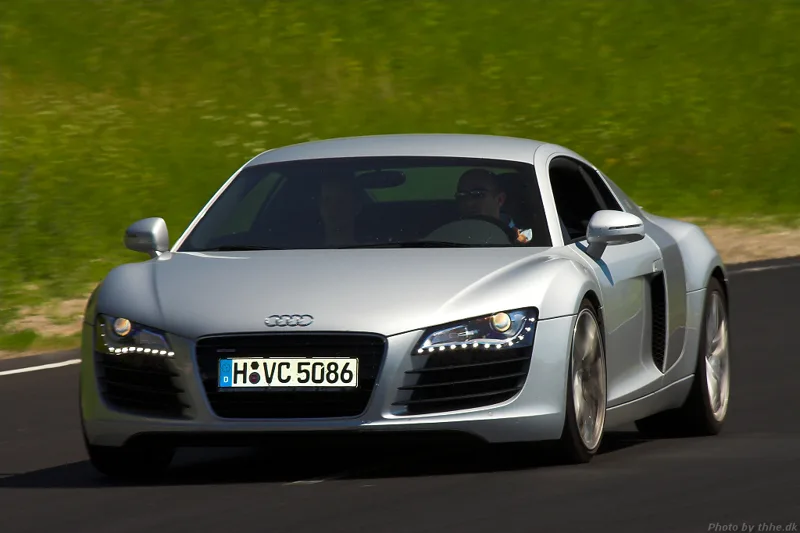
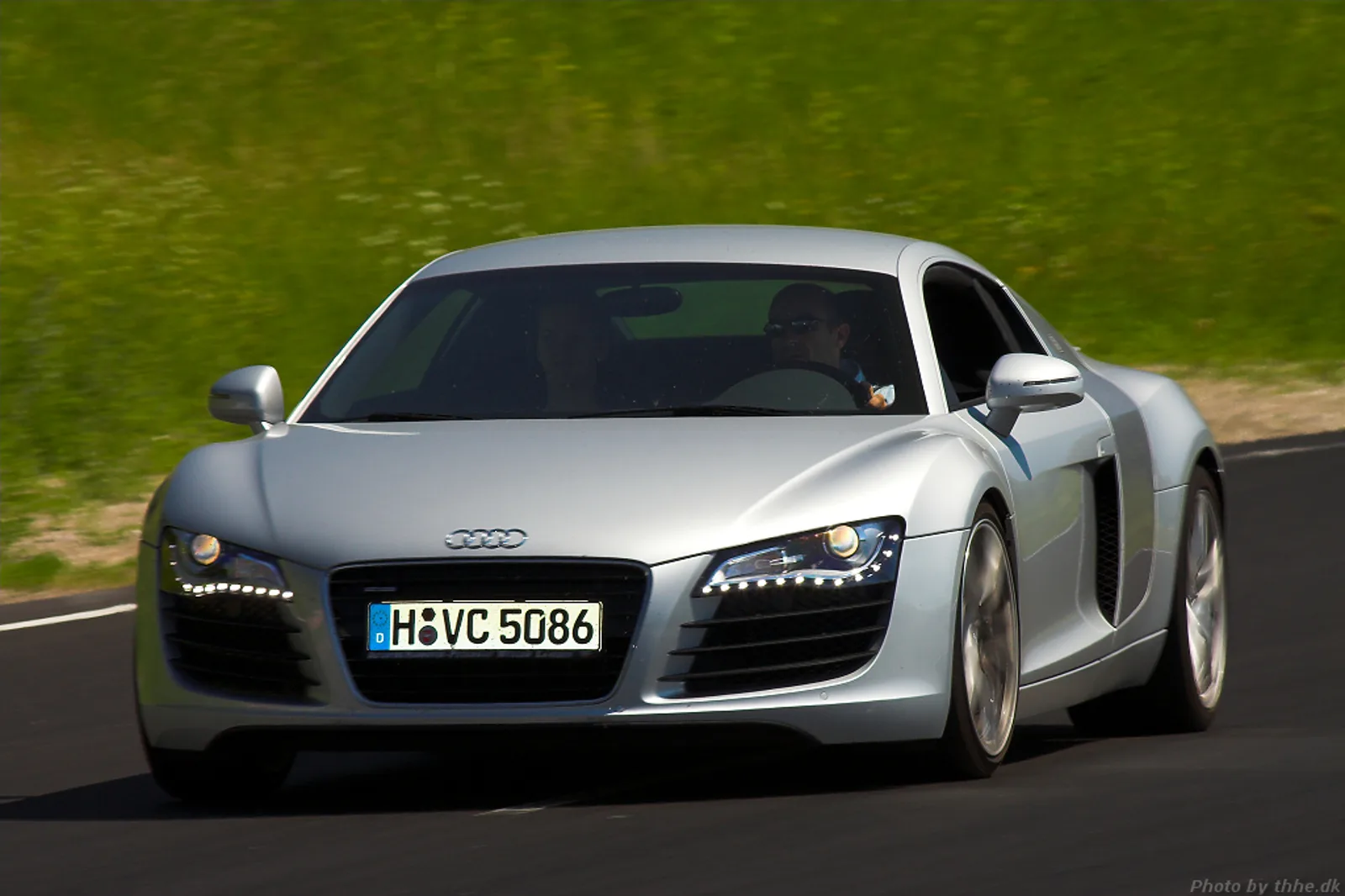
The Type 42 shared its chassis and engines with the Gallardo, a sensible saving inside a Volkswagen Group that owned both brands. The first engine was the 4.2-litre FSI V8, an all-aluminium 32-valve unit of 4,163 cc that Audi rated at 420 PS (414 hp) and 430 N.m. It is essentially the engine from the B7 RS 4 with a dry-sump oil system added. The four-wheel-drive system leaned to the rear and could send up to 70 per cent of the power back there, with 30 per cent going to the front. Road & Track timed the manual car from 0 to 60 mph in 4.0 seconds and the automated manual in 4.3 seconds, with a top speed of 301 km/h (187 mph).
The V10 followed, shown on 8 December 2008. It took the 5.2-litre unit from the Gallardo LP560-4 and retuned it to 525 PS (518 hp) and 530 N.m. Audi quoted 3.9 seconds from 0 to 100 km/h, 8.1 seconds from 97 to 200 km/h (60 to 124 mph) and 316 km/h (196 mph). The V10 coupe also brought V10 badges on the front wings, a 465-watt Bang & Olufsen sound system, larger rear brakes, twin exhaust outlets and different wheels. Its all-LED headlights were a world first.
Spyder and GT versions
The convertible, which Audi calls the Spyder, was spotted in photographs taken on the Iron Man 2 set in August 2008 and shown formally at the 2009 Frankfurt show. It added extra chassis support and a pair of roll-over bars, and its fuel filler moved. It launched with the V10, and in April 2011 Autocar reported that the V8 was on offer too, at 434 PS (428 hp), good for 0 to 100 km/h in 4.3 seconds and 300 km/h (186 mph).
The R8 GT, introduced at the 2010 Worthersee Tour, was the hard-edged version. It used the 5,204 cc V10 tuned to 560 PS (552 hp) at 8,000 rpm and 540 N.m at 6,500 rpm. Weight fell by 100 kg (220 lb) to 1,525 kg (3,362 lb), top speed rose to 320 km/h (199 mph), and 0 to 100 km/h took 3.6 seconds, 0.3 faster than the standard V10. It had red brake calipers, a fixed rear wing and nose winglets, and just 333 cars were made: 35 for the UK and 90 for the US.
The GT Spyder, shown at the 2011 Le Mans 24 Hours, was limited to 333 units as well, with only 50 reaching the US. It used a magnesium engine frame and carbon fibre for the roof cover, rear side panels, spoilers, bumper and seats. Those seats alone saved 32 kg (70 lb), and the package was 85 kg (187 lb) lighter than the V10 Spyder, at 1,640 kg (3,616 lb) dry. A facelift in 2012 added the V10 Plus to the line-up, and Type 42 production ended in August 2015.
How did the second-generation R8 change?
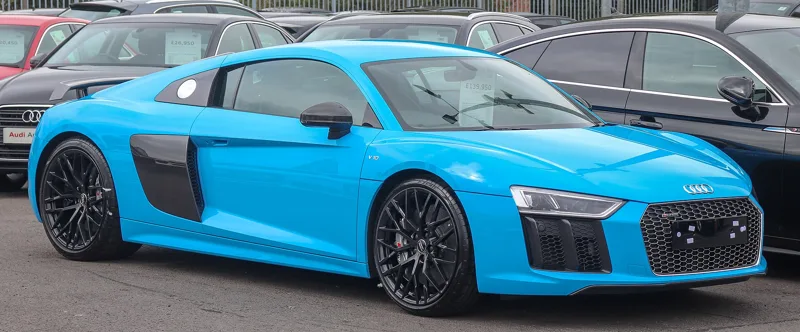
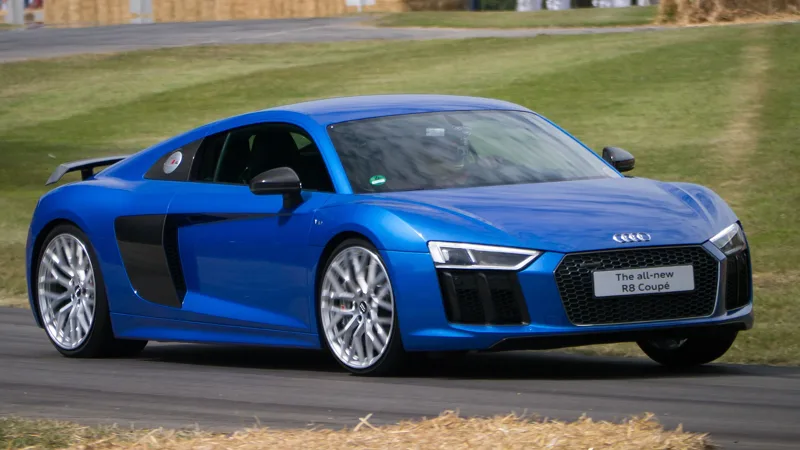
Development of the Type 4S began in 2013, prototypes were testing by early 2014 and production started in late 2014. The car was unveiled at the 2015 Geneva show on the Modular Sports System platform it shares with the Huracan. Its first models were the 5.2 FSI V10 and the V10 Plus, with a 540 PS (533 hp) and 610 PS (602 hp) rating respectively. Audi detuned the Huracan engine for the base car and left it alone for the Plus. Talk of a V8 came to nothing: emissions rules killed it, and there was no manual either, only a 7-speed S-Tronic gearbox.
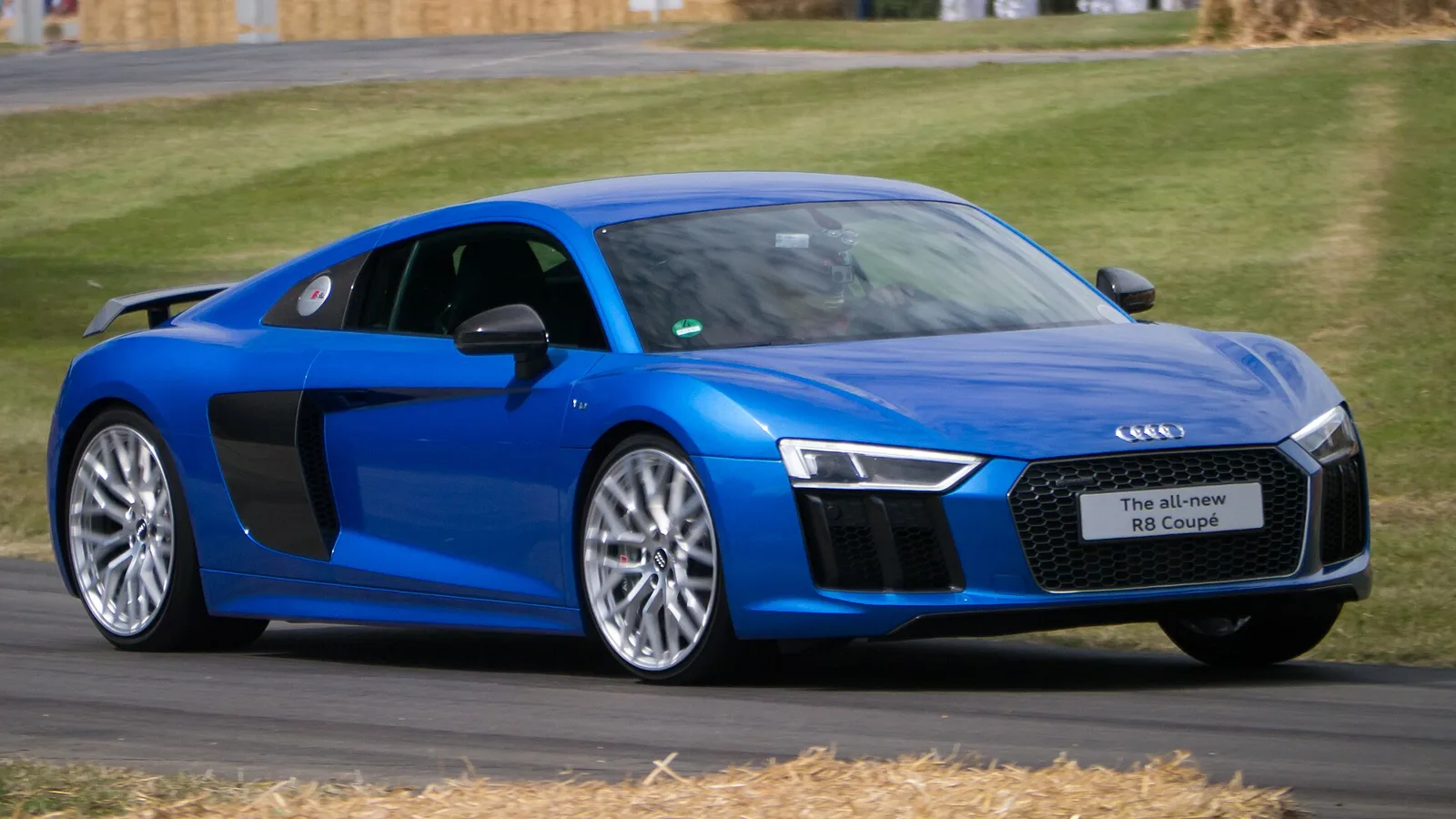
Carbon fibre replaced several large aluminium parts in the shell, so the body is lighter and stiffer. The quattro system is slightly rear-biased, working with a water-cooled front differential, a passive limited-slip rear differential and electromechanical steering. The Virtual Cockpit first seen in the TT came inside, and magnetic-ride dampers were optional in Europe only. The side blades behind the doors split into two, one on the rear side window and one below the beltline, and could be painted in body colour. Laser headlamps were an option in Europe. Wheels were 19-inch as standard with 20-inch available, and carbon-ceramic brakes were optional.
Spyder, RWS and Exclusive Edition
The Spyder appeared at the 2016 New York show with the base V10, and the V10 Plus Spyder followed in mid-2017. Its redesigned soft top works at speeds up to 50 km/h (31 mph). The R8 RWS, unveiled at the 2017 Frankfurt show, dropped the all-wheel-drive system and was limited to 999 units. It kept the 540 PS V10 and lost 50 kg (110 lb), giving a coupe weight of 1,590 kg (3,505 lb) and a Spyder weight of 1,680 kg (3,704 lb), with the Spyder shedding 40 kg (88 lb). Weight distribution was 40.6:59.4 for the coupe. Matte-black trim marked it out, and a red vinyl stripe was optional.
The 2017 V10 Plus Exclusive Edition was a run of 25 for the United States, and the first Audi sold there with laser headlight technology. The laser module supplements the LED lamps and switches on above 40 mph (64 km/h), and its use in the US depends on FDA approval. Quantum Gray paint covered the body, a Titanium Black-optic package sat alongside an orange stripe on the carbon sideblades, and the cabin had black and Signal Orange leather, a quilted Alcantara headliner and carbon sills inscribed with "one of 25".
The 2018 refresh and the last cars
The October 2018 facelift made the nose squarer, with winglets at the corners, a wider grille and three small intakes above it that echo the original Quattro. Exposed carbon side skirts and a single wide rear grille with round twin tailpipes completed the change. The base car became the V10 quattro and gained 30 PS to reach 570 PS (562 hp), while the V10 Performance quattro rose 10 PS to 620 PS (612 hp). All models gained a particulate filter, Michelin Pilot Sport Cup 2 tyres were offered, the carbon-ceramic brakes grew and the steering rack was new. A carbon roll bar saved 2 kg. Audi claimed 0 to 97 km/h (0 to 60 mph) in 3.5 seconds for the base car and 3.1 for the Performance, with 330 km/h (205 mph) flat out. The refreshed R8 reached European showrooms in early 2019.
On 19 November 2019 Audi made rear-wheel drive a permanent part of the range, with the 540 PS (533 hp) and 540 N.m V10 from the RWS. The RWD coupe weighed 1,595 kg (3,516 lb), which is 65 kg (143 lb) under the quattro, and the Spyder came in at 1,695 kg (3,737 lb). On 7 October 2021 the V10 performance RWD arrived with 570 PS (562 hp) and 550 N.m, adding dynamic steering, carbon stabilisers and ceramic discs, and it replaced the base V10 quattro. In July 2020 Audi announced that the 5.2 FSI would leave the US, marking the occasion with 25 coupes and 5 Spyders in Mugello Blue, Avus Silver or Sonoma Green, all with milled 20-inch wheels.
The 2023 R8 GT, announced in October 2022, was the last R8. It made 620 hp, was lightened and sharpened for handling, and was capped at 333 units.
Was there an electric R8?
A 2010 prototype built on the first-generation car never reached customers. The production R8 e-tron was shown at Geneva in 2015, sold only in Europe and bought by fewer than 100 people. Two electric motors on the rear axle delivered 462 PS (456 hp) and 919 N.m, fed by a T-shaped 92 kWh lithium-ion pack with liquid cooling. The claims were 3.9 seconds for 0 to 97 km/h (0 to 60 mph), 250 km/h (160 mph) flat out and a 450 km (280 mi) range, at a kerb weight of 1,780 kg (3,924 lb).
What was the R8 LMS?
Announced for 2009 to meet the GT3 rules, the R8 LMS (known inside Audi Sport as the R16) used a 500 PS (493 hp) V10. GT3 regulations ban four-wheel drive, so the LMS was rear-drive only, with a new six-speed sequential gearbox. Audi Hungaria Motor Kft. in Gyor shared the build with Audi Sport and quattro GmbH, and customer deliveries were planned for autumn 2010. The 2010 Evolution brought better engine cooling, revised suspension, race-tuned electronics and exhaust, and a gearbox that could be inspected through a housing opening. Earlier cars could be updated with a kit.
Where is the Audi R8 built and sold?
All R8s come from the aluminium site at Neckarsulm, a 28 million euro redevelopment. There, 70 workers fit 5,000 different parts by hand, and output is normally between eight and fifteen cars a day, with a ceiling of 29. Ninety-five lasers check the car in five seconds, making sure more than 220 measurements are within 0.1 millimetres of the programmed plan.
In Asia the R8 has been sold in India, Israel, Japan, Taiwan, South Korea and Thailand, among others, and in China, Singapore and the United Arab Emirates since 2008. European sales cover Austria and Belgium through to Germany, Italy and Spain.
How did the R8 become a film star?
The R8 served as the personal car of Tony Stark, played by Robert Downey Jr., in six Marvel films. Type 42 cars featured in the Iron Man trilogy: a V8 in the first, a V10 Spyder in the second and an e-tron prototype in the third. Type 4S cars followed, a 2016 V10 Plus turned up in Captain America: Civil War and Avengers: Age of Ultron, and Spider-Man: Homecoming used a Spyder. Jacky Ickx, a six-time Le Mans winner, called it the best handling road car of its day.
What are the Audi R8 specifications?
| Version | Years | Engine | Output | Notes |
|---|---|---|---|---|
| 4.2 FSI quattro coupe | 2006-2012 | 4.2-litre V8 | 420 PS (414 hp) | 0-60 mph in 4.0 s, 301 km/h |
| 5.2 FSI quattro coupe | 2009-2012 | 5.2-litre V10 | 525 PS (518 hp) | 316 km/h, 0-100 km/h in 3.9 s |
| Spyder 5.2 FSI | 2010-2012 | 5.2-litre V10 | 525 PS (518 hp) | Soft top, extra chassis support |
| Spyder 4.2 FSI | 2011-2012 | 4.2-litre V8 | 434 PS (428 hp) | 300 km/h |
| R8 GT | 2011-2013 | 5.2-litre V10 | 560 PS (552 hp) | 333 cars, 1,525 kg |
| V10 and V10 Plus (Type 4S) | 2015 on | 5.2-litre V10 | 540 PS / 610 PS | 7-speed S-Tronic, no manual |
| R8 RWS | 2017 | 5.2-litre V10 | 540 PS (533 hp) | Rear drive, 999 units |
| V10 quattro and Performance | 2018 on | 5.2-litre V10 | 570 PS / 620 PS | Performance reaches 330 km/h |
| V10 performance RWD | 2021 on | 5.2-litre V10 | 570 PS (562 hp) | 550 N.m, replaced base quattro |
| R8 GT RWD | 2023 | 5.2-litre V10 | 620 hp | 333 units, last R8 |
| R8 e-tron | 2015 | Two electric motors | 462 PS (456 hp) | 92 kWh, under 100 sold |