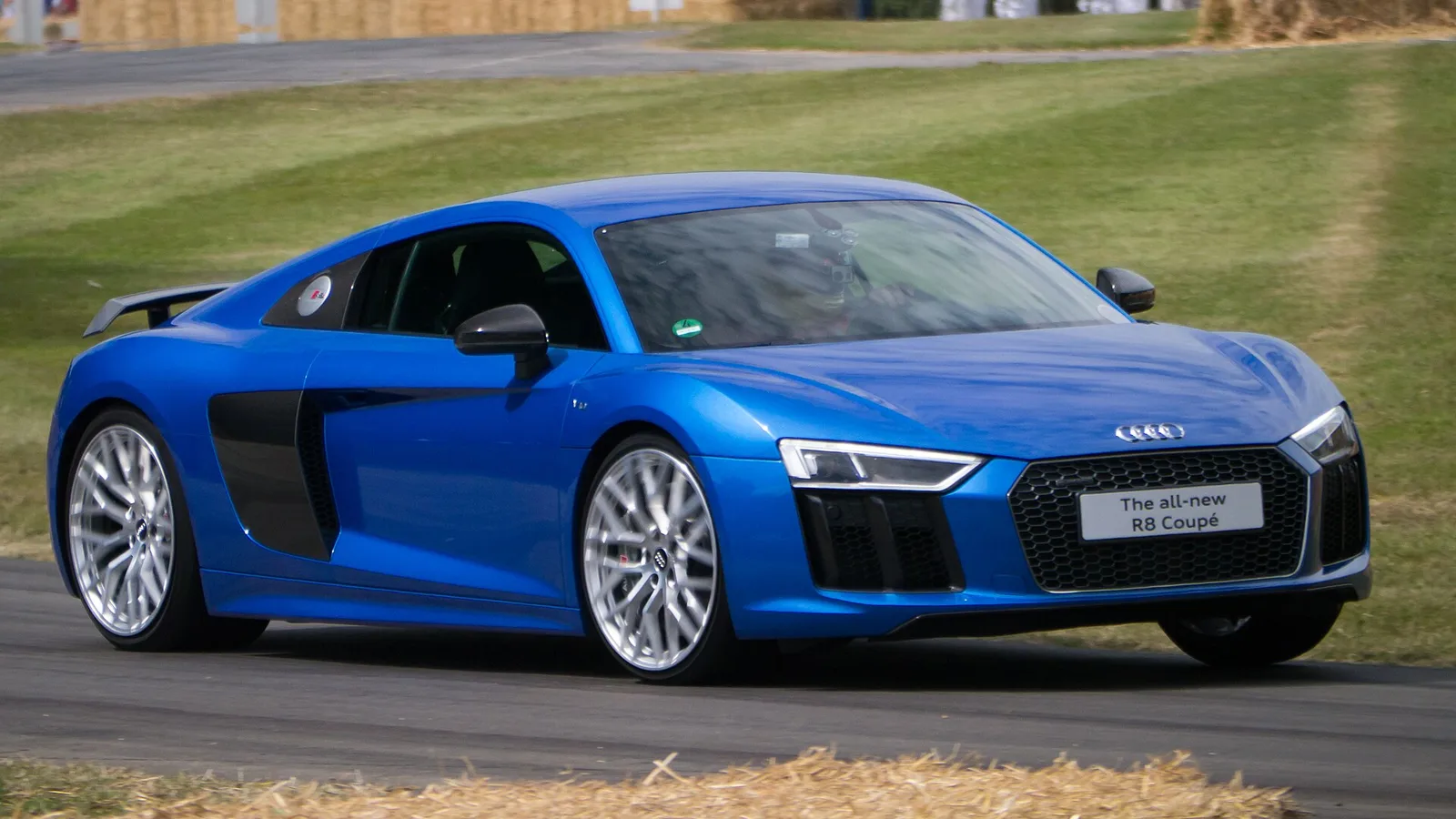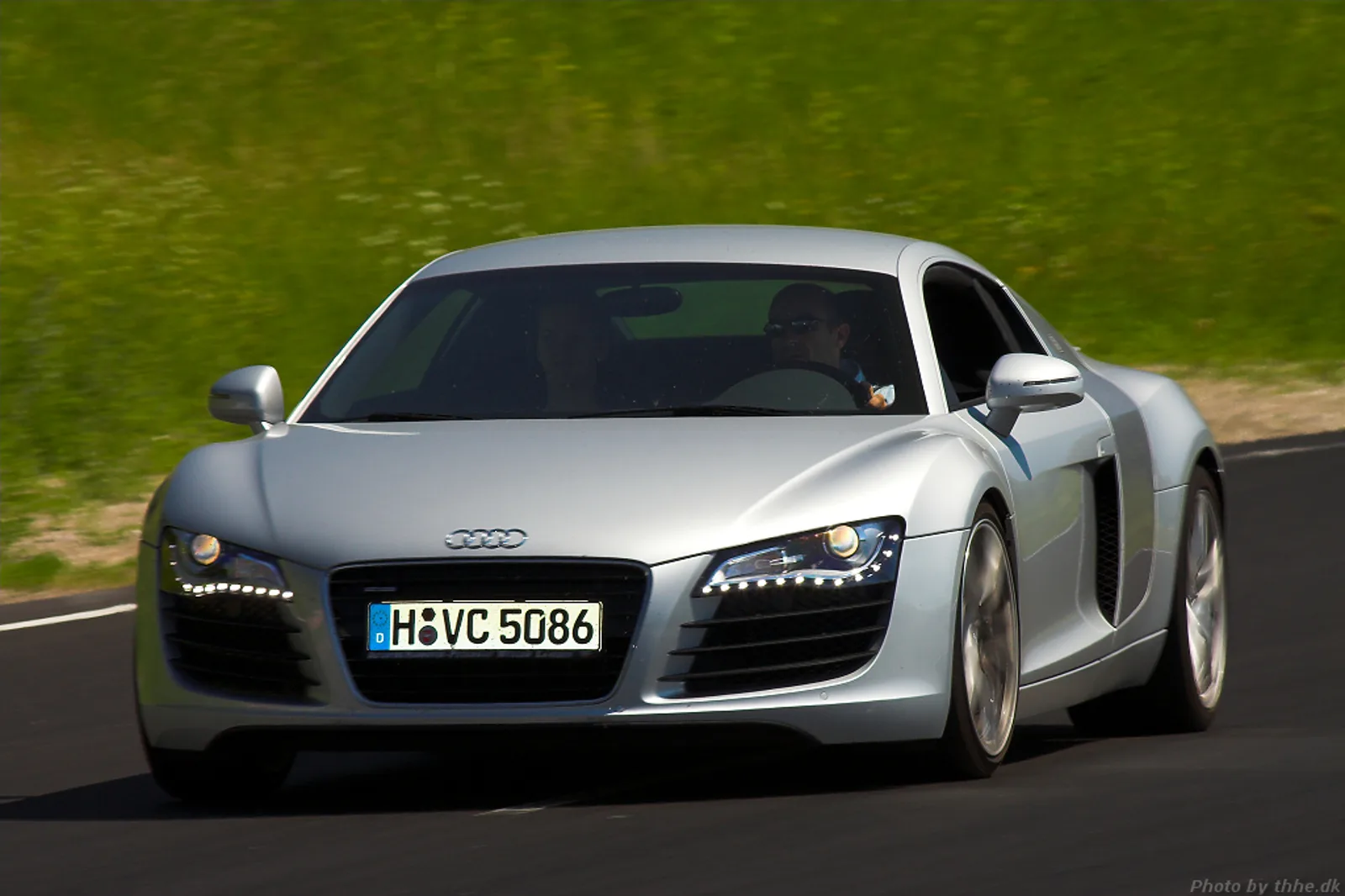
A Lamborghini-based mid-engined sports car from 2006 to 2015, with V8 and V10 engines, open-top and GT versions, and a long racing record.
The Audi R8 Type 42 was built from June 2006 to August 2015 on the Lamborghini Gallardo's chassis. It came with a V8 or V10 engine, and the range included Spyder, GT and Competition versions as well as LMS race cars.
The Audi R8 Type 42 was the first generation of Audi's mid-engined sports car, built from June 2006 until August 2015. It shared its chassis and engine with the Lamborghini Gallardo, a brand within the same Volkswagen Group, and its V8 and V10 engines powered coupes, Spyders, GT models and race cars.
This article follows the car from its 2003 concept to the end of production in 2015. It covers the engines, the open-top and GT versions, the race cars, the electric prototypes and the awards that followed its launch.
Where did the Audi R8 come from?
The R8 began as the Audi LeMans Quattro concept, first shown in 2003. Designer Frank Lamberty's design was frozen for production in 2004, and the road car reached the public in 2006. Audi shared the Gallardo's chassis and engine to save development costs.
The concept appeared at the 2003 Frankfurt Motor Show and then at the Geneva show. Its body was built from aluminium and carbon fibre to keep weight low, and it wore 20-inch wheels and a single-frame grille. Jet Blue was its exterior colour, with dark interior colours inside.
A 2005 announcement said a road car would borrow the race car's name. Pre-production bodies were field tested from January 2006, and the car made its public debut at the 2006 Paris Motor Show.
Audi also made a lighting claim. The company was the first to put LED-only headlights into mass production, and the R8 used them as standard.
A Lamborghini-based sports car that gave Audi a mid-engined V8 and V10 family, a racing record and an electric prototype.
What engines did the first R8 use?
The original R8 used a 4,163 cc (4.2 L) V8 with FSI direct injection, producing 420 PS (309 kW; 414 hp) and 430 Nm (317 lbf-ft). A 5.2-litre V10 followed, and quattro all-wheel drive with a rear bias ran through both engines.
The V8 is an all-aluminium 32-valve design with two chain-driven camshafts per cylinder bank and variable valve timing on both inlet and exhaust. It uses dry sump lubrication.
Drive goes mostly to the rear, because the quattro system can send up to 70% of its power to the rear wheels. Road and Track recorded the manual car at 0-60 mph in 4.0 seconds, while the automated manual took 4.3 seconds. The top speed was 301 km/h (187 mph).
Graziano Trasmissioni built both gearboxes offered with the V8.
How quick was the R8 V10?
The 5.2 FSI V10 produced 525 PS (386 kW; 518 hp) and 530 Nm (391 lbf-ft). Audi quoted 0-100 km/h in 3.9 seconds, with the top speed at 316 km/h (196 mph). The 97-200 km/h sprint took 8.1 seconds.
The engine was re-tuned from the Gallardo's V10 for the R8. Alongside it came all-LED headlights, a Bang and Olufsen sound system rated at 465 watt, a more aggressive body and a dual exhaust with V10 badging on the front fenders.
Audi's published figures showed enhanced performance for the V10 over the V8 variant.
What were the Spyder and GT versions?
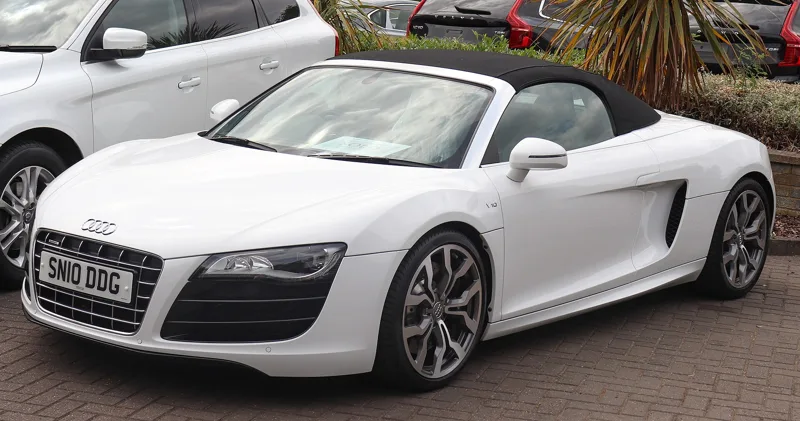
The Spyder added a retractable cloth roof to the R8, and it arrived first with the 5.2-litre V10 before a 4.2-litre V8 Spyder followed. The GT was a lighter, more powerful V10 coupe built in a limited run of 333 cars, and a GT Spyder followed later.
The V10 Spyder used the same engine as the coupe, with extra chassis support and a pair of roll-over bars. It was formally unveiled at the 2009 Frankfurt Motor Show, after the press had speculated about an open-top R8 for some time.
A 4.2-litre V8 Spyder came later. Autocar reported in April 2011 that the 4.2 FSI V8 would join the open-top range, offering 434 PS (319 kW; 428 hp) and 430 Nm (317 lbf-ft). The Spyder reached 0-100 km/h in 4.3 seconds and topped out at 300 km/h (186 mph).
The R8 GT was a high-performance V10 with quattro four-wheel drive. It lost 100 kg (220 lb) to reach 1,525 kg (3,362 lb), and it produced 560 PS (412 kW; 552 hp) at 8,000 rpm and 540 Nm (398 lb-ft) at 6,500 rpm. The GT reached 0-100 km/h in 3.6 seconds, with a top speed of 320 km/h (199 mph).
Only 333 GT coupes were built, with 35 for the UK and 90 for the US. The GT Spyder was unveiled at the 2011 24 Hours of Le Mans, and its dry weight of 1,640 kg (3,616 lb) was 85 kg (187 lb) lighter than the V10 Spyder. Carbon fibre parts covered the soft top cover, the side panels and even the seats.
What race cars came from the R8?
The R8 LMS was a GT3 race car with a 500 PS (368 kW; 493 hp) V10 and rear-wheel drive, because GT3 rules barred four-wheel drive. Later LMS ultra and Grand-Am versions adapted the platform for other rules and series.
Audi Sport, quattro GmbH and Audi Hungaria built the LMS together. It used a race-oriented six-speed sequential gearbox, and customer deliveries were planned from autumn 2010, after the first test races in the 2009 season.
The first R8 LMS, chassis 101, went to Audi Sport Italia in 2009. Audi itself did not enter a factory team, so privateers ran the cars at the 2009 Nurburgring 24 Hours, where the R8s finished 2nd and 23rd or better.
In 2010 Mark Eddy ran the first R8 LMS in the Southern Hemisphere, competing in the Australian GT Championship. At the 2011 Bathurst 12 Hour, the Joest team of Basseng, Mies and O'Young won by 0.71 seconds. Craig Lowndes set the fastest lap, and the class lap record stood at 2:09.0861 on the 6.213 km Mount Panorama circuit.
The LMS ultra added CFRP doors and 570 PS (419 kW; 562 hp). It gave Audi its first 24 Hours of Nurburgring victory in 2012, with a 1-2 finish, and Phoenix Racing took the 2012 24 Hours of Spa in an LMS ultra.
The Grand-Am version cut the engine from 470 PS to 450 PS (331 kW; 444 hp) with an air restrictor. It carried an 83.3 litre fuel tank and no traction control or ABS, and it debuted at Daytona in January 2012. APR Motorsport finished 31st at the 2012 Rolex 24, and in 2013 Audi took the GT class in a 1-2 finish.
Did the R8 become an electric car?
Audi built several electric R8 prototypes. The 2009 e-tron concept made 317 PS (233 kW; 313 hp), and a 2011 prototype reached 381 PS (280 kW; 376 hp). Production was paused in May 2013 and revived in March 2014 for customers who requested one.
The e-tron concept carried a 42.4 kWh battery and offered a range of 248 km (154 miles), with four electric motors driving the car. Its styling followed the petrol R8, with a body that echoed the V8 and V10 cars.
The 2011 prototype used a 48.6 kWh battery and produced 820 Nm (604.80 lb-ft) of torque. An early prototype set a lap of 8:09.099 at the Nurburgring on 26 June 2012.
Audi paused the project in May 2013, saying battery technology had not advanced as fast as it had hoped. In March 2014 it revived the car, with range rising from 215 km (134 mi) to approximately 450 km (280 mi).
Which special editions were built?
Audi built several limited R8s for particular markets. These included a 100-unit V8 Limited Edition for the UK, an 80-unit China Edition based on the 5.2 FSI coupe and a 60-example Competition for the USA.
The V8 Limited Edition was built to mark a Le Mans win, and it offered a titanium body colour option. The China Edition used a 5.2 FSI coupe with unique trim, and its serial numbers left out the number 4, which is considered unlucky in China.
The LMX of 2014 came with a laser high-beam module, 570 PS (419 kW; 562 hp) and 540 Nm (398 lb-ft), and it used a seven-speed S tronic transmission. Its bodywork included matte carbon fibre pieces and a fixed rear spoiler.
What was the 2015 R8 Competition?
The 2015 R8 Competition was the most powerful production Audi of its time and the final version of the first-generation car. Only 60 examples were produced for the USA, with 570 horsepower, an 8,800 rpm redline and a 0 to 60 mph time of 3.2 seconds. Pricing started above $200,000 USD.
The car used matte carbon fibre for its spoiler, mirror housings, side blades, nose and diffuser. Audi Exclusive handled the 60 cars, so each buyer could choose the interior and exterior colours.
The engine was revised from the standard 5.2-litre V10 to produce more power. The only transmission offered was the seven-speed S-Tronic dual-clutch, which gave race-car style exhaust overrun sounds through the sports exhaust.
What did the 2012 facelift change?
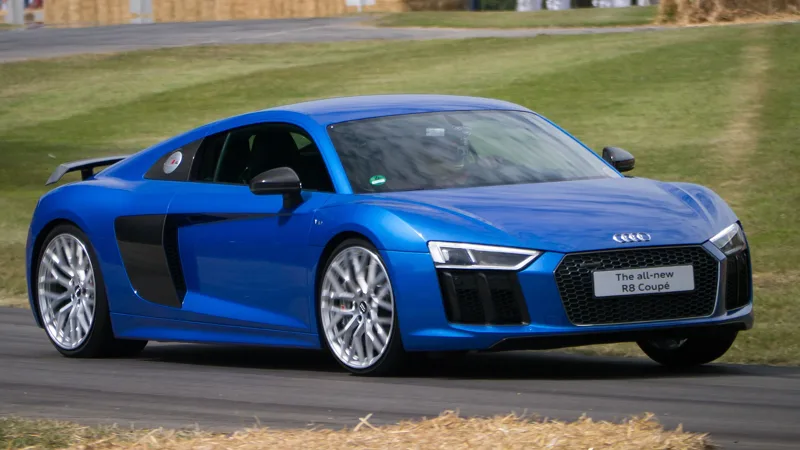
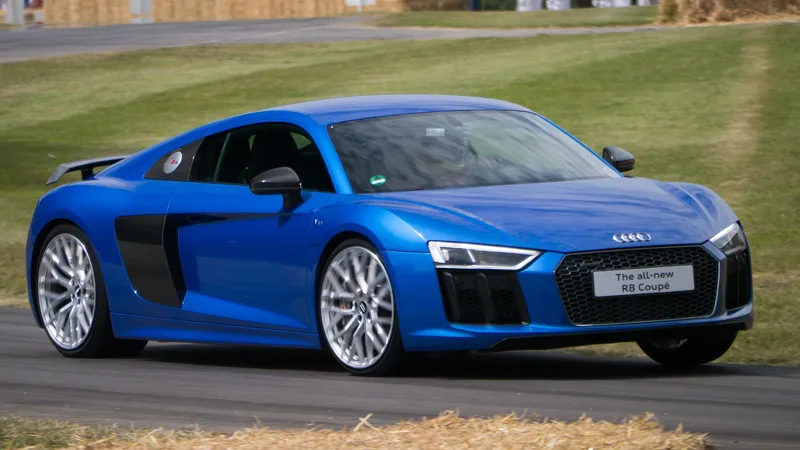
The autumn 2012 facelift made LED headlights standard on every variant and replaced the R-tronic with a seven-speed S-Tronic. It also brought a high-gloss black single-frame grille, matte black vent louvers on the V10 coupe and a new V10 plus variant.
The V10 plus, introduced in 2012 as a coupe only, rated its V10 at 550 PS (405 kW; 542 hp), peaking at 8,000 rpm, with 540 Nm (398.28 lb-ft) reached at 6,500 rpm. Its dry weight was 1,570 kg (3,461.26 lb).
The plus model added carbon fibre parts, including a front splitter, mirror housings and a rear diffuser, along with cross-drilled ceramic brakes. Its interior used standard bucket seats with prominent side sections.
European models arrived at the end of 2012, UK cars went on sale from August 2012 as 2013 model year cars, and US models followed in April 2013 as 2014 models.
How did reviewers rate the R8?
Reviewers praised the R8 for its handling, stability and steering. Evo Magazine called it a supercar, Autocar awarded it best handling and the title of fastest car for 2007, and it won several 2008 awards, including MSN Car of the Year.
Top Gear compared the V8 with the Nissan GT-R and found it much slower, though more involving to drive. On the same track the R8 ran ahead of the Lamborghini Gallardo and Aston Martin DB9.
The MSN Car of the Year 2008 vote gave the R8 42% of the votes, ahead of the Ferrari F430 on 13% and the BMW M3 on 11%. Playboy named it Car of the Year for 2008, and the Automobile Journalists Association of Canada named it Canadian Car of the Year.
Autobild gave the R8 its SportsCar of the year award, and the 2008 World Car awards named it both World Performance Car and World Design Car of the Year.
What are the Audi R8 Type 42 specifications?
| Specification | Detail |
|---|---|
| Production span | June 2006 to August 2015 |
| Chassis basis | Shared with the Lamborghini Gallardo |
| V8 engine | 4,163 cc (4.2 L) 32-valve FSI, 420 PS (309 kW; 414 hp) |
| V8 torque | 430 Nm (317 lbf-ft) |
| V10 5.2 FSI | 525 PS (386 kW; 518 hp), 530 Nm (391 lbf-ft) |
| V10 0-100 km/h | 3.9 seconds |
| V10 top speed | 316 km/h (196 mph) |
| V8 curb weight | 1,560 kg (3,439 lb) |
| V10 plus dry weight | 1,570 kg (3,461.26 lb) |
| GT | 560 PS (412 kW; 552 hp) at 8,000 rpm; 1,525 kg (3,362 lb) |
| Competition (2015) | 570 hp; 0 to 60 mph in 3.2 seconds |
| Gearbox | Six-speed manual, or S or R Tronic automated manual |