An Audi R18 TDI took its tenth Le Mans victory in a race of rain, safety cars and heavy attrition, with only 28 of 56 starters classified as finishers.
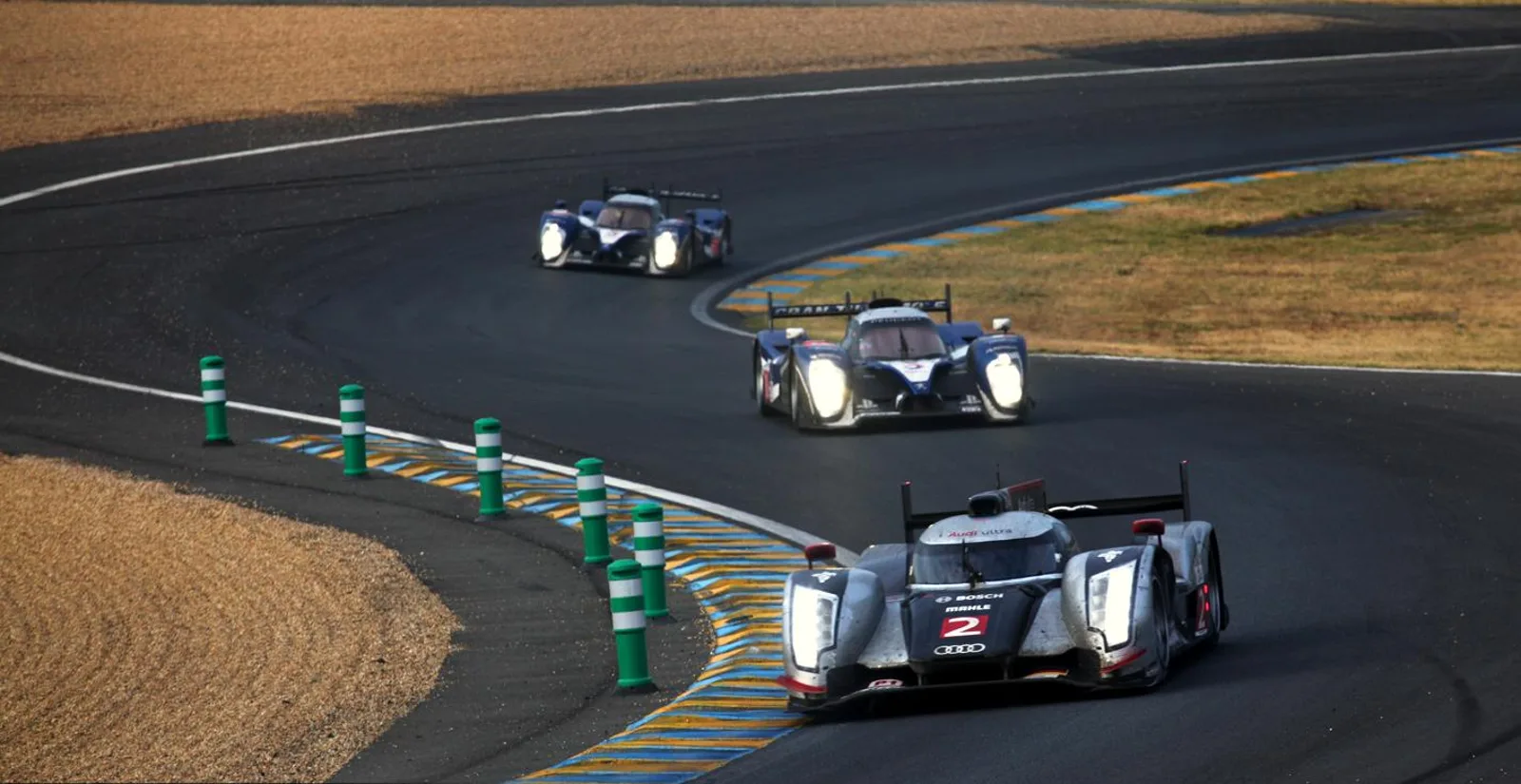
Audi took its tenth Le Mans win in 2011, with Marcel Fassler, Andre Lotterer and Benoit Treluyer sharing the No. 2 R18 TDI. Their closest challenger, a Peugeot 908, finished 13.854 seconds behind after a long fight, and 28 of the 56 starters completed the race.
The 2011 24 Hours of Le Mans was the 79th running of the event and the third round of the Intercontinental Le Mans Cup. An Audi R18 TDI driven by Marcel Fassler, Andre Lotterer and Benoit Treluyer won it, Audi's tenth Le Mans victory, after a long battle with a trio of Peugeot 908s. Only 28 of the 56 starters finished.
The race was notable as the first time it had formed part of a championship since 1992. Qualifying gave Audi the first overall pole at Le Mans since 2006, and the race itself was shaped by hybrid technology, a series of safety car periods and some dramatic accidents.
What was the 2011 race and where was it held?
Spectators numbered 249,500 for the weekend of 11 and 12 June 2011, held on the Circuit de la Sarthe outside Le Mans, France. Fifty-six teams of three drivers entered Le Mans Prototype and Le Mans Grand Touring Endurance cars, and it was the 79th edition organised by the Automobile Club de l'Ouest since 1923.
The race has its roots in 1923, when the journalist Charles Faroux, the Automobile Club de l'Ouest general secretary Georges Durand and the industrialist Emile Coquile agreed to test vehicle reliability and durability. Its place in the Triple Crown of Motorsport is part of its prestige, and the 2011 race was run on the 13.629 km (8.469 mi) circuit.
An Audi win after a long Peugeot fight, decided through safety car periods and a late lap of fuel and tyre strategy.
Which rule changes shaped the 2011 field?
The Automobile Club de l'Ouest wrote the 2011 regulations to encourage new technologies that cut carbon emissions and fuel use. Le Mans Prototype cars could now use four-wheel or kinetic energy recovery hybrid powertrains, with each hybrid system limited to 500 kW (670 hp) between braking zones. Driver aids such as push-to-pass were banned, fuel capacity was reduced, and turbocharged and diesel engines were downsized.
To reduce lift, all prototypes had to weigh at least 900 kg (2,000 lb) and carry vertical fins on the engine cover. The second-tier LMP2 category was overhauled to keep costs down for privateers. Its engines had to be production-series units, with required engine life rising from 30 hours to 50 hours over three years, and each LMP2 team had to sign at least one silver or bronze driver.
The LM GT1 category was dropped in favour of one set of GT Endurance rules, split into LM GTE Pro and LM GTE Am. The Pro class used new cars driven by any driver, while the Am class used one-year-old cars with a minimum of two silver or bronze licensed drivers per team.
Who was entered for the race?
The Automobile Club de l'Ouest received 71 applications by the entry deadline of 19 January 2011. Its eight-member selection committee granted 56 invitations, and 40 per cent of applications were for the LMGTE Am class. Automatic entries were announced on 3 December 2010 for teams that had won their class or earned places in Le Mans-based series.
The entry list changed before the race. Signatech Nissan withdrew its second car, the No. 27 Oreca 03-Nissan, on 12 April, and the No. 44 Extreme Limite entry was promoted in its place. Highcroft Racing withdrew its LMP1 car on 16 May, citing a lack of financial support, and it also ended its partnership with Honda and HPD after the Tohoku earthquake and tsunami. The Kronos Racing Lola-Aston Martin then joined the field.
How did testing and practice go?
The test session returned to Le Mans for the first time since 2008. Two four-hour sessions were held on 24 April, seven weeks before the race, with 54 cars from the entry and reserve lists taking part. Romain Dumas set the fastest first-session time of 3:27.900 in the No. 1 Audi R18 TDI, and Tom Kristensen improved to 3:27.687 in the second.
Official practice took place on 8 June with the full field of 56 cars on track for four hours. Audi and Peugeot traded fastest laps before Mike Rockenfeller set the quickest overall time of 3:27.986 in the No. 1 Audi. In LMP2 Jonny Kane led with 3:42.863, and Jan Magnussen's Corvette was the fastest non-BMW car in LMGTE Pro.
Practice was not without incident. Raymond Narac's Porsche was badly damaged against the tyre wall at the Porsche Curves, stopping practice for 18 minutes, and Roger Wills struck a barrier exiting the same corner in his Ferrari F430 GT2.
How was qualifying decided?
Qualifying ran over three two-hour sessions, and the starting order was set by each team's fastest driver. Audi led from the start of the first session, but Stephane Sarrazin's Peugeot took provisional pole with 3:27.033 before the end of that session. Marcel Fassler then moved the No. 2 Audi to the top with 3:25.961 in the second session.
In the third session Dumas first bettered the provisional pole, but Benoit Treluyer reset the fastest time to 3:25.738. That gave Audi its first overall pole position at Le Mans since 2006. Simon Pagenaud took third on the grid for Peugeot, while Kristensen started fifth in the No. 3 Audi.
Class qualifying was also close. Soheil Ayari claimed LMP2 pole for Signatech, while the Strakka car of Nick Leventis hit a barrier at around 195 km/h (121 mph) and 9.4 G. In LMGTE Pro, Augusto Farfus took the pole for BMW, with Bruni's Ferrari second. Marco Cioci gave AF Corse the inaugural LMGTE Am pole.
What happened in the warm-up and at the start?
A 45-minute warm-up took place on the morning of 11 June in cloudy but dry conditions. Bourdais set the fastest lap of 3:27.228 just before the end, and Treluyer was second. Toni Vilander led LMGTE Pro in the warm-up for AF Corse.
The field set off from a rolling start at 15:00 local time, flagged away by FIA President Jean Todt. Treluyer led the field for the first ten laps, and Aston Martin lost both of its LMP1 cars early on. Darren Turner stuck the No. 009 car in the gravel at the first Mulsanne chicane, and Adrian Fernandez retired the No. 007 with broken alternator pulleys.
The first hour ended in a serious accident. McNish passed Bernhard's slowing Audi on the inside, and Beltoise, approaching the high-speed Esses, collided with the rear of the No. 3 car. McNish went backwards through the gravel, hit the outside tyre wall at high speed and landed upside down. He was unhurt, but the safety cars were deployed for 72 minutes while marshals repaired the walls.
What happened through the night?
As night fell, Rockenfeller's No. 1 Audi overtook Lamy's Peugeot for third place. Soon afterwards he was lapping the No. 71 Ferrari of Rob Kauffman on the straight between Mulsanne and the Indianapolis corner, when Kauffman drove into his path and touched the rear of the Audi. The Audi speared left into the Armco barrier at high speed, destroying the car and about 20 metres (66 ft) of barrier. Kauffman was ordered to retire, and Rockenfeller spent the night in hospital with a minor arm wound.
The safety cars were deployed for the second time, for 2 hours and 22 minutes, while the barrier was repaired and debris cleared. The leading prototypes made full-service pit stops, and CRS brought its No. 62 Ferrari in after Shaun Lynn damaged the right-rear corner at the Ford Chicane. When racing resumed, the Audi and three Peugeots traded the lead through pit-stop cycles.
In LMP2 the Oreca that had led for 96 laps stopped with electrical problems, handing the lead to Greaves Motorsport's Zytek of Olivier Lombard. Russo lost control of the PeCom Oreca in the Porsche Curves, and Watts's Strakka retired after an oil cooler problem. Hallyday later retired the No. 48 Oreca, and Christophe Bouchut's Level 5 car moved into the class podium.
How did the morning and afternoon unfold?
Beretta, suffering from fumes during the safety car periods, missed his braking point at Arnage and damaged his Corvette against the tyre wall. He reversed and rejoined in third in LMGTE Pro. Later in the morning Magnussen, leading LMGTE Pro in the No. 74 Corvette, lost the rear of his car while lapping Horst Felbermayr's No. 63 Porsche, and both cars were forced to retire after colliding with the barriers.
The safety cars were deployed a fifth time while marshals spent 29 minutes clearing debris. Pagenaud took the race lead from Treluyer before Treluyer reclaimed the position on the outside. In the 19th hour Wurz damaged the No. 7 Peugeot's front-left corner and lost four laps while the suspension was repaired.
As the 19th hour ended, light rain began to fall. Treluyer was blocked behind the lapped Davidson in the No. 7 Peugeot and was told to slow, and Lotterer later took over in a routine stop. With fewer than 40 minutes left, the No. 2 Audi made an extra stop for four new tyres after its left-rear tyre began to deflate.
Who won the 2011 24 Hours of Le Mans?
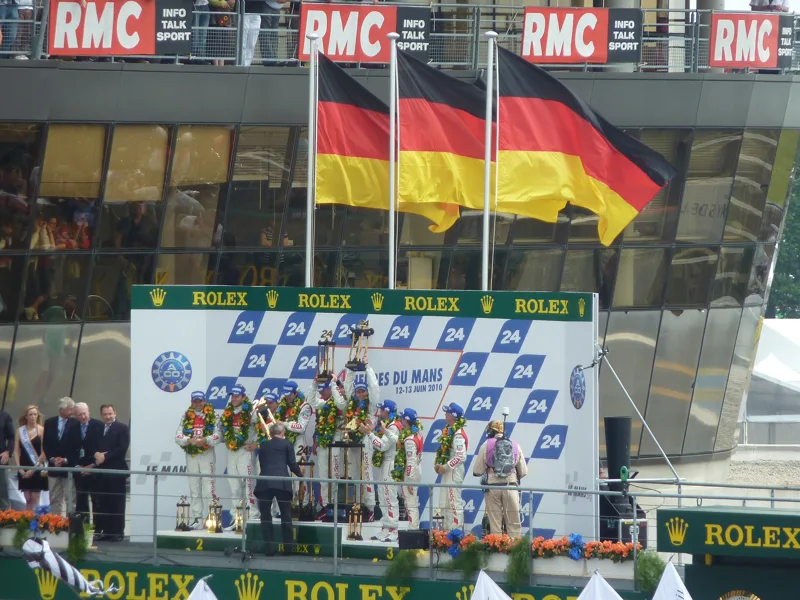
Lotterer pulled away from the No. 9 Peugeot over the final half-hour, and the No. 2 Audi crossed the line first after 355 laps. It was Audi's tenth Le Mans win and the first for Lotterer, Fassler and Treluyer. Their lead engineer, Leena Gade, became the first female race engineer to win the event.
Pagenaud's Peugeot finished second, 13.854 seconds behind, which was the fourth-closest finish in the race's history. The No. 8 Peugeot, driven by Minassian, finished third, two laps down after overnight vibration problems. Greaves led the final 137 laps in LMP2 to win the class with Kimber-Smith, Lombard and Karim Ojjeh, Nissan's first class win since 2000. Level 5 finished third in its Le Mans debut.
In LMGTE Pro, Corvette Racing held on for a seventh class win, with Tommy Milner taking his first class victory. The No. 51 AF Corse Ferrari was second, the first class podium for AF Corse at Le Mans, and BMW's No. 56 finished third. Larbre Competition won LMGTE Am with the No. 50 Corvette, while the Robertson Racing Ford GT finished third in the class, making David and Andrea Robertson the first married couple to finish on the podium together.
What did the teams say after the race?
Fassler spoke of watching his co-drivers battle Peugeot in the closing hours, and Bourdais conceded that Peugeot had lost to a slightly stronger and more reliable Audi. Pagenaud said that finishing second by only 13 seconds had been a hard fight. Davidson denied any team order had been used against Lotterer, saying he had acted on his own initiative.
McNish praised the strength of the Audi after his first-hour accident, and Rockenfeller credited the safety standards of the car for protecting him. Audi team principal Wolfgang Ullrich said the closed cockpit reduced visibility but did not explain the team's accidents. Kimber-Smith said the Greaves strategy of low risk had been decisive, and Doug Fehan, Corvette's general manager, said the result had been a script for the 100th anniversary of Chevrolet.
What were the class results?
| Class | Position | Car | Drivers |
|---|---|---|---|
| LMP1 | 1st | Audi R18 TDI, No. 2 | Marcel Fassler, Andre Lotterer, Benoit Treluyer |
| LMP1 | 2nd | Peugeot 908, No. 9 | Sebastien Bourdais, Pedro Lamy, Simon Pagenaud |
| LMP1 | 3rd | Peugeot 908, No. 8 | Nicolas Minassian, Franck Montagny, Stephane Sarrazin |
| LMP2 | 1st | Zytek Z11SN-Nissan, Greaves Motorsport | Tom Kimber-Smith, Olivier Lombard, Karim Ojjeh |
| LMGTE Pro | 1st | Chevrolet Corvette C6.R, No. 73 | Olivier Beretta, Antonio Garcia, Tommy Milner |
| LMGTE Am | 1st | Chevrolet Corvette C6.R, No. 50 | Patrick Bornhauser, Julien Canal, Gabriele Gardel |
Only 28 cars completed the race, and the table lists the class winners. Audi's win moved it closer to Peugeot in the LMP1 Manufacturers' Cup, while Corvette's class victory pushed it past BMW and Ferrari in the LMGTE standings.
How did the championship standings change?
Peugeot kept the lead in the LMP1 Manufacturers' Cup with 103 points, ahead of Audi on 69. Corvette's class win lifted it to 84 points at the head of the LMGTE Manufacturers' Cup, with Ferrari and BMW level on 72 apiece. Audi Sport Team Joest overtook Peugeot Sport in the LMP1 Teams' Cup, while Signatech and AF Corse kept their leads in LMP2 and LMGTE Pro, and Larbre passed Proton Competition in the LMGTE Am Teams' Cup with four rounds left in the season.
The race confirmed Audi as the dominant force in prototype racing that year, though Peugeot showed that the battle for the top step would be close into the late stages of the event.