An Audi R18 e-tron quattro became the first hybrid electric car to win Le Mans, after a Toyota lead, a crash that broke Davidson's vertebrae and a DeltaWing retirement.
Audi's hybrid R18 took the 2012 race, the first hybrid to win at La Sarthe. The race also featured a major Toyota accident and the retirement of the DeltaWing entry, which had been granted the Garage 56 slot.
The 2012 24 Hours of Le Mans was the 80th running of the race and the third round of the FIA World Endurance Championship. An Audi R18 e-tron quattro shared by Andre Lotterer, Marcel Fassler and Benoit Treluyer won it, the first hybrid electric car to take the race win, and Audi swept the podium with its second and third cars.
The race was dramatic from start to finish. A Toyota TS030 Hybrid led early on, a serious crash at the start of the sixth hour brought out a long safety car period, and Audi's lead challenger McNish crashed in the 22nd hour, which gave the winning crew a clear run to the flag.
What was the 2012 race and where was it held?
The 80th Le Mans was held on 16 and 17 June 2012 at the Circuit de la Sarthe, close to Le Mans in France, in front of approximately 240,000 spectators. Thirty of the race's 56 entries contested the World Endurance Championship, and the event was the third of eight races in that series.
The Automobile Club de l'Ouest moved the race forward by one week to avoid a clash with Formula One races and to give teams time to set up their facilities at the circuit. It was the 80th annual edition of an event first held in 1923, and it is widely regarded as part of the Triple Crown of Motorsport.
A hybrid Audi won Le Mans for the first time, after a Toyota lead, a serious crash and a DeltaWing retirement.
What rules and technology were new in 2012?
2012 was the first year that hybrid electric vehicles raced at Le Mans. The Automobile Club de l'Ouest and the FIA created seven recuperation zones on the Circuit de la Sarthe, each placed 50 m (160 ft) before a corner. Energy harvested under braking in those zones was capped by a mandatory limit of 500 kJ (140 Wh) between two braking zones, which kept the costs of the new systems under control.
The regulations also created a new route for entries that wished to test technology. The 56th place was the Garage 56 entry, and it went to the American DeltaWing project, which had been developed for the IndyCar Series and had a layout far removed from the usual Le Mans prototype. The DeltaWing was backed by Highcroft Racing, All American Racers and the Panoz Group. Reserve places went to the Swiss GreenGT LMP-H2, which used a hydrogen fuel cell, and the French Courage 0.12, which used stored energy to drive electric motors.
How were the entries and reserves decided?
Automatic entries were granted to teams that won their class at the 2011 race and to winners of Le Mans-based series such as the American Le Mans Series and the Le Mans Series. The Automobile Club de l'Ouest announced the automatic entries on 24 November 2011. Peugeot Sport declined its place, because it withdrew from sports car racing in January 2012 after financial difficulties. BMW Team RLL and Pegasus Racing also declined their entries, since both were concentrating on their own series.
The full entry list of 56 cars and nine reserves was announced in Paris on 2 February. Of those, 30 were guaranteed entries from the WEC, five came from the American series and three from the Le Mans Series, while the rest were one-off entries. On 16 April Dyson Racing withdrew both of its Lola B12/60-Mazda cars, which promoted the Status Grand Prix Lola and the Murphy Prototypes Oreca 03 Nissan from the reserve list.
What happened in testing and practice?
A test day on 3 June, two weeks before the race, required every entrant to complete eight hours of track time split into two sessions. Duval set the fastest lap in the first session, but McNish later improved to 3:25.927 in the No. 2 Audi before crashing at Tertre Rouge with an hour remaining. In the same practice, Guillaume Moreau crashed the No. 15 OAK Racing Pescarolo heavily into a concrete barrier in the Porsche Curves and fractured a vertebra, and Franck Montagny took his place.
Official practice was held on 13 June with the full field on track for four hours. Audi again led the timesheets, with Lotterer setting the session's fastest lap of 3:25.163. Nakajima was the quickest Toyota in fifth, and Kimber-Smith led LMP2 with a 3:39.669 lap. Turner set the pace in LMGTE Pro at 3:57.036.
How was qualifying decided?
Qualifying ran in three two-hour sessions beginning late on 13 June. Audi led from the first minutes, with Jarvis's flying lap in the No. 4 Audi, and Lotterer's final lap of 3:25.453 gave the No. 1 car provisional pole. Duval's second-session lap of 3:24.098 then put the No. 3 Audi ahead, before Lotterer returned in the third session with 3:23.787 to take pole.
That was an important result. Audi became the first manufacturer to take pole at Le Mans with a hybrid electric car, and it earned its seventh overall pole at the race. Davidson's Toyota came within a second of pole in the final minutes, and Kristensen split the two Toyotas in fourth place on the grid.
In LMP2 John Martin's ADR-Delta Oreca set a time of 3:38.181 early in the third session, and his lap stood to the end. In LMGTE Pro Frederic Makowiecki's Luxury Racing Ferrari took pole, while the Flying Lizard Porsche of Patrick Pilet led LMGTE Am.
How did the race begin?
The race started at 15:00 Central European Summer Time, with Toyota vice president Takeshi Uchiyamada waving the French tricolour. Fifty-six cars were planned for the start, but the No. 16 Pescarolo had to change its engine in the pit lane, and the No. 21 Strakka HPD joined 22 minutes late after a gearbox oil leak.
Lotterer maintained his lead on the first lap and pulled away from the field. McNish overtook Sarrazin's Toyota for third and held off a challenge to keep the position. Light rain fell on the north section of the track but did not affect the race. In LMP2 John Martin led the opening nine laps until Pla's OAK car passed him during the pit stop rotation.
The first hour brought the first retirement, when Rostan's No. 29 Gulf Lola broke a front-left wheel alignment after an accident leaving the Porsche Curves. Pilet and then Pumpelly took the LMGTE Am lead when a misfire forced Simonsen's Aston Martin out of contention.
What happened in the middle hours?
Nearly four hours in, Kristensen's No. 2 Audi returned to the garage so mechanics could remove a large lump of rubber debris from its right-rear suspension. He rejoined fifth, and Lapierre and Buemi moved the Toyotas into second and third through a routine pit stop for Duval's No. 3. Toyota's fuel economy was better than the Audis', and Buemi attacked in the fourth hour to cut Treluyer's lead to 20 seconds.
Dumas lost ground after an incident with the leading LMGTE Am Porsche at the first Mulsanne chicane, and his Audi needed a 26-minute stop to repair its bodywork. The fifth hour ended with Lapierre beating Treluyer in a duel for the lead at the Porsche Curves.
What was the big accident in the sixth hour?
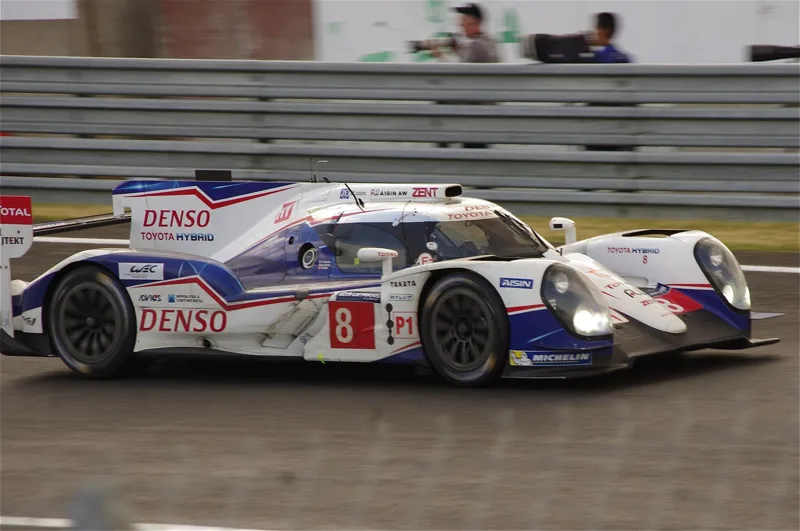
At the start of the sixth hour, Davidson in third was lapping Perazzini's AF Corse Ferrari in LMGTE Am when the left-rear of Davidson's Toyota No. 8 made contact with the front-right of the Ferrari at Mulsanne corner. The Toyota rotated through 360 degrees, lifted into the air as its right-rear wheel detached, and landed on its front-left corner before hitting the barrier. Perazzini's Ferrari was heavily damaged and turned onto its roof.
The safety cars were deployed for 70 minutes while marshals repaired the barriers and cleared the circuit. Both drivers left their cars without help. Davidson was taken to hospital with shock and back pain, and he had fractured his T11 and T12 vertebrae. Perazzini was unhurt.
Half a minute after the restart, Audi's leader Fassler was delayed by slower traffic, and Nakajima's No. 7 Toyota collided with the DeltaWing of Satoshi Motoyama, sending it hard into a concrete barrier. The DeltaWing sustained damage to its steering arm, powertrain and bodywork. Motoyama spent 90 minutes trying to repair it with garage equipment, but he was unable to make the car mobile and retired.
How did the leaders swap places?
Lotterer had an anxious moment in the first third of a lap, but he returned without losing the lead. In LMP2 the No. 48 Murphy Oreca-Nissan gave up its lead when Hughes entered the pit lane with a right-rear puncture that sent it spinning at Arnage. Pla regained the class lead in the OAK Oreca until an oil pressure fault forced its retirement, which handed the lead to Starworks.
Soon after Westbrook took over from Milner in the No. 74 Corvette, the car's left-rear tyre came apart at the Dunlop Esses. The car lost the LMGTE Pro lead it had held for 66 consecutive laps to the No. 51 AF Corse Ferrari, and it later crashed at the first Mulsanne Straight chicane and needed repairs.
As the race approached half distance, Fassler led Kristensen by 40 seconds. Audi's three leading cars swapped positions throughout the early hours as pit stop cycles went on, and McNish took over the No. 2 Audi to set laps in the 3-minute-30-second range.
What did the early morning bring?
In the early morning Fassler's No. 1 Audi spun in the Porsche Curves and hit a barrier, which handed the lead back to McNish's No. 2 car. Hartley's No. 48 Oreca broke a rear transmission part and was pushed to the pit lane. Abdulaziz Al Faisal crashed backwards into a concrete barrier, bringing out a second safety car period.
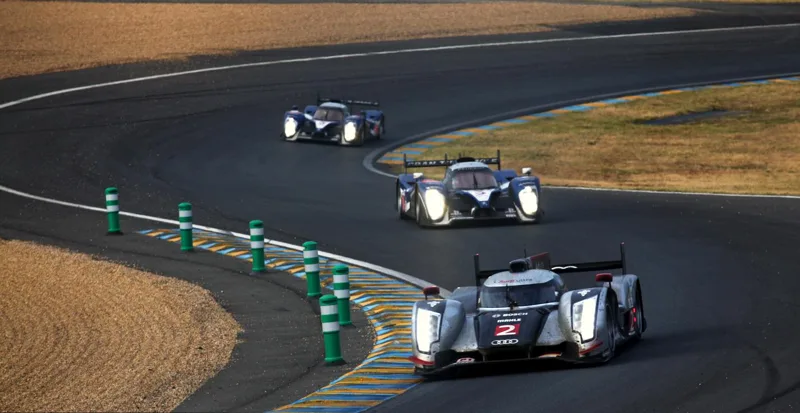
Later Fassler struck the rear bodywork of his car against a barrier after dodging a Corvette that had spun at Mulsanne. Audi kept him on track until his next stop, and the car was repaired in a little over two minutes. Kristensen's No. 2 car then reclaimed the lead after a pit stop, and in the 22nd hour McNish's car punctured on an Armco barrier in the Porsche Curves while he was lapping the Luxury Racing Ferrari.
The race-leading Audi of Treluyer spun at the entry to the pit lane, and McNish's damaged No. 2 car dropped a lap behind Lotterer. Gene then ended up in a wall at the exit of the first Mulsanne chicane. Anthony Pons' Porsche ceded the LMGTE Am lead to Lamy's Larbre Corvette, which kept it to the finish after Pons suffered a left-rear puncture on the final lap.
Who won the 2012 24 Hours of Le Mans?
The No. 1 Audi R18 e-tron quattro of Fassler, Lotterer and Treluyer held the lead without trouble over the final two hours. It covered 378 laps and 5,151.8 km (3,201.2 mi), which gave the trio their second consecutive Le Mans win and Audi its eleventh overall. The car was the first hybrid electric and non-permanent four-wheel drive vehicle to win the 24-hour race.
Audi then completed a sweep of the podium with the No. 2 and No. 4 cars. Starworks Motorsport held the LMP2 lead for the final 215 laps to win, a result that gave Kimber-Smith his third class win and gave Dalziel and Potolicchio their first. Thiriet by TDS Racing was second in LMP2, and PeCom Racing finished third.
In LMGTE Pro the AF Corse Ferrari held its three-lap lead over Luxury Racing and took the class win after 336 laps. It was Bruni's second class win, and Fisichella and Vilander's first. Aston Martin finished third. The IMSA Performance Porsche took second in LMGTE Am after a late puncture, and Krohn Racing completed the class podium in third. A total of 35 of the 56 starters finished the race.
What did the race mean for the championship?
With the win, McNish, Kristensen and Capello moved to the top of the drivers' championship on 77 points, and Lotterer, Fassler and Treluyer were six and a half points behind in second. Dumas and Duval fell from first to third on 67 points, while Gene was fourth on 49 and the Rebellion trio of Heidfeld, Jani and Prost were fifth on forty-two and a half.
Audi retained its lead in the manufacturers' standings, with five rounds of the season remaining and Toyota still behind it. The post-race comments from the teams reflected the close finish, with Toyota's team principal admitting that the Japanese manufacturer had not been looking for an aggressive start and that the balance of its car had been difficult early on.
What were the results in each class?
| Class | Position | Car | Drivers |
|---|---|---|---|
| LMP1 | 1st | Audi R18 e-tron quattro, No. 1 | Marcel Fassler, Andre Lotterer, Benoit Treluyer |
| LMP1 | 2nd | Audi R18 e-tron quattro, No. 2 | Tom Kristensen, Allan McNish, Rinaldo Capello |
| LMP1 | 3rd | Audi R18 ultra, No. 4 | Oliver Jarvis, Marco Bonanomi, Mike Rockenfeller |
| LMP2 | 1st | HPD ARX-03b, Starworks Motorsport, No. 44 | Enzo Potolicchio, Ryan Dalziel, Tom Kimber-Smith |
| LMGTE Pro | 1st | Ferrari 458 Italia GT2, AF Corse, No. 51 | Giancarlo Fisichella, Gianmaria Bruni, Toni Vilander |
| LMGTE Am | 1st | Chevrolet Corvette C6.R, Larbre Competition, No. 50 | Patrick Bornhauser, Pedro Lamy, Julien Canal |
The results show Audi's dominance at the top, Starworks' privateer success in LMP2, and the AF Corse and Larbre wins in the GT classes.
What did the race leave behind?
Davidson's recovery was the most closely followed story after the race. He was flown home on 20 June to begin a three-month recovery period, and he credited the design of his race seat and head rest with protecting him. Toyota's team members visited the Nissan garage to apologise for the collision that ended the DeltaWing's race.
The DeltaWing itself was a talking point. It had been granted the 56th entry as the Garage 56 project, and its retirement after the collision meant that the experimental concept did not reach the finish.