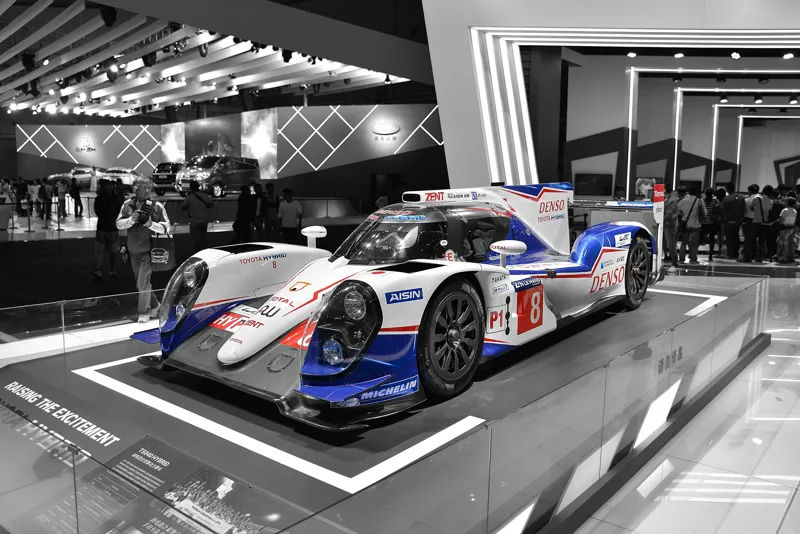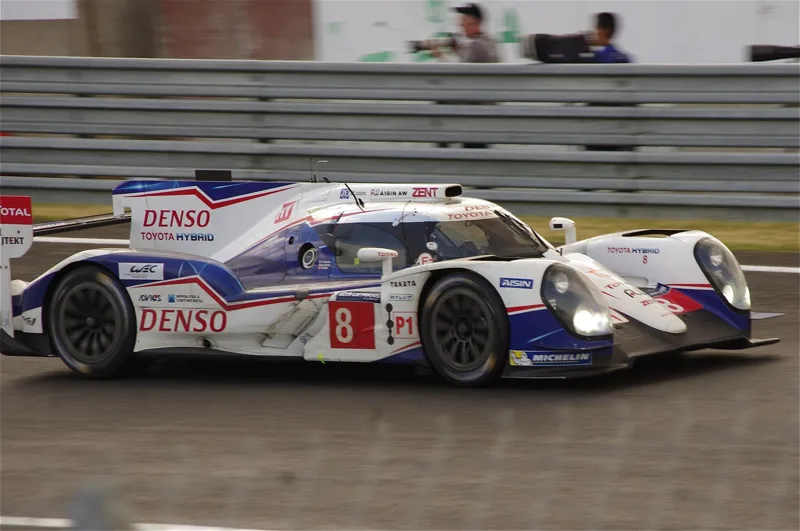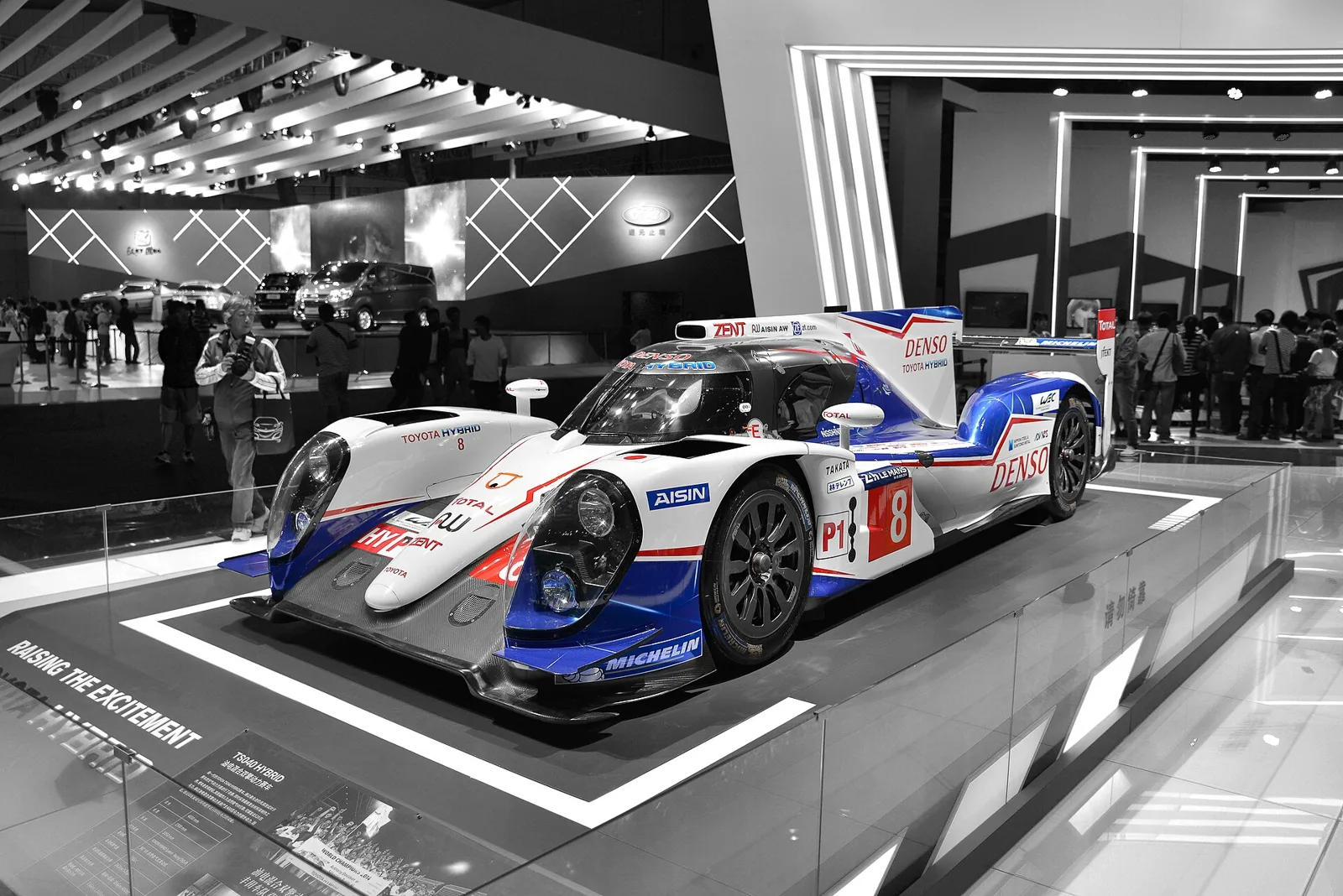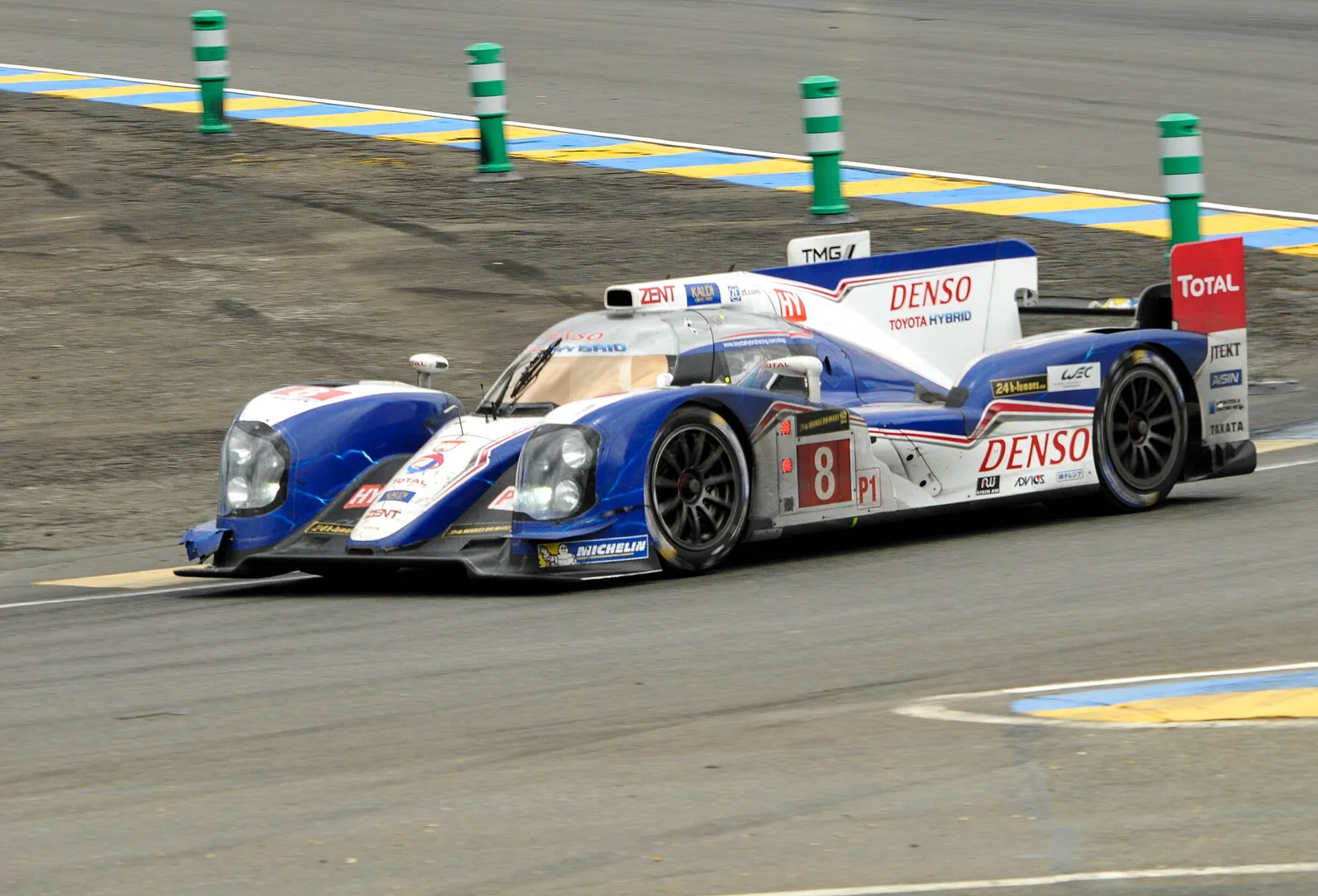
Built in Cologne for the 2012 and 2013 World Endurance Championship, the TS030 Hybrid gave Toyota five race wins and a Le Mans debut that ended in a heavy crash.
Toyota's TS030 Hybrid used a 3.4-litre V8 and a kinetic energy recovery system in a Le Mans Prototype 1 chassis. Its five race wins came before the 2014 rules ended its competitive life in the series, and it was the first petrol-hybrid in the WEC.
Toyota returned to top-level endurance racing with a car designed from a clean sheet. The TS030 Hybrid competed in the 2012 and 2013 World Endurance Championship, took five race wins and reached Le Mans as the first petrol-hybrid car in the series. Its story covers a rushed build, a crash that injured its driver, a debut pushed back by a test accident and two seasons spent chasing Audi.
What was the Toyota TS030 Hybrid?
The Toyota TS030 Hybrid was a Le Mans Prototype 1 sports car built by Toyota Motorsport in Cologne for the 2012 and 2013 World Endurance Championship. It paired a 3.4-litre V8 with a kinetic energy recovery system, and it won five rounds before the 2014 rules made it obsolete.
It was Toyota's first wholly new prototype since the GT-One, which last raced in 1999. Its engine was based on the Super GT unit, its chassis was a carbon fibre monocoque, and its bodywork was white with blue stripes along the cockpit and sidepods, a livery that echoed Toyota's hybrid road cars.
A purpose-built hybrid that gave Toyota wins in its first season and a second place in both championships it contested.
Why did Toyota return to sports car racing?
Toyota had last competed in sports car racing in 1999, when its GT-One cars qualified on pole for Le Mans. After the Supra HV-R won the Tokachi 24 Hours in 2007, the company wanted a purpose-built hybrid that could win international attention at the 24 Hours of Le Mans.
In that 1999 race the three GT-Ones were quick for most of the event, though two retired with tyre problems. The remaining car finished second behind the BMW winner. Toyota then withdrew to concentrate on its Formula One team, and the sports car programme stayed closed for more than a decade.
Engineers set a clear objective: a car built to bring Toyota back to international endurance racing, with Le Mans as the showcase. Work on the design began in late 2010, when early chassis designs were put before Toyota Motorsport.
How was the TS030 Hybrid engineered?
The TS030 Hybrid used a carbon fibre monocoque, a naturally aspirated 3.4-litre V8 set at a 90-degree angle and a kinetic energy recovery system that added an automatic 300 bhp (220 kW; 300 PS) at the rear wheels. The car ran a six-speed sequential gearbox and carbon brakes.
The monocoque was built at Toyota Motorsport's headquarters in Cologne, which made 84% of the chassis. Designers looked at the outdated Dome chassis and at current Audi and Peugeot monocoques, then ran their aerodynamic development in the Cologne wind tunnel.
Independent double wishbones with pushrod-actuated dampers gave the car its suspension, and the tyres were wide to match. Toyota chose to adapt its Super GT engine rather than build a new one, and the six-speed sequential gearbox sat transverse to the engine.
The hybrid system was called KERS by Toyota and ERS by the Automobile Club de l'Ouest. Under braking the motor-generator fed a super capacitor, which Nisshinbo supplied and which sat in the passenger compartment. Aisin AW built the front motor, Denso built the rear unit and Toyota Racing Development produced the system itself.
The 2012 rules let the hybrid system work at any speed. Audi had chosen to send hybrid power to the front wheels, and that system was restricted to a minimum speed of 120 km/h (75 mph), which gave Toyota more flexibility. Michelin supplied the tyres, and Oreca gave the team operational support.
How did the TS030 Hybrid reach its debut?
Toyota announced its return in October 2011 and tested the car privately at Circuit Paul Ricard three months later. A heavy crash on 4 April 2012 damaged the chassis beyond repair, and the planned Spa debut slipped to Le Mans instead.
The car was shown to the press on 24 January 2012, during a test at Paul Ricard. Its roll-out covered more than 2,000 km (1,200 mi), with tyre evaluation, long-distance hybrid running and set-up work. In mid-February it completed a 30-hour endurance stint.
Toyota had planned 40,000 km (25,000 mi) of testing before the season began. After the April accident the team cancelled seven days of running at Lausitz and Aragon, rebuilt the car and held a functionality test at Magny-Cours a month later.
The Peugeot withdrawal had prompted the ACO and the FIA to ask Toyota to expand its World Endurance Championship presence, but the team kept its focus on Le Mans. It skipped the 12 Hours of Sebring because the schedule did not allow enough time to prepare the car.
Who drove the TS030 Hybrid?
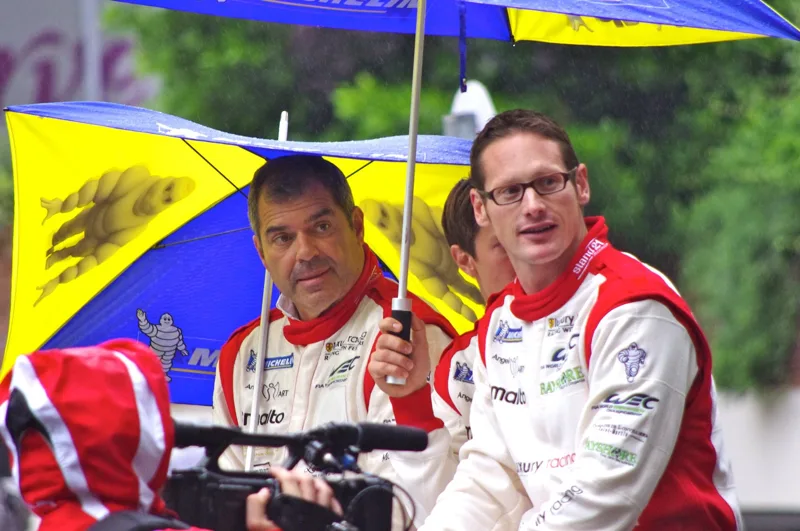
Toyota named its drivers in early 2012. The line-up included Sebastien Buemi, the third driver for Red Bull Racing, former Williams driver Kazuki Nakajima and Alexander Wurz, who had twice won Le Mans. Anthony Davidson was added for his sports car experience.
Nicolas Lapierre moved across from Oreca's Le Mans squad, and Stephane Sarrazin replaced Hiroaki Ishiura in May 2012 after Ishiura withdrew because of back discomfort. Andrea Caldarelli, a Super GT driver, served as the team's junior, and Nakajima missed several rounds because of his Super GT commitments.
How did the 2012 Le Mans race go?
The TS030 Hybrid made its race debut at Le Mans in 2012, becoming the first petrol-hybrid car to race in the World Endurance Championship. The No. 8 car qualified third and the No. 7 car fifth, but the race went badly wrong for the team almost at once.
On the 82nd lap Davidson collided with the AF Corse Ferrari of Piergiuseppe Perazzini at Mulsanne corner. His car flew into the air and hit a tyre barrier hard. He climbed out unaided but was taken to hospital, where a medical check found cracked vertebrae, T11 and T12.
The No. 7 car had briefly led the race before Davidson's crash. It had already suffered damage that needed lengthy repairs, and it retired after ten and a half hours when its engine failed.
How did the 2012 season unfold?
After Le Mans, Toyota ran a single car for the rest of 2012. It finished second at Silverstone, won three races at Sao Paulo, Fuji and Shanghai, and finished second to Audi in the manufacturers' championship with 96 points.
At Silverstone the No. 7 car qualified third, seven-tenths behind the Audi on pole. The race was a close duel with the leading Audi, the two cars swapped the lead several times, and the Toyota lost out in the end. At Sao Paulo, Wurz took the first pole position for the TS030, and the car secured its first WEC victory.
Bahrain went badly. The illuminated number panels failed, which forced a seven-minute stop for replacement parts. Lapierre later made contact with the Strakka Racing HPD of Jonny Kane, which damaged the suspension, and the car was left at the side of the track.
Fuji brought Nakajima back for pole position, and the car pulled away from the field at the start. An Audi was penalised for colliding with a slower car, and the Toyota held the lead for the rest of the race. In Shanghai, Wurz and Lapierre ran as a two-person entry, took pole and went on to win with a large margin.
| Season | Event | Result for TS030 Hybrid |
|---|---|---|
| 2012 | 24 Hours of Le Mans | No. 8 crashed; No. 7 retired with engine failure |
| 2012 | Silverstone | Second place, behind Audi |
| 2012 | Sao Paulo | Win, first WEC victory |
| 2012 | Bahrain | Retired after suspension damage |
| 2012 | Fuji | Win |
| 2012 | Shanghai | Win |
| 2013 | Silverstone | Third and fourth overall |
| 2013 | Spa-Francorchamps | No. 7 retired with brake overheating; No. 8 fourth |
| 2013 | 24 Hours of Le Mans | No. 8 second, behind an Audi |
| 2013 | Circuit of the Americas | No. 8 second |
| 2013 | Fuji | Win for No. 8 |
| 2013 | Bahrain | Win for No. 8; No. 7 engine failure |
What changed for 2013?
The 2013 rules raised the minimum weight of LMP1 cars by 15 kg (33 lb). Toyota responded by tuning the engine for power, efficiency and reliability, and by building new chassis tubs with a narrower front nose. The company had limited resources, so one car ran the whole season and a second joined for selected rounds.
The narrower nose made sense because the hybrid no longer had to drive the front wheels. The team kept the existing car concept and focused its effort on refinement, which suited the team's limited budget and its engineering priorities.
At Spa, technical director Pascal Vasselon argued that the balance of performance favoured Audi's turbo-diesel over Toyota's normally aspirated petrol engine. The FIA and the ACO reviewed the rules at the end of May 2013, and from Le Mans onward the petrol cars were given an extra 3 litres (0.66 imp gal; 0.79 US gal) of fuel capacity.
How did the 2013 season end?
Toyota won at Fuji and Bahrain in 2013, then finished second in the manufacturers' championship with 142.5 points, 64.5 behind Audi. The Bahrain win came by one minute and ten seconds, even though the sister car's engine failed before the second hour ended.
The season began at Silverstone, where the two cars qualified first and second but finished third and fourth after tyre-management problems. At Spa the No. 7 car retired with overheating brakes caused by a fault in the energy recovery system, while the No. 8 car finished fourth.
At Le Mans the cars qualified fourth and fifth and fought Audi's cars through the night, with Buemi taking second place. Heavy rain in the final hour caused an aquaplaning accident for Lapierre, which needed extensive repairs. At the Circuit of the Americas, Buemi drove the No. 8 car to second place.
Fuji was shortened by heavy rain. The No. 8 car won after the leading Audi made unscheduled stops for debris, while the sister car finished a lap down after a pit-lane error at the start. In Shanghai the No. 8 car retired from the lead when a suspension bolt sheared. It returned to win the season's final round in Bahrain.
What replaced the TS030 Hybrid?
The 2014 LMP1 regulations made the TS030 Hybrid obsolete, and Toyota retired it in favour of the TS040 Hybrid. The car had given the company a solid platform, finishing second in the manufacturers' championship in both seasons it raced.