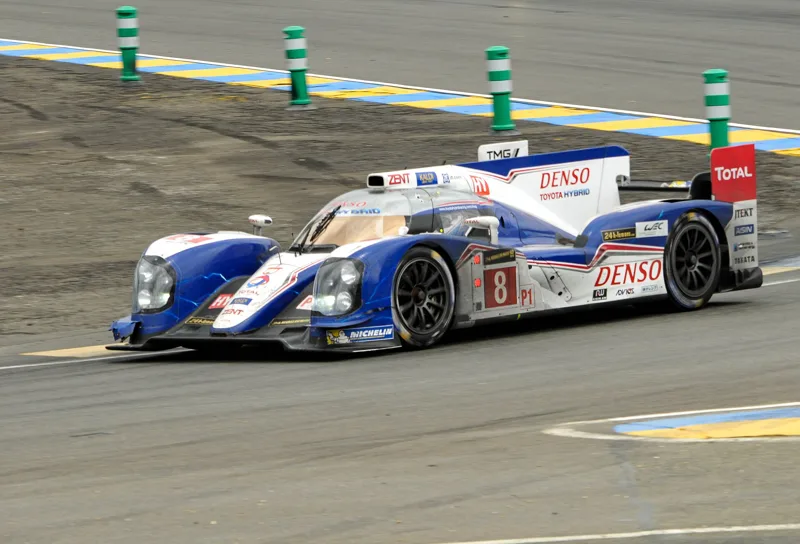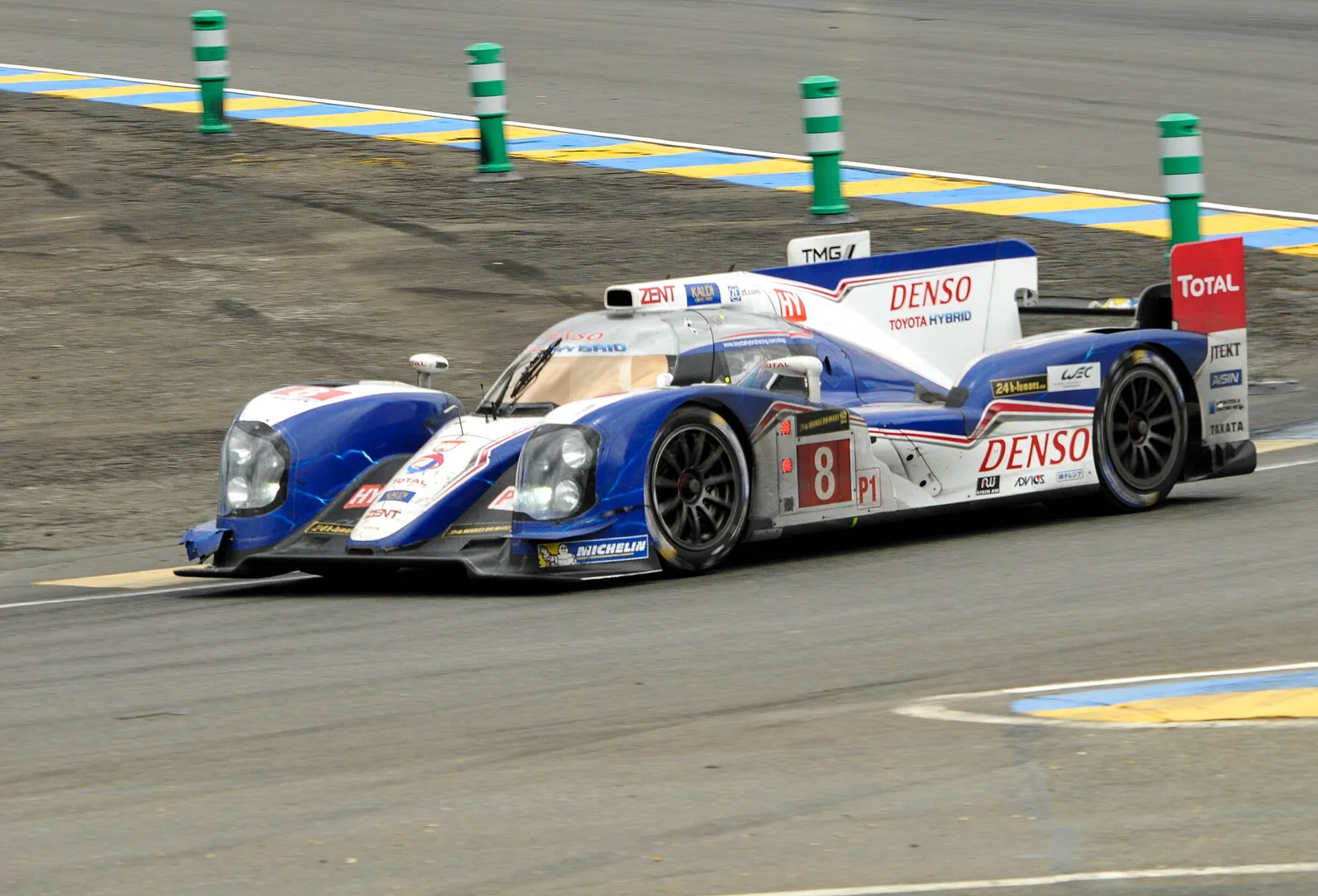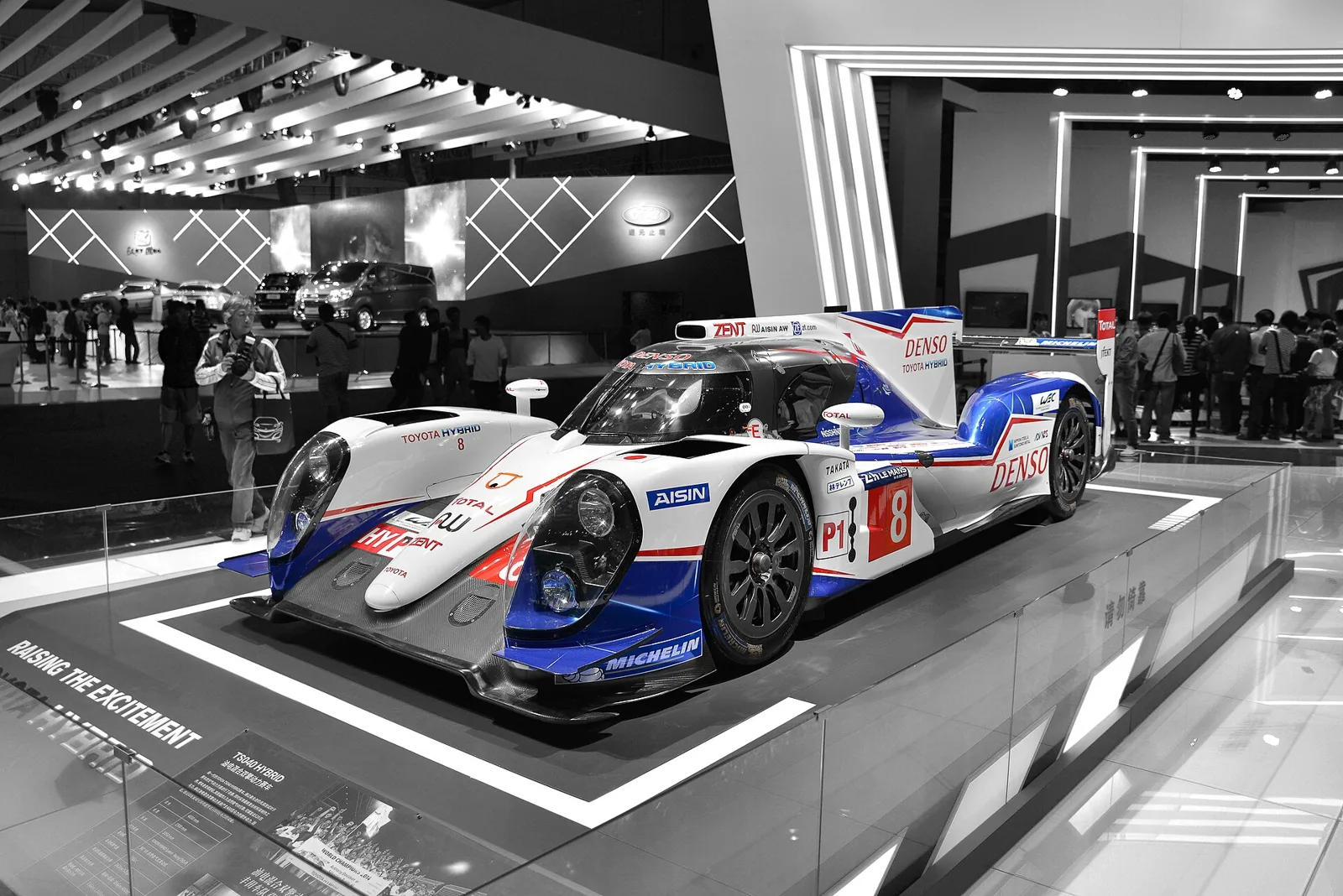
A redesigned follow-up to the TS030 with four-wheel drive, a larger engine and a manufacturers' title in its first season before it gave way in 2016.
Toyota's TS040 Hybrid raced in 2014 and 2015 with four-wheel drive and two energy recovery units at its axles. Its 2014 season brought the manufacturers' title on 289 points, and its 2015 season ended with third place on 164 points.
Toyota's TS040 Hybrid was the car that gave the company its World Endurance Championship manufacturers' title. It raced in 2014 and 2015, scored 289 points in its first season and was replaced for 2016. What follows covers how the team redesigned its predecessor, who shared the cars and how the two seasons played out.
What changed from the TS030 Hybrid?
The TS040 kept the engine family of the TS030 Hybrid but gained four-wheel drive, a larger 3.7-litre capacity and energy recovery units at both axles. Toyota also rebuilt the chassis to suit the 2014 LMP1 rules, and the car was built at the Cologne headquarters.
The car was an aerodynamic improvement on its predecessor. The new rules made it 10 cm (100 mm) shorter, the tyre arches were narrowed by 5 cm (50 mm), and the team aimed to cut fuel consumption by 25 per cent compared with 2013. Weight came down by the mandated 45 kg (99 lb).
Initial studies and simulations began straight after the Automobile Club de l'Ouest published the first revision of the 2014 WEC technical regulations in November 2012. Toyota increased its involvement after the 2013 24 Hours of Le Mans, and in July 2013 it confirmed that it would race a new car in the championship. Pascal Vasselon revealed the car's details at the 6 Hours of Sao Paulo on 31 August 2013.
Four-wheel drive, a bigger engine and two energy recovery units gave Toyota a title in its first season.
How was the TS040 chassis designed?
The chassis was built from carbon fibre and aluminium, and the car's design allowed four-wheel drive. Engineers relied on hardware-in-the-loop testing to refine individual components against track data, and the aerodynamic design was developed in Toyota's wind tunnel in Cologne.
The suspension used independent push-rod units linked to a bellcrank, with the torsion bar mounted at the pivot point. Front cooling air left through ducts behind the front wheel guards, and the brakes were Brembo carbon ceramic discs. Michelin remained the tyre supplier.
The seven-speed sequential gearbox was made of aluminium, and its multiplate clutch came from ZF Friedrichshafen. Total, Toyota's petrol supplier, worked with the team on fuel efficiency and performance. The differential was a viscous mechanical locking unit, and the driveshafts used constant-velocity joints.
How did the engine and hybrid system work?
The naturally aspirated V8 was carried over from the TS030, but its displacement rose from 3.4 L (210 cu in) to 3.7 L (230 cu in) by lengthening the stroke. The engine produced 513 horsepower (383 kW) to the rear wheels, and it was tuned to run with a fuel flow meter that pushed the team towards efficiency rather than peak power.
Two kinetic energy recovery systems sat at the front and rear axles. They charged a supercapacitor, and the front and rear units added an automatic 473 horsepower (353 kW), taking total output to 986 horsepower (735 kW). The units were developed by Toyota Racing Development, with Denso building the rear motor and Aisin AW the front one.
The engine used eight solenoid injectors in the inlet tract, placed over angled throttle valves, and two knock control systems. Real-time combustion pressure sensors tuned the spark timing during a race, which helped reliability when conditions changed.
The 2014 regulations grouped hybrid storage into 2 MJ (0.56 kWh) steps, from 0 MJ to 8 MJ (2.2 kWh). Toyota chose the 6 MJ (1.7 kWh) class, because the heavier 8 MJ option cost lap time and its extra weight was a disadvantage.
Who drove the TS040 in 2014?
Toyota ran two cars with six drivers in 2014: Alexander Wurz, Nicolas Lapierre, Kazuki Nakajima, Anthony Davidson, Stephane Sarrazin and Sebastien Buemi. Mike Conway was signed as reserve and test driver, and he was later called up when Nakajima's other commitments clashed with the calendar.
The line-up changed in February 2014, when Sarrazin moved to the No. 7 car and Lapierre to the No. 8 car after the team assessed their strengths and characteristics.
Testing began on 21 January at Circuit Paul Ricard, when Wurz and Davidson completed a shakedown. The TS040 was introduced to the press on 26 March during a preseason session, after more than 25,000 km (16,000 mi) of running at the Ciudad del Motor de Aragon and the Algarve International Circuit.
Photographs of the car on track appeared eight days after its first long-distance runs, and the first video, showing Davidson driving in wet weather, was released on 3 March. Testing carried on through March before the press introduction at Paul Ricard.
How did the 2014 season unfold?
The No. 8 car, driven by Lapierre, Davidson and Buemi, won the season's first two races, at Silverstone and Spa. Toyota then took its first Le Mans pole since 1999 and finished the year with 289 points, which secured the manufacturers' crown and handed Buemi and Davidson the drivers' championship.
At Silverstone the No. 7 car took pole by five-thousandths of a second, but the race was shortened by rain. Buemi's tyre choice put the No. 8 car in the lead, and the crew kept it there. At Spa, Porsche's Jani and Lieb took pole in changeable conditions, and Toyota's double-stinted tyres let Buemi take the lead.
Nakajima took pole at Le Mans in the No. 7 car. Lapierre aquaplaned into the barriers in the second hour, went back to the pits and recovered to finish third. Nakajima led into the ninth hour before a mandated monitoring device melted a wiring loom at Arnage, and he had to abandon the car. Earlier, Sarrazin had lost the lead to Porsche's Brendon Hartley and Timo Bernhard during the pit-stop phase, and he took it back in the fourth hour.
At the Circuit of the Americas a thunderstorm stopped the race in the second hour, after Lapierre and Conway had aquaplaned off the circuit. Buemi drove the No. 8 car to third. Davidson and Buemi took pole at Fuji, and the No. 8 car won there ahead of the No. 7 Toyota.
Shanghai went to Buemi and Davidson again, with the sister car a minute and twelve seconds behind. In Bahrain Conway drove the No. 7 car to victory, while the No. 8 car lost half an hour to an alternator fault. Buemi and Davidson finished eleventh, which was enough to clinch the drivers' title with a round to spare.
| Season | Event | TS040 result |
|---|---|---|
| 2014 | Silverstone | Win, No. 8 car |
| 2014 | Spa-Francorchamps | Win, No. 8 car |
| 2014 | 24 Hours of Le Mans | Pole for No. 7; No. 8 third after Lapierre's aquaplaning |
| 2014 | Fuji | Win, No. 8 car; No. 7 second |
| 2014 | Shanghai | Win, No. 8 car; No. 7 finished a minute and twelve seconds behind |
| 2014 | Bahrain | Win, No. 7 car with Conway |
| 2015 | Silverstone | Third, No. 1 car; No. 2 fourth |
| 2015 | 24 Hours of Le Mans | No. 2 sixth; No. 1 eighth |
| 2015 | Shanghai | No. 1 fifth; No. 2 sixth |
| 2015 | Bahrain | No. 2 third, closing out the season |
How did the TS040 compare with Audi and Porsche?
Toyota's main rivals in 2014 were Audi and Porsche, both fielding fast prototypes, and the TS040 still won the manufacturers' title. In 2015 the car was more than two seconds per lap quicker than the year before, yet Toyota could not match the race pace of Audi and Porsche, and that gap showed in the results all season.
At Silverstone in 2014, the No. 7 TS040 started from pole, just ahead of the No. 1 Audi R18 e-tron quattro of Loic Duval and Tom Kristensen. That margin showed how close the two manufacturers were at the front.
Porsche was the other constant threat. Neel Jani and Marc Lieb took pole at Spa, and at Sao Paulo Davidson's No. 8 car was almost fifteen seconds behind Jani's No. 20 Porsche when a serious crash involving Mark Webber ended the race.
What did the 2015 redesign change?
The 2015 regulations forced an 80 per cent redesign of the TS040. The changes included a new front crash structure, a suspension tuned to preserve tyre life, extra weight reduction, and two separate body kits for fast and tight circuits.
Construction of the revised car started straight after Le Mans 2014 and continued into January 2015. Toyota considered a battery system and compared its hybrid with the Porsche 919 Hybrid, and it even weighed the 8 MJ class, but it kept the 6 MJ category. The supercapacitor was modified for better performance instead.
How did the 2015 season go?
Toyota finished third in the manufacturers' standings in 2015 with 164 points, but its cars never matched the race pace of Audi and Porsche. The best finish of the year came at Bahrain, where the No. 2 car moved into third after the No. 8 Audi needed repairs.
At Silverstone the team briefly ran first and second, but the No. 1 car finished fifteen seconds behind the No. 7 Audi. Conway had to change a nose cone after running over a trackside bollard while lapping a Corvette. Nakajima was injured in a heavy practice collision at Spa, which left Buemi and Davidson to drive the No. 1 car as a two-person entry.
At Le Mans, Davidson damaged the front right corner of the No. 1 car in a collision with a Ferrari he was lapping, and a thirteen-minute pit stop dropped him five laps down. The No. 2 car passed an Audi with technical trouble to finish sixth. At the Nurburgring the TS040s finished fifth and sixth, three and four laps behind the leaders.
At the Circuit of the Americas, Conway lost control of the No. 2 car at turn eleven while avoiding slower traffic, and it hit the barrier hard enough to end his race. At Fuji, penalties for the crew limited the Toyotas to sixth, and in Shanghai Buemi drove the No. 1 car to fifth while Sarrazin took sixth in the No. 2 car.
Why did the TS040 leave the grid?
The TS040 was replaced by the TS050 Hybrid for the 2016 season. A 2015-specification chassis was tested in January 2016 at Aragon and Paul Ricard alongside its successor, so the programme moved on quickly.
A post-season rookie test was held at the Bahrain International Circuit the day after the finale. Bird, Conway and Davidson shared a TS040 there.