A GT car built around a suitcase rule, a Hybrid that stopped on the last lap and the prototypes that turned that heartbreak into repeated Le Mans wins.
Toyota chased Le Mans from 1985, coming second in 1999 with the loophole-built GT-One and losing the 2016 race on the final lap with the TS050 Hybrid. The TS050 then won three straight times from 2018, and the GR010 Hybrid, now the TR010, added further wins including 2026.
With 3 minutes 25 seconds left in the 2016 24 Hours of Le Mans, the leading Toyota rolled to a halt just beyond the finish line, its power gone, and a Porsche swept past a few seconds later to take the victory. Toyota had chased a win at the race since 1985. It would finally get one two years later.
The story of Toyota at Le Mans moves from a loophole-hunting GT car of the late 1990s through the TS050 Hybrid's near miss and its three straight wins to the GR010 Hybrid, which cleaned up the first Hypercar seasons and has since been rebadged as the TR010.
| Car | Rules | Engine | Le Mans story |
|---|---|---|---|
| GT-One (TS020) | Group GT1, then LMGTP | Twin-turbo 3.6 L R36V V8 | Ninth in 1998, second overall in 1999 |
| TS050 Hybrid | 2016 LMP1 | 2.4-litre twin-turbo V6 with 8-megajoule hybrid system | Unclassified in 2016, wins from 2018 to 2020 |
| GR010 Hybrid | 2021 Le Mans Hypercar | 3.5 L twin-turbo V6 with hybrid system | Wins in 2021 and 2022, then the TR010 version won in 2026 |
Why did Toyota build the GT-One?
Toyota's route to Le Mans after the Group C era, which ended around 1994, ran through production-based grand tourers. For 1995 it chose two paths: a heavily modified Supra, the Supra LM, with a turbocharged Toyota 503E inline-four, and a purpose-built car with a small number of road-going versions to satisfy homologation.
That second car, the SARD MC8-R, used a turbocharged 1UZ V8 and was developed heavily from the MR2. Its design echoed the Porsche 911 GT1, with the front chassis parts modified from the road car and a custom racing structure at the rear. The Supra performed admirably in 1995 and the MC8-R looked stronger in 1996.
Toyota concluded that a car designed as a racer first would suit its GT effort better, and announced it would skip the 1997 race to build one. An MC8-R was entered anyway that year but failed to qualify.
Toyota stopped just past the line in 2016, then won Le Mans three years running from 2018.
How did the GT-One exploit the rules?
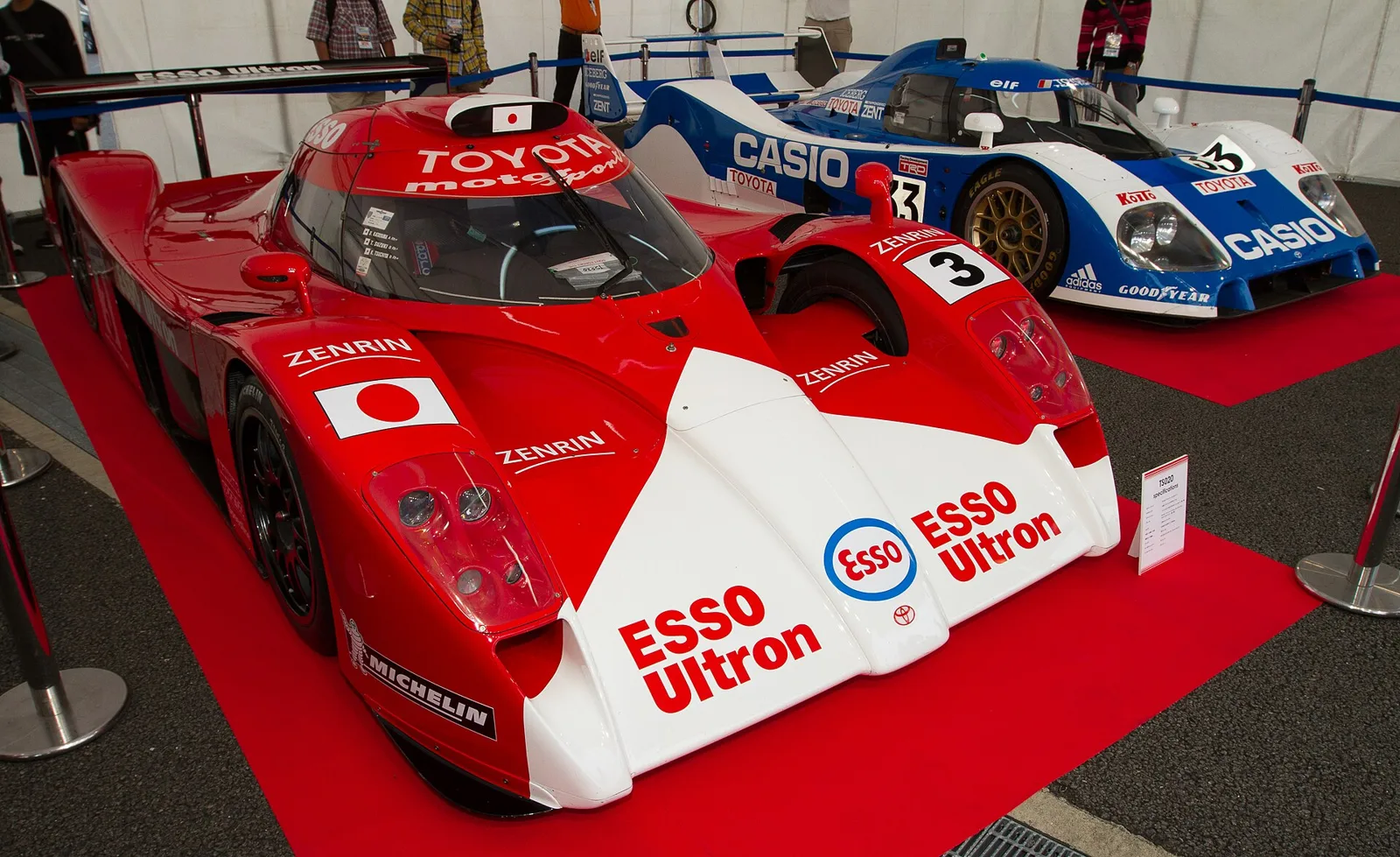
Toyota Team Europe (TTE), Toyota's arm in Cologne, and Dallara were handed the project. During the year off, TTE watched the competition. In 1997 the Mercedes-Benz CLK GTR and Porsche 911 GT1 were the dominant cars in the class, both custom-built supercars that exploited the rules, with only a handful of road cars built to homologate them. TTE realised it needed just one road car, and since nobody would ever buy it, driver comforts could be left out.
The suitcase rule gave a second opening. GT cars had to offer enough storage space for a standard suitcase to count as usable by the public. Mercedes had put a small cubby hole beneath the rear bodywork. Toyota went further, convincing officials of the Automobile Club de l'Ouest (ACO) that the fuel tank, empty when the car is inspected before the race, could theoretically hold a suitcase and so counted as luggage space.
TTE designed and built the carbon fibre chassis and bodywork in-house. The engine was Toyota's own twin-turbocharged 3.6 L R36V V8, a thoroughly reworked descendant of the unit from its Group C days. Just two GT-One road cars were made, painted red with a basic interior: one went to a museum in Japan and the other sits at Toyota Motorsport GmbH headquarters in Cologne.
How did the GT-One do at Le Mans in 1998?
The GT-One appeared at the official test days in May 1998 and its three cars set the second, fifth and tenth best times, comfortably beating the dedicated prototypes that were supposed to be the superior class. In qualifying they started second, seventh and eighth, beaten only by Mercedes-Benz.
The race went less well. The number 28 car crashed at high speed halfway through, and while the other two stayed in the top 10, the higher-ranked number 29 car suffered a gearbox failure in the closing hours while challenging for the win. Toyota finished ninth with the number 27, 25 laps behind the winning Porsche 911 GT1.
What happened to the GT-One in 1999?
The ACO and FIA closed the loopholes for 1999, requiring a large number of production vehicles in the GT classes. Mercedes evolved its CLK LM into the closed-cockpit CLR, Nissan and Panoz chose open-cockpit prototypes, Porsche withdrew, and Audi built for both prototype classes while BMW stayed in the LMP class. Toyota followed Mercedes and turned the GT-One into a GTP prototype, which needed no extensive redesign because the car was already close.
After a long-distance test at Spa-Francorchamps soon after a snowfall, the GT-Ones took the first, third and fifth fastest times at the Le Mans test and qualified first, second and eighth. During the race they fought BMW and Mercedes for the lead, hampered by fuel consumption one or two laps per stint worse than BMW and by Michelin tyre failures caused largely by sharp gravel carried onto the track.
The design of the wheel arches meant that a burst tyre could destroy the mechanical parts behind it. Just 90 laps in, Martin Brundle's number 1 car suffered an explosive puncture and was abandoned on the track. Halfway through, Thierry Boutsen crashed the number 2 car at high speed while lapping a slower car, and the accident ended his racing career. That left car number 3, still near the top while rivals fell away: all the Mercedes cars were out after their famous accident, Audi had lost two of four cars and Nissan its factory R391.
In the final hour Ukyo Katayama chased the leading BMW but picked up a tyre failure in traffic and had to crawl round for new rubber. He finished second overall, one lap behind the winning BMW, and took the GTP class as the only car in it to finish. A single GT-One then ran at the 1999 Le Mans Fuji 1000 km, finishing second to a Nissan R391 by one lap but winning the LMGTP class.
Toyota did not continue the programme into 2000, turning TTE into the leader of its new Formula One team instead. That ended its Le Mans efforts, begun in 1985, until the TS030 Hybrid brought it back in 2012 in the FIA World Endurance Championship.
Seven GT-Ones were built, six in 1998 and one in 1999. Chassis LM804 was the only car to race at Le Mans in both years, and it and LM805 were the only ones to finish. Marlboro sponsored the 1999 car, hence its white and red chevron livery, but a French anti-tobacco law meant no logos appeared at Le Mans.
What was the Toyota TS050 Hybrid?
The TS050 Hybrid was created for the Le Mans Prototype regulations of 2016 in the World Endurance Championship, as successor to the TS040 Hybrid raced in 2014 and 2015. Toyota unveiled it at Circuit Paul Ricard on 24 March 2016, a timing set by its two-year cycle policy. It had completed over 22,000 km of testing by then, starting with a shakedown at Aragon in late February.
Under the bodywork the engine changed completely. A 2.4-litre twin-turbocharged V6, the Toyota H8909, replaced the older car's naturally aspirated V8 for better fuel efficiency, and a lithium-ion battery replaced the capacitor energy store as the car moved up to the 8-megajoule hybrid class. The suspension followed the TS040's double wishbone and pushrod layout with torsion bars, and the nose was raised, a trait shared with the Audi R18 and Porsche 919 Hybrid.
For 2017 only the monocoque carried over. Regulations meant to reduce speeds raised the front splitter by 15 mm and narrowed the rear diffuser, and cost control cut aero configurations from three to two. Toyota reworked the 2.4L V6's block, head and combustion chamber for a higher compression ratio and better thermal efficiency, and fitted smaller, lighter motor-generator units. Before the pre-season test the car had covered 30,000 km in five tests, four of them 30-hour endurance runs.
What went wrong for Toyota at Le Mans in 2016?
Toyota qualified third and fourth behind the two Porsche 919 Hybrids and worked its way into the lead. A first win seemed inevitable, after four second places in 1992, 1994, 1999 and 2013. With 6 minutes 30 seconds left the number 5 car led the number 2 Porsche by 1:14, both on the lead lap.
Then Kazuki Nakajima reported that the car was losing a great deal of power when accelerating, and the Porsche began reeling him in. With 4:30 to go the gap was 37.580 seconds. Toyota chose to keep the car on the track, and Nakajima pulled up just beyond the line as the power failed completely, with 3:25 on the clock. The number 2 Porsche passed it seconds later for the overall win.
Nakajima kept the car still until the race clock officially reached 24 hours, then drove on slowly to complete a final lap officially timed at 11:53.815, well above the six-minute maximum. The number 5 car was not classified and earned no championship points. Earlier in the season the team had taken second at Silverstone, and then suffered engine trouble at Spa that was later attributed to the forces going through Eau Rouge.
When did the TS050 start winning?
In 2017 Toyota entered three cars at Le Mans for the first time since returning in 2012. On 15 June Kamui Kobayashi set a qualifying lap of 3:14.791, the quickest lap on the Circuit de la Sarthe since the Mulsanne Straight gained its chicanes in 1990. In the race the number 8 car finished eighth, while the number 9 and number 7 retired with a puncture and an MGU issue.
The 2018-19 season brought the breakthrough. Toyota was the only LMP1 team running hybrids, took a one-two at the 6 Hours of Spa-Francorchamps and then won Le Mans with another one-two, becoming the second Japanese manufacturer to win the race after Mazda in 1991 with the 787B. A Silverstone one-two ended in disqualification, but it added one-twos at Fuji and Shanghai.
In 2019 Toyota finished one-two at Sebring, at Le Mans and at Spa, securing the LMP1 world title, and the number 8 crew took the drivers' title. A harsher Equivalence of Technology and a success ballast system followed for the next season, aimed at helping non-hybrid privateers. The changes worked: at Shanghai Rebellion won, the first time the TS050 had finished behind an internal combustion privateer.
In 2020 the Rebellion R13 was quick again at the Lone Star Le Mans, but Toyota answered with a one-two at Spa. At the 2020 Le Mans the number 8 won for the third straight year, while the number 7 lost time with a turbocharger failure in the night and recovered to third. The number 7 then won in Bahrain, the last race for the TS050, with Mike Conway, Kobayashi and Jose Maria Lopez taking the drivers' title. Over its life the TS050 collected two double world titles and a hat-trick of Le Mans wins.
How did the GR010 Hybrid carry on?
The Toyota GR010 Hybrid was built by Toyota Gazoo Racing Europe to the Le Mans Hypercar regulations introduced in 2021, and revealed online on 15 January 2021. Its styling drew on the GR Super Sport Concept that Toyota showed at the 2018 Tokyo Auto Salon, and power comes from a 3.5 L petrol V6 with two turbochargers and a lithium-ion hybrid system. The trademark was filed in September 2020, with a first rollout at Paul Ricard in October 2020.
A road car developed in parallel was cancelled early in 2021, and the GR Super Sport itself in August of that year. Lexus considered running a GR010 in IMSA, but it never happened. A 2023 update focused on efficiency, reliability and cooling, with new dive planes, smaller rear wing end plates and new headlights for night visibility.
The debut year was a clean sweep. The GR010 won all six races of the 2021 World Endurance Championship, took pole and fastest lap at five, and Toyota clinched the Hypercar title in the first Bahrain race. At Le Mans it was a fourth consecutive overall win, and the first for the number 7 crew of Conway, Kobayashi and Lopez. In 2022 both cars reached the podium in every race, finishing one-two at Le Mans, Fuji and Bahrain, and the number 8 crew won the drivers' title.
In 2023 the team had only three finishes outside the top two. At Le Mans the number 7 was hit by another car and retired, leaving the number 8 third, but Toyota still won the constructors' title with 217 points.
The slide began in 2024. At the Qatar opener Toyota failed to reach the podium for the first time since Silverstone in 2018, with the number 7 sixth and the number 8 ninth. Three wins followed, at Imola, Sao Paulo and Bahrain, and Toyota took the manufacturers' title by six points from Porsche, though the number 6 Porsche won the drivers' crown.
In 2025 the team ran in the midfield for the first half of the season without a podium, its best result fourth at Spa. At Le Mans it clocked 342.3 km/h (212.7 mph) in the speed trap, among the slowest cars. After Sao Paulo, where the cars were 14th and 15th, technical director David Floury attacked the championship's balance of performance as "far too artificial". A one-two in the Bahrain finale did not prevent the end of the GR010's four-year run of titles, with Ferrari winning in 2025.
What changed with the TR010 in 2026?
After the 2025 6 Hours of Fuji, Toyota confirmed it would test an update of the car at Circuit Paul Ricard. The update had originally been planned for 2025 but was delayed to 2026, and on 7 January 2026 it appeared as the TR010 Hybrid, a new name that follows the team's rebrand as Toyota Racing. Changes include a reworked nose, different sidepods and a revised rear wing.
The new package was an immediate success: Toyota finished first and third at the 2026 6 Hours of Imola opener, and at the 2026 24 Hours of Le Mans it held off BMW and Cadillac, taking its third victory there in six seasons. As of 2025 the GR010 remained the most successful sports prototype Toyota has built.