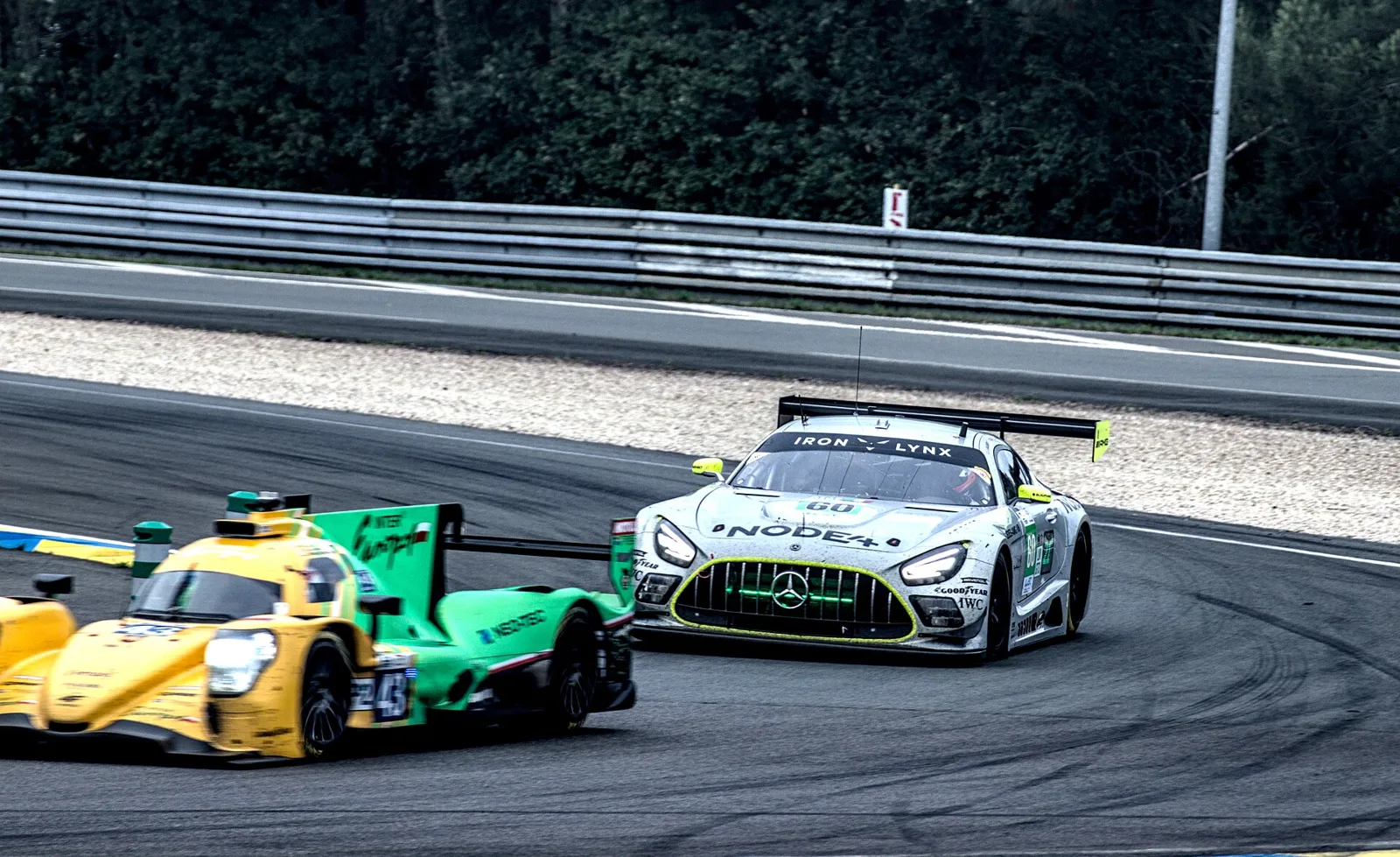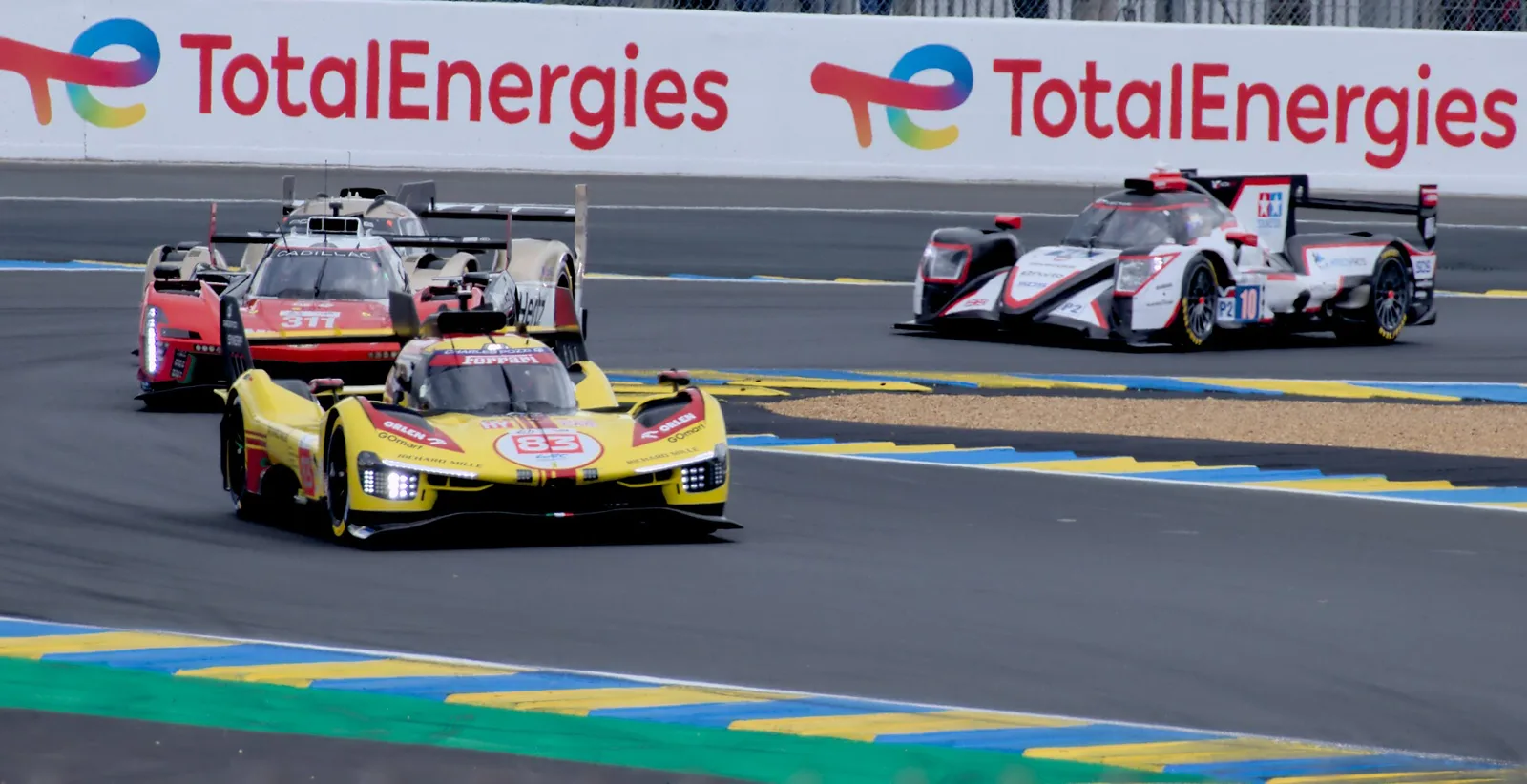
Ferrari's 499P No. 50 won after 311 laps, helped by a four-hour safety car period, a late door fault on the leader and a rain-soaked night.
Ferrari's Fuoco, Molina and Nielsen won the 2024 24 Hours of Le Mans in the 499P No. 50 after 311 laps. The race was held in wet and changing conditions, and Porsche's Kevin Estre took pole.
The 2024 24 Hours of Le Mans was the 92nd running of the race, held on 15-16 June 2024 at the Circuit de la Sarthe. Ferrari's 499P No. 50 won after 311 laps, after a race in changing weather that included a record safety car stint and the debut of the LMGT3 class.
When and where was the 2024 race held?
Running on 15 and 16 June 2024, the race used the Sarthe circuit, a 13.626 km (8.467 mi) layout outside the city of Le Mans in France. It was the fourth round of the 2024 FIA World Endurance Championship, and the Automobile Club de l'Ouest (ACO) announced the dates in June 2023. Organisers reported 329,000 spectators.
The test day was held on 9 June, a week before the start, when all entrants had to drive for six hours across two sessions. Before the race, the Porsche Penske trio of Kevin Estre, Andre Lotterer and Laurens Vanthoor led the Hypercar drivers' standings on 74 points.
A record safety car stint of four hours and 26 minutes shaped a wet race, which Ferrari's 499P No. 50 won after 311 laps.
What changed in the rules for 2024?
The biggest change was the new Le Mans Grand Touring Car (LMGT3) category, based on the global GT3 specification. It replaced the older LMGTE Am class as the production-based car category, with the aim of cutting costs and making Le Mans more affordable. The class follows pro-am rules, which require each team to sign at least one Bronze-rated driver and one more Bronze or Silver-rated driver.
Le Mans Prototype 2 (LMP2) was dropped from the WEC because of the rise in Hypercar entries, but it was kept for Le Mans. Those entries earned no championship points because they did not compete full-time in the WEC. The restart procedure was also modified after criticism that restarts ran on too long following a safety car period in 2023. The drop-back feature was removed, so all three classes now run together at a restart.
To bring the race into line with the rest of the WEC season, the ACO banned the heating of tyres with tyre warmers before they were fitted to a car. An exception had applied in 2023 after several cars crashed on cold tyres at the 6 Hours of Spa-Francorchamps. The Mulsanne to Arnage road was also resurfaced in September 2023, the first time since 2005, to improve technical compliance for sports cars.
How was the 62-car field made up?
Registration ran from 7 December 2023 to 13 February 2024, and the ACO Selection Committee issued 62 invitations. Automatic invitations went to champions of the European Le Mans Series, the Asian Le Mans Series and the GT World Challenge Europe Bronze Cup, along with the ELMS LMP2 runner-up. For the first time, Le Mans Cup entrants were not invited.
Some automatic places were turned down. Algarve Pro Racing declined its LMP2 invitation because it wanted to run two cars rather than risk quality with three, and Pure Rxcing also declined its automatic invitations after winning two titles. The ACO published the full automatic list on 12 February, and the full 62-car list followed on 19 February.
The grid contained 37 guaranteed WEC entries, 17 ELMS entries, seven WTSC entries and a single one-off entry, with no ALMS entries. The two prototype classes held 39 entries, and LMGT3 held 23. There was no Garage 56 entry that year. Seven reserves were named, and the list was cut to five after two withdrawals. By the start of testing three reserves remained, including a second Proton Competition Porsche 963.
What was the pre-race balance of performance?
The balance of performance was changed to create parity across all three classes. The new Power Gain tool, which debuted at this race, adjusts maximum power across two speed thresholds. Power rose for the BMW M Hybrid V8, the Alpine A424, the Isotta Fraschini Tipo 6 LMH-C and the Toyota GR010 Hybrid. Power fell for the Ferrari 499P, the Lamborghini SC63 and the Peugeot 9X8.
Neither the Cadillac V-Series.R nor the Porsche 963 had their power changed. Every LMGT3 car had ballast added to alter its handling, and several models, including the Aston Martin Vantage AMR GT3 Evo and the Porsche 911 GT3 R (992), received power increases. The BMW M4 GT3 and the McLaren 720S GT3 Evo were left alone.
How did testing and practice go?
Testing on 9 June was held in sunny weather. Some drivers missed it, including several who were competing in IndyCar at Road America. Toyota led the morning session with a 3:28.467 lap from Kobayashi's No. 7 car, but Estre finished testing first overall at 3:26.907. Kobayashi then crashed the No. 7 Toyota into a barrier, which ended the session early. Jarvis set the quickest LMP2 time in testing, at 3:34.704.
Practice began on 12 June in cloudy, cool weather. Hartley's No. 8 Toyota set the fastest Hypercar time at 3:26.013 with 50 minutes left, and Ilott's No. 12 Jota Porsche had led most of the session before that. Alex Lynn crashed the No. 3 Cadillac at Tertre Rouge, and Dries Vanthoor crashed his BMW at Indianapolis corner in the second session. Ilott later crashed the Jota Porsche, which was beyond repair, and the team was given a replacement chassis from Penske.
The final session, on the evening of 13 June, was rain-affected, and Hartley set the fastest overall lap of 3:29.451 in the closing hour. Teams switched to wet-weather tyres as the rain increased.
Who took pole for the 2024 race?
Kevin Estre took pole for Porsche in the No. 6 Porsche 963 with a 3:24.634 lap in the Hyperpole shootout. That was Porsche's 19th overall Le Mans pole, and its first since 2016. Estre had slipstreamed Deletraz's LMP2 car into Indianapolis corner and used electrical power while saving fuel to set the time.
Earlier in the qualifying session Vanthoor set the quickest Hypercar time of 3:24.465 in a BMW, but his later Hyperpole run ended when his car hit the tyre wall at Indianapolis corner. Kobayashi's Toyota had its times deleted after a spin at the Porsche Curves, so the No. 7 Toyota began at the back of the Hypercar class. Lynn was second in the No. 2 Cadillac, and Bourdais took third in the sister No. 3 car.
In LMP2, Deletraz set pole in the No. 14 AO by TF car at 3:33.217, his first pole at Le Mans. In LMGT3, Iribe put the No. 70 Inception McLaren on pole at 3:58.120, the first pole for both the team and the McLaren marque. The No. 2 Cadillac was also demoted five places for a collision with a BMW at the 6 Hours of Spa-Francorchamps.
How did the race unfold?
The race started at 16:00 Central European Summer Time, with footballer Zinedine Zidane waving the French tricolour. The air was between 12.5 and 18.8 degrees C (54.5 and 65.8 F), and the track between 13.5 and 22.8 degrees C (56.3 and 73.0 F). Nielsen moved the No. 50 Ferrari from fourth into the lead on lap one, while Giovinazzi's sister No. 51 moved into second by lap four.
Nielsen was given a ten-second stop-and-go penalty for releasing into the path of Bourdais' Cadillac in the fast lane. Rain fell in the second hour, and some teams switched to wet-weather tyres, which briefly made them quicker than cars still on slicks. In the third hour Thomas Flohr crashed the No. 54 AF Corse Ferrari at the Dunlop chicane. The car was retired, and the slow zone that followed shuffled the order, leaving Shwartzman's No. 83 Ferrari in the lead.
Later the Ferrari No. 83 driven by Kubica collided with Dries Vanthoor's BMW at Mulsanne corner, as both were overtaking a slower LMGT3 Porsche at night. The BMW was retired, and Vanthoor was checked at the medical centre. Race control dispatched the safety cars for the first time to clear debris and repair the barrier. The stewards judged Kubica at fault and gave him a 30-second stop-and-go penalty, which dropped him to sixth and handed the lead to Hirakawa's No. 8 Toyota.
Rain returned in the ninth hour, and Al Harthy's WRT BMW was retired after a crash at the Forest Esses on a damp white line. In the 11th hour David Heinemeier Hansson's Nielsen LMP2 car collided with a Proton Ford on the inside at the Forest Esses, and both cars needed to be extracted, which put the Nielsen car out of the class fight.
How did the safety car period shape the race?
Rain returned in the 12th hour, and the safety cars were deployed a second time, bunching the field in all three categories. Every team switched to wet-weather tyres. Incessant rain and poor visibility kept the safety cars on track for longer than planned, and each one had to be refuelled before a reserve car took its place on the start-finish straight.
The safety car stint lasted four hours and 26 minutes, the longest single safety car deployment in the race's history, and it also set a record for the most time spent behind the safety car. A gear-selection fault took Bachler's LMGT3 Porsche into the pit lane for 25 minutes, which left the car five laps down in class and handed the lead to Lietz's sister No. 91 car.
When the safety cars were released, the overall lead became a four-way fight between Ferrari, Porsche, Toyota and Cadillac. Nasr crashed the No. 4 Penske Porsche into the tyre barrier at Indianapolis corner in the 18th hour, and the slow zone that followed let Laurens Vanthoor pit and take the race lead from Hirakawa's Toyota. A further safety car period came after Mancinelli's Heart of Racing Aston Martin landed upside down following a high-speed impact. Nico Muller's Peugeot also crashed in that period.
How did the lead change in the final hours?
In the 21st hour Shwartzman's No. 83 Ferrari retired after a motor-generator unit fault at the front axle. Soon afterwards Pier Guidi's No. 51 Ferrari collided with Hartley's No. 8 Toyota at Mulsanne as he tried to pass on the inside for second. Hartley spun and dropped to sixth, losing about 35 seconds on that lap and another five on the next.
Lopez's No. 7 Toyota then tried to pass Pier Guidi at the Dunlop chicane, and the two cars collided. Lopez slipstreamed past on the Mulsanne straight and took second. Nielsen's No. 50 Ferrari then had a right-hand door that would not stay shut, and the race director used black-and-white flags to call him in to fix it. That promoted Lopez to the lead and dropped Nielsen to fifth, and the No. 51 Ferrari was given a five-second penalty at its next stop.
Because Nielsen's stop had taken him out of the usual pit cycle, he regained the lead once the other Hypercars had stopped. He conserved fuel and energy under pressure from Lopez, and he crossed the line first after 311 laps.
Who won the 2024 24 Hours of Le Mans?
Antonio Fuoco, Miguel Molina and Nicklas Nielsen won in the Ferrari 499P No. 50, after 311 laps. It was their first overall Le Mans victory, and it was Ferrari's 11th overall win and its second in succession. The Toyota GR010 Hybrid No. 7 of Nyck de Vries, Kamui Kobayashi and Jose Maria Lopez took second, 14.2 seconds adrift.
The No. 7 car was hit by three slow punctures and a boost fault traced to a sensor. The No. 51 Ferrari of Calado, Giovinazzi and Pier Guidi completed the overall podium in third. A record number of cars, nine, finished on the lead lap.
What were the class results?
Ferrari won the Hypercar class, United Autosports took LMP2, and the Porsche of Manthey EMA took LMGT3. The table lists each class winner with the car and margin.
| Class | Winner | Car | Margin and notes |
|---|---|---|---|
| Hypercar | Fuoco, Molina, Nielsen (No. 50) | Ferrari 499P | 311 laps; 14.2 seconds ahead of Toyota No. 7 |
| LMP2 | Garg, Jarvis, Siegel (No. 22) | Oreca 07-Gibson | 18.651 seconds ahead of Inter Europol No. 34; first LMP2 win for the team since 2020 |
| LMGT3 | Lietz, Schuring, Shahin (No. 91) | Porsche 911 GT3 R (992) | One lap ahead of Team WRT BMW M4 GT3 No. 31 |
The minimum distance for classification was 217 laps, which was 70 per cent of the winner's distance. Inter Europol finished second in LMP2, and IDEC Sport third, 33 seconds behind the winners. Lietz, who won his fifth Le Mans GT class victory, shared the LMGT3 win with Schuring and Shahin.
How did the drivers and teams react?
Nielsen described it as one of the toughest races he had ever done, given the changeable conditions and the door problem. Fuoco said the team had prepared well and that the result was hard to take in, while Molina praised the late switch to wet-weather tyres. De Vries was bittersweet about second place because of the Toyota's technical trouble, and Lopez said the event was the hardest he had experienced.
Calado admitted Ferrari had been weaker in the wet than in the dry, and that strategy errors had left the team on the back foot. Porsche's LMDh factory director Urs Kuratle said the German marque lacked top speed and had chosen the wrong tyres as conditions changed. Ferrari's endurance chief Antonello Coletta said the team had learned from losing a win at the 6 Hours of Imola by keeping cars out on dry tyres.
The stewards' penalty on Kubica drew criticism. WRT team principal Vincent Vosse and Dries Vanthoor both said the 30-second penalty was too lenient, and Kubica denied causing the crash on purpose. Hartley said his late-race spin ended any chance of winning in the final hours.
What did the result do to the standings?
Estre, Lotterer and Vanthoor stayed top of the Hypercar drivers' championship on 99 points, but the winning Ferrari crew moved from fifth to second, nine points behind. In the LMGT3 drivers' trophy, Lietz, Shahin and Schuring moved into a joint lead with Bachler, Sturm and Malykhin.
Porsche kept its lead in the WEC Hypercar championship, but Ferrari closed the gap to nine points. Hertz Team Jota extended its World Cup lead to 50 points over Proton Competition, with four races left in the season.