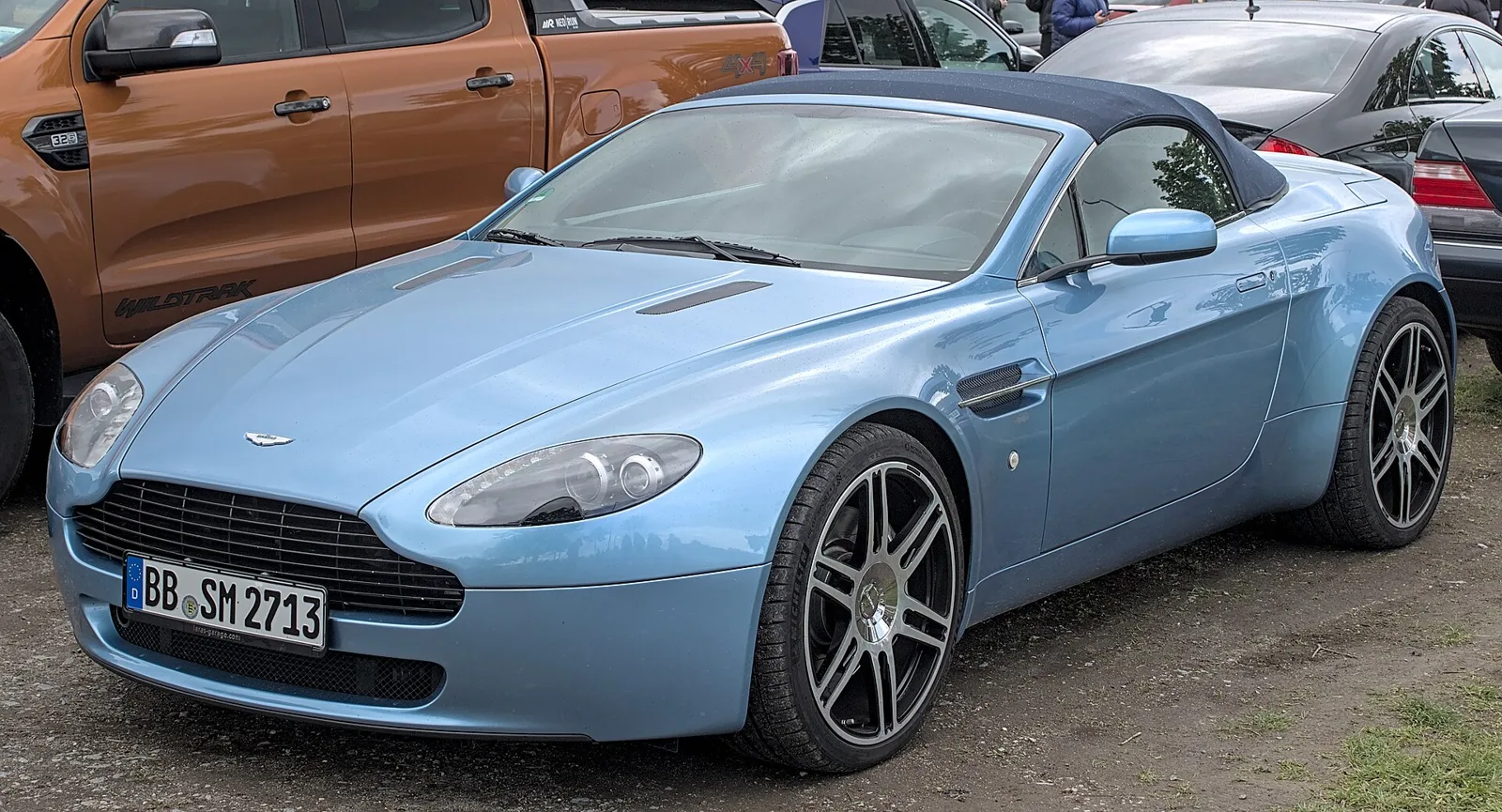
From the 2005 V8 Vantage coupe to the V12 Vantage GT12 and V600, the leanest car in the Aston Martin range and the basis of a long run of limited editions.
A sports car line from Aston Martin, first launched as the V8 coupe in 2005 and later extended into a V12 family. Production ended in 2017 and 2018, before the next generation arrived. The line produced a long run of limited editions along the way.
The Aston Martin Vantage is a series of sports cars from the British maker, and it is the leanest and most agile car in Aston's lineup. It began as the V8 Vantage in 2005, grew into a V12 family, and ran through a long list of limited editions until the next generation arrived in 2017. Aston intended it to reach buyers of cars such as the Porsche 911.
Where did the Aston Martin Vantage come from?
The name had a history before the modern car. Aston Martin used Vantage on high-performance variants of its GT models in the 1990s, notably on the Virage-based car. The current Vantage revived the badge for a more focused machine. That gave the new car a clear place in the range.
Development began with the AMV8 Vantage concept, which was shown at the 2003 North American International Auto Show. The production V8 Vantage followed at the 2005 Geneva Motor Show and was sold as a 2006 model year car.
The coupe was a two-seat, two-door design with a bonded aluminium structure, which gave it strength with light weight. A convertible, called the V8 Vantage Roadster, followed later in 2006.
The leanest car in Aston's lineup, from a 2005 V8 coupe to a V12 family that ended with the V600.
What did the first V8 Vantage look like?
The coupe measured 172.5 in (4.38 m) in length and featured a hatchback-style tailgate, which gave it a large luggage shelf behind the seats. That practicality was unusual for a car of its character. It was a two-seat coupe with a lightweight bonded structure.
Its design is officially credited to Henrik Fisker, who was design director at Aston Martin when the Vantage was introduced. Some accounts give a large share of the work to Ian Callum, who had worked at Aston before Fisker joined. Callum himself said a good 80 percent of the design was completed under his watch.
Car Design News readers voted the V8 Vantage the best current production car design in their 2006 survey. The result was based on over 1,000 responses, most from working designers and students, which gave the praise real weight.
How did the original V8 Vantage perform?
The first car used a 4.3-litre quad-cam 32-valve V8 rated 380 bhp (283 kW; 385 PS) at 7,300 rpm, with 410 Nm (302 lb-ft) of torque at 5,000 rpm. The initial version reached 0-60 mph in 4.8 seconds before topping out at 175 mph (282 km/h).
The engine was front mid-mounted with a rear transaxle, giving a 49-51 front to rear weight distribution. Slotted Brembo brakes were standard, which suited a car intended for fast road and track driving.
The engine itself was largely Aston's own work. The block, heads, crankshaft, pistons and engine management were designed in-house, and each engine was assembled by hand at the company's Cologne facility, which also built the V12 for the DB9 and Vanquish.
Race-style dry-sump lubrication let the engine sit low in the chassis. That lowered the centre of gravity and helped the car's handling, which was the point of the layout.
What did the 2009 update change?
The May 2008 announcement brought technological updates for the 2009 model year, covering the engine, transmission, suspension and appearance. The 4.7-litre engine used new cylinder liners pressed into the aluminium block, which allowed a thinner liner and a larger capacity of 4,735 cc.
Output rose to 420 bhp (313 kW; 426 PS) at 7,000 rpm, an 11% increase, and peak torque reached 470 Nm (347 lb-ft) at 5,750 rpm, a 15% increase. The update cut 0-60 mph to 4.7 seconds and lifted the top speed to 180 mph (290 km/h).
The chassis changed too. Aston stiffened the suspension, moved to Bilstein dampers and offered an optional sports pack with stiffer springs. Combined European fuel economy and CO2 emissions improved by 13%, which was a useful step for a sports car.
How many V8 Vantages were built?
By the end of production in 2017, Aston Martin had built 15,417 V8 coupes and 6,231 V8 Roadsters. The model reached chassis number 10,000 in the first half of 2008, a milestone that only the DB9 had passed before it.
Those numbers are small by the standards of mainstream car makers. For perspective, Porsche was building over 20,000 911s a year in the same period, and it had produced more than a million 911 variants in total.
The low volume made each Vantage feel special, and it is part of why a V8 or V12 from this generation is still a rare sight. Aston kept the Vantage in a niche of its own.
What were the V8 Vantage special editions?
The N400, a limited edition released at the 2007 Frankfurt Motor Show, tuned the 4.3-litre V8 to 400 bhp (298 kW; 406 PS) to mark the company's success at the Nurburgring. It came with lightweight graphite-finished wheels, uprated springs and a numbered plaque, and a total of 480 examples were built.
The N420 followed in 2010, based on the 4.7-litre car, with the Sports Pack suspension as standard and a weight saving of 27 kg (60 lb). The N430 used the S 430 bhp engine and S suspension, and the GT added North American and Australian buyers to the list.
The S became the sharpest of the V8 range, with 430 bhp (321 kW; 436 PS) at 7,300 rpm and 490 Nm (361 lb-ft) of torque. It came with the seven-speed Sportshift II, which was 24 kg (53 lb) lighter than the six-speed unit on the standard car.
The GTS was exclusive to the US market, with a total run of 100 cars. The GT8 followed in 2017 as a track-focused version, limited to 150 cars and rated at 440 bhp (328 kW; 446 PS), with a 190 mph top speed.
What was the V12 Vantage?
The V12 Vantage RS was a concept unveiled in December 2007 as part of the company's new design studio opening. It used the AM11 V12 from the DBS, rated 510 bhp (380 kW; 517 PS) with 570 Nm (420 lb-ft), and it was an early sign of the V12 road car that followed.
The production V12 Vantage arrived in 2009, and the V12 Vantage Roadster followed in 2013 with a limited run of 101 units. The Roadster was 80 kg (176 lb) heavier than the coupe after chassis stiffening, yet it kept the coupe's top speed of 190 mph (306 km/h).
The V12 Vantage S, announced in May 2013, reached 565 bhp (421 kW; 573 PS) at 6,750 rpm from a revised 5.9-litre V12, with its torque peaking at 620 Nm (457 lb-ft). It used the seven-speed Sportshift III, with no manual option, and it weighed 1,665 kg (3,671 lb).
The V12 Vantage GT12 was a limited track-focused special, rated 592 bhp (441 kW; 600 PS) and 625 Nm (461 lb-ft). It weighed 1,565 kg (3,450 lb) and could reach 0-60 mph in 3.5 seconds, and the V600 that followed was built in only 14 units.
Did the Vantage race?
Yes. A near-stock V8 Vantage N24 was revealed at the 2006 British Motor Show and entered the Nurburgring 24 Hours, where it finished 4th in class and 24th overall. Ulrich Bez, the company's CEO, drove it in the race. The entry showed how close the road car was to the race car.
The N24 was then offered to customers as a track car. The V8 Vantage GT2 debuted at the 2008 Grand Prix of Long Beach, while the Vantage GTE became a factory effort in 2012 after the AMR-One prototype struggled.
The V12 Vantage GT3, unveiled in 2011 with 625 bhp (466 kW; 634 PS), raced for seven years and finished 2nd at the 2019 Bathurst 12 Hour. It led until the final minutes against newer machinery, which was a strong result for an older car.
Prodrive also released a tuning package for the V8 Vantage in 2007, and the Vantage GT4 debuted in late 2008 as an updated version of the N24. Two Multimatic-run Vantages later entered the 2012 Continental Tire Sports Car Challenge.
How did the press and television react?
The V8 Vantage earned a strong reception from the motoring press. Automobile magazine voted it one of its 2007 All-Stars for performance, road manners and design. The praise came from both enthusiasts and designers. Its design and performance both drew attention.
On the BBC's Top Gear the V8 Vantage was placed in the DB9 Section, a mini-fridge reserved for the coolest cars, and it was described as the baby Aston. Jeremy Clarkson named it Best Sounding Car of the Year in the 2005 awards, even though the top award went elsewhere.
The V8 Vantage N24 was picked by James May for a Top Gear quest to find Europe's best driving road, although co-hosts Richard Hammond and Jeremy Clarkson mocked it as an ill-considered choice. Clarkson later praised the V12 Vantage on the 13th series.
What were the Vantage specifications?
The Vantage moved from a 4.3-litre V8 at 380 bhp to a 4.7-litre at 420 bhp, and then to 565 bhp from the V12 S and 592 bhp from the GT12. The table below sets out the main figures across the range.
| Specification | Detail |
|---|---|
| Launch engine | 4.3-litre quad-cam V8, 380 bhp (283 kW; 385 PS) |
| 2009 engine | 4.7-litre V8, 420 bhp (313 kW; 426 PS), 470 Nm (347 lb-ft) |
| V8 Vantage S | 430 bhp (321 kW; 436 PS), 490 Nm (361 lb-ft) |
| V8 Vantage S, 0-60 mph | 4.5 seconds, top speed 189 mph (304 km/h) |
| V12 Vantage S | 565 bhp (421 kW; 573 PS), 620 Nm (457 lb-ft) |
| V12 Vantage S, 0-62 mph | 3.9 seconds, top speed 205 mph (330 km/h) |
| V12 Vantage GT12 | 592 bhp (441 kW; 600 PS), 1,565 kg (3,450 lb) |
| Vantage GT8 | 440 bhp (328 kW; 446 PS), 190 mph top speed |
How did the Vantage's production run end?
V8 Vantage production ended in 2017, while the V12 Vantage continued until 2018. The company unveiled the next-generation Vantage in November 2017, and it began production the following year. The model's final years were a run of special versions, each with its own focus on track or road.
The final years brought the AMR editions, limited to 300 cars split between 200 V8 and 100 V12 models. Buyers of those cars were choosing the most focused Vantage yet. The AMR Pro was a track-focused car, built in seven examples, and the V600 closed out the V12 line in 14 units.
What is the Vantage's legacy?
The Vantage gave Aston Martin a sports car aimed at the Porsche 911 on everyday roads and on track. Its run of limited editions, from the N400 to the V600, kept enthusiasts engaged for more than a decade. The series kept the model fresh across many years.
The V8's strong sales helped the company's health in its era, and the V12's place at the top of the line showed what Aston could do with its own engines. A V8 or V12 from this generation remains a rare treat for owners and fans.
.jpg)