How a track-focused 911 that began in 1999 grew into a family of road cars, race cars and one-make series machines, and where its lap records stand.
The Porsche 911 GT3 began in 1999 as a homologation model for GT racing, built around a Mezger-derived engine. Its RS variants, customer racers and one-make cars have since won Le Mans class races, Nurburgring events and lap records across four generations.
The Porsche 911 GT3 is a high-performance homologation version of the 911 sports car. It began in 1999 as a racing-focused model and has since grown into a family of road cars, customer race cars and one-make series machines, with a racing career that runs from Le Mans to the Nurburgring.
What did the GT3 start out as?
The GT3 nameplate arrived in 1999 with the 996 generation, as a homologation model for cars entered in the GT class. It followed the 911 RS line, which began with the 1973 911 Carrera RS, and the 996 GT3 was built with racing in mind. It predated the Group GT3 class, which arrived in 2005.
Porsche stripped out anything that added weight. Sound deadening was almost completely removed, along with the rear seats, rear loudspeakers, sunroof and air conditioning. Automatic air conditioning and a CD radio came back as no-cost options. The chassis was then sharpened with enlarged brakes, a lowered and re-tuned suspension, lighter wheels and a new front bumper with a matched rear spoiler for more downforce.
A no-cost Clubsport package replaced the electrically adjustable front seats with manual racing buckets in fire-retardant fabric. It also added a single-mass flywheel, a bolt-in half roll cage, a six-point harness, a fire extinguisher and a battery master switch. Porsche never offered the Clubsport package in the United States, where the extra crash testing needed for sales would have been required.
A track-focused 911 that began as a homologation special in 1999 and has since won Le Mans class races, Nurburgring races and lap records.
Why did the GT3 engine matter so much?
The 996 GT3's engine shared nothing with the standard water-cooled 996 Carrera flat-six. It was naturally aspirated and based on the Mezger racing engine, which had powered the 962 and the 911 GT1 race cars. The Mezger was named after its designer, Hans Mezger, and it kept the air-cooled 911's dry-sump crankcase with an external oil reservoir.
In the GT3 the crankcase was split along the crankshaft centreline, with separate water jackets added on each side to cool banks of three cylinders. That made it closely related to the water-cooled 962 engine, which used the same crankcase, although the 962 had six separate cylinder heads. The 996 GT3 produced 265 kW; 355 hp (360 PS), compared with 221 kW; 296 hp (300 PS) for the standard 996.
The GT3 also used a six-speed manual with interchangeable gear ratios, the G96/50, which was more durable than the Carrera gearbox. From model year 2004 production of the Mezger block moved to Valmet facilities in Spain, France and Austria, and the road-legal engines took new part numbers.
How did the 996 GT3 RS and RSR develop?
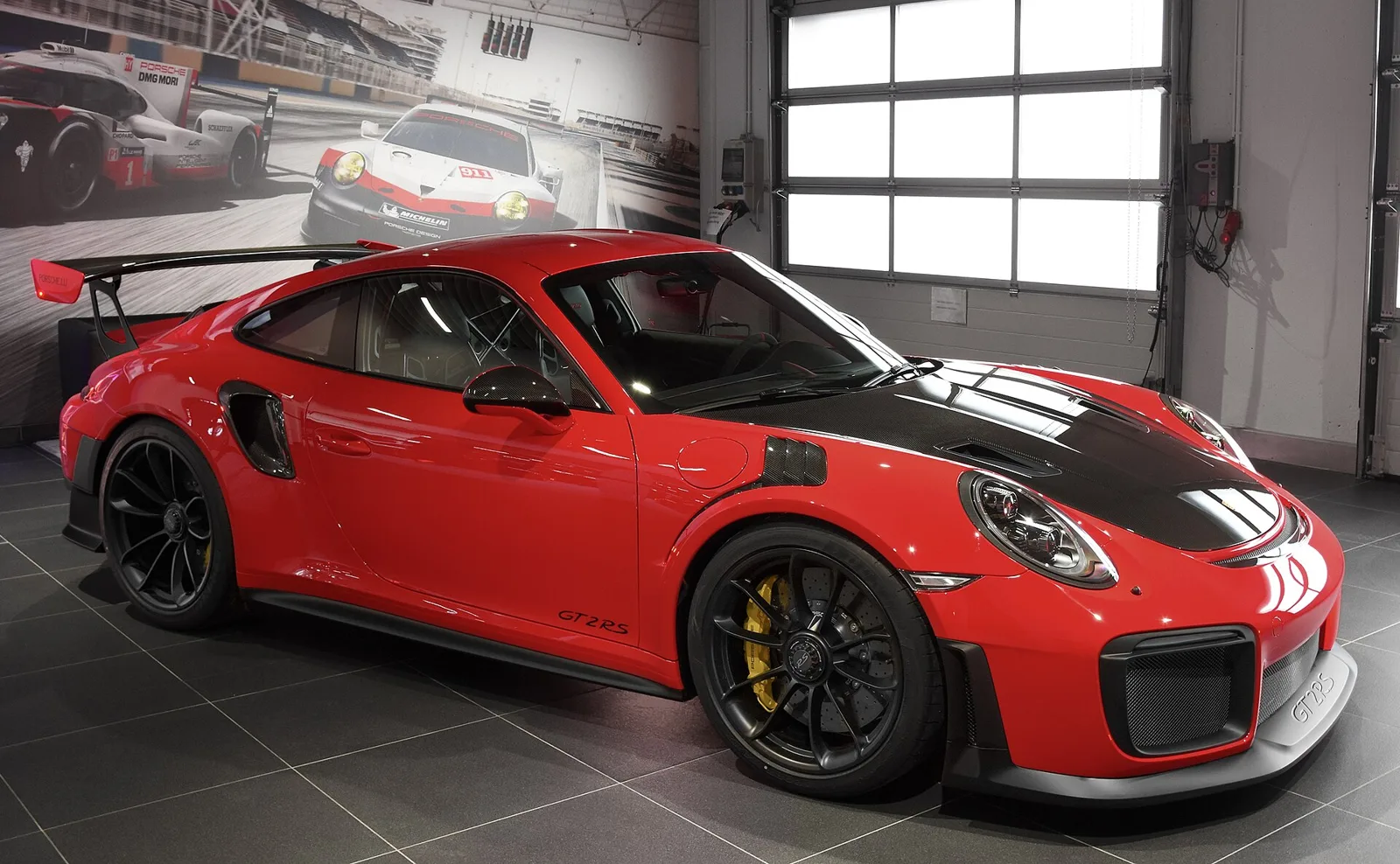
The RS arrived in 2003 as an even more track-focused version of the 996 GT3. The name is short for the German RennSport, meaning racing sport, and it linked the car to historic models such as the Carrera RS of 1973. A polycarbonate rear window and carbon fibre bonnet and rear wing cut weight, and ceramic composite brakes were optional.
The RS had reshaped intake and exhaust ports, progressive springs and uprated dampers, which were 10 to 15% stiffer in bounce and rebound than the GT3's. Its rear wing gave 35 kg (77 lb) of downforce at 200 km/h (120 mph), and ram-air ducts added power that could not be homologated. Porsche's own figure was 284 kW (381 hp), but its control dyno showed nearly 298 kW (400 hp).
The 996 GT3 RS was built from 2003 to 2005, and only a small number reached the UK. It was not sold in the United States or Canada. Automotive reviewers reported 0-97 km/h (0-60 mph) acceleration in the four-second range and more than 1.0g on the skidpad. Its Nurburgring lap of 7:43 was four seconds faster than the 996 GT2, then the top model of the range.
The 996 GT3 RSR of 2004 was the ultimate development of the 996 GT3 for motorsport. It used a 331 kW (450 PS; 444 hp) 3.8-litre flat-six and a six-speed sequential gearbox, with carbon fibre panels to reduce weight. Only 37 were built. It won three ALMS GT2 races and took class wins at the 2004 and 2005 Le Mans races.
What did the 997 generation change?
Porsche unveiled the 997 GT3 in February 2006. Its new 3.6 litre flat-six produced 305 kW (415 PS), and the car used what Porsche called zero lift aerodynamics, meaning its shape created downforce without the lift that reduces grip. The car was also the first GT3 or RS to get electronically adjustable suspension, a track-tuned version of the PASM system.
The 997 GT3 had a rated 0-97 km/h (0-60 mph) time of 4.1 seconds and a top speed of 311 km/h (193 mph). Road and Track measured 3.8 seconds. Walter Rohrl lapped the Nordschleife in 7 minutes, 42 seconds in the car during 2006. It went on sale in the summer of 2006, with 917 units sold in the United States and 46 in Canada.
The 997 GT3 RS was 20 kg (44 lb) lighter than the standard car, at 1,370 kg (3,020 lb). Its adjustable carbon fibre wing, steel engine cover and lightweight windscreen gave it 224 kW (300 hp) per tonne. Its rear body was 64 mm (2.5 in) wider, a legacy of the Carrera 4 shell it shared, and the wider track improved cornering grip. Production ended in 2009.
The second-generation 997.2 GT3 arrived in 2009 with a 3.8 litre engine rated at 320 kW (435 PS). It added dynamic engine mounts and a pneumatically lifting front axle that helped clear low ground. The RS version followed for 2010 with 331 kW; 444 hp (450 PS), an extra 11 kW (15 hp) from the new engine.
What made the 997 GT3 RS 4.0 special?
The 911 GT3 RS 4.0, launched in 2011, was the last 997-based RS. It had a 4.0 litre flat-six, the largest engine offered in a street-legal 911 at the time. The engine used the crankshaft from the RSR with a longer stroke, with a longer stroke, and its chassis development drew on the GT2 RS and other RS models.
Output stood at 368 kW; 493 hp (500 PS) at 8,250 rpm, and torque was 460 N m (339 lb ft) at 5,750 rpm. The car weighed 1,360 kg (2,998 lb), and its front dive planes added downforce. Porsche built only 600 of them, and it was one of the most powerful naturally aspirated six-cylinder engines in any production car of its time.
The RS 4.0 had a top speed of 311 km/h (193 mph). Its colours were limited to Basalt Black, Carrera White and two paint-to-sample options.
How did the 991 generation perform?
Porsche introduced the 991 GT3 at the 2013 Geneva Motor Show. Its new 3.8 litre flat-six, rated at 349 kW; 469 hp (475 PS) at 8,250 rpm, was based on the Carrera S unit but shared only a few parts with it.
Titanium connecting rods and forged pistons let it reach 9,000 rpm, and it came with a PDK dual-clutch gearbox and rear-wheel steering.
The car's early years brought an engine problem. After several engine failures, the supplier of the connecting rod bolts was found to have made an alloy error, so all 785 GT3s built to that point were recalled and fitted with new engines. Porsche also updated the engine family after valvetrain wear reports, and it offered a transferable warranty.
The 991 GT3 RS arrived in 2015 with a newer 4.0 litre unit producing 368 kW; 493 hp (500 PS), along with 469 N m (346 lb ft) of torque. It used a PDK-only transmission and was quick off the line. The 991.2 GT3, unveiled at the 2017 Geneva Motor Show, raised the redline to 9,000 rpm, added a taller rear spoiler for 20% more downforce, and brought back a manual option.
How quick were the GT3s around the Nurburgring?
The Nordschleife became the standard test for each GT3 and its RS variant. Porsche promoted the lap times, and each new generation pushed them lower. The table sets out the official figures that Porsche or its test drivers recorded on the circuit.
| Model | Year | Nordschleife lap |
|---|---|---|
| 996 GT3 RS | 2003 model | 7:43 |
| 997.1 GT3 | 2006 | 7:42, Walter Rohrl |
| 997 GT3 RS 4.0 | 2011 | 7:27 |
| 991.1 GT3 | 2013 | 7:25 |
| 991.1 GT3 RS | 2015 | 7:20 |
| 991.2 GT3 RS | 2018 | 6:56.4, Kevin Estre |
| 992 GT3 | Launch era | 6:55.34, Lars Kern |
| 992.1 GT3 RS | 2022 | 6:44.848, Jorg Bergmeister |
The 991.2 GT3 RS set a time of 6:56.4 in April 2018, which made it the third Porsche production car to break the seven-minute barrier, after the 918 Spyder.
Where did the GT3 win races?
The GT3 has won major events outright as well as countless class victories. The 24 Hours Nurburgring was won eight times with the GT3 by the Manthey Racing team, most recently in 2021, and the car also won the Spa 24 Hours, the Daytona 24 Hours, the Petit Le Mans and the Bathurst 12 Hour in various years.
Porsche's one-make series has used the 911 GT3 since its introduction. Porsche Carrera Cup and GT3 Cup Challenge series around the world ran it, along with the international Porsche Supercup, which supports the Formula One World Championship.
How did the GT3 race at Le Mans?
Porsche took seven consecutive class victories at Le Mans from 1999 to 2005, after its overall win the year before the GT3 was introduced. In 1999 the factory was absent, so privateers ran the air-cooled 993 GT2 Turbo and the new water-cooled 996 GT3-R. One of the 996 GT3-R entries, run by Manthey Racing, finished 13th overall.
The 996 GT3-R won class honours at Le Mans in 1999 and again in 2000, with a 302 kW (411 PS; 405 hp) 3.6 litre engine that was restricted by a 43.1 mm plate. In 2006 the Porsches led for much of the race before the competitors fell away one by one, and the winner was the Panoz Esperante GTLMM. The 997 RSR arrived the following year.
In 2013 the 991 RSR took a 1-2 finish in the GT class at Le Mans, and in 2018 the Manthey Racing cars finished 1-2 in LM GTE Pro. Those two cars carried liveries that marked the marque's 70th anniversary, one a homage to the 917/20's Pink Pig and the other a Rothmans-inspired scheme from Porsche's Mezger-era racers.
What did the customer race cars become?
The GT3 R, RSR and GT3 Cup carried the design into customer racing. Each generation brought hardware updates that suited teams running the cars across a season. The 997 GT3 RSR, first introduced in 2006, was built to meet the rules of the Automobile Club de l'Ouest, the FIA GT series, IMSA and the VLN.
The 997 RSR used a 3.8 litre flat-six with two restrictors, rated at 335 kW (455 PS; 449 hp) at 8,500 rpm. It won the 2011 and 2013 Petit Le Mans, and the driver Sabine Schmitz set a Nurburgring lap record of 7:07 for non-turbocharged cars in one. The 997 GT3 R Hybrid of 2010 used a flywheel-based energy recovery system developed by the Williams F1 Team.
The 997 GT3 R was built from the ground up for FIA GT3 regulations and replaced the GT3 Cup S. Its 4.0 litre engine produced 368 kW (500 PS; 493 hp). Porsche later improved it for 2013 with a new aerodynamic package and wider track. The 991.2 GT3 R of 2019 produced around 405 kW (551 PS; 543 hp), and it added an electro-hydraulic clutch that removed the need for a clutch pedal.
Where does the GT3 stand today?
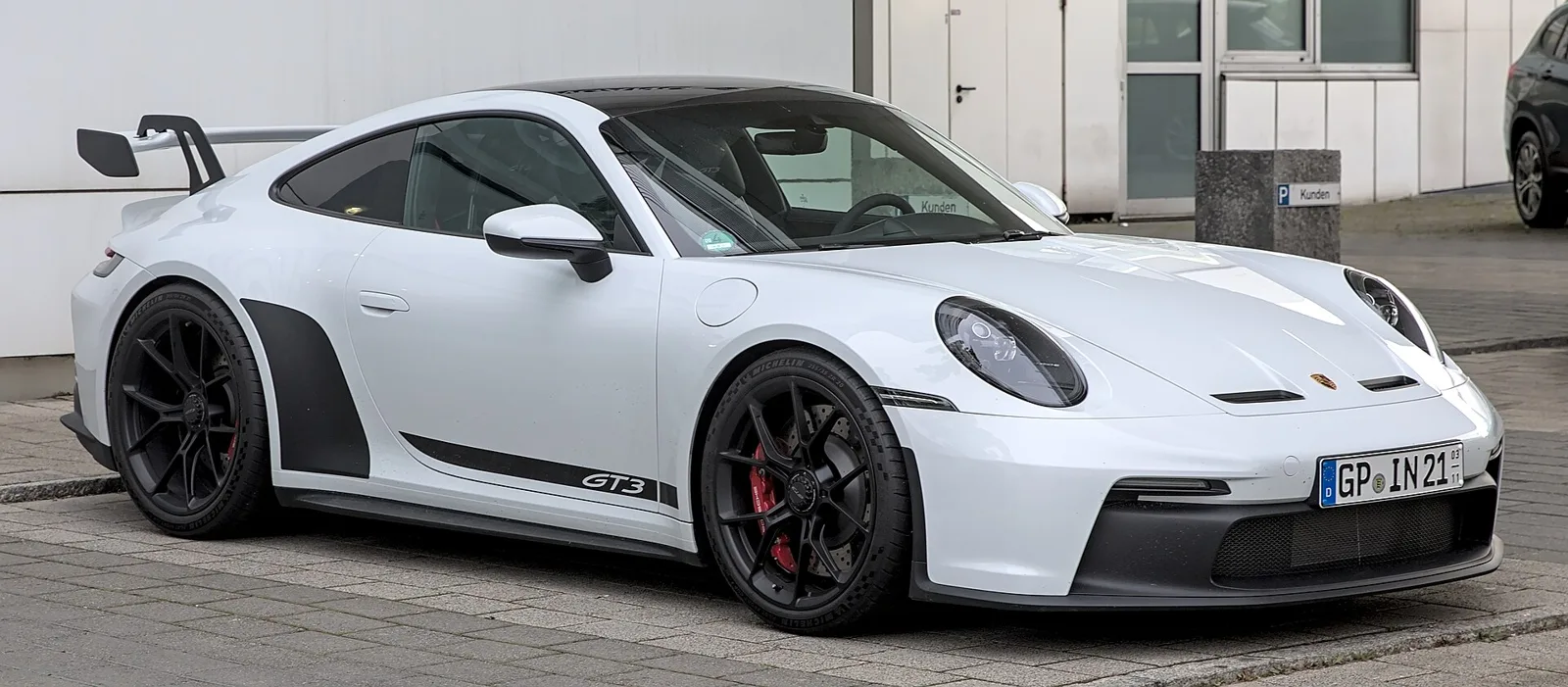
The 992.2 GT3 arrived in October 2024. It kept the 4.0 litre naturally aspirated flat-six at 375 kW (503 hp; 510 PS) and added torque of 450 N m (332 lb ft). It could reach 100 km/h (62 mph) in 3.4 seconds, and its top speed was 311 km/h (193 mph).
Unlike the Carrera range, it kept a key ignition instead of a start button.
The 992 GT3 R that Porsche ran with Herberth Motorsport finished second overall in the SP4 developmental class at the 2025 12 Hours of Spa-Francorchamps on its first start. Its competitive debut came at the 2026 24 Hours of Daytona. Porsche also presented a 911 Challenge car in August 2026, built on the 992.2 road GT3 for entry-level racing.