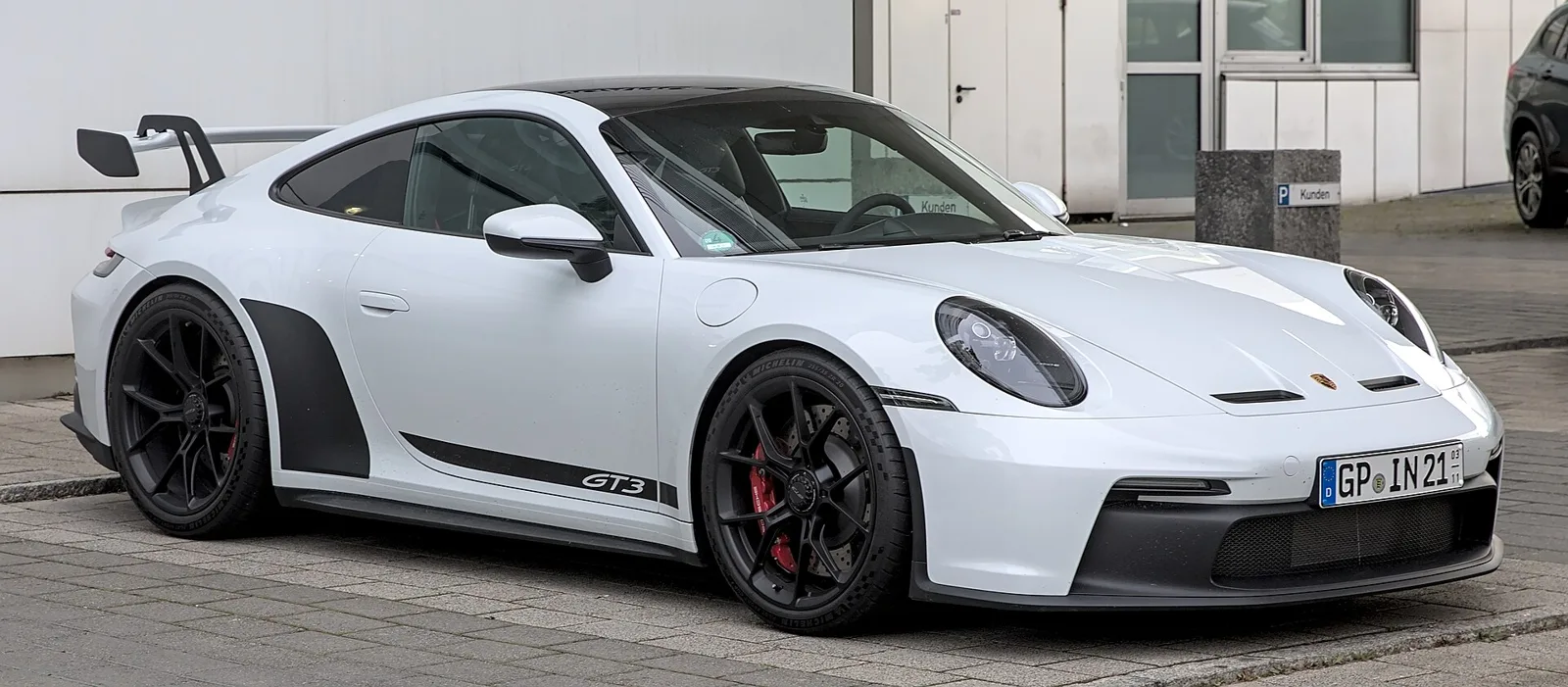
How a racing homologation car became a rear-drive, twin-turbo road model that set lap records and then went racing again as a GT2 RS.
A track-focused 911 from Porsche, the GT2 borrowed the Turbo's twin-turbo engine and sent its power to the rear wheels only. It was built from 1993 to 2019, carried the GT2 RS badge from 2010, and set Nurburgring production lap records.
The Porsche 911 GT2 was a track-focused sports car that Porsche built from 1993 to 2019, and from 2010 as the GT2 RS. It was based on the 911 Turbo and shared its twin-turbocharged engine, but it was rear-wheel drive, lighter and stiffer, which made it the fastest and most expensive model in the 911 range.
What set the GT2 apart from the 911 Turbo?
The GT2 kept the Turbo's twin-turbo engine but received upgrades, including larger brakes and a stiffer suspension calibration. Dropping the all-wheel drive system and removing interior components saved considerable weight, so the GT2 was much lighter than the Turbo it was built from.
The GT2 has since moved through several generations, from the 993 to the 991. Each one kept the same basic idea of a road-legal car that could also be raced, although the racing rules and the engines changed over time.
A homologation special that became the fastest 911 on the road, then a racer again as the GT2 RS.
How did the 993 GT2 come about?
The 993 GT2 was built to meet homologation requirements for GT2 class racing. Because the cars were made to satisfy those rules, the road cars were badged as 911 GT. It came with wider plastic fenders, a bigger rear wing and air scoops in the struts for engine cooling.
Its 3.6 L (220 cu in) engine was rated at 316 kW (430 PS; 424 hp) at first. In 1998 the output rose to 331 kW (450 PS; 444 hp). Porsche built 57 road cars, and thirteen of them were right-hand drive.
Why did Porsche move the GT2 to the 996 in 1999?
In 1999 the 993 gave way to the 996. The new GT2 needed two years of development, and in that period Porsche chose to drop the GT2 from motorsport. Instead it concentrated on Le Mans GT class racing with the naturally aspirated 911 GT3.
The 996 GT2 was developed mainly as a road car, unlike its predecessor. It used a twin-turbocharged version of the GT3's 3.6 L flat-six, producing 340 kW (462 PS; 456 hp), a figure later raised to 355 kW (476 hp). Its body differed significantly from the other 996 variants, with wider fenders, a more aggressively shaped nose and a large rear wing.
Car and Driver found the GT2 suffered from hardly any turbo lag. Its ride height was 10 mm lower than the 911 Turbo's, yet its drag coefficient was slightly higher, at Cd=0.34 against the Turbo's 0.33, because of the fixed rear wing.
How fast was the 997 GT2?
The 997 GT2 replaced the 996 GT2 in 2007, after a brief hiatus. It was launched at the 62nd Frankfurt Motor Show, and cars reached dealerships in November 2007. Its engine was based on the Turbo's flat-six, with two variable geometry turbochargers.
Output stood at 390 kW (530 PS; 523 hp) at 6,500 rpm, while torque reached 680 N m (502 lb ft) by 2,200 rpm. The car went from 0 to 100 km/h in 3.6 seconds and reached 200 km/h in 10.6 seconds, with a top speed of 328 km/h (204 mph). That made it the third Porsche production road car to pass 322 km/h (200 mph), after a 1998 911 GT1 built for street use in small numbers.
Motor Trend tested a 2008 911 GT2 and recorded 0-60 mph in 3.4 seconds and a quarter mile in 11.4 seconds at 127.9 mph (205.8 km/h). Braking from 60 mph to a standstill took 98 feet (30 m), and the car produced 1.10g of lateral grip. The 997 GT2 also had a revised front lip, a new rear wing with small air inlets, and a rear bumper with titanium exhaust pipes and shark fin outlets.
What did the 997 GT2 RS change?
Porsche announced the RS variant on 4 May 2010, when it was offered to German dealers in Leipzig. The GT2 RS weighed 70 kg (154 lb) less than the GT2 and produced 456 kW (620 PS; 612 hp) with 700 N m (516 lb ft) of torque.
It had a top speed of 330 km/h (205 mph) and reached 97 km/h (60 mph) in 3.3 seconds.
Porsche's motorsport manager, Andreas Preuninger, said the RS had been conceived around 2007 as a skunk-works project. Its code number, 727, matched a Nissan GT-R lap time around the Nordschleife, and Porsche claimed that test driver Timo Kluck beat that target by nine seconds. Only 500 units of the 997 GT2 RS were produced.
What is the 991 GT2 RS?
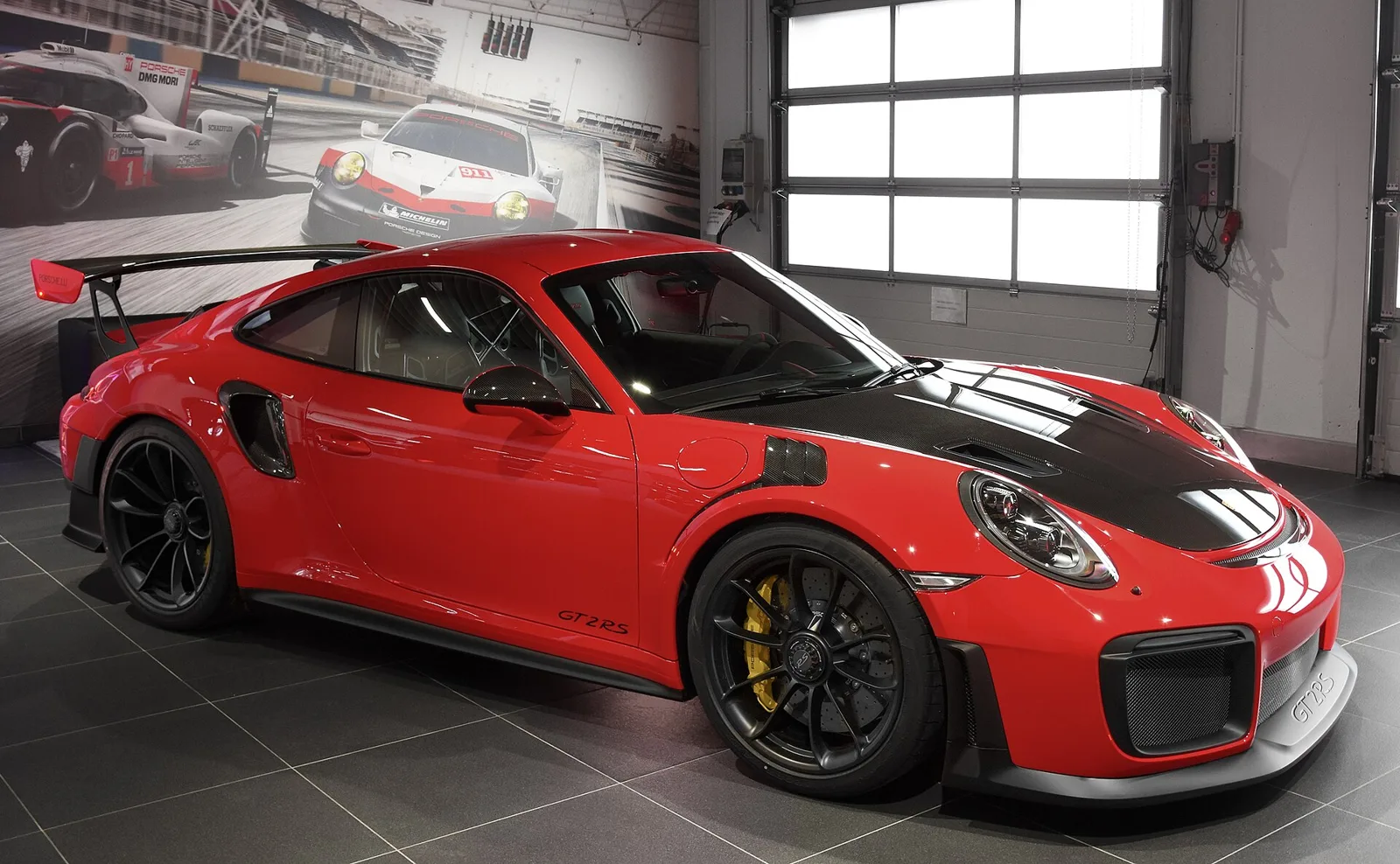
The 991 GT2 RS was first unveiled at Microsoft's Xbox briefing at E3 in 2017, where it was the cover car of the Forza Motorsport 7 video game. It was launched that year at the Goodwood Festival of Speed, alongside the 911 Turbo S Exclusive Series.
The 991 GT2 RS used a 3.8 L twin-turbocharged flat-six rated at 515 kW (700 PS; 691 hp) at 7,000 rpm, with 750 N m (553 lb ft) of torque available. It was the most powerful production 911 ever built. Unlike the earlier GT2s, it had a seven-speed PDK transmission to handle the torque, and Porsche claimed a 0-97 km/h time of 2.7 seconds and a top speed of 340 km/h (211 mph).
The car used a magnesium roof, carbon fibre panels, a titanium exhaust and polycarbonate rear and side windows, giving a wet weight of 1,470 kg (3,241 lb). A Weissach package cut another 30 kg (66 lb) through extra carbon fibre and titanium parts, along with magnesium wheels made by BBS.
How did the GT2 RS perform on the Nurburgring?
In September 2017 a 911 GT2 RS driven by test driver Lars Kern set a lap of 6:47.3 on the Nordschleife, averaging 184.11 km/h (114.40 mph). In 2018 Warren Luff set a production lap record of 3:24.079 minutes at The Bend Motorsport Park, around its 7.77 km GT layout.
That was the fastest production car lap on the track at the time. On 25 October 2018, Lars Kern set a lap of 6:40.33 minutes around the Nordschleife in a 911 GT2 RS MR prepared by Manthey Racing. That beat an unmodified Lamborghini Aventador SVJ, which had taken the record from the GT2 RS in July 2018. Later in 2019 further production times followed at North American venues: Road Atlanta (1:24.88), Road America (2:15.17) and Canadian Tire Motorsport Park (1:22.36).
| Generation | Introduced | Engine | Peak output |
|---|---|---|---|
| 993 GT2 | 1993 | 3.6 L (220 cu in) flat-six | 316 kW (430 PS; 424 hp), later 331 kW (450 PS; 444 hp) |
| 996 GT2 | 1999 | Twin-turbo 3.6 L flat-six | 340 kW (462 PS; 456 hp), later 355 kW (476 hp) |
| 997 GT2 | 2007 | 3.6 L flat-six, two variable geometry turbochargers | 390 kW (530 PS; 523 hp) at 6,500 rpm |
| 997 GT2 RS | 2010 | Upgraded GT2 engine | 456 kW (620 PS; 612 hp) |
| 991 GT2 RS | 2017 | 3.8 L twin-turbo flat-six | 515 kW (700 PS; 691 hp) at 7,000 rpm |
What is the GT2 RS Clubsport?
The GT2 RS Clubsport was introduced at the 2018 Los Angeles Auto Show as the track-only version of the GT2 RS. New aerodynamic elements increased downforce, and removing non-essential parts cut weight further. Its larger rear wing was shared with the GT3 R, and its carbon fibre roof had an integrated escape hatch in case of a crash.
The car made its track debut at the Bathurst 12 Hour in January 2019, and a one-make series for the Clubsport, run by SRO Motorsports Group, held its first event in July 2019 at the 24 Hours of Spa weekend.
New safety features included PSM stability management and ABS, both set by rotary dials on the centre console. Inside, the car had an FIA-approved roll cage, a single racing bucket seat and a carbon fibre race steering wheel with an integrated colour display. It weighed 1,390 kg (3,064 lb), which was 80 kg (176 lb) less than the road car. Production was limited to 200 units. The car ran on 18-inch centre lock forged alloy wheels wrapped in racing slicks, shared with the GT3 R race car.
How did the GT2 race in motorsport?
The GT2 came from a long line of 911 Turbo racing cars. The 1974 911 Carrera turbo raced in Group 5, followed by the 934, a racing version of the 930. The 935 dominated Group 5 and IMSA racing through 1984.
In 1993 Porsche tested the extensively modified 964 Turbo S LM-GT, and then chose to develop a turbocharged 993 for customers.
The 993 GT2 race car had a stripped interior, an integrated roll cage, wider fenders for racing slicks and twin KKK turbochargers, with air restrictors that limited it to 335.7 kW (450 hp). The GT2 Evo raised power to 447.6 kW (600 hp) and cut weight to 1,100 kg (2,425 lb). It also had a higher-mounted rear wing and larger fenders for the wider tyres allowed in GT1, and in 1996 the company moved on to a purpose-built 911 GT1 instead.
The GT2 and GT2 Evo ran in the BPR Global GT Series and other national series. In 1996 they won seven of eleven class rounds, and they earned class victories at the 1996 and 1997 24 Hours of Le Mans. By 1998, Chrysler Viper GTS-Rs had made the GT2 far less competitive, and it won only a single race that year.
By 1999 the Vipers and newcomers from Lister had overpowered the GT2s, although a car prepared by Roock Racing still won the GT2 class at the Daytona 24 Hours that year. An increase in engine size to 3.8 litres in 2000 did not help, and Porsche ended the project. Private teams kept running GT2s until 2004.
Private teams also built racing versions of the 996 GT2. Two privateers, one Belgian and one German, built racing versions of the 996. They ran with modest results in national series including the Spanish GT Championship and Belcar.
Where does the GT2 stand today?
Porsche became the first manufacturer to commit to the SRO GT2 category, which launched in 2018, with the 911 GT2 RS Clubsport. Since then the car has raced in GT Sports Club America from 2020, and in the GT2 European Series from 2021. An evo kit for the car was introduced in 2023.