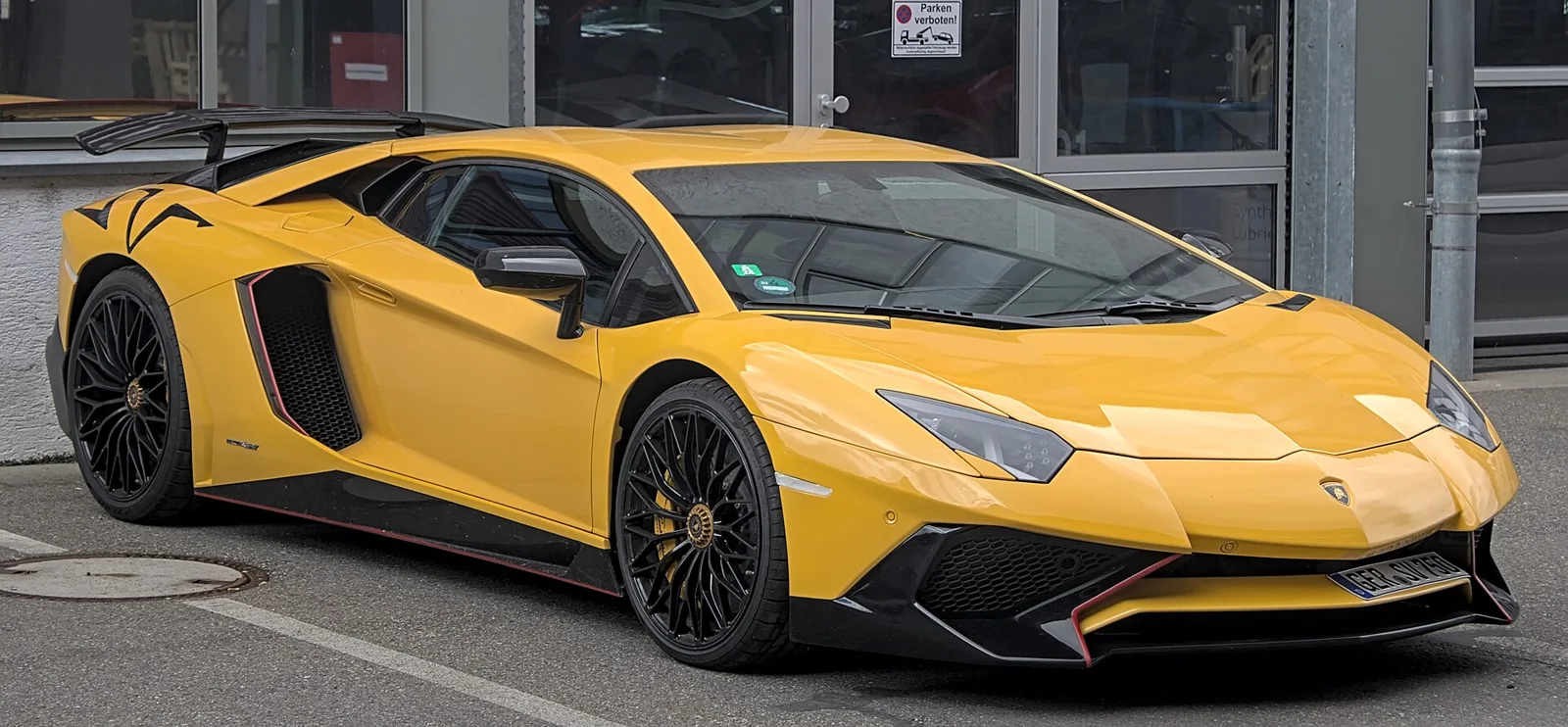
From the 700 PS LP 700-4 to the track-focused SVJ and the limited Ultimae, the Aventador carried Lamborghini's V12 flagship from 2011 to 2022.
The Lamborghini Aventador was a mid-engined two-seat sports car built in Sant'Agata Bolognese from 2011 to 2022. Its 6.5-litre V12 started at 700 PS, and variants ranged from the SuperVeloce to the track-focused SVJ and the final Ultimae. It was succeeded by the Revuelto in 2023.
Few supercars were as closely tied to a single brand as the Aventador. It carried Lamborghini's flagship role through a decade of change, from the first LP 700-4 coupe to the track-focused SVJ and the limited Ultimae that closed out the line.
Where did the Aventador come from?
The car was presented on 28 February 2011 at Geneva, roughly five months after its first public showing in Sant'Agata Bolognese. It replaced the Murcielago as the brand's flagship and was internally codenamed LB834. Its name honours a fighting bull that fought in Zaragoza in 1993.
Soon after the unveiling, Lamborghini said 12 cars had already been sold, and customer deliveries would begin in the second half of 2011. That early order book reflected strong demand for the flagship before the first customer car arrived.
The Aventador was designed to replace the Murcielago, which by then was a decade old. It kept the mid-engined V12 formula while adding carbon fibre construction and electronic all-wheel drive, a combination that marked a clear step forward for the brand.
By March 2016 the company had built 5,000 Aventadors, which made it the second-best selling Lamborghini model of all time at that point. The number was well ahead of the original plan for the car.
A V12 flagship that ended its run with a farewell model, a sunken shipment and a replacement build.
How was the Aventador engineered?
The Aventador's engine was a 6,498 cc 60-degree V12 producing 700 PS (515 kW; 690 hp). Lamborghini's internal code for it was L539, and the unit weighed about 235 kg (518 lb). It was the fifth in-house engine Lamborghini had built and the second V12 design the company had produced.
Power reached the rear wheels through a seven-speed single-clutch automated manual built by Graziano Trasmissioni. The all-wheel drive system was electronically controlled and supplied by the Swedish company Haldex Traction, which gave the car stability in bad weather.
Suspension and steering were managed by the LDVA control unit, which offered four selectable modes: Sport, Strada, Corsa and Ego. Each mode changed the character of the car from relaxed road use to firm track setups, so the driver could choose the balance for the day.
Carbon ceramic brakes were standard on the S, with front discs of 400 mm and rear discs of 380 mm. The original car's carbon fibre monocoque was built on moulds that were expected to last 500 moulds each, and only 8 were made.
What were the Aventador's performance figures?
The LP 700-4 reached 0-100 km/h in 2.9 seconds and 0-161 km/h in 6.4 seconds. It covered 400 m in 10.5 seconds at 220 km/h (137 mph), and it braked from 97-0 km/h in 30 m (100 ft).
Cornering was rated at 1.05 g, and the braking distance from 97 km/h to a standstill was measured in the same test. Those figures gave the car a strong all-round performance profile for a road machine of its era.
The S raised output to 740 PS (544 kW; 730 hp) at 8,400 rpm, while its 0-100 km/h time stayed at 2.9 seconds. Its torque reached 690 Nm (509 lb ft) at 5,500 rpm, and the car could reach 350.0 km/h (217 mph).
The S also added four-wheel steering and an updated suspension, which together improved stability at speed and gave the car a more composed feel through fast corners.
What changed with the SuperVeloce and SVJ?
The SuperVeloce raised output to 750 PS (552 kW; 740 hp) and cut weight by 50 kg (110 lb), with production limited to 600 units. The SVJ pushed further, to 770 PS (566 kW; 759 hp) and a kerb weight of 1,525 kg (3,362 lb).
The SuperVeloce raised downforce by 180 percent compared with the standard coupe. It added a revised front splitter and rear diffuser, a fixed CFRP rear wing, and electronic steering with magnetic push-rod suspension.
The SVJ's Aerodinamica Lamborghini Attiva system added a disconnected front splitter, a large carbon rear wing and a diffuser. It worked with the LDVA 2.0 management system, which used inertial sensors to adjust the car's configuration.
Lamborghini claimed the SVJ achieved 40% more downforce than the SV, along with a 1% reduction in drag coefficient, which made the new aero package a headline feature of the car.
What did the Roadster versions add?
The Roadster was announced for production on 27 December 2012. It kept the coupe's V12 and added a removable roof made of two carbon fibre panels, each weighing 6 kg (13 lb), that stowed in the front compartment.
The roadster weighed 1,625 kg (3,583 lb), which was only 50 kg (110 lb) more than the coupe. The extra weight came from the roof itself and from stiffening in the sills and A-pillars that the open body needed.
The S Roadster followed in 2017 and was mechanically identical to the S coupe. Its 0-97 km/h time of 3.2 seconds was 0.3 seconds slower than the coupe, a small price for the open-top experience.
How fast was the SVJ around the Nurburgring?
A camouflaged SVJ prototype driven by test driver Marco Mapelli set a production car lap of 6:44.97 on the Nurburgring Nordschleife in July 2018. The time beat the Porsche 911 GT2 RS, which had held the production record before it.
The SVJ was the first production V12 Lamborghini to use the Aerodinamica Lamborghini Attiva system. The combination of active aero and inertial sensors allowed the car to adjust its configuration every 0.5 seconds.
The SVJ accelerated from 0 to 100 km/h in 2.8 seconds and from 0 to 200 km/h in 8.6 seconds, with a top speed of 350.0 km/h (217 mph). Its power-to-weight ratio of 0.5 hp/kg put it at the top of its class.
The SVJ Roadster kept the same powertrain with a removable two-piece carbon-fibre hard top, and 800 units were produced. It was the open-top companion to the coupe rather than a lighter or quicker car.
What were the Ultimae and the final cars?
The Ultimae, announced in July 2021, was limited to 600 units: 350 coupes and 250 roadsters. It produced 780 PS (574 kW; 769 hp) with the SVJ's 720 Nm (531 lb ft) of torque, and it came with the standard features of the S and SVJ.
Lamborghini claimed 0-100 km/h in 2.84 seconds and a top speed of 354 km/h (220 mph) for the Ultimae. The coupe's kerb weight was 1,550 kg (3,417 lb), which made it a light and powerful farewell to the V12 line.
In February 2022 the car carrier Felicity Ace caught fire and sank near the Azores with 15 Ultimae aboard. Lamborghini restarted production to replace those cars, so the full run of 600 could still be completed.
The very last Aventador rolled off the line in July 2022. It was styled as a tribute to a single 1968 Miura P400, finished in a flake-blue paint with silver wheels and a pale leather cabin, and the final coupe later sold at auction for over US$1.6 million.
How many special editions and one-offs were made?
Lamborghini built many special runs, including the 50th Anniversary cars of 2013 with 200 units and the Veneno, which was priced at US$4,000,000 when it debuted in 2013. Each special run added a different angle to the Aventador story.
The Veneno was built in limited numbers, with four coupes for the factory and customers, plus nine roadsters. It used the 6.5-litre V12 with more power than the standard car, and it remained one of the most sought-after derivatives.
The Centenario celebrated Ferruccio Lamborghini's 100th birthday and was built in 40 units, including 20 coupes and 20 roadsters. Each car was pre-sold through invitation to selected customers.
The SVJ 63 Edition marked the company's 1963 foundation and was limited to 63 units. The Sian FKP 37 was the first Lamborghini hybrid, and it was limited to 63 coupes and 19 roadsters.
The Essenza SCV12 was a track-only model with 610 kW (819 hp; 830 PS), built in a run limited to 40 units. It was the most powerful naturally aspirated production car at its unveiling.
The Aventador J, shown at the 2012 Geneva Motor Show, was a one-off barchetta that used the standard V12 at 700 PS (690 hp; 515 kW). It had no air conditioning or radio to save weight, and it sold at auction for US$2.8 million.
How did critics and presenters rate the Aventador?
Car and Driver called it The Best Lamborghini Ever, and Motor Trend described it as the friendliest V12 supercar in the world. Top Gear named it Supercar of the Year for 2011, which put the car at the top of the programme's rankings.
Richard Hammond reviewed the car on 31 July 2011 and was impressed by its performance and handling. His main complaint was that it felt too accessible compared with earlier Lamborghinis, which had a sharper and more dangerous edge.
The Aventador posted a Top Gear test-track time of 1:16.5, the fifth fastest recorded on the programme. Jeremy Clarkson later said it was better than the Ferrari 458 Italia, which the programme had earlier called the best supercar ever.
Criticism focused mainly on the single-disc clutch of the early cars, which many reviewers found unrefined. The engine itself was widely praised for its responsiveness, torque and smooth power delivery.
What are the Lamborghini Aventador specifications?
The table lists core figures for the LP 700-4 and the main later variants, with metric values first and imperial figures in brackets. Where a row refers only to one version, the variant is named so the figures stay separate. Figures come from the original launch specifications unless otherwise noted.
| Specification | Detail |
|---|---|
| Engine | 6,498 cc 60-degree V12 (L539), 235 kg (518 lb) |
| LP 700-4 output | 700 PS (515 kW; 690 hp) |
| LP 700-4 0-100 km/h | 2.9 seconds |
| Transmission | Seven-speed single-clutch automated manual by Graziano |
| All-wheel drive | Haldex Traction, electronically controlled |
| S output | 740 PS (544 kW; 730 hp) at 8,400 rpm |
| S torque | 690 Nm (509 lb ft) at 5,500 rpm |
| SuperVeloce output | 750 PS (552 kW; 740 hp) |
| SVJ output | 770 PS (566 kW; 759 hp) at 8,500 rpm |
| SVJ kerb weight | 1,525 kg (3,362 lb) |
| Ultimae output | 780 PS (574 kW; 769 hp) |
| Ultimae coupe weight | 1,550 kg (3,417 lb) |
| Cornering | 1.05 g |
Frequently asked questions
How much extra downforce did the SuperVeloce gain?
Lamborghini said downforce rose sharply, helped by a revised front splitter, a rear diffuser and a fixed rear wing made from CFRP. The package was one of the clearest examples of the company using aerodynamics as a performance tool.
Did Lamborghini replace the cars lost at sea?
Yes. Production restarted to replace the cars lost when the Felicity Ace sank, and the last Ultimae was built in July 2022 as an homage to a 1968 Miura.
Which special model was the most expensive?
The Veneno was among the most expensive production cars in the world, with a US$4,000,000 price when it was revealed at Geneva in 2013. Its limited run made it a collector's piece from the start.
What did the Mansory-style special editions include?
Lamborghini's Ad Personam division offered bespoke finishes, and the Xago Edition was built for clients of the virtual studio in 2020. Ten were produced, each with a custom paint scheme inspired by Saturn's hexagonal storms.
.jpg)