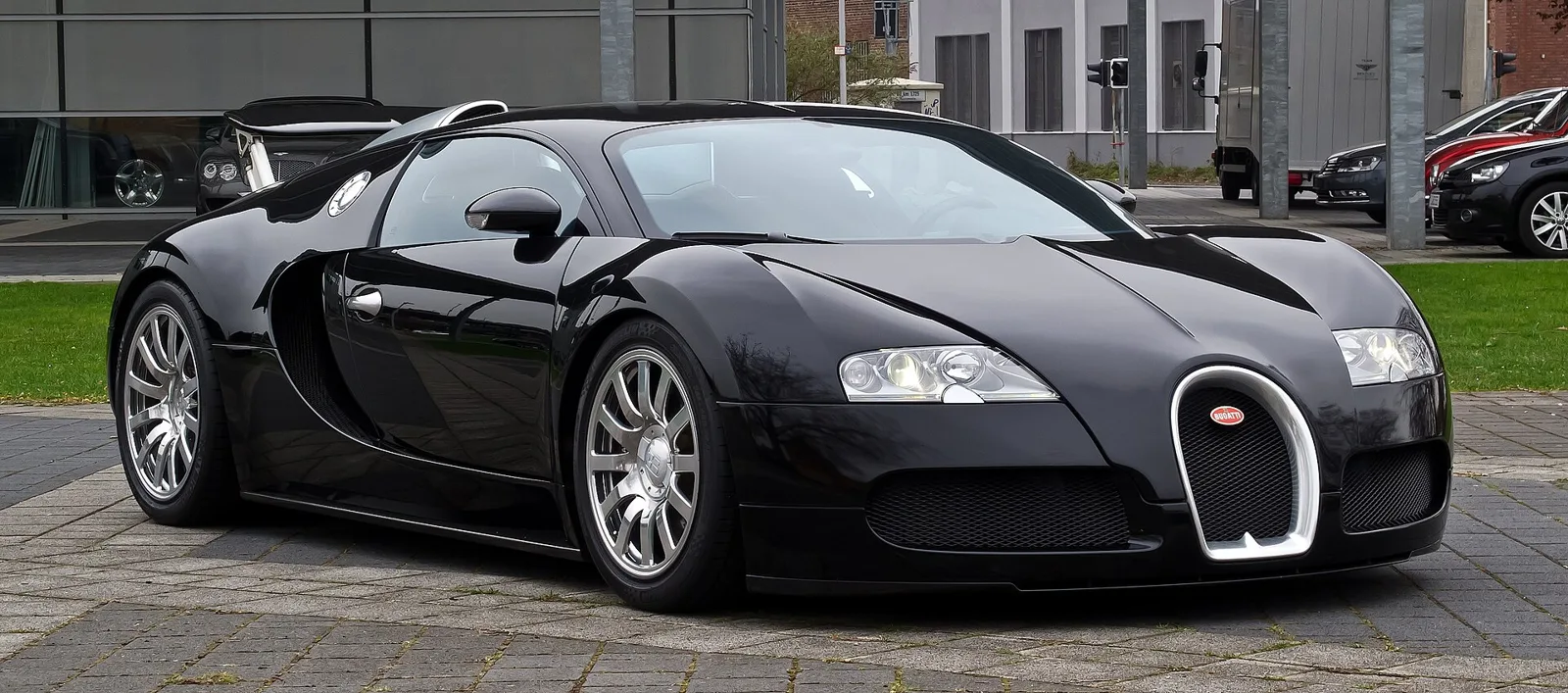
One arrived from a revived French marque with Volkswagen money and a quad-turbo W16; the other carried Lamborghini's naturally aspirated V12 torch into a new decade. We compare the Bugatti Veyron and Lamborghini Aventador on history, engineering, pace and character.
The Bugatti Veyron and Lamborghini Aventador are both mid-engined, all-wheel-drive flagship supercars, but they answer different questions. The Veyron chased outright speed with a quad-turbo W16 and a 407.5 km/h (253.2 mph) Top Gear run; the Aventador chased drama with a naturally aspirated V12, carbon monocoque and a Nurburgring record.
Each of these two cars sat at the top of its maker's range, using a mid-mounted engine, drive to all four wheels and a powerplant of at least twelve cylinders. For ten years they appeared together at motor shows and on the wish lists of the very rich. Yet the Veyron and the Aventador set out to settle separate briefs: for one, the goal was outright pace on the road; for the other, maximum spectacle.
How did the Bugatti Veyron come to exist?
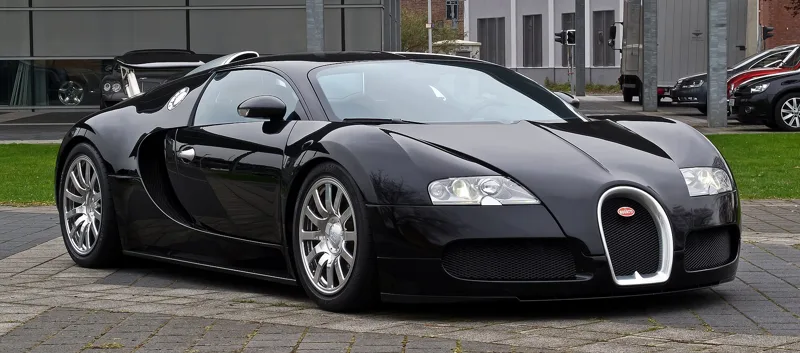
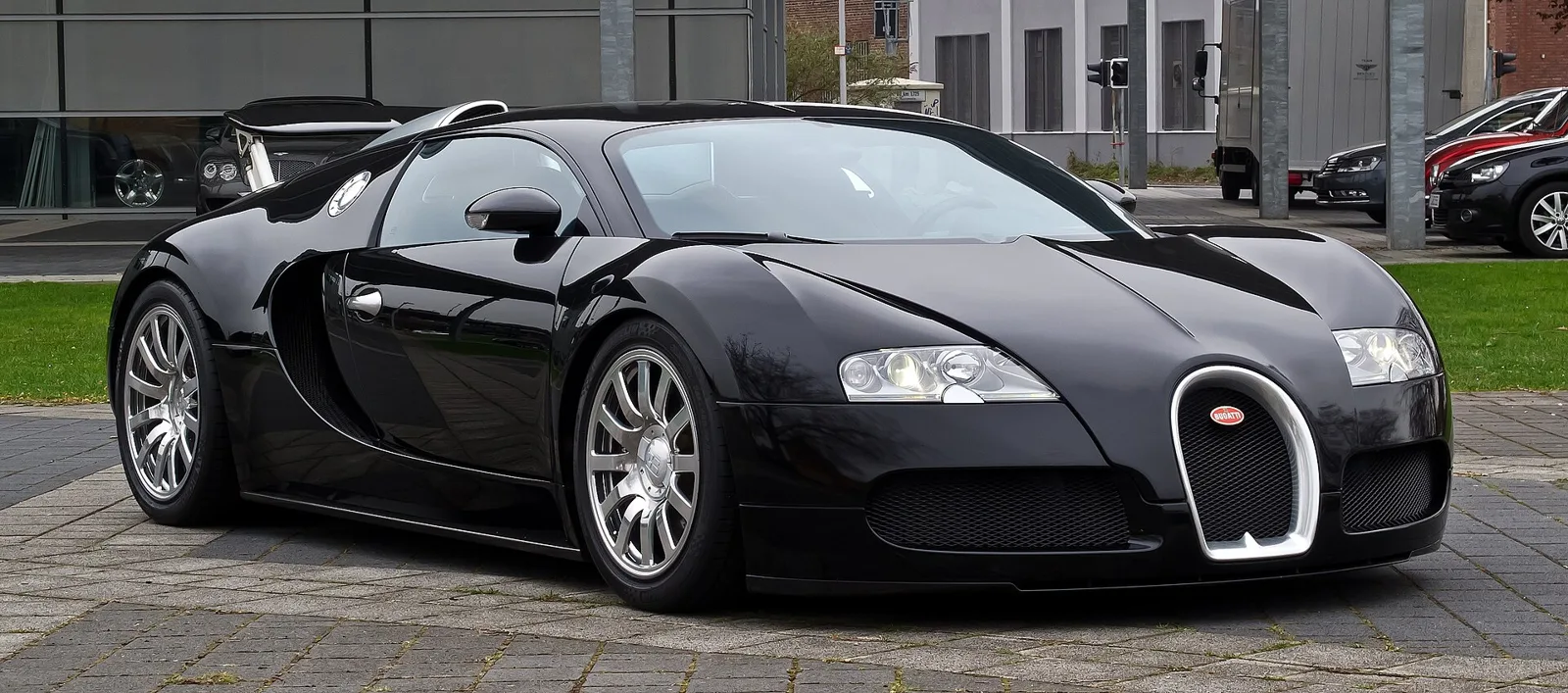
Volkswagen AG bought the Bugatti name and logo in May 1998, then spent seven years turning a series of Giugiaro concepts into a production reality. The EB 18/4 Veyron concept appeared at the Tokyo Motor Show in October 1999, and by 2000 the EB 16/4 had switched to the four-bank W16 architecture that would define the car.
The early concepts had used permanent four-wheel drive and W18 engines. The EB 118 of 1998 was a two-door luxury coupe shown in Paris, the EB 218 a four-door saloon at Geneva in 1999, and the 18/3 Chiron a mid-engine sports car at Frankfurt that same year. Styling was handled in-house under Hartmut Warku, who also commissioned a Walter de Silva proposal and then rejected it in favour of his own direction. VW Group signed off production in 2001, but the first roadworthy prototype did not run until August 2003, and technical problems pushed the start of series build to September 2005.
The name honours Pierre Veyron, the Bugatti engineer and racing driver who won Le Mans in 1939 alongside Jean-Pierre Wimille. The EB prefix stands for Ettore Bugatti, and 16.4 denotes sixteen cylinders and quad turbochargers.
Where the Veyron overwhelms with force and complexity, the Aventador seduces with noise, balance and the sense that every panel was shaped to be looked at.
Where did the Lamborghini Aventador fit in?
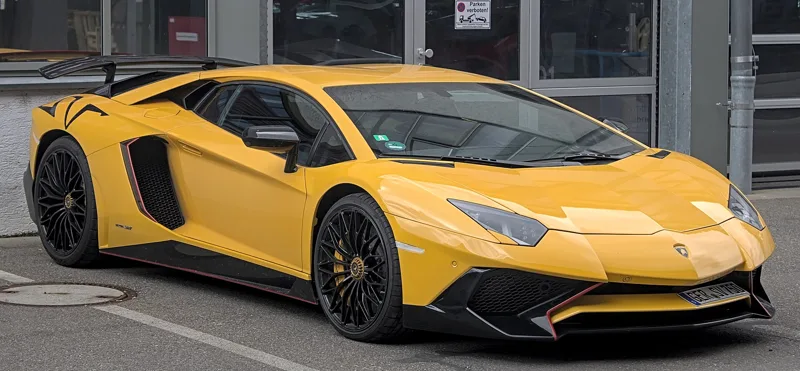
Lamborghini unveiled the Aventador at the Geneva Motor Show on 28 February 2011, five months after showing it to a private audience in Sant'Agata Bolognese. It carried the internal codename LB834 and replaced the decade-old Murcielago as the company's V12 flagship.
The name comes from a fighting bull, a 1993 Zaragoza animal, continuing a tradition that runs back through Miura, Islero and Murcielago. Twelve cars were pre-sold immediately after the unveiling, and customer deliveries began in the second half of 2011. It stayed in production until July 2022 and was replaced by the Revuelto in 2023.
What makes the Veyron's engineering so extreme?
At its heart is a W16 built from two narrow-angle V8s bolted together, each cylinder with four valves for a total of 64. Two overhead camshafts drive two banks, so only four camshafts are needed, and four turbochargers feed the whole assembly. Bore and stroke are square at 86 by 86 mm (3.39 by 3.39 in).
Drive is sent to the wheels via a computer-managed seven-speed dual-clutch DSG whose manufacture was handled by Ricardo, an English firm, not Borg-Warner. Shift times of less than 150 milliseconds are possible using the magnesium paddles mounted behind the wheel. A Haldex Traction setup provides permanent all-wheel drive, while the rubber consists of Michelin PAX run-flats created with top-speed running in mind. Should the transmission need replacing, the bill exceeds US$120,000; tyres come in at US$25,000 per set, and fitting them is possible solely in France, at US$70,000.
The thermal management setup deserves separate treatment. Altogether there are ten radiators: three intercoolers, three engine water radiators, one air-conditioning condenser, one transmission oil radiator, one differential oil radiator and one engine oil radiator. Volkswagen Group gave a power-to-weight figure of 530 PS (390 kW; 523 hp) per ton. In its normal configuration the drag coefficient is 0.41, dropping to 0.36 when lowered; frontal area measures 2.07 m2 (22.3 sq ft), giving a drag area of CdA=0.74 m2 (8.0 sq ft).
How does the Aventador's chassis differ?
Where the Veyron leaned on mass and turbocharged muscle, the Aventador was built around a carbon fibre monocoque, with moulds expected to last 500 cycles and only eight ever made. The engine sits in the middle and drives all four wheels through a seven-speed single-clutch automated manual from Graziano Trasmissioni, with electronically controlled all-wheel drive by Haldex Traction.
The naturally aspirated V12 weighs 235 kg (518 lb). Suspension is by push-rod on the SV and Centenario, magnetic push-rod on the SV, and four-wheel steering arrives with the S. The LDVA unit manages four suspension modes, and the later LDVA 2.0 system uses inertial sensors that update every half a second. Carbon ceramic brakes are standard, with the S running 400 mm front and 380 mm rear discs.
Over time, Lamborghini's designs grew ever more aerodynamically focused. On the S, a bigger front splitter appeared, along with two additional ducts in the front bumper and a rear diffuser finished in black, featuring fins and three single exhaust outlets. The SVJ pushed things further still: its front splitter is disconnected, a tri-dimensional air outlet sits on the bonnet, a central fin runs through a large carbon fibre rear wing, vortex generators are fitted underneath, and the rear diffuser is substantial. Active aerodynamics via the ALA system and a titanium exhaust also came with the SVJ.
Bugatti Veyron vs Lamborghini Aventador: specification comparison
| Specification | Bugatti Veyron | Lamborghini Aventador |
|---|---|---|
| Production years | 2005-2015 | 2011-2022 |
| Body style | 2-door mid-engine coupe, targa and roadster variants | Two-seater coupe and roadster |
| Peak power, Super Sport / SVJ | 1,200 PS (882 kW; 1,183 hp) at 6,400 rpm | 770 PS |
| Peak torque, Super Sport | 1,500 N.m (1,106 lb.ft) at 3,000-5,000 rpm | 690 N.m (509 lb.ft) at 5,500 rpm (S) |
| Top speed, Super Sport | 431.072 km/h (267.856 mph), limited to 415 km/h (258 mph) | 349 km/h for LP 700-4 Roadster |
| Production total | 405 cars produced and delivered as of 6 August 2014 | 5,000th unit built by March 2016 |
How fast is the Bugatti Veyron?
The Veyron's standard configuration caps its speed at 343 km/h (213 mph). With the Super Sport, that figure climbed to 431.072 km/h (267.856 mph), a mark that made it the quickest road-going production machine when it launched, although a 415 km/h (258 mph) electronic cap was fitted to safeguard the tyres.
To reach its top speed, a dedicated key beside the driver's seat must be used. Once turned, it sets off a systems check, pulls the spoiler back in, closes the front diffusers and brings the ride height down from 12.5 cm to 6.5 cm. At 220 km/h the hydraulics have already brought the car to roughly 9 cm, while in handling mode the wing and spoiler extend to create 3,425 newtons (770 lbf) of downforce. At full speed the engine draws in 45,000 litres of air every minute. Bugatti stated that from 400 km/h the car could stop in under ten seconds, covering half a kilometre in the process. James May hit 407.5 km/h in November 2006 on Top Gear.
How fast is the Lamborghini Aventador?
The LP 700-4 Roadster hits 60 mph in 2.9 seconds and tops out at 349 km/h. The SV is quicker still, reaching 100 km/h in 2.8 seconds with 750 PS (552 kW; 740 hp), 50 kg lighter than the standard car, and delivering 180 per cent more downforce than the standard coupe.
At 8,400 rpm the S develops 740 PS (544 kW; 730 hp), while its 690 N.m (509 lb.ft) torque peak arrives at 5,500 rpm. It hits 60 mph in 2.9 seconds, tops out at 217 mph, and carries 130 per cent more front downforce than the original. The SVJ, rated at 770 PS, set a Nurburgring Nordschleife lap of 6:44.97 in July 2018 in the hands of Lamborghini test driver Marco Mapelli, which bettered the production car record held by the Porsche 911 GT2 RS. Elsewhere, the standard car covered 0-161 km/h (0-100 mph) in 6.4 seconds, ran the quarter mile in 10.5 seconds at 220 km/h, stopped from 97-0 km/h in 30 metres and pulled 1.05 g in corners.
What is the Veyron like to live with?
The Veyron was assembled by Bugatti at Molsheim in France, while its design and development work was carried out in Germany under Volkswagen Group. Burmester Audiosysteme was responsible for the audio setup fitted to the cabin, and an online Veyron 16.4 Configurator introduced in December 2010 let customers choose exterior and interior colours.
Certain components, such as the air filter and hydraulic pump, were carried over from other Volkswagen Group vehicles and suppliers. This makes servicing easier, though it can lead to quicker deterioration when the car is driven hard. Launched in 2009, the Grand Sport featured a targa top, structural strengthening, a modified windscreen and running lights, along with two detachable roofs: a solid panel and a provisional umbrella-type soft top. With the hardtop in place it equalled the coupe's maximum speed, reached 369 km/h (229 mph) once the roof was taken off, and was limited to 130 km/h (81 mph) when the soft roof was fitted. Only 150 examples were made, the initial 50 of which were set aside for existing registered Bugatti owners, and assembly started in the second quarter of 2009.
The Super Sport followed for 2010 and 2011, limited to 48 units with a revised aerodynamic package. The World Record Edition, restricted to five cars, wore orange detailing, orange wheels and a black exposed carbon body, and its electronic limiter was deactivated. It was unveiled in 2010 at The Quail during Monterey's Pebble Beach week. The Grand Sport Vitesse then applied Super Sport power to the targa body between 2012 and 2015. The final car was the Grand Sport Vitesse 'La Finale', displayed at the Geneva Motor Show from 5 to 15 March 2015.
What is the Aventador range like?
The Aventador family grew into one of the broadest supercar line-ups of its era. The LP 700-4 coupe ran from 2011 to 2016, with the Roadster joining in 2013. The SV LP 750-4 arrived in 2015, limited to 600 units and ending production in July 2017, while the SV Roadster was capped at 500 units and weighed 1,575 kg, 50 kg less than the standard roadster.
The S LP 740-4 came in 2016 with four-wheel steering, and the S Roadster followed in 2017, 50 kg heavier than the coupe and hitting 60 mph in 3.2 seconds. The SVJ LP 770-4 ran from 2018 to 2021 with 900 units built, and the SVJ Roadster added another 800. The Ultimae LP 780-4 closed the book in 2021 and 2022 with 600 cars, split between 350 coupes and 250 roadsters.
Special editions ran alongside: the one-off Aventador J barchetta concept of 2012 with 700 PS, the LP 720-4 50 Anniversario of 2013 with 200 units, the Pirelli Edition of 2014 in coupe and roadster form, the SVJ 63 with 63 cars in 2018, the SVJ 63 Roadster with 63 more in 2019 and the SVJ Roadster Xago Edition with 10 units in 2020. The Sian took its Gandini wedge shape and Terzo Millennio-inspired lines in a different direction, and remains notable as the most powerful production Lamborghini at its launch. The Veneno, at US$4,000,000, ranks among the most expensive production cars, while the Aventador J sold at auction for US$2.8 million.
Production was not without drama. Fifteen Ultimaes were destroyed aboard the Felicity Ace in February 2022, and Lamborghini restarted Ultimae production to replace the lost cars. The last Aventador was built in July 2022 in Azzuro Flake blue as a homage to the Miura, and the final Ultimae coupe sold at RM Sotheby's for over US$1.6 million.
Which one should you choose?
Picking one over the other depends on what a halo model should deliver for you. The Veyron stands as an engineering landmark: a quad-turbo W16, ten radiators, a key that releases 431.072 km/h, and a gearbox priced above most homes. Top Gear handed it its Best Car Driven All Year accolade in 2005, and the same programme later called it the 2000s Car of the Decade; the Bugatti Chiron ultimately claimed its speed record.
Between these two, the Aventador is the one that puts on more of a show. Its racing pedigree is essentially non-existent, yet it holds a Nurburgring lap record for a production car, uses a naturally aspirated V12 that spins to 8,400 rpm in S trim, and sits on a carbon monocoque that helped make it Lamborghini's second-best selling model ever by 2016. The Veyron imposes itself through brute strength and intricate engineering, while the Aventador draws you in with its sound, its poise and the impression that each panel was designed to be admired.
Both are gone now, replaced by the Chiron and the Revuelto respectively. But they represent two distinct philosophies from the same era: one chasing an absolute number, the other chasing an experience. Buyers with the means rarely had to choose, and that is probably the honest answer.
,_5._April_2012,_D%C3%BCsseldorf.jpg)