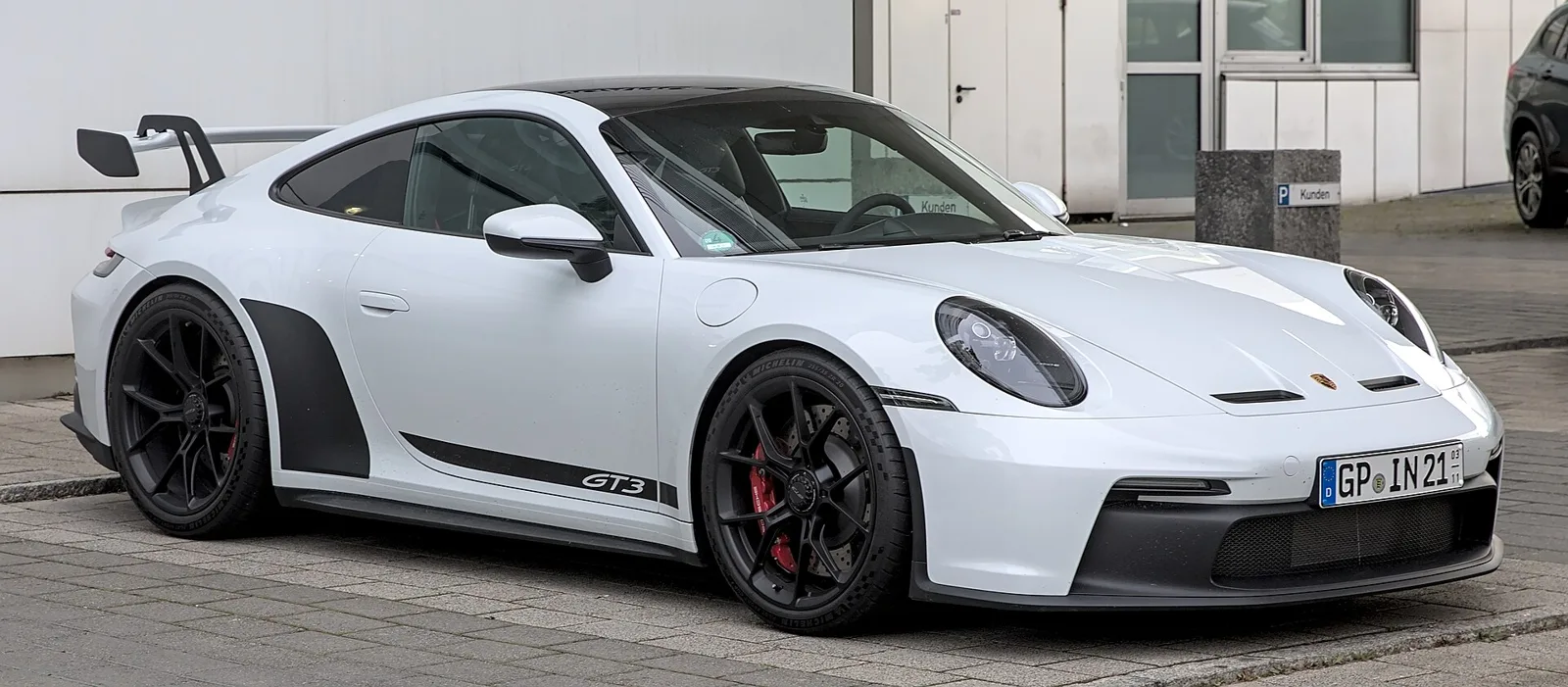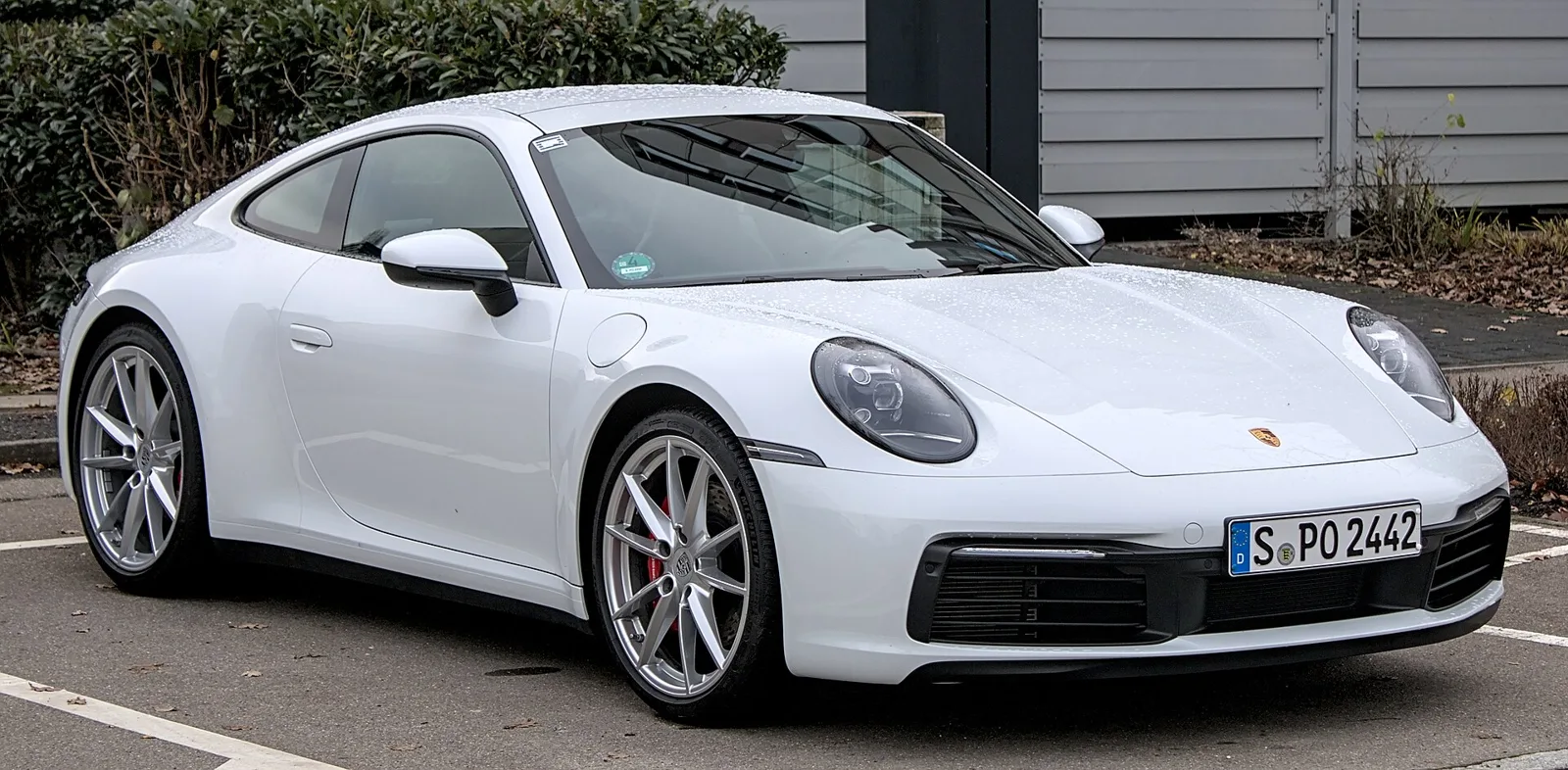
Wider bodywork, aluminium panels and a run of special editions carried the 992 from its 2018 debut to hybrid GTS and Turbo S models, with GT3 and off-road spin-offs along the way.
The Porsche 992 is the eighth-generation 911, introduced in November 2018 and revised for the 2025 model year. It spans everything from 3.0-litre Carreras to hybrid Turbo S and GTS models, with GT3 and off-road variants along the way. Its wide body and aluminium panels set it apart from the car it replaced.
The Porsche 992 is the eighth generation of the 911 sports car and the one that carried the model into the hybrid era. It was revealed in late 2018 and spent the following years expanding into coupes, cabriolets, Targas, Turbo, GT3 and off-road variants. Its range stretched from a 3.0-litre Carrera to a hybrid Turbo S with 711 PS.
What is the Porsche 992?
The 992 is the eighth-generation 911, unveiled at a launch event in Los Angeles on 27 November 2018. It is 45 mm (1.8 in) wider than its predecessor and uses aluminium body panels across the range. The front was styled to echo an early 911, while the rear carries a full-length light bar on every model.
Porsche showed the first models at the 2018 LA Auto Show. The Carrera S and Carrera 4S led the launch, and the cabriolet and base Carrera followed in 2019.
One rear-engined body carried everyday Carreras, a Dakar off-roader and hybrid Turbo S models that outran their predecessors.
How is the 992 engineered underneath?
The 992 uses rack and pinion steering, with MacPherson strut suspension at the front and a rear multi-link arrangement. Wide rear-wheel arches are fitted to every model, a feature that previously appeared mainly on high-performance 911s. Wheels measure 20 inches at the front and 21 inches at the rear.
Piezo injection arrived alongside a revised intake, and some markets required particulate filters under Euro 6 rules. At launch the only gearbox was an 8-speed PDK dual-clutch unit, with manual options arriving later. The GTS came with a 7-speed manual and the GT3 with a 6-speed, and both bundled the Sport Chrono Package.
What changed inside and out?
The interior was reworked with a straighter dashboard that recalls the classic 911 layout. The instrument cluster carries two 7-inch digital displays alongside an analogue tachometer, which is a deliberate nod to older cars.
Outside, the 992 gained electric pop-out door handles and LED headlights. A retractable rear spoiler was fitted to specific models only, and the rear bumper received larger exhaust tips than before.
What equipment came as standard?
Fitted as standard were a 10.9-inch screen running Porsche Communication Management and navigation, the 8-speed PDK gearbox, and driver-assistance kit that includes collision detection and braking intervention. Buyers could add adaptive cruise control, night vision and a sports suspension that sits the car 10 mm (0.4 in) lower.
A Wet Mode feature uses acoustic sensors in the wheel wells to detect wet pavement. It then tunes the stability control, rear wing angle and gearbox response. The Sport Chrono package adds an overboost function that provides extra performance for 20 seconds and trims 0.2 second from the 0-100 km/h time.
How did the first phase, 992.1, begin?
The 992.1 phase opened with the Carrera S and Carrera 4S, which share a 3.0-litre engine with two turbochargers and six boxer cylinders. Cabriolets of those two came in January 2019, and the base Carrera and Carrera 4 reached showrooms in July 2019.
Limited editions came quickly. A Carrera 4S Ben Pon Jr. Edition appeared in 2019 with Fish Silver Grey paint and only 20 units. In 2020 a Carrera 4S Belgian Legend Edition marked Jacky Ickx's 75th birthday, painted in X Blue, with an X-shaped stitch pattern and his signature on the armrest. The run totalled 75 cars.
What did the Targa 4 and Targa 4S bring?
The Targa body style first appeared in a 9:11 Magazine web-TV broadcast on 18 May 2020. Targa 4 models use the all-wheel-drive layout of the Carrera 4, while Targa 4S versions can be ordered with PDK or the optional seven-speed manual.
The Targa 4 produces 283 kW (380 hp) and 450 N m of torque. That is 11 kW (15 hp) more than its predecessor. The Targa 4S is rated at 331 kW (444 hp) and 530 N m, 22 kW (30 hp) up on the old car. The 4 runs 330 mm (13.0 in) discs and the 4S 350 mm (13.8 in) units, while PASM is standard on both.
Why did the GTS models matter?
In 2021 the GTS line grew to include the Targa 4 GTS, the Carrera GTS and the Carrera 4 GTS, with a twin-turbocharged 3.0-litre flat-six in the coupes. It produced 480 PS (473 hp; 353 kW) and 651 N m of torque. The Targa used the same engine at 2.9 litres.
Compared with the earlier cars, the GTS offered an Aerokit that swapped the retractable spoiler for a fixed wing and spoiler. The year 2022 also brought a 911 Edition 50 Years Porsche Design based on the Targa 4 GTS, with exclusive side stickers and a Porsche Design clock. Production was limited to 750 units, and each car came with a matching timepiece.
How fast was the 992 Turbo S?
The Turbo S arrived in March 2020 with a twin-turbocharged 3.7-litre flat-six rated at 478 kW (641 hp) and 800 N m. It reached 62 mph (100 km/h) in 2.7 seconds and 124 mph (200 km/h) in 8 seconds, topping out at 330 km/h (205 mph). A Sport Auto test on 30 January 2021 recorded a Nurburgring lap of 7:17.3 minutes, the quickest by a road-legal production car without semi-slick tyres.
The Turbo S added active suspension management, rear-axle steering and ceramic composite brakes as standard. Its rear wing generates 15 percent more downforce than the outgoing model.
How did the Turbo differ from the Turbo S?
The Turbo arrived in July 2020 with the same 3.7-litre twin-turbo flat-six, detuned to 427 kW (572 hp) and 750 N m using a slightly smaller compressor wheel and altered mapping. It came with four square exhaust tips, cast-iron discs with red calipers, and wheels with five lugs. Nearly all Turbo S options were available for it as well.
In 2024 Porsche marked 50 years of the 911 Turbo with the Turbo 50. 1,974 units were built, a figure chosen to echo 1974, the year the original 911 Turbo debuted. Tartan-patterned trim recalled the interior of Ferry Porsche's own 1974 Turbo.
What made the GT3 a track car?
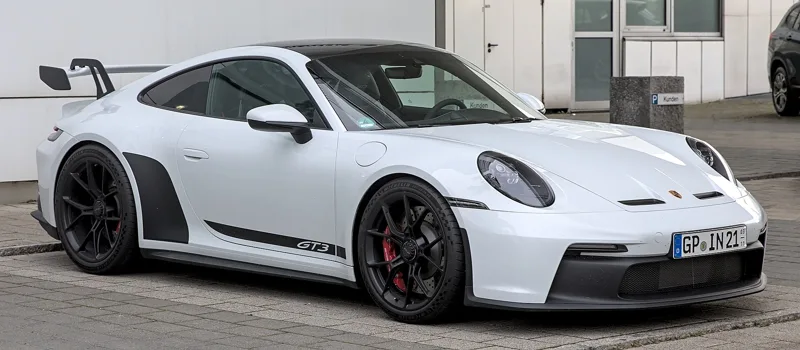
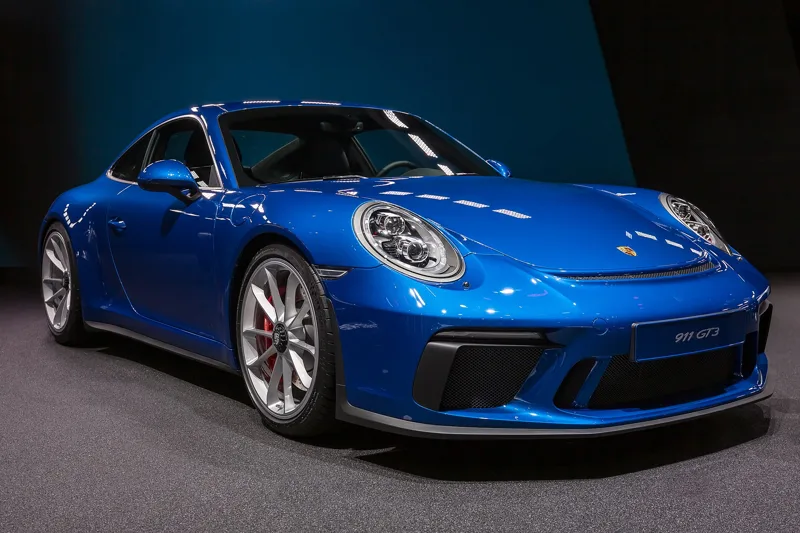
The GT3 version arrived in February 2021 with the 4.0-litre naturally aspirated flat-six from the 991.2, making more than 510 PS (375 kW; 503 hp). Acceleration to 100 km/h takes 3.4 seconds, and the ceiling is 320 km/h (199 mph). A large rear spoiler, bigger diffuser, bucket seats and an optional roll cage marked it out from the standard car.
Gearbox choice on the GT3 is either the seven-speed PDK or a six-speed manual, unlike the other models' gearboxes. The 992 GT3 set a Nurburgring Nordschleife lap of 6:55.34 minutes. A GT3 Touring variant was also offered, and Porsche built a 70 Years Porsche Australia edition in June 2021, of which just 25 were made.
How far did the GT3 RS go?
The 992 GT3 RS was unveiled in August 2022 as the highest-performance road-legal 911 in the line. Downforce reaches 860 kgf (8.4 kN) at 285 km/h, double the figure of the 991.2 GT3 RS, and falls to 409 kgf (4.01 kN) at 200 km/h. Its engine produces 386 kW at 8500 rpm, and it has a 9000 rpm redline.
The rear wing has a static part and an active part that opens and closes automatically or by a button on the steering wheel, inspired by the Drag Reduction System used in Formula 1. The European-spec curb weight is 1450 kg, and the car needs 3.2 seconds to reach 100 km/h and 10.6 seconds for 200 km/h. Porsche quotes a top speed of 296 km/h (184 mph).
What was the Sport Classic?
The 911 Sport Classic arrived in April 2022 with rear-wheel drive and a 7-speed manual, which was not available on the Turbo it was based on. Its 3,745 cc (3.7 L) twin-turbo flat-six makes 550 PS (542 hp; 405 kW) and 600 N m, which is 30 PS and 150 N m less than the Turbo. Porsche detuned the engine because the manual gearbox could not cope with the Turbo's output.
The Sport Classic shares the wide Turbo body but has no rear-fender intakes, using ducts in its ducktail spoiler instead, and it has a carbon fibre hood. Worldwide production was limited to 1,250 units. The previous Sport Classic, based on the 997 Carrera GTS, was limited to 250.
Was there an off-road 992?
Yes. Porsche launched the 911 Dakar at the Los Angeles Auto Show in November 2022. Its suspension sits 50 mm (2.0 in) above that of a standard 911, and the lift system adds another 30 mm (1.2 in), giving 191 mm (7.5 in) of ground clearance. Pirelli Scorpion All Terrain Plus tyres are fitted.
The Dakar borrows the 3.0-litre flat-six from the GTS. Peak torque of 569 N m arrives between 2,300 and 5,000 rpm, alongside 480 PS (473 hp; 353 kW). It is all-wheel drive only, with an 8-speed automatic, and it tops out at 149 mph (240 km/h). Production was capped at 2,500 units.
What is the 911 S/T?
The 911 S/T was revealed in August 2023 to mark the 60th anniversary of the model. It borrows the naturally aspirated 4.0-litre flat-six from the GT3 RS, which produces 386 kW (518 hp) and 465 N m at 6,300 rpm. It weighs 1,404 kilograms (3,095 lb), making it the lightest Porsche in the 992 generation.
The S/T is rear-wheel drive with a six-speed manual only. Sprint to 100 km/h takes 3.7 seconds, and it tops out at 299 km/h (186 mph). Only 1,963 units were planned, for release in 2024.
What changed with the 992.2 refresh?
A refresh for the 2025 model year, the 992.2, went on sale from 28 May 2024, starting with Carrera and Carrera GTS coupes and cabriolets. Power comes from a 3.0-litre, two-turbocharger six-cylinder boxer rated 389 hp (394 PS; 290 kW), with 450 N m of torque. Zero to 97 km/h takes 3.9 seconds, and the car reaches 295 km/h (183 mph).
The Carrera S followed in January 2025 with 473 hp (353 kW) and 530 N m. With the Sport Chrono package it reaches 100 km/h in 3.3 seconds and has a top speed of 308 km/h. The all-wheel-drive 911 4S and the Targa 4S were introduced in July 2025 with the same performance figures.
What was the Carrera GTS T-Hybrid?
The GTS T-Hybrid was the first hybrid 911 to enter full-scale production, revealed on 28 May 2024 with production starting in June that year. The newly engineered 3.6-litre turbocharged flat-six delivers 534 hp (541 PS; 398 kW) and 569 N m. The battery holds about 1.9 kWh and drives through an all-new eight-speed PDK.
The coupe and cabriolet reach 100 km/h in 3.0 seconds with a top speed of around 312 km/h (194 mph). During testing the GTS set a Nurburgring Nordschleife lap of 7:16.931 minutes, about 8.7 seconds faster than its predecessor, despite being 47 kg (104 lb) heavier.
What is the GT3 S/C?
The GT3 S/C is the open-top cabriolet version of the 992.2 GT3, introduced as a 2027 model. The 4.0-litre naturally aspirated flat-six is unchanged, giving 503 hp (510 PS; 375 kW) and 450 N m, with a 9,000 rpm redline. Acceleration to 100 km/h takes 3.9 seconds, the car tops out at 313 km/h (194 mph), and its DIN kerb weight is 1,497 kg.
The S/C is offered only with a six-speed GT Sport manual, which is about 17 kg lighter than the PDK. Lightweight parts include carbon-fibre rear anti-roll bar links and thrust panel, forged magnesium wheels and ceramic composite brakes.
How does the 2026 Turbo S differ?
The 2026 Turbo S, shown at the 2025 Munich Auto Show, uses a hybrid drivetrain and is rated at 711 PS (701 bhp; 523 kW), about 61 PS more than the fully petrol predecessor. Peak torque of 800 Nm arrives between 2,300 and 6,000 rpm. The twin-turbo 3.6-litre flat-six is paired with an 8-speed PDK.
Porsche says the car is the most powerful 911 it has ever mass-produced. The coupe reaches 100 km/h in 2.5 seconds, and the car laps the Nurburgring in 7:03.92 minutes and tops out at 322 km/h (200 mph). That is 14 seconds faster than the non-hybrid predecessor, despite the hybrid system adding 85 kg (189 lbs.).
Which 992 variants and editions stand out?
| Model | Introduced | Headline power | Headline figure |
|---|---|---|---|
| Targa 4S | 2020 | 331 kW (444 hp) | 530 N m of torque |
| Turbo S | March 2020 | 478 kW (641 hp) | 2.7 seconds to 100 km/h |
| GT3 | February 2021 | Over 510 PS (375 kW; 503 hp) | 3.4 seconds to 100 km/h |
| Sport Classic | April 2022 | 550 PS (542 hp; 405 kW) | 1,250 units worldwide |
| GT3 RS | August 2022 | 386 kW | 296 km/h (184 mph) top speed |
| 911 S/T | August 2023 | 525 PS (518 hp; 386 kW) | 1,963 units planned |
| Carrera GTS T-Hybrid | May 2024 | 541 PS (534 hp; 398 kW) | 7:16.931 minutes at the Nurburgring |
| Turbo S (2026) | Munich 2025 | 711 PS (701 bhp; 523 kW) | 322 km/h (200 mph) top speed |
Several editions were built in very small numbers. The Turbo S Embraer Duet, a collaboration with Embraer whose Phenom 300E customers could order a matching car, ran to 10 cars, while a Carrera GTS Le Mans Centenaire Edition was limited to 75 units for the French market.
What is the 992's place in the 911 story?
The 992 spans petrol and hybrid power, road cars and track machines, and it keeps the rear-engined layout that defines the 911. The range shows how one body could support a Carrera for everyday use, a Dakar for rough roads and a GT3 RS built for the Nurburgring.
The hybrid GTS and Turbo S show where the line is heading, while the S/T and Sport Classic show Porsche's continuing interest in manual gearboxes.