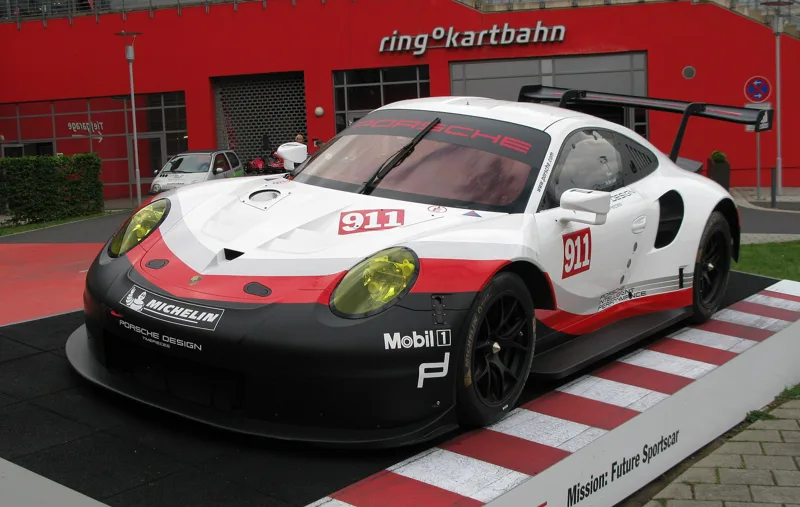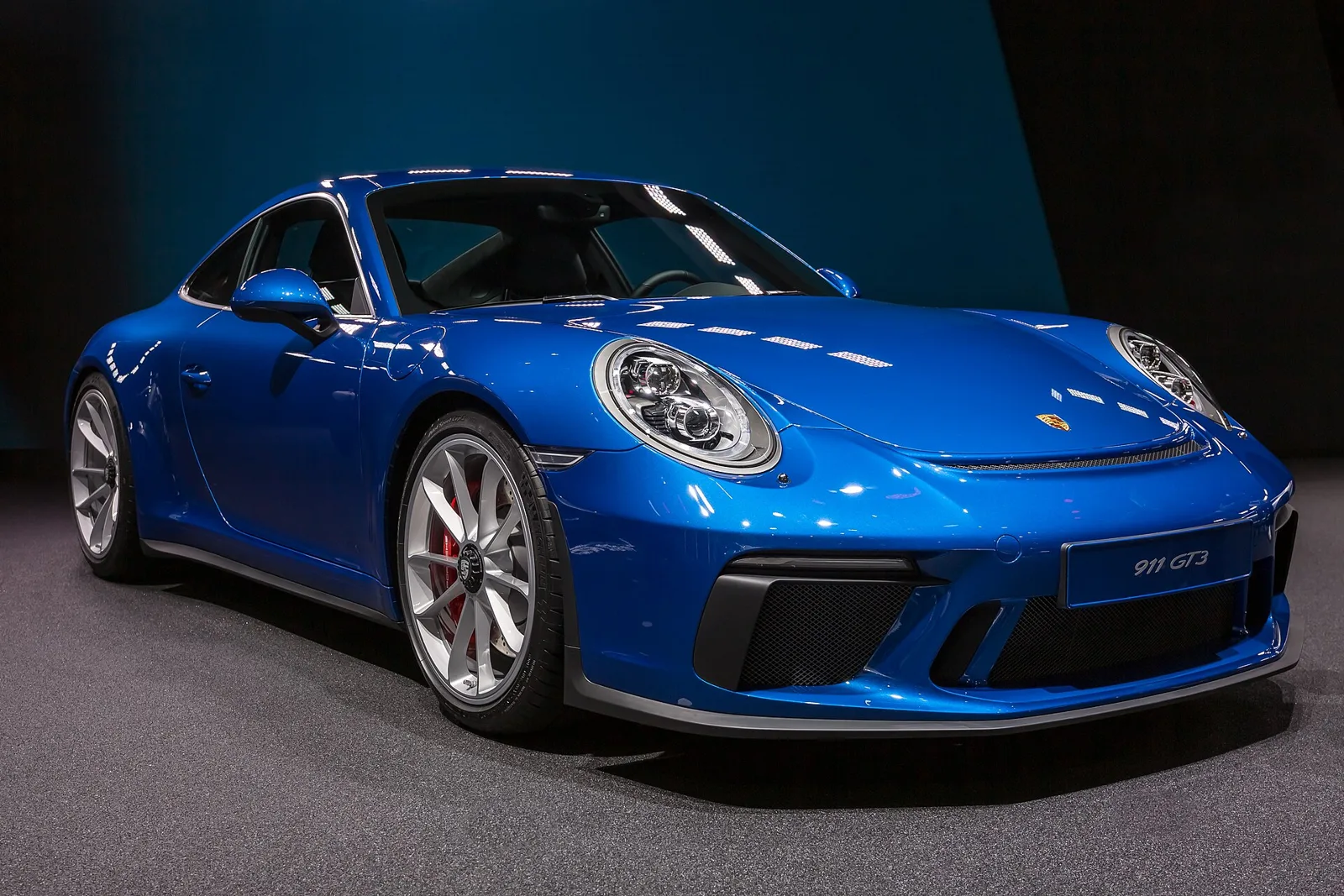
A near-series GT racer from Porsche, run in the Carrera Cup and Supercup and by private teams in endurance events, across four generations.
Porsche's racing version of the 996 GT3 went into service in 1998, and the line has since reached the 992 generation. Its one-make grids and private teams in many GT events have used the car since then, and each generation has raised output.
Porsche's 911 GT3 Cup has become the best-selling race car since production began in 1998. It is a near-series GT racer that runs in the Carrera Cup and Supercup, and private teams take its derivatives into other series.
Where did the GT3 Cup begin?
The Porsche 911 GT3 Cup is a near-series GT racing car used in the Carrera Cup and Supercup. Production began in 1998, and private teams now run its derivatives in national GT series and endurance events, where it has become the best-selling race car.
The first cars used the racing version of the new 996 GT3, whose water-cooled boxer ended the era of air-cooled boxer engines. Its dry-sump lubrication drew oil from a separate tank. Output started at 265 kW (360 PS; 355 hp) and rose to 272 kW (370 PS; 365 hp) in 1999, running on Super Plus fuel.
The launch car's adjustable rear wing produced up to 1,000 newtons of downforce. For the 2001 season a larger rear wing doubled the downforce on the rear axle, which improved road holding and reduced tyre wear. 113 cars of that version were produced.
In 2002 the car adopted the teardrop headlamps of the Turbo models, and a new front section improved cooling airflow by 15%. A rear wing adjustable in seven steps reduced lift, and lighter doors, windscreen and mirrors kept the weight constant. The engine took the control software of the 996 GT3 RS, lifting output to 279 kW (380 PS; 374 hp) and torque to 380 Nm (280 lb ft).
By 2004 the car weighed 1,150 kg (2,535 lb), helped by carbon fibre reinforced plastic for the rear cover, bonnet and doors, and by plastic for every window except the windscreen. The fuel tank grew from 64 to 89 litres for endurance racing. In total, 873 Cup versions of the 996 GT were built.
The long straights of the Hockenheimring were no longer part of the calendar, so gears four to six were geared shorter. An infinitely adjustable suspension allowed fine tuning for each track. The cabin ventilation was also improved, and for safety the roll cage was padded so the HANS system could be used.
Each generation raised the output, from 265 kW at the 1998 launch to 375 kW in the 992 cars.
How did the 997 GT3 Cup change?
The 997 Cup debuted in the Supercup in 2005 and joined the Carrera Cup from 2006. Its downforce rose by about 40% over the predecessor, while its weight stayed at 1,150 kg (2,535 lb) through heavier use of CFRP parts.
The 2005 car produced 294 kW (400 PS; 394 hp) at 7,300 rpm, with torque of 400 Nm (295 lb ft) arriving at 6,500 rpm. A sequential six-speed gearbox with a power interruption replaced the earlier unit. Ceramic brake discs were used, but there was no anti-lock braking, because GT series rules did not allow it.
The 2008 revision raised output to 309 kW (420 PS; 414 hp), with 420 Nm (310 lb ft) of torque. That year the 997 GT3 Cup S also arrived, built to GT3 rules for international championships, with 324 kW (440 PS; 434 hp) at 8,000 rpm and 430 Nm (317 lb ft) at 7,250 rpm.
The 997 generation totalled 1,485 examples. The 2010 Cup was based on the GT3 RS introduced in 2009, and it used the 3.8-litre engine of the road model, giving 331 kW (450 PS; 444 hp).
For 2010 the factory also intended to supply the new car to national Carrera Cup grids in Germany, Asia, Japan and Italy. Customer teams took it into GT3 Cup Challenges in the USA and the Middle East as well.
Alongside that Cup development, the successor to the Cup S, the 997 GT3 R, was presented in January 2010. Unlike the 996 GT3 R, which had been a Group GT2 car, it followed the GT3 rules, like the Cup S before it.
What did the 991 and 992 generations bring?
The 991 GT3 Cup, presented in December 2012, was the first race car built on the seventh generation of the 911. It used a 3.8-litre six-cylinder boxer with 338 kW (460 PS; 453 hp) and a six-speed dog-clutch gearbox operated by paddles on the steering wheel.
Porsche fitted one-piece 18-inch racing wheels with central locking. Michelin slicks grew to 27 cm wide at the front and 31 cm at the rear, and the 38 cm brake discs were gripped by six-piston aluminium calipers at the front.
Driver safety received particular attention. The roll cage and the racing bucket seat were newly designed, and a roof hatch lets track marshals reach a driver after an accident. Works driver Timo Bernhard said the car was much easier to drive at the limit. He also credited the new axle geometry with a very positive effect on handling, and called the car simply fun to drive.
The 992 generation, which has been on sale since 2019, received GT3 Cup versions from 2021. Its body is 70% aluminium, it is 40 mm wider than the 991, and its 4.0-litre naturally aspirated boxer six reaches a maximum of 8,750 rpm. Porsche has also tested the 992 on an E-fuel blend, aiming to reduce CO2 emissions.
Porsche 911 GT3 Cup specifications
| Generation | Engine | Output | Notes |
|---|---|---|---|
| 996 GT3 Cup (1998) | Water-cooled boxer six, dry sump | 265 kW (360 PS; 355 hp), 272 kW (370 PS; 365 hp) from 1999 | Super Plus fuel; top speed 286 km/h (178 mph) |
| 996 GT3 Cup (2002) | Boxer six with GT3 RS engine control | 279 kW (380 PS; 374 hp); 380 Nm (280 lb ft) | Weight held constant |
| 996 GT3 Cup (2004) | Boxer six | 287 kW (390 PS; 385 hp) at 7,200 rpm | 1,150 kg (2,535 lb); 89-litre tank |
| 997 GT3 Cup (2005) | Boxer six | 294 kW (400 PS; 394 hp) at 7,300 rpm | Sequential six-speed gearbox |
| 997 GT3 Cup (2008) | Boxer six | 309 kW (420 PS; 414 hp); 420 Nm (310 lb ft) | Revised Cup |
| 997 GT3 Cup S (2008) | Boxer six | 324 kW (440 PS; 434 hp) at 8,000 rpm | 430 Nm (317 lb ft) at 7,250 rpm |
| 997 GT3 Cup (2010) | 3.8-litre boxer six | 331 kW (450 PS; 444 hp) | Based on the GT3 RS |
| 991 GT3 Cup (2013) | 3.8-litre boxer six | 338 kW (460 PS; 453 hp) at 7,500 rpm | Six-speed dog-clutch gearbox |
| 992 GT3 Cup (2021) | 4.0-litre naturally aspirated boxer six | 375 kW (510 PS; 503 hp) | Maximum 8,750 rpm |
Where do GT3 Cups race beyond the brand cups?
Porsche 911 GT3 Cups that once ran in the Carrera Cup and Supercup spread into national GT series and club events, because they combine competitiveness with a comparatively low price. Many teams start on them in the Nurburgring endurance races.
The Nurburgring endurance series and the 24-hour race regularly field a double-digit number of GT3 Cups. Guest entries have also run one in the 24-hour race at Spa-Francorchamps in recent years, and the FIA GT3 European Championship and ADAC GT Masters, which use GT3 regulations, have them too.
Porsche's 911 GT3 Cup S, built specially for endurance racing to GT3 regulations, has been available since 2008.
What was the 997 GT3 R Hybrid?
The 997 GT3 R Hybrid stored its energy in a flywheel rather than a battery. Two 60 kW electric motors acted as generators under braking and fed a flywheel spinning at up to 40,000 rpm. The system was presented at the Geneva Motor Show.
Under acceleration the flywheel's motor became a generator, slowing the flywheel and delivering six to eight seconds of extra electric thrust. The racing debut came in the VLN Nurburgring endurance series on 27 March 2010.
In the 24-hour race at the Nurburgring the hybrid led for 22 hours before a technical fault ended its run. The oil pump for the dry-sump lubrication failed, and the engine failed.
What record did Jeff Zwart set?
In 2010 the American Jeff Zwart set a new Time Attack 2WD record at the Pikes Peak International Hill Climb in a Porsche 997 GT3 Cup, recording 11:31.095 minutes. He returned in 2014 with a turbocharged 997 GT2 engine variant in place of the Cup engine, because of the heavy loss of power at altitude.