How Porsche's dual-hybrid V4 prototype went from a 2011 decision to back-to-back World Endurance titles, a 2015 Le Mans win and an Evo that broke Nurburgring records.
A two-litre V4 hybrid LMP1 from Porsche, the 919 raced in the WEC from 2014 to 2017 and took three straight Le Mans overall victories. A later evolution, the 919 Evo, was not built for competition, but it set Nurburgring records in 2018.
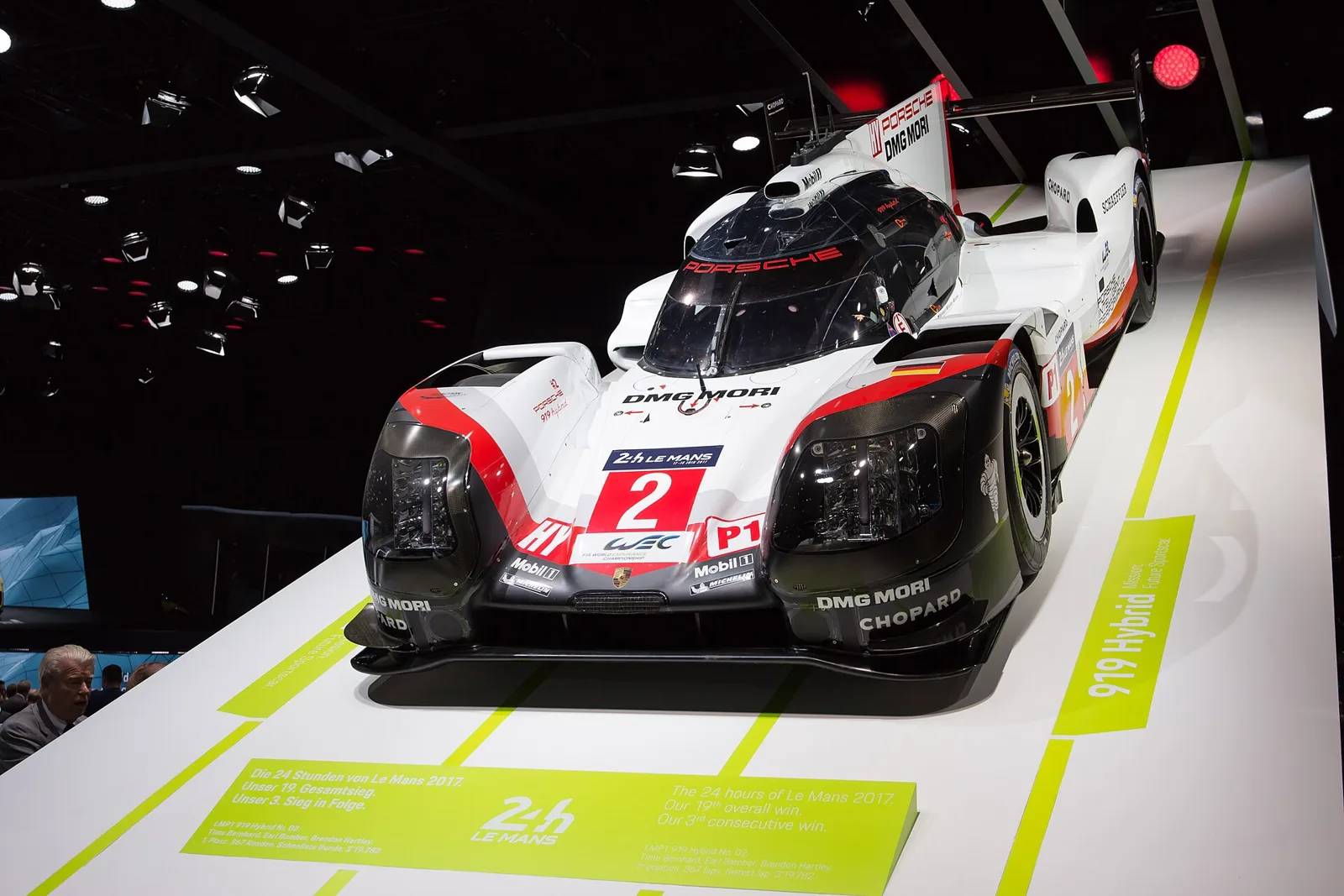
The Porsche 919 Hybrid was a Le Mans Prototype 1 racer with two hybrid energy-recovery systems. Porsche used it in the FIA World Endurance Championship from 2014 to 2017, and it won the 24 Hours of Le Mans in 2015, 2016 and 2017. Its engine was a two-litre V4 that also served as part of the chassis.
Why did Porsche build the 919 Hybrid?
Porsche decided in mid-May 2011 to compete as a works team in the Le Mans Prototype 1 class of the World Endurance Championship, which began in 2012. Two months later the company announced its plans and said the car would debut in 2014.
The programme grew quickly, and the Porsche Motorsport Centre in Weissach expanded to 200 full-time employees working on the project.
Porsche brought in Fritz Enzinger from BMW in late 2011 as vice-president of LMP1, and he oversaw the organisation of the car's construction. At the end of that year Alex Hitzinger, a former head of F1 development at Cosworth and later head of advanced technologies at Red Bull Racing, joined to oversee the technical design.
The name acknowledged Porsche's move into hybrid technology and honoured its tradition of similarly named cars at Le Mans. The 919 was Porsche's first sports car prototype since the RS Spyder of 2005, and its first prototype in the top category since the 1998 911 GT1-98 and LMP1-98. A total of nine chassis were built.
A two-litre V4 with two hybrid systems took Porsche to three Le Mans wins and two straight World Endurance titles.
How was the 919 Hybrid designed?
The 919 Hybrid's monocoque was finalised at the end of 2012, when Porsche wanted it ready for testing in June 2013. It was designed for maximum efficiency while meeting the 2014 rules on driver visibility, which required a raised cockpit. The developers were new to LMP1, but they drew on the 911 GT3 R Hybrid and the 918 Spyder.
The 2014 regulations capped the car at 4,650 mm (183 in) long and 1,050 mm (41 in) tall, with a maximum width of around 1,800 mm (71 in) to 1,900 mm (75 in). The chassis was a carbon fibre and honeycomb aluminium design, and Porsche spent 2,000 hours in wind tunnels at Weissach and the University of Stuttgart refining its aerodynamics. The car's maximum weight was reduced to 870 kg (1,920 lb) for the class.
The independent multi-link suspension used pushrods and adjustable dampers, and the car ran 360 mm (14 in) Michelin tyres. The car had traction control, a hydraulically operated paddle-shift seven-speed sequential gearbox and carbon ceramic brakes. For night driving, Porsche designed two four-point LED headlights on each side of the car.
What made the hybrid system work?
The engine was a two-litre 90-degree V4 with a single Garrett turbocharger, mounted in the middle of the car and running to 9,000 rpm. It produced about 500 hp (370 kW) and acted as a load-bearing part of the chassis.
Because the engine was small, the transmission casing was fixed to the rear suspension and made up almost a third of the car's length.
The car had two energy-recovery systems. At the rear, a two-turbine generator recovered heat energy from the exhaust gases. At the front, a 185 kW (248 hp) motor-generator on the front axle converted kinetic energy into electricity under braking. That energy was stored in water-cooled lithium-ion battery packs from A123 Systems and removed turbo lag.
Under acceleration the front motor-generator worked as an electric motor, which made the car temporarily four-wheel drive. The extra 400 hp (300 kW) at the front brought the total to 1,000 hp (750 kW). Porsche chose the 6 MJ (1.7 kWh) category for 2014, although it had designed the system to run in the 8 MJ class.
How did the 919 Hybrid start in 2014?
Porsche named its first two drivers in April 2013. Timo Bernhard and Romain Dumas were chosen for their experience in LMP racing, and Neel Jani and Mark Webber joined in the summer. Brendon Hartley and Marc Lieb completed the line-up in December 2013.
The No. 14 car held Dumas, Jani and Lieb, and the No. 20 car held Bernhard, Webber and Hartley.
The car was revealed at the Geneva Motor Show on 4 March 2014. Porsche held a two-car endurance test at Paul Ricard in late March, which covered 4,756 km (2,955 mi). Multiple technical problems stopped both cars several times in that session, but Hartley set the fastest overall lap during a Friday night session, in a low-downforce set-up.
During the 2014 season Dumas, Jani and Lieb won three pole positions, and Jani and Lieb took the first at Spa. The season ended with a win at the 6 Hours of Sao Paulo for the No. 14 car. Over the year the car scored 193 points, which gave Porsche third place in the manufacturers' championship.
| Season | Key result | Manufacturers' points and standing |
|---|---|---|
| 2014 | Three poles, a season-ending win at Sao Paulo | 193 points, third place |
| 2015 | Four wins from eight races; Le Mans overall win | 344 points, manufacturers' champion |
| 2016 | Le Mans and Silverstone wins for Dumas, Jani and Lieb | 324 points, second consecutive manufacturers' title |
| 2017 | Le Mans win after a 13-lap deficit was recovered | 337 points, third consecutive manufacturers' title |
How did the 919 Hybrid win at Le Mans in 2015?
The 2015 car was categorised in the 8 MJ class, thanks to a lighter and refined hybrid system that pushed maximum power to 294 hp (219 kW). Porsche redesigned the chassis as a single piece to save weight, cutting the overall mass from 900 kg (2,000 lb) to 870 kg (1,920 lb).
The nose-cone structure was lowered and narrowed, and the centre exhaust gave way to a symmetrical twin-pipe layout.
The car started testing at Weissach in December 2014 and was then tested in the Middle East and Spain. Porsche revealed the car at the Paul Ricard pre-season test on 26 March 2015. For Le Mans it ran three liveries, with No. 17 in red to honour the 917 that gave Porsche its first overall Le Mans victory in 1970, No. 18 in black to show its link to the 918 Spyder, and No. 19 in white.
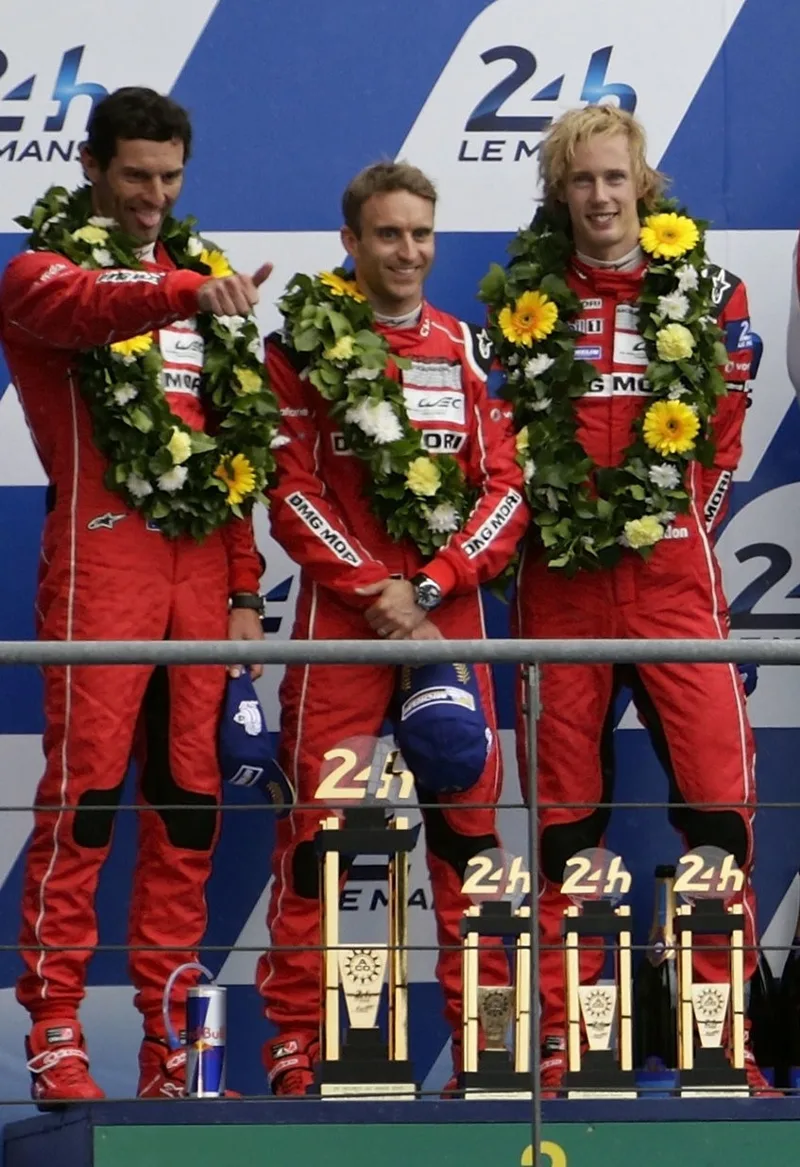
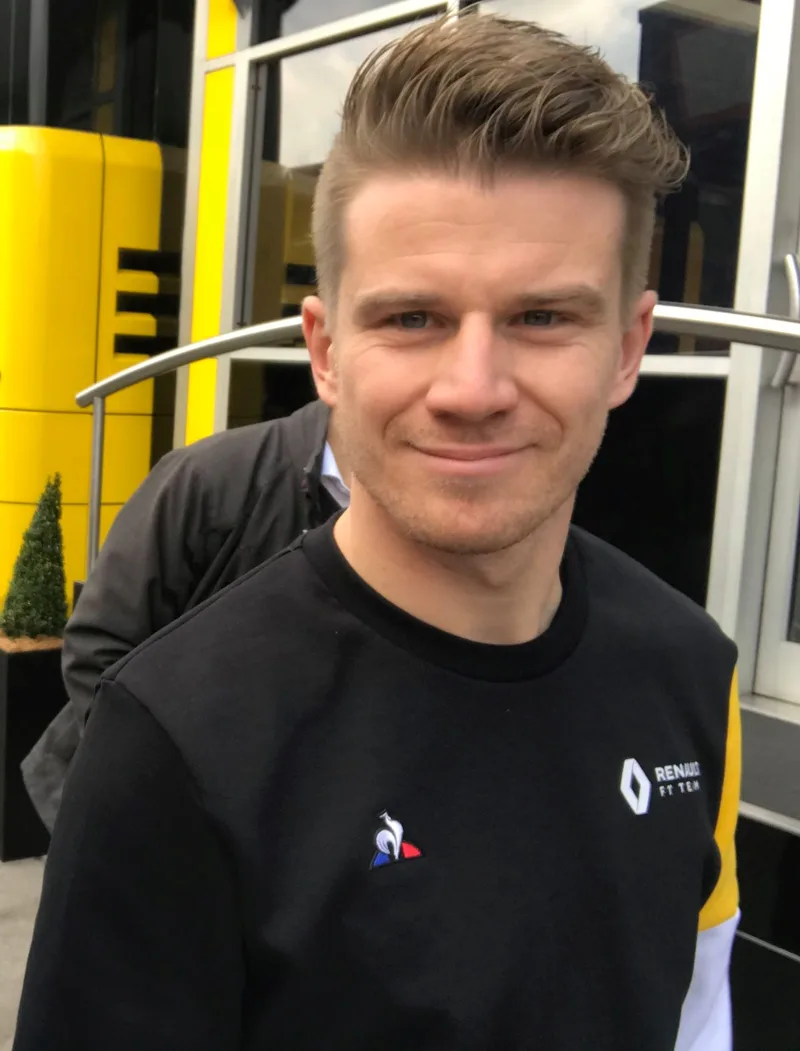
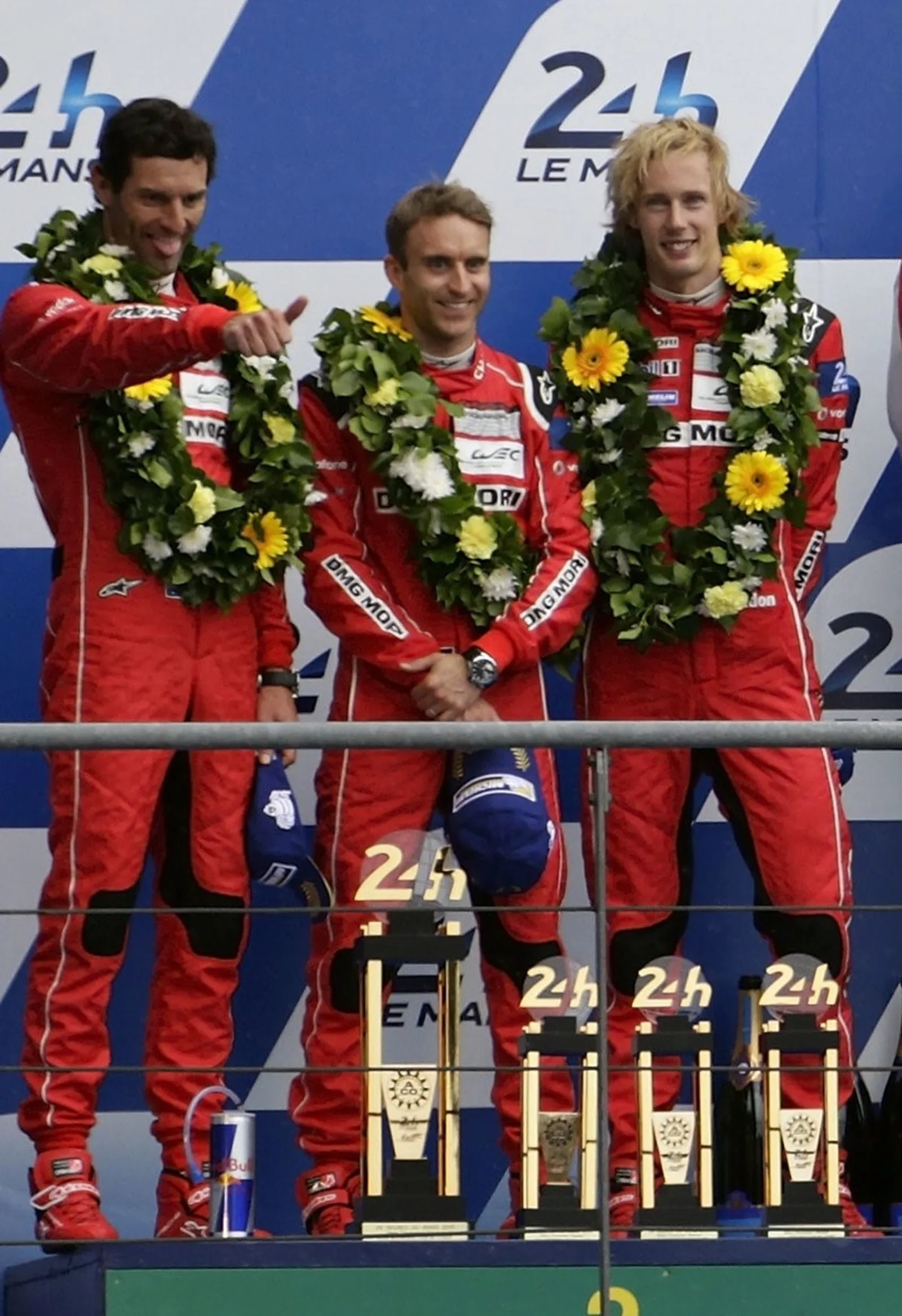
The 2015 season was a strong one. Bernhard, Hartley and Webber won four of the eight races and took the drivers' title, and Porsche won the manufacturers' championship with 344 points. A third 919 Hybrid, driven by Earl Bamber, Nico Hulkenberg and Nick Tandy, won the 24 Hours of Le Mans.
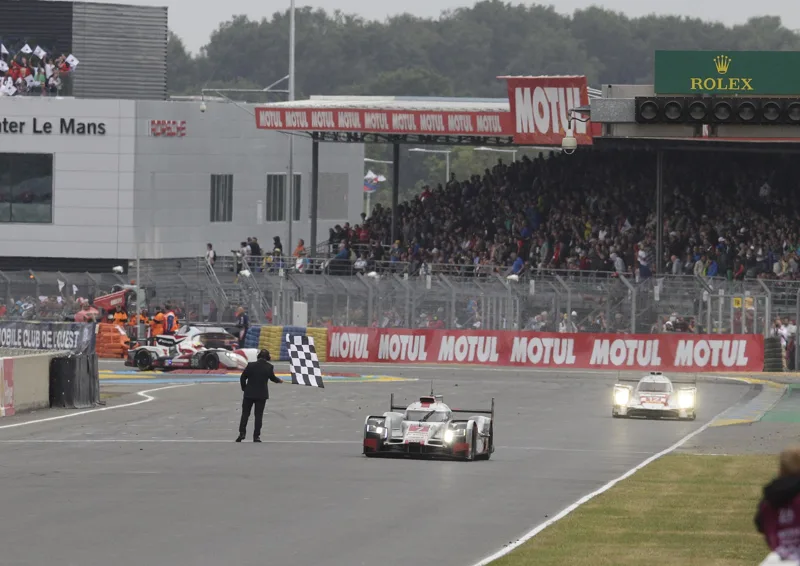
The Le Mans race was Porsche's first overall win at the event since 1998. Bamber took the lead in the middle of the 14th hour and held it to the flag. At the season-closing Bahrain round, Hartley and Bernhard's qualifying pace ensured that Porsche won every pole of 2015.
What changed for 2016 and 2017?
The 2016 car kept the carbon fibre chassis, but many components were improved for performance and weight. Its wheel rim was deeper to reduce drag, and the car used three aerodynamic packages depending on the circuit. Two high-downforce set-ups were used at Silverstone, and a low-downforce package for Spa and Le Mans.
New WEC rules cut the available energy and fuel by 8%, so The engine was lightened, and its output was raised to roughly 480 to 495 hp (358 to 369 kW). The front axle delivered more than 400 hp (300 kW) from an 800-volt battery, and the combined output reached 900 hp (670 kW). Dumas, Jani and Lieb won the 2016 Silverstone 6 Hours and Le Mans, and the team's second drivers' title came from the same trio.
For 2017 Porsche said 60 to 70% of the car was new, although the monocoque was carried over. The front was redesigned with wider wheel arches to reduce sensitivity to debris, and the cost-cutting rules limited each team to two aerodynamic packages. The exhaust turbine ran above 120,000 rpm and recovered about 60% of the braking energy through the front system.
Tandy and Lotterer replaced Dumas and Lieb in the No. 1 car, and Bamber joined Bernhard and Hartley in the No. 2. At Le Mans in 2017 the trio of Bamber, Bernhard and Hartley recovered from a 13-lap deficit to win, Porsche's 19th overall victory at the race. The car also won three more races that year, and Porsche's third consecutive World Drivers' and Manufacturers' titles were secured at the penultimate round in Shanghai.
Why did Porsche end the 919 Hybrid programme?
The 919 Hybrid programme ended after 2017. Porsche chose to concentrate on the all-electric single-seater Formula E championship, which it entered from the 2019-20 season. The company kept increasing its commitment to its global GT programmes. The car had won the manufacturers' championship in each of 2015, 2016 and 2017.
After the 2016 season a 919 Hybrid had been driven in a post-season rookie test at Bahrain by Gustavo Menezes and driver adviser Yannick Dalmas, and in 2017 Pietro Fittipaldi drove one with Bernhard in a similar test.
How fast was the 919 Evo?
Porsche revealed an evolution of the 919 Hybrid on 11 April 2018. The 919 Evo was not built for competition, so it was free of the rules and reliability limits that govern endurance racing. Fuel flow restrictions were removed, so the engine could make 720 PS (530 kW; 710 hp).
The electric motors rose to 440 PS (294 to 324 kW). Taking out air conditioning, wipers, headlights and other electrical items cut the car's weight by 39 kg (86 lb), leaving it at 849 kg (1,872 lb) dry and 888 kg (1,958 lb) with driver ballast. Aerodynamic upgrades, including an active drag-reduction system and a larger rear wing, raised downforce by 53% and aero efficiency by 66% against the 2017 Spa qualifying specification.
The Evo set the fastest unofficial lap ever at Spa-Francorchamps at that time, with Neel Jani at 1 minute, 41.77 seconds. That was more than 12 seconds quicker than the 2017 pole lap of 1 minute, 54.097 seconds. On the Kemmel Straight the car's speed trap read 359 km/h (223.1 mph).
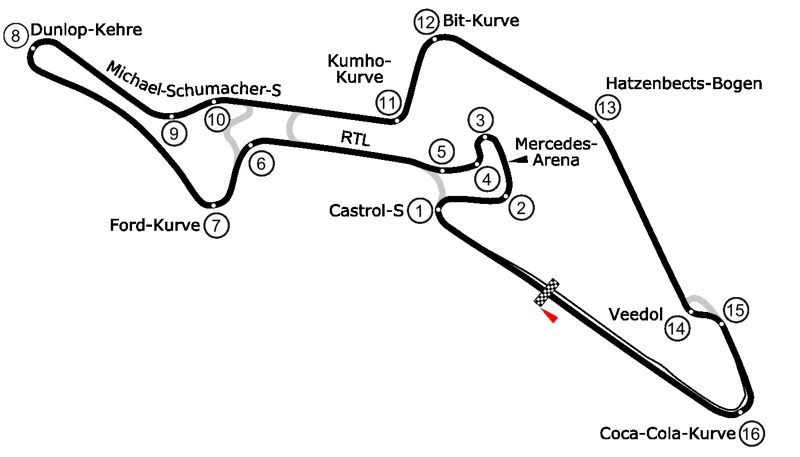
In June 2018 Timo Bernhard took the Evo around the Nurburgring Nordschleife in 5 minutes, 19.546 seconds. That broke the record set in May 1983 by Stefan Bellof in a Porsche 956, which had stood at 6 minutes, 11.13 seconds. The Evo also took part in demonstration runs, including the 919 Tribute Tour, and it appeared at Goodwood and Laguna Seca.