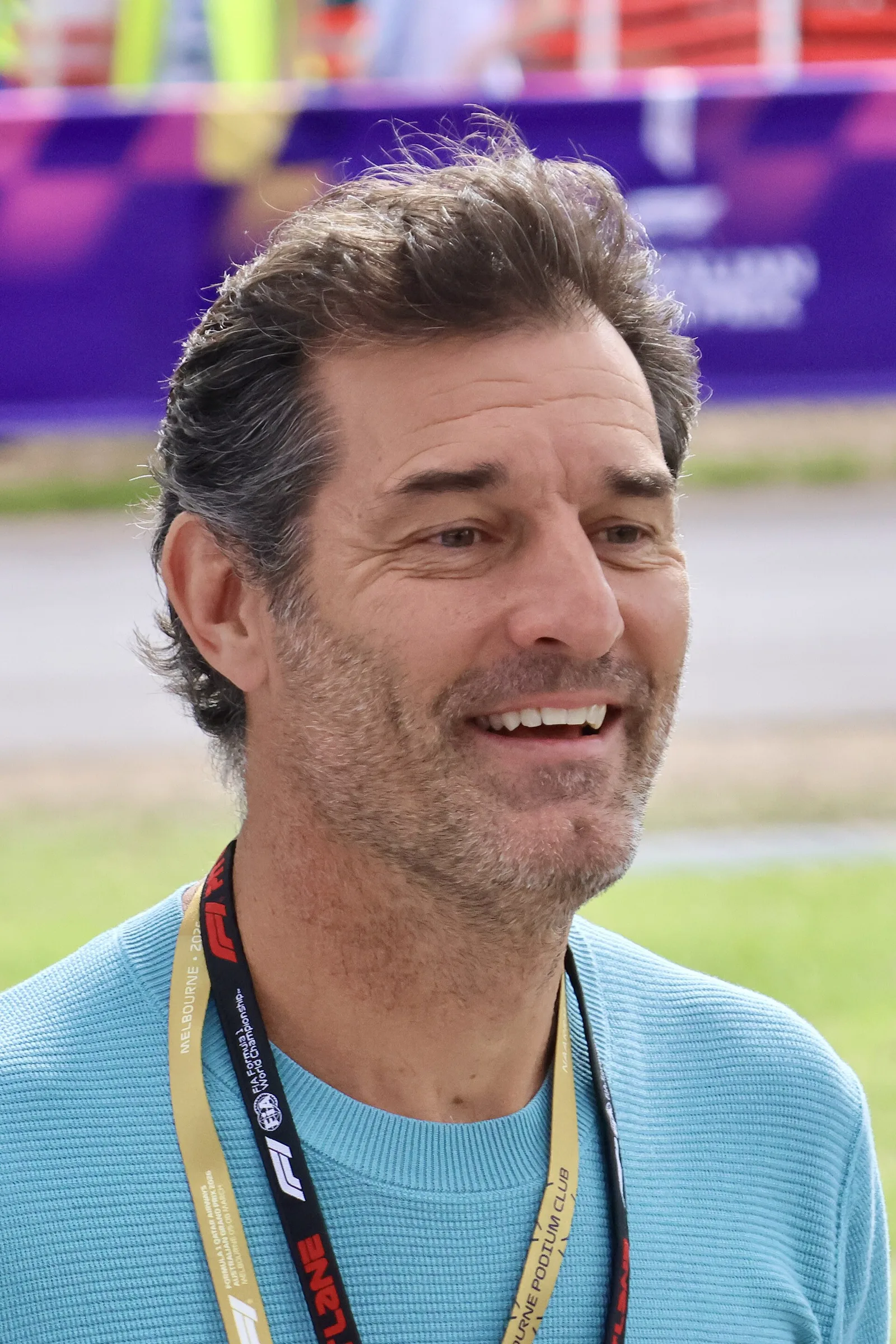
Nine Formula One wins, three third places in the championship, a 2015 World Endurance title with Porsche and a long run of television work since 2016.
Mark Webber, from Australia, raced in Formula One between 2002 and 2013. Nine Grands Prix wins and three third-place championship finishes marked his career with Red Bull. He later won the FIA World Endurance Drivers' Championship with Porsche in 2015 and became a respected broadcaster.
Mark Webber is an Australian former racing driver who spent twelve seasons in Formula One, from 2002 to 2013. He won nine Grands Prix and finished third in the world championship in three different years. After leaving the cockpit he won the FIA World Endurance title with Porsche in 2015 and built a second career as a broadcaster.
Who is Mark Webber?
Mark Alan Webber was born on 27 August 1976 in Queanbeyan, New South Wales, near Canberra. He began karting as a teenager and moved into car racing through the Australian Formula Ford Championship. He later raced in British Formula 3 and became one of Australia's best-known drivers.
Webber was known for his determination and for a straight-talking approach that made him a favourite with many fans. Those qualities helped him through the tough years at Minardi and Jaguar and into the front ranks of Red Bull.
Nine Grands Prix, three third places in the championship and a World Endurance title with Porsche in 2015.
How did Webber get into racing?
Webber began karting at twelve or thirteen and won the 1992 Australian Capital Territory and New South Wales state championships. In 1993 he added the Canberra Cup and the New South Wales Junior National Heavy Championship. His father worked long hours to fund the karting.
In 1994 he made his car racing debut in the Australian Formula Ford Championship, driving a car that had been won by Craig Lowndes the previous year. A third place at Phillip Island was his best result of that season. In 1995 he finished fourth overall in the series with three victories, then moved to England. He finished second in the 1996 British Formula Ford Championship and won the Formula Ford Festival in 1995.
In 1997 he joined Alan Docking Racing for the British Formula 3 Championship. He finished fourth overall with 131 points, won the Brands Hatch Grand Prix event and was voted Rookie of the Year. He also finished fourth in the Macau Grand Prix that year.
How did sports car racing shape Webber's path?
In 1998 Webber raced for the AMG Mercedes team in the FIA GT Championship, alongside the touring car driver Bernd Schneider. The pair won five races and took eight podium finishes, but Webber finished runner-up to teammates Klaus Ludwig and Ricardo Zonta after a title battle that lasted to the final round.
His first Le Mans start in 1998 ended after 75 minutes with a steering pump fault that caused an engine failure. In 1999 he was forced out of the race after an aerodynamic fault sent his car airborne on the Mulsanne Straight during warm-up. Later that year he moved into International Formula 3000 with Paul Stoddart's team.
His 2000 season in International Formula 3000 gave him a third place in the championship with 21 points and a win at Silverstone. In 2001 he joined Super Nova Racing as the title favourite. He won at Imola, Monaco and Magny-Cours, but four consecutive retirements in the final rounds cost him the title, and he finished runner-up to Justin Wilson with 39 points.
What was Webber's Formula One debut like?
Webber made his Formula One debut with Minardi in 2002, replacing Fernando Alonso for the first three races. He qualified 18th for the Australian Grand Prix and finished fifth, a strong result from a car he described as underdeveloped. Minardi kept him for the rest of the season.
The season was not always smooth. At the Spanish Grand Prix he and teammate Alex Yoong were withdrawn after three wing failures in practice. His best result for the rest of the year was eighth at the French Grand Prix, and he finished 16th in the championship with two points.
Why did Webber move from Jaguar to Williams?
Webber moved to Jaguar in November 2002, replacing Eddie Irvine. The Jaguar R4 was unreliable, but in 2003 he qualified third at the Brazilian Grand Prix before a crash in the rain-affected race. He scored points seven times that year, with three sixth places, and finished tenth with 17 points.
In 2004 he contributed to the development of the Jaguar R5 and finished 13th with seven points, including a second place at the Malaysian Grand Prix. He used a performance clause to leave Jaguar for Williams in 2005, and at Monaco he finished third for his first Formula One podium. He was tenth in the championship with 36 points.
His 2006 season at Williams was less successful. He finished 14th with seven points, and his best results were two sixth places, in Bahrain and San Marino. He had grown frustrated with the team's management, and by the end of the year he was ready to move on.
How did Webber's Red Bull years begin?
Webber joined Red Bull in 2007, partnering David Coulthard. The RB3 was quick but unreliable, and he retired seven times in the season. He finished seventh in the United States, then took a third place at the European Grand Prix, his second career podium. He finished 12th overall with ten points.
In 2008 Webber was again partnered by Coulthard, and the RB4 was more reliable. He scored points in nine of the 18 rounds and finished fourth at Monaco, but Red Bull's focus shifted to the 2009 regulation changes and his points dried up. He ended the year 11th with 21 points.
In 2009 he was joined by Sebastian Vettel, who had been promoted from Toro Rosso. Webber scored points in seven of the first eight races, and three podiums briefly made him a title contender. At the German Grand Prix he overcame a drive-through penalty for a first-lap collision with Rubens Barrichello to win from his maiden pole position, his first Grand Prix victory.
He took his second victory at the Brazilian Grand Prix, the penultimate round, and finished fourth overall with 69.5 points. The first Australian winner since the 1981 Caesars Palace Grand Prix was Alan Jones, and Webber was the next.
How close did Webber come to the title in 2010?
In 2010 Webber was third in the championship with 242 points. He won four Grands Prix and took three pole positions, and he led the championship at various points in the season. Going into the Abu Dhabi finale he was eight points behind Fernando Alonso and needed to win while Alonso finished third or lower.
He finished eighth at Abu Dhabi, where Vettel won and Alonso came seventh. Webber was angry afterwards, because he believed the team had devalued his achievements. A collision with Vettel in a duel for the lead at the Turkish Grand Prix had already strained relations with the team adviser Helmut Marko, who blamed Webber for the crash.
What did Webber achieve in 2011 and 2012?
Webber scored a career-high 258 points in 2011 and finished third overall after winning the Brazilian Grand Prix. He took consecutive poles at the British and German Grands Prix. Team owner Dietrich Mateschitz had directed that both drivers should race each other.
In 2012 the RB8 was less dominant, and Webber finished sixth with 179 points. He won the Monaco Grand Prix from pole position and the British Grand Prix, where he passed Alonso with eight laps to go. He took two more podiums later in the year, in Korea and India.
Why did Webber retire from Formula One after 2013?
Webber had promised Horner and Mateschitz he would stay at Red Bull until his Formula One career ended. He turned down a Ferrari offer to replace Felipe Massa for a year, feeling it would be inappropriate to switch teams. He decided to retire after 2013 to spend more time with his family.
The 2013 season was tense. At Malaysia, Vettel ignored a team order and passed Webber to win, which strained their relationship. Webber finished third overall with 199 points, took eight podium finishes and won no races. He called time on his Formula One career at the end of the season.
What did Webber win in endurance racing?
Webber joined Porsche's sports car programme in 2013, seeking fewer races and less attention. He shared the No. 20 Porsche 919 Hybrid with Timo Bernhard and Brendon Hartley in the World Endurance Championship. In 2014 he finished ninth in the drivers' standings with 64.5 points.
The season-ending race at Sao Paulo ended badly. Late in the race a car hit the rear of his Porsche and sent him into a concrete barrier, leaving him with a lung contusion and a concussion. He recovered and returned in 2015.
In 2015 Porsche renumbered the car as No. 17, and the crew won four consecutive races before the final round in Bahrain. They needed a third place to take the title, and they finished fifth and claimed the championship with 166 points, five ahead of Audi's Marcel Fassler, Andre Lotterer and Benoit Treluyer. Webber's teammates were Bernhard and Hartley.
In 2016 the crew finished fourth in the championship with 134.5 points. Webber decided to retire from motor racing at the end of that season. He kept the decision quiet until he reached Japan, citing Porsche's reduced commitment to the LMP1 programme.
What has Webber done since leaving motor racing?
Webber has been a television pundit since 2016. He provides Formula One analysis for Channel 4 in Britain and has covered the Australian Grand Prix for Channel 10. He also works as a driver manager, and he has mentored Oscar Piastri since early 2020 through his JAM Sports Management company.
He has written for Autosport, the BBC and The Sydney Daily Telegraph. He published the book Up Front in 2010 and an autobiography, Aussie Grit: My Formula One Journey, in 2015. In 2017 he was appointed Officer of the Order of Australia for services to motor sport and to the community.
How did Webber's driving style compare with his rivals?
Journalist Mark Hughes described Webber as someone who extracted more potential from the car than almost anyone through fast, aerodynamically loaded corners. Webber could feel the braking grip of his tyres and could modulate throttle and brake pressure to stay within the limit of the tyre.
That style was shaped in downforce-heavy sports cars in the late 1990s. It was less suited to the Pirelli tyres in the V8 era, which wore out faster than the Bridgestones he had used before, and he had to adapt to a new way of managing them.
What do Webber's Formula One numbers look like?
Webber won nine Grands Prix and took 13 pole positions across his Formula One career. He finished third in the championship in 2010, 2011 and 2013, and his best full season was 2011, when he scored 258 points. The table below lists each season with a recorded finish and points total.
| Season | Team | Championship position | Points |
|---|---|---|---|
| 2002 | Minardi | 16th | 2 |
| 2003 | Jaguar | 10th | 17 |
| 2004 | Jaguar | 13th | 7 |
| 2005 | Williams | 10th | 36 |
| 2006 | Williams | 14th | 7 |
| 2007 | Red Bull | 12th | 10 |
| 2008 | Red Bull | 11th | 21 |
| 2009 | Red Bull | 4th | 69.5 |
| 2010 | Red Bull | 3rd | 242 |
| 2011 | Red Bull | 3rd | 258 |
| 2012 | Red Bull | 6th | 179 |
| 2013 | Red Bull | 3rd | 199 |
How is Webber remembered?
Webber is remembered as one of Australia's most successful racing drivers, a man with a straight-talking manner and a fierce competitive streak. He was named Aussie Grit for his determination in the face of adversity, and his career brought him several Australian and international honours.
In 2018 he was added to the Australian Motor Sport Hall of Fame, and in 2019 to the FIA Hall of Fame. He was inducted into the Sport Australia Hall of Fame in 2022, and he received the Peter Brock Medal in 2017.