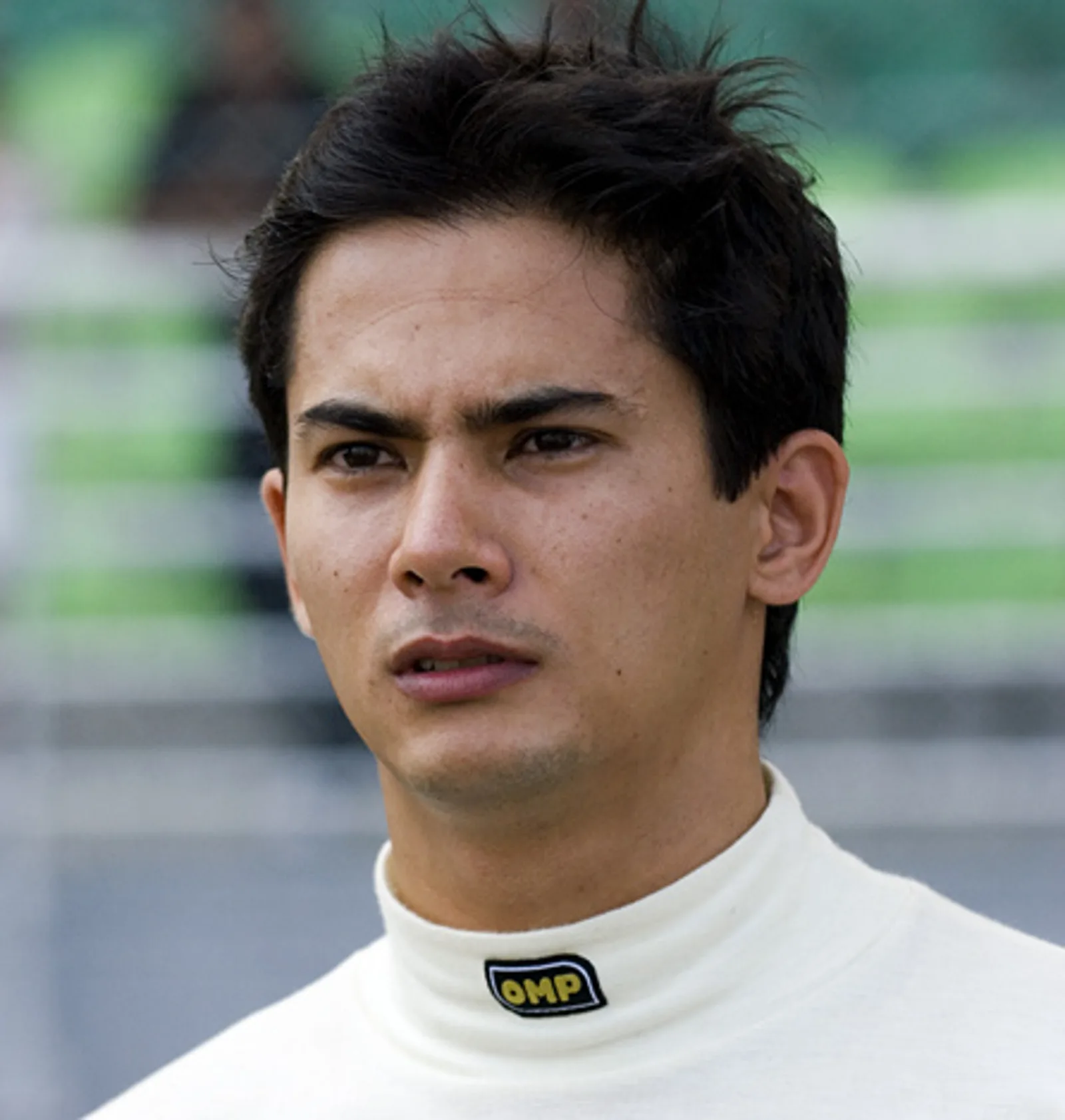
Yoong's 2001 and 2002 Formula One seasons with Minardi made him the first Malaysian in the sport, and a later run of wins in A1 Grand Prix and sportscars rebuilt his reputation.
Yoong drove 18 Formula One races for Minardi across 2001 and 2002, and he is still the sole Malaysian to have started in the sport. In A1 Grand Prix he later won three races for his country's team.
Alex Yoong, who later became a commentator, made 18 starts for Minardi in 2001 and 2002, and he is the only Malaysian to have raced in Formula One's top category. He remains the only Malaysian to have raced in the sport. Away from Formula One, he won races in Formula Renault, Formula 3000, the Porsche Carrera Cup Asia and A1 Grand Prix, and he later became a commentator.
How did Yoong's racing career begin in Malaysia?
Yoong was born in Kuala Lumpur on 20 July 1976, to a Malaysian father of Chinese descent and an English mother. His grandfather had emigrated in 1933 and worked as a contractor and steel trader before the 1997 Asian financial crisis forced him to retire. His father raced sedans from 1978, and his mother took up rallying in 1983, so motorsport was never far from home.
He followed Formula One from the age of four, and his heroes were Nelson Piquet and Ayrton Senna. On his eighth birthday he received a 50cc Kawasaki motocross bike, which first revealed his talent. In 1992, at 16, he began in saloon cars and at that point was the youngest driver ever to race in Malaysian motorsport, entering a one-make Proton series. He won two of five races in that category, after taking pole and a win in his fourth start.
That same year he entered a Toyota Corolla at Macau and came third in the 1600cc category. He then moved to a 400 horsepower BMW, the most powerful saloon in the region, and in 1994 he took out a loan of RM 50,000 to enter the Formula Asia International Championship. A podium run and a win in the season finale at Zhuhai followed.
The only Malaysian to race in Formula One, and a driver whose best days came after a long run of setbacks.
Why did Yoong move to Formula Renault and Formula Three?
In 1995 Yoong won the Malaysian national title, then came close to the Continental Championship, where he took eight wins but finished second by two points. He also worked on the set of Jackie Chan's racing film Thunderbolt, shot at Shah Alam, and Chan called him a very good racing driver. Paul Stewart invited him to test a Formula Vauxhall car, and he trialled a Formula Renault machine at Donington Park and Snetterton with Startline Racing.
He raced for Startline in Formula Renault in 1996, with sponsorship from the Malaysian tyre maker Silverstone. At the first round at Donington he was involved in an early collision, finished 20th, and scored plenty of top six finishes without winning. In 1997 he stayed with Startline, but a crash at Donington and an uncompetitive chassis kept him outside the top ten of the championship.
Advised by his father that lower categories offered his best chance, he chose Formula Three anyway, to prove to himself that he was a capable driver. He joined Portman Racing in 1998, and his sponsors pulled out the following year, leaving his father to fund the racing until the family ran into debt.
What happened in Yoong's 1999 Formula 3000 season?
After missing the first two rounds of 1999, Yoong returned at Thruxton and finished sixth, 11 seconds behind Jenson Button. A fifth place at Brands Hatch and a second place behind Narain Karthikeyan followed, before he left the series for Formula 3000. That rise took him from 268th to 214th overall.
He joined the Italian F3000 championship from its third round, driving for the Monaco Motorsports team of former Formula One driver Lamberto Leoni, alongside Marco Apicella. At Donington he ran second for much of the race, finishing just over a second behind Werner Lupberger after a spin on a puddle, and the drive was among the best of his career.
His season was then overshadowed by a serious accident at Belgium's Eau Rouge, where a collision with Justin Wilson's car sent him into the tyre barrier at around 260 km/h. The impact was measured at about 6.5G, and he was unconscious for 20 minutes. Sid Watkins and the FIA medical team treated him at the scene, and he was taken by helicopter to hospital in Liege for scans. Doctors found no neurological or spinal injury, but he was kept under observation.
Why was the Formula Nippon spell difficult?
Yoong tested for the Nakajima and Le Mans teams at Suzuka in December 1999, and Satoru Nakajima said he was much better than expected. His Formula Nippon debut went badly. He crashed at 130R in qualifying at Suzuka at 250 km/h and missed the race. At Motegi a mechanical failure left him stalled at the start, and he caused a multi-car collision while trying to recover places.
He did find success away from the series. He shared a TVR Chimaera with Adam Lokman and Saladin Mazlan to second place in the Merdeka Millennium Endurance race at Sepang. In 2001 another Motegi start went wrong, when he lost six places in a multi-car accident and retired on lap 14.
| Series | Years | Notable result |
|---|---|---|
| Formula Renault | 1996-1997 | Top six finishes, no wins, outside the top ten in 1997 |
| British Formula Three | 1998-1999 | Eleventh in the 1999 championship |
| International Formula 3000 | 1999 | Second at Donington; tenth in the championship |
| Formula One | 2001-2002 | 18 Grands Prix; seventh in Australia in 2002 |
| Champ Car | 2002 | Ninth in Mexico, then left by late May |
| A1 Grand Prix | 2005-2008 | Three victories for A1 Team Malaysia |
| Le Mans 24 Hours | 2007 | Eighth overall, fifth in LMP1 |
How did Yoong reach Formula One with Minardi?
Minardi sporting director Rupert Manwaring visited Malaysia to meet backers and offered Yoong a seat, possibly from the British Grand Prix. By July 2001 he had secured money from the government-backed Magnum Corporation, a figure the Singapore press put at US$5 million, although the real amount was never disclosed. At Mugello he became the first Malaysian to try a Formula One car, and he was granted a Super Licence.
He made his debut at the 2001 Italian Grand Prix, replacing Tarso Marques, who had no sponsorship money. Electrical and gearbox problems limited his running at Monza, and he shared a spare car with Fernando Alonso. He retired at Indianapolis after 38 laps with a gearbox failure, and finished 16th at Suzuka, three laps down.
In 2002 Mark Webber became his team-mate. At the Australian Grand Prix he qualified 21st and climbed to ninth on the first lap, then passed David Coulthard for sixth before Mika Salo overtook him. He finished seventh, the best result of his Formula One career. At his home race in Malaysia he retired after a collision with Eddie Irvine, and in Brazil he finished 13th after a spin, which he called the toughest race he had driven.
The rest of the year was harder. He failed to qualify at San Marino, missing the 107 percent limit by under half a second, and crashed in Monaco practice before retiring after debris damaged his car. He finished 14th in Canada and 10th at Magny-Cours, and was out of the points at Silverstone and Germany. At Suzuka he retired after 14 laps in the final race.
What did Yoong do in Champ Car and sportscars?
In 2002 Yoong joined Dale Coyne Racing in Champ Car, replacing Roberto Gonzalez, who had left for lack of sponsorship. He qualified 17th and finished ninth in Mexico, then was last at Long Beach, spun at Brands Hatch and suffered mechanical problems at the Lausitzring. Sponsorship dried up, and he left the series by late May.
Next came a seat in the Porsche Carrera Cup Asia, starting as a guest in a support race at the Macau Formula Three Grand Prix. He qualified third in a 2002-spec car, passed the leaders at the start and won by 1.186 seconds despite a gearbox problem.
In 2003 he joined SAE Racing for the Bathurst 24 Hours in a BMW 320i. The car was competitive in testing, but fuel and injector problems in qualifying and the race limited it to 50 laps. A year later he presented Formula One for ESPN Star Sports and drove in V8 Supercar events backed by a Malaysian company, including a 15th place at Bathurst with Neil McFadyen.
How did A1 Grand Prix rebuild Yoong's career?
Yoong drove for A1 Team Malaysia from 2005 to 2008. Many observers see the series as the turning point that restored his standing. He became the lead driver of a team built around Malaysian crew members, a model that other national teams later followed.
He finished fifth in the feature race at Brands Hatch on the team's debut and made several strong runs in the 2005-06 season. A second place in the feature race at Indonesia stood out, and he won a sprint race at China at the end of that season.
The 2006-07 season brought his best results. He won both races at Brno, took pole and a sprint win at Mexico City, and on 28 April 2007 he received the Bruce McLaren Trophy in recognition of his performances. The 2007-08 season was harder. He retired from four races in a row in Zhuhai and New Zealand, missed the Australian and South African rounds, and the team turned to Fairuz Fauzy, ending a run of 45 successive starts.
What was Yoong's Le Mans record?
After the 2005-06 A1 season he raced in the 2006 Le Mans Series and the 2006 Le Mans 24 Hours for Racing For Holland, sharing with Jan Lammers. He was running third in the car when the throttle stuck and sent it into the wall at the Mulsanne chicane, breaking both steering arms. He set the fastest lap at Istanbul but retired there after a starter motor failure.
In 2007 he drove for Charouz Racing with Jan Charouz and Stefan Mucke. The team completed 338 laps at Le Mans and finished eighth overall, and fifth in the LMP1 class. In November 2010 he returned to win the GTC class of the Intercontinental Le Mans Cup at Zhuhai in an Audi R8 LMS, alongside Marchy Lee and Matthew Marsh.
What has Yoong done since racing?
After Formula One, Yoong claimed he was owed money by his former team, and the disputes spread to sponsors, which he said were unrelated to salary. In December 2009 Lotus Racing gave him leadership of its young driver development programme, with a focus on Asia.
He also competed in water skiing, winning silver at the 1997 Jakarta Games, and returned at the 2011 Southeast Asian Games to win one gold and one silver in the slalom and jump events. He has since worked as a commentator, covering Formula One for Malaysian television, Fox Sports Asia and 8TV.
What is Yoong's legacy in Malaysian motorsport?
No other Malaysian has yet driven in Formula One, which makes Yoong a reference point for the country's drivers. His early success in karts, saloons and single-seaters, followed by his leadership of A1 Team Malaysia, gave Malaysian motorsport a visible presence across several series.
His commentary and his role in development at Lotus Racing kept him involved in the sport after he stopped racing, and his family's sporting record in water skiing has added to a remarkable story for a single household.