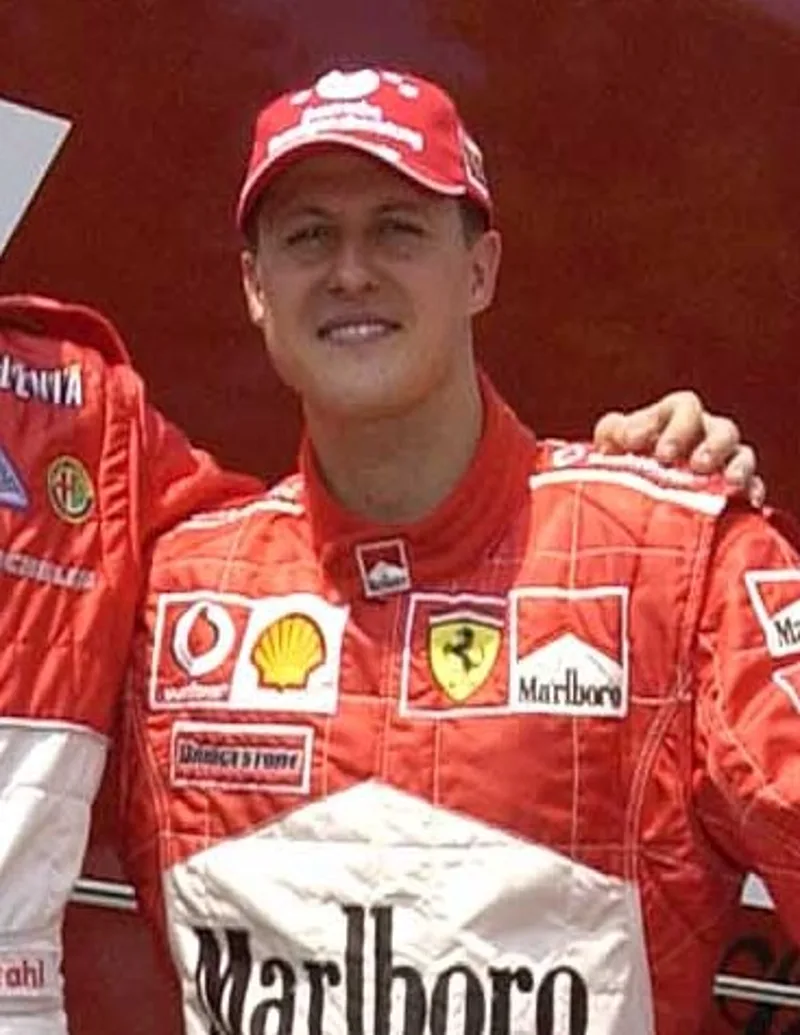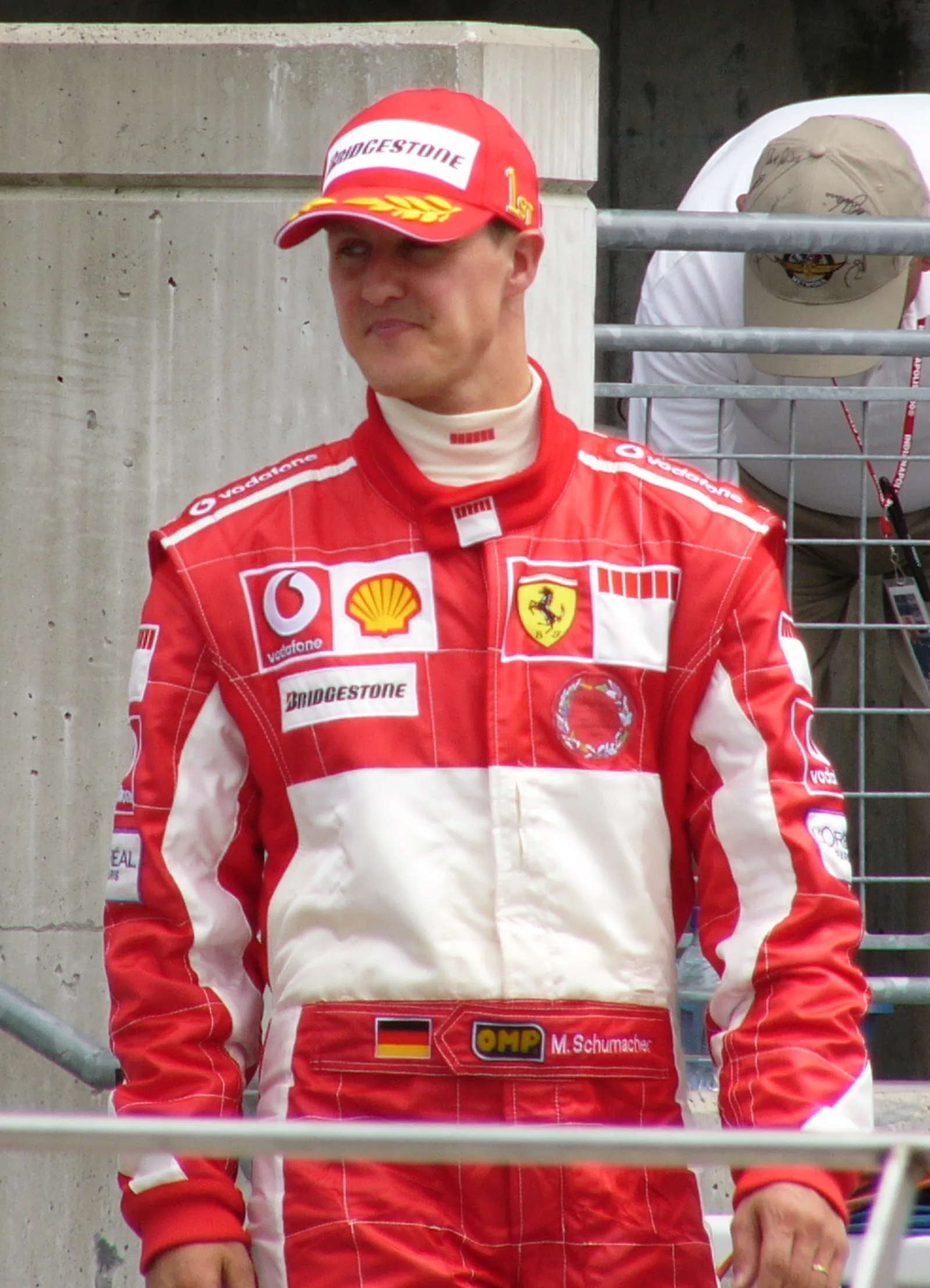
Michael Schumacher won 13 races on the way to his seventh and final title, while Ferrari set a constructors' record that stood alone.
Michael Schumacher took the 2004 Drivers' Championship for Ferrari, his seventh and last, with Rubens Barrichello second and Jenson Button third. Ferrari also secured a record 14th constructors' title, ahead of BAR and Renault. The season set several records, including 13 race wins for Schumacher alone.
Michael Schumacher won his seventh and final Drivers' Championship in 2004, driving for Ferrari, which also took a record 14th constructors' title. The season was the 58th of FIA Formula One motor racing and the 55th World Championship, run across eighteen rounds, opening on 7 March and closing on 24 October. Schumacher's 13 wins set a new standard that stood for years.
Who won the 2004 title?
Schumacher took the drivers' title for Ferrari, his seventh and last. His team-mate Rubens Barrichello finished second in the standings, while Jenson Button of BAR took third. Ferrari's constructors' title came ahead of BAR and Renault, and it was the team's sixth consecutive constructors' title, a record.
Schumacher clinched the crown at the Belgian Grand Prix, where Kimi Raikkonen won from tenth on the grid. Schumacher finished second that day and secured the title, because his advantage over Barrichello was by then too large to overturn.
Schumacher's seventh title came with 13 wins, a single-season record that defined Ferrari's 2004 dominance.
How did Schumacher set his winning record?
Schumacher won 13 races in 2004, breaking his own record of 11 wins in a single season from 2002. He also set a record for the most consecutive drivers' titles, while Ferrari broke the record for consecutive constructors' titles. Those records came in a year when Ferrari's pace was unmatched.
The record lasted until 2013, when Sebastian Vettel, a fellow German, matched it. It was then broken by Max Verstappen in 2022. Schumacher's achievement remains one of the defining statistics of the era.
What changed in the rules for 2004?
Qualifying was held entirely on Saturday, in two sessions where each driver could complete only one fast lap. The first session set the order for the second, and the Sunday warm-up was abolished. The new format changed how teams planned their runs.
Fully-automatic gearboxes and launch control were banned, which ended a period of three seasons in which both had been used. Traction control remained allowed, and it stayed legal until it was banned for 2008. Each engine had to last the whole race weekend, and a driver who needed a new unit took a ten-place grid penalty.
The pit lane speed limit was raised from 80 km/h to 100 km/h, although safety reasons sometimes led to the limit being waived. Squads that had finished outside the top four in the prior year could field a third car for Friday testing.
How did the teams and drivers line up?
Four of the ten teams were subsidiaries of major car companies, and BAR belonged to British American Tobacco. Williams and McLaren had supply deals with BMW and Mercedes-Benz, and Honda built the engines for BAR. Sauber ran Ferrari engines badged as Petronas.
Several line-ups changed before the season began. Massa carried considerable knowledge of Ferrari components with him to Sauber, which had used Ferrari engines the year before. At Minardi, Gianmaria Bruni was signed full-time and Zsolt Baumgartner joined with Hungarian government sponsorship, while Jos Verstappen left. Jordan, Sauber and Minardi all started 2004 with new drivers. At Sauber, Heinz-Harald Frentzen left for the DTM, while Felipe Massa returned from his Ferrari test role. Nick Heidfeld and Giancarlo Fisichella effectively swapped seats, and Christian Klien was brought in to partner Mark Webber at Jaguar.
Ford announced during the season that it would leave Formula One through its Jaguar team after 2004, and it also agreed to sell its Cosworth motor and engineering divisions, and the squad was bought by Red Bull. The team became Red Bull Racing for 2005, which set up the next phase of the sport's history.
How did the calendar change in 2004?
Two new venues joined the calendar: Bahrain, at a newly built circuit in Sakhir, and China, at a new circuit in Shanghai. Both were built for the sport's 2004 calendar. Eight Grands Prix took place outside Europe, a higher count than any earlier season.
The Brazilian Grand Prix left its usual early-season slot to become the finale. The United States Grand Prix moved from late September to late June, where it ran back to back with the Canadian race. Those changes made the schedule look very different from the previous season. The Austrian Grand Prix was the last race held at the A1-Ring, which had been used for seven years.
What happened in the opening rounds?
Ferrari dominated the start of the season in Australia, locking out the front row and taking a 1-2 finish. Schumacher set the fastest lap on his way to victory, with Barrichello and Fernando Alonso on the podium. Malaysia followed with another pole and win for Schumacher, with Montoya and Button behind.
Mark Webber split the Ferraris in qualifying in his Jaguar, but he later suffered a poor start and collided with Ralf Schumacher. Button's podium in Malaysia was his first of his career, and it was the best result for the BAR Honda team since the 2001 German Grand Prix. In Bahrain, Formula One visited the Arab world for the first time since the 1958 Moroccan Grand Prix, and Ferrari again finished 1-2 in qualifying and the race. Ferrari's early advantage was clear, and the team had the points lead it needed.
How did the European rounds unfold?
At San Marino, Button took the first pole of his team's history, but Schumacher overtook him on the eighth lap and won by nearly ten seconds. Button and Montoya completed the podium, and Raikkonen claimed his first points of the season in eighth. In Spain Schumacher dominated again, despite a defective exhaust.
- Monaco: Jarno Trulli won from pole, his first career victory, after holding off Button.
- Europe: Schumacher led most of the race at the Nurburgring, with Barrichello and Button following him home.
- Canada: Schumacher crossed the line first, but the results were later changed after Williams and Toyota runners were excluded.
- United States: Schumacher won again, and Takuma Sato took his first and only Formula One podium.
Which mid-season changes mattered?
Several drivers were replaced after injuries or as part of team decisions. Timo Glock took over at Jordan in Canada, while Marc Gene and then Antonio Pizzonia filled in for the injured Ralf Schumacher at Williams. Ricardo Zonta replaced Cristiano da Matta at Toyota from Hungary onward.
Zonta was later dropped for the Japanese race, then returned for Brazil, replacing Olivier Panis, who stepped down and left the sport.
Jarno Trulli's relationship with Renault broke down after his Monaco win. He left after the Italian Grand Prix, and Jacques Villeneuve, the 1997 world champion, returned to replace him for the last three races.
How did the final races decide the season?
Schumacher's title was effectively settled at Belgium, where Raikkonen won from tenth on the grid. Schumacher's second place there put him out of reach of Barrichello, so the title was secured with races still to run. The constructors' title had already been secured at Hungary.
Japan was affected by Typhoon Ma-on, which postponed qualifying to race morning. Schumacher took his 13th win of the year from pole, with Ralf Schumacher second. Brazil closed the year with a win for Montoya from second on the grid, the last for Williams until 2012. It was a fitting end to a season of records.
What were the main safety incidents of 2004?
Several races were marked by serious accidents. At Monaco a fire from Takuma Sato's BAR set off a chain of collisions, and Giancarlo Fisichella flipped over David Coulthard's McLaren. Olivier Panis stalled on the grid, which cut the race short to 77 laps.
The United States Grand Prix was another difficult afternoon. A first-lap incident eliminated four cars, and Ralf Schumacher was hurt in a crash at the final corner, with a concussion and fractured vertebrae that kept him out of the next six races. Only eight cars crossed the line.
The last classified finisher was Zsolt Baumgartner, whose point gave Minardi its first since 2002 and made him Hungary's first points scorer. Belgium also had early drama, with Webber and Sato eliminated on the first lap.
How did the leading teams compete beyond Ferrari?
BAR were the closest challengers to Ferrari for much of the year. Jenson Button's steady results lifted him to third in the drivers' standings, and the team secured its maiden pole at San Marino. Renault also had moments of success, most notably Trulli's Monaco win from pole.
Alonso's Renault was a regular podium contender, with finishes in Australia, Germany and Hungary. Trulli's relationship with the team deteriorated after his Monaco win, and he left after the Italian race.
Williams relied on Montoya and Ralf Schumacher, and Montoya's clash with Michael Schumacher under the safety car at Monaco ended the championship leader's five-win streak. Toyota's first points of the season also came at Monaco, where Panis finished eighth and da Matta sixth.
Button's Malaysian podium, his first, was the best result for BAR since 2001. That result showed the team could challenge at the front, even though Ferrari was in a class of its own.
What happened to the Canadian result?
The Canadian Grand Prix produced a late change to the results. Ralf Schumacher, Juan Pablo Montoya and two Toyota drivers were excluded over an irregularity in the brake ducts, which promoted Barrichello to second and Button to third. Michael Schumacher's win stood.
Timo Glock and Nick Heidfeld both gained points from the disqualifications. McLaren and Jordan were among the beneficiaries of the four disqualifications, which reshuffled the points in a way few had expected at the start of the weekend.
Race winners at a glance
| Grand Prix | Winner | Key point |
|---|---|---|
| Australian | Michael Schumacher | Ferrari 1-2 with Barrichello |
| Malaysian | Michael Schumacher | Pole and win ahead of Montoya |
| Monaco | Jarno Trulli | First career win, from pole |
| Canadian | Michael Schumacher | Results changed after exclusions |
| Belgian | Kimi Raikkonen | Won from tenth on the grid |
| Chinese | Rubens Barrichello | Won from pole |
| Japanese | Michael Schumacher | 13th win of the season |
| Brazilian | Juan Pablo Montoya | Last Williams win until 2012 |