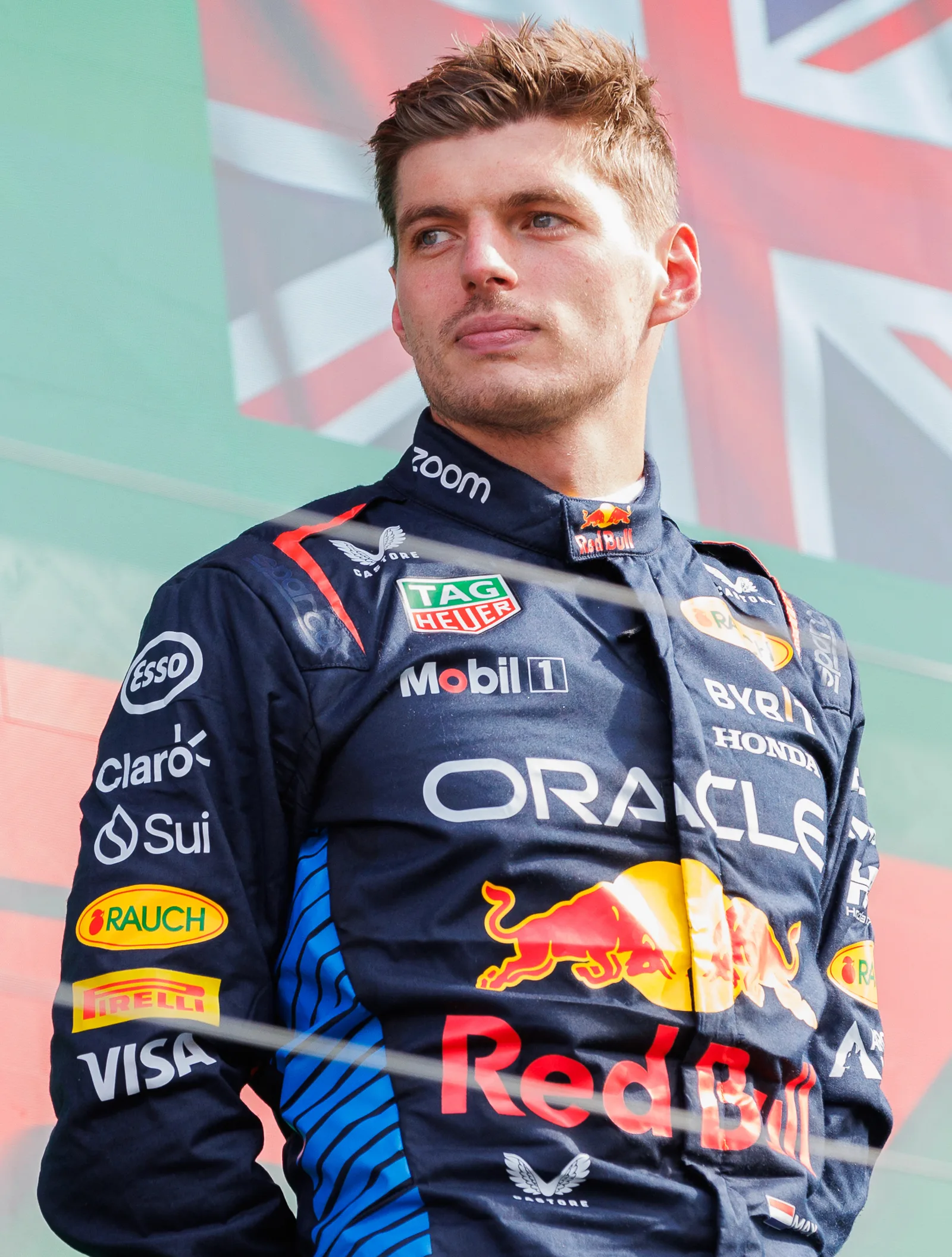
From Belgian karting to a Red Bull seat at 18: the record-breaking title run from 2021 to 2024 and a 2025 battle lost by two points.
Verstappen was born in Hasselt in 1997 and has taken four straight Formula One titles with Red Bull, from 2021 to 2024. He has 72 Grand Prix wins, and he set a single-season record of 19 wins in 2023. He became the youngest Grand Prix winner in 2016.
Max Verstappen is a Dutch driver, born in Belgium, who has won four Formula One World Drivers' Championships in a row from 2021 to 2024, all with Red Bull. He has won 72 Grands Prix across 12 seasons as of the 2026 Singapore Grand Prix, and he is the youngest driver ever to win a Grand Prix. His aggressive, precise style has made him one of the most discussed drivers of his generation.
His rise was unusually fast. From a childhood in karting to a Red Bull seat at 18, and then to a run of championships, he has rewritten several of the sport's record books along the way.
Who is Max Verstappen and where did his career begin?
Verstappen was born on 30 September 1997 in Hasselt, Belgium. His father, Jos Verstappen, had been a Formula One driver, and his mother, Sophie Kumpen, had competed in karting. He started racing karts at four and was competing in championships by seven.
He won the Belgian Cadet Championship in 2008, and he later joined CRG's factory team and stepped up to international karting in 2010. In 2011 he won the WSK Euro Series, ahead of Esteban Ocon.
Four titles in a row, a record 19 wins in one season and a career that began with a Red Bull seat at 18.
What made Verstappen's karting years stand out?
In 2013 Verstappen completed a record-breaking season, aged 15, winning three CIK-FIA championships in a single year. He became the first driver since his father to win two European championships in the same season, and he added the KZ World Championship at Varennes-sur-Allier, beating Charles Leclerc to the title.
The results marked him out for single-seater racing. Within a year he had moved into formula racing, first in the Florida Winter Series and then in the FIA Formula 3 European Championship.
How did Verstappen perform in Formula 3?
Verstappen made his junior formulae debut in the 2014 Florida Winter Series, winning at Palm Beach International Raceway after starting from pole. He then joined Van Amersfoort Racing for the FIA Formula 3 European Championship, where he won ten races, including six consecutive wins at Spa-Francorchamps and the Norisring.
He finished third in the championship that year. At Hockenheim he became the youngest race winner and polesitter in the history of Formula Three.
How did Verstappen reach Formula One so young?
During the first practice session at the 2014 Japanese Grand Prix, Verstappen replaced Jean-Eric Vergne as part of his preparation for a full-time seat. At 17 years and three days he was the youngest person in history to take part in a Formula One race weekend, and he had joined the Red Bull Junior Team that August.
He made his full-time Grand Prix debut for Toro Rosso at the 2015 Australian Grand Prix, aged 17 years and 166 days. He scored his first points at the next race, the Malaysian Grand Prix, aged 17 years and 180 days, breaking the record for the youngest driver to score championship points.
How did Verstappen become the youngest Grand Prix winner?
Red Bull promoted Verstappen to its senior team in 2016, replacing Daniil Kvyat from the Spanish Grand Prix onward. He qualified fourth there, rose to second on the opening lap and then took the lead on a two-stop strategy. He held off Kimi Raikkonen to win, aged 18 years and 228 days, which made him the youngest Grand Prix winner in the sport's history.
Later that year, at the Brazilian Grand Prix, he recovered from 16th to third place in a rain-affected race. Toto Wolff labelled it The Verstappen Show, although Sebastian Vettel complained about his defensive driving late in the race.
How did Verstappen's career develop in 2017 and 2018?
In 2017 Verstappen claimed his second career win at Malaysia, a day after turning 20, by taking the lead from Hamilton early on. He won again at the Mexican Grand Prix, after passing Vettel on the opening lap.
The 2018 season was more erratic, with incidents in several early races, including a collision with Hamilton in Bahrain and a clash with Vettel in China. Verstappen finished the year fourth overall with 249 points, two wins and eleven podium finishes. His fifth career win came at the Mexican Grand Prix, and he was then second behind Hamilton at Brazil after an incident with Esteban Ocon.
| Season | Team | Result |
|---|---|---|
| 2015 | Toro Rosso | Debut season with points, fourth at Hungary |
| 2016 | Red Bull | Youngest Grand Prix winner at Spain, third at Brazil |
| 2017 | Red Bull | Two wins, including Malaysia and Mexico |
| 2018 | Red Bull | Fourth overall, 249 points, two wins |
| 2019 | Red Bull | Third overall, 278 points, three wins, first pole in Hungary |
| 2020 | Red Bull | Third overall, 214 points, two wins |
| 2021 | Red Bull | Champion, first Dutch World Drivers' Champion |
| 2022 | Red Bull | Champion, fifteen wins, 454 points |
| 2023 | Red Bull | Champion, 19 wins, 575 points |
| 2024 | Red Bull | Champion, wet-weather win at Sao Paulo |
| 2025 | Red Bull | Runner-up to Lando Norris by two points, eight wins |
How did Verstappen change Red Bull's fortunes with Honda?
In 2019 Red Bull switched from Renault to Honda power units. Verstappen took his maiden pole position at the Hungarian Grand Prix, becoming the first Dutch driver to do so, and he led most of that race before Hamilton passed him on the closing laps.
He won the German Grand Prix from the front after the race was run in wet and chaotic conditions, and he added a third win at Brazil later in the season. He finished third overall with 278 points.
Earlier in the season, his win in Austria was the first Honda-powered race victory since the 2006 Hungarian Grand Prix. He took the lead from Charles Leclerc with three laps to go, a move that drew debate about its legitimacy.
The 2020 season brought two more wins, including the 70th Anniversary Grand Prix at Silverstone, and he finished third overall again with 214 points.
How did Verstappen win his first world title in 2021?
Verstappen won his first world title in 2021 in a close fight with Hamilton. He took back-to-back pole positions for the first time at the Bahrain Grand Prix, and he won at Monaco to become the first Dutch driver to lead the championship. His form continued through the summer, and his pole and win at the Styrian Grand Prix extended his lead.
At the Austrian Grand Prix he won from pole, led every lap and claimed his first grand slam, becoming the youngest driver to do so. He also became the first driver to win three races in three consecutive weekends that June and July. A high-speed crash with Hamilton at the British Grand Prix produced a 51 g impact with the barrier, but he recovered to keep a strong position in the standings.
The title came down to the final lap of Abu Dhabi, where Verstappen passed Hamilton to become the first World Drivers' Champion from the Netherlands and the 34th overall. The race director's handling of the final safety car period became one of the most controversial episodes in the sport's recent history.
How did Verstappen defend his title in 2022 and 2023?
In 2022 Verstappen won fifteen races, a record for a single season, and clinched his second title with 454 points. That beat the old benchmark of thirteen, which Michael Schumacher reached in 2004 and Sebastian Vettel matched in 2013. A victory from pole at the Japanese Grand Prix gave him a 113-point lead with four races to go.
The 2023 season was even more dominant. Verstappen won 19 races and scored 575 points, more than double the total of second-placed Sergio Perez. His ten consecutive wins broke Vettel's record of nine, and Red Bull's fifteen consecutive wins also set a record, beating McLaren's 11 from 1988.
What did the 2024 title and the 2025 season show?
In 2024 Verstappen clinched his fourth consecutive title with a dominant wet-weather win at Sao Paulo, which he won by a 19-second margin. He had matched Ayrton Senna's record of eight consecutive poles earlier that year, and the title was secured at Las Vegas with two races remaining.
He became the first driver to win the championship while driving for a third-placed constructor in 41 years. Andrew Benson of BBC Sport described the season as a towering achievement, given that Red Bull did not have the best car for most of the year.
The 2025 season was tighter. Verstappen finished runner-up to Lando Norris by two points after a season of fierce competition. He took a surprise pole and victory at the Japanese Grand Prix, and his pole lap at Monza was the fastest in the sport's history. He won eight races in total, the most of any driver that season.
What is Verstappen's driving style?
Verstappen is widely regarded as one of the fastest drivers in Formula One over a single lap. Nico Rosberg called him the fastest driver on the grid in 2019, and Jenson Button said he believed Verstappen was the fastest driver who had ever raced an F1 car.
He is also known for an aggressive style. Eddie Irvine described him as by far the most dominant team leader on the grid, and Jolyon Palmer suggested in 2021 that his title could usher in a new era of dominance.
Not every assessment has been positive. Verstappen has also been criticised for several incidents on track, and Felipe Massa branded him dangerous in 2015. Jackie Stewart described him in 2021 as still in the puppy stage of his career.
Helmut Marko, Red Bull's adviser, said Verstappen had clearly moved away from his former teammate Daniel Ricciardo from the second half of 2018 onward. Three-time champion Niki Lauda called him the talent of the century after his 2016 Spanish win, and Christian Horner, Red Bull's team principal, has said he is the best driver the team has ever seen.
What is Verstappen's legacy beyond the track?
Verstappen was appointed an Officer of the Order of Orange-Nassau in 2022, and Time listed him among the 100 most influential people in 2024. He has competed in sim racing since 2015 and runs the Verstappen Racing team.
In August 2026 he signed a contract extension with Red Bull until the 2030 season, a commitment that keeps him at the team that gave him his first Formula One win.