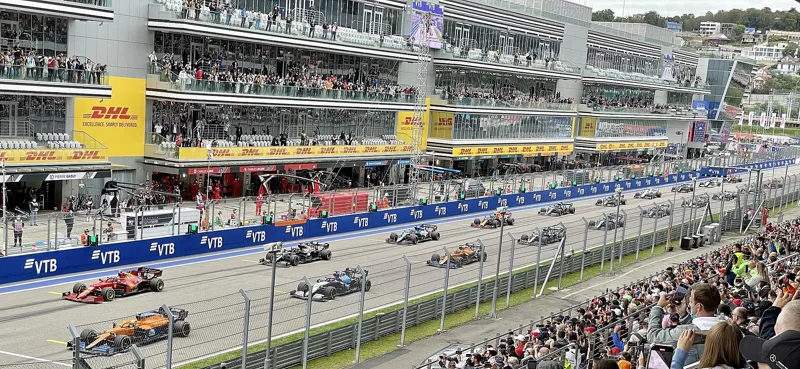
Red flags, a standing restart and a bitter collision with Max Verstappen made the inaugural Saudi race one of the most controversial of the 2021 season.
Lewis Hamilton won the inaugural Saudi Arabian Grand Prix on 5 December 2021, starting from pole at the Jeddah Corniche Circuit. Max Verstappen was second and Valtteri Bottas third, leaving Hamilton and Verstappen level on points before the season finale.
The 2021 Saudi Arabian Grand Prix was a Formula One race run through the streets of Jeddah on 5 December 2021, and it was the first grand prix staged in the kingdom. Lewis Hamilton converted pole into a 50-lap win, although the race was defined by red flags, a standing restart and a bitter clash with title rival Max Verstappen. Valtteri Bottas finished third, leaving Hamilton and Verstappen tied on points before the season finale.
Why was the Jeddah race so important for the title?
Verstappen and Hamilton were fighting for the championship, and the Saudi race was the penultimate round of a season that had produced repeated clashes between them. Going into Jeddah, Verstappen had a lead of eight points, so the result would decide how the final round in Abu Dhabi would look. Both drivers entered the weekend knowing that a single incident could decide the title.
A night race in Jeddah, a standing restart and a collision that split the paddock, all with a title on the line.
How did the championship stand before the race?
Verstappen led the drivers' table with 351.5 points, with Hamilton eight points behind. Bottas was third on 203 points, ahead of Sergio Perez on 190 and Lando Norris on 153. Mercedes led the constructors on 546.5 points, with Red Bull second on 541.5 and Ferrari, McLaren and Alpine behind them.
The previous round in Qatar had shifted the balance. Verstappen overcame a five-place grid penalty to finish second, and his bonus point for the fastest lap cut Hamilton's lead from 14 points to eight. Bottas's retirement in Qatar also let Red Bull reel in Mercedes, reducing the constructors' gap from 11 points to five.
With 26 points available for a win, To take the title, Verstappen had to finish at least 18 points clear of Hamilton. Mercedes needed to earn 40 more points than Red Bull in Jeddah to hold on to the constructors' title. Those calculations shaped the thinking of both teams before a wheel had turned.
How had the rivalry built up?
The fight between the two drivers was compared with the famous Prost and Senna rivalry of the late 1980s and early 1990s. The pair had already collided in three races that season, at Silverstone, Monza and Sao Paulo, and many observers feared that the title might be settled by another crash.
Damon Hill, the 1996 world champion who had lost the 1994 championship after contact with Michael Schumacher, hoped the governing body would take steps to avoid a similar outcome. Hamilton said he was calmer than when he first fought for a title, since he had been around for a long time. Verstappen said he did not need to overthink things to be quick.
Was there a dispute over the Mercedes rear wing?
Red Bull had alleged that the main plane of the Mercedes rear wing flexed backwards to cut drag. Toto Wolff dismissed the claim and said Christian Horner was chasing ghosts. The FIA tests carried out on the Mercedes wings in Sao Paulo and Qatar confirmed that they were rigid enough, which settled the matter.
Horner's complaints were softened by the fact that Hamilton had used an older engine in Qatar. Wolff confirmed that Hamilton would run the newest unit in Saudi Arabia, since the long straights of the circuit rewarded power over downforce.
What was the criticism of holding a race in Saudi Arabia?
The decision to host the race drew strong criticism from human rights groups, who accused the sport of sportswashing. Amnesty International UK and Human Rights Watch both said the race distracted from the country's record, including its treatment of activists and women. A group of British politicians wrote to Formula One's chief executive, Stefano Domenicali, asking him to speak out about the use of the death penalty.
Hamilton said he was not comfortable racing in Saudi Arabia, but he still planned to wear a pride flag design on his helmet, the same design he had used in Qatar. Sebastian Vettel invited a group of female drivers to a kart track he had rented, to learn about the discrimination women faced locally. Some figures in the sport took a more positive view, while race promoter Prince Khalid Al-Faisal said he was open to talking with drivers who had concerns.
How did Frank Williams's death affect the weekend?
Williams co-founder and former owner Frank Williams died on 28 November, one week before the race, at the age of 79. His team had won 16 world championships, seven in the drivers' table and nine in the constructors'. He had kept out of public view since the 2019 British Grand Prix, as his health had declined.
Several teams ran tributes on their cars, and a minute of silence was held before the start. A lap of honour in the FW07 was driven by former Williams driver Damon Hill, in the car that gave Williams its first championship in 1980. Team CEO Jost Capito also tested positive for coronavirus on the eve of the race and missed the weekend.
How did the three practice sessions go?
There were three 60-minute practice sessions, two on Friday 3 December and one on Saturday 4 December. Hamilton led the first session on a dry track with a time of 1:29.786, while Verstappen was only five hundredths behind. Bottas, Pierre Gasly and Antonio Giovinazzi followed. Ocon and Verstappen went wide at turn one, almost colliding while Ocon tried to let him pass.
Hamilton was quickest again in the second session at 1:29.018 under the night sky. Bottas was six hundredths slower. Charles Leclerc lost rear grip at turn 22 and hit the barrier at 241.4 km/h (150.0 mph), smashing the right-hand side and rear wing of his car. He was checked at the medical centre and released without injury, and Ferrari repaired the car overnight.
Race director Michael Masi then banned drivers from preparing for flying laps between turns 23 and 25, because the slow traffic had been a problem. In the third session Verstappen posted the fastest time of 1:28.100, ahead of Hamilton and Perez. Hamilton failed to yield to double yellow flags during the session and impeded Nikita Mazepin, which earned him a reprimand and a summons to the stewards. Mercedes were fined 25,000 euros.
How did qualifying settle the grid?
Qualifying lasted 60 minutes and was split into three segments of 18, 15 and 12 minutes, with the 107 per cent rule in force. Perez set the first Q1 time at 1:28.021, while Nicholas Latifi skidded at turn four and could do no better than 16th. Sebastian Vettel and Lance Stroll were both caught in traffic and started 17th and 18th.
Hamilton led at the end of Q2 with a lap of 1:27.712. Daniel Ricciardo felt his result did not reflect his pace after running over a kerb and damaging the floor of his car. Carlos Sainz Jr. spun at the exit of turn ten, and he later described his car as undrivable.
In the final segment Hamilton slid wide at turn two and then pitted to change his front wing. He came back to set the pole time of 1:27.511, which was his fifth pole of the season and his 103rd in his career. Verstappen was faster through the first two sectors but locked his front-left tyre at the final corner, lost control on the rear and hit the wall, which broke his suspension and dropped him to third.
Bottas took second, giving Mercedes a front-row lockout. It was also his 100th consecutive race in the top ten of qualifying, a feat previously achieved only by Alain Prost and Ayrton Senna. Leclerc, Perez, Gasly, Norris, Tsunoda, Ocon and Giovinazzi filled the remaining top-ten places.
How did the race start?
The race began in the evening at 20:30 local time, with air at 29 C (84 F) and the track at 32 C (90 F). Around 143,000 spectators watched the 50-lap race over a distance of 308.450 km (191.662 mi). Hamilton kept the lead into the first corner, but Schumacher crashed into the barriers at turn 22 on lap ten, and that brought out the first safety car.
Both Mercedes drivers pitted to switch to hard tyres. Bottas then held Verstappen up on his in-lap, which left Hamilton seven seconds ahead. Verstappen decided to stay out and took the lead, and the race was red-flagged on lap 13 so that marshals could repair the barriers. Hamilton was angry, because the rules allowed the Red Bull driver to change tyres under the stoppage.
What did the restarts do to the order?
The red flag was lifted after almost 20 minutes, and officials ordered a standing start. On the formation lap Verstappen complained that Hamilton was more than ten car lengths behind him. Off the line Hamilton got away better, but Verstappen skipped the second corner to keep his place, and Ocon passed Hamilton for second.
A four-car crash followed when Perez was spun by Leclerc at turn three and Mazepin struck Russell. A second 20-minute red flag followed, and in that stoppage Michael Masi offered Red Bull the chance to hand back the place to Ocon rather than face a penalty. Red Bull accepted, so Ocon led from Hamilton.
The third standing start came on lap 17, and Verstappen moved to the inside of Hamilton at turn one and grabbed the lead. For a short time Ocon took second from Hamilton, who then regained it. Tsunoda was later given a five-second penalty for causing a collision with Vettel, and two further virtual safety cars followed for debris, including one after Vettel and Raikkonen clashed at the fourth corner.
What happened in the closing laps?
The third virtual safety car lasted until lap 33, when Verstappen had a 1.2-second advantage. Once it ended on lap 37, Hamilton used his slipstream to pass Verstappen on the outside into turn one. Verstappen steered wide, skipped the second corner and kept the lead, and Red Bull told him to let Hamilton through before the final corner so they could gain DRS.
Verstappen then slowed sharply at turn 26 and braked suddenly. Hamilton had been following and swerved left, but ran into the left-rear tyre of the Red Bull and damaged the front-right of his wing. Verstappen continued to hold the lead, and Mercedes argued with Masi for several laps about who was to blame. Bottas passed Ricciardo for fourth on lap 40.
Verstappen let Hamilton back ahead before the final corner on lap 42, then lunged down the inside with DRS to reclaim the lead. The stewards handed him a five-second penalty for leaving the track. On the following lap he gave the lead back at the final corner, and Hamilton nearly pushed him off the track, which led to a warning for Mercedes that Hamilton was close to a black flag.
Verstappen's tyres began to wear, and Hamilton set a series of fast laps, including the race's fastest of 1:30.734 on the 47th lap. He won, taking his eighth win of the season and his 103rd in Formula One. Verstappen finished second, 11.825 seconds behind, and Bottas took third after using DRS to pass Ocon by 0.102 seconds on the front straight.
Why did Verstappen receive a penalty after the race?
The stewards summoned both drivers under the FIA's International Sporting Code. The FIA later added a further ten seconds for the lap 37 incident, a change that left his finishing place alone, and gave him two penalty points on his super licence. The braking was judged erratic and the main cause of the collision.
The FIA explained that Hamilton could have overtaken when Verstappen first slowed, but that Verstappen's sudden braking was the predominant cause of the collision. The decision drew anger from Red Bull, and Horner compared the race directorship to haggling at a market. Helmut Marko insisted Verstappen had not brake-tested Hamilton, and said Hamilton's contact had left Verstappen's rear tyre cut so badly that the team could no longer attack.
What did drivers and commentators make of the race?
Verstappen was voted Driver of the Day by fans, but he walked off the podium without spraying champagne with the Mercedes drivers. Hamilton said Verstappen was one of the few rivals in a 28-year career who had driven over the limit. Andrew Benson of BBC Sport called it one of the most dramatic races of a dramatic season, while Charles Bradley of Autosport described it as one of the strangest races in Formula One history.
Martin Brundle called the race dirty and absolutely crazy. The circuit itself drew criticism from drivers and fans for its full-throttle nature and lack of braking zones. Russell, who was the director of the Grand Prix Drivers' Association, said his accident was pretty inevitable. Perez described the circuit as too dangerous without a real reason, and the barriers at several corners were moved back before 2022.
What did the result mean for Abu Dhabi?
Verstappen and Hamilton each finished on 369.5 points, which left them level before the finale. It was only the second time in Formula One history that the top two had been level with one race left, and the first since 1974. Bottas was third in the standings on 218 points.
| Place | Driver | Points after Saudi Arabia | Note |
|---|---|---|---|
| First | Lewis Hamilton | 369.5 | Won the race, level with Verstappen |
| Second | Max Verstappen | 369.5 | Second on the road, level on points |
| Third | Valtteri Bottas | 218 | Third in the race for Mercedes |
| Fourth | Sergio Perez | 190 | Early retirement after an accident |
| Fifth | Charles Leclerc | 158 | Moved ahead of Norris in the standings |
Mercedes extended their constructors' lead to 28 points over Red Bull, reaching 587.5 points, after Perez's early retirement. Ferrari were on 307.5 points, McLaren on 269, and Alpine on 149.