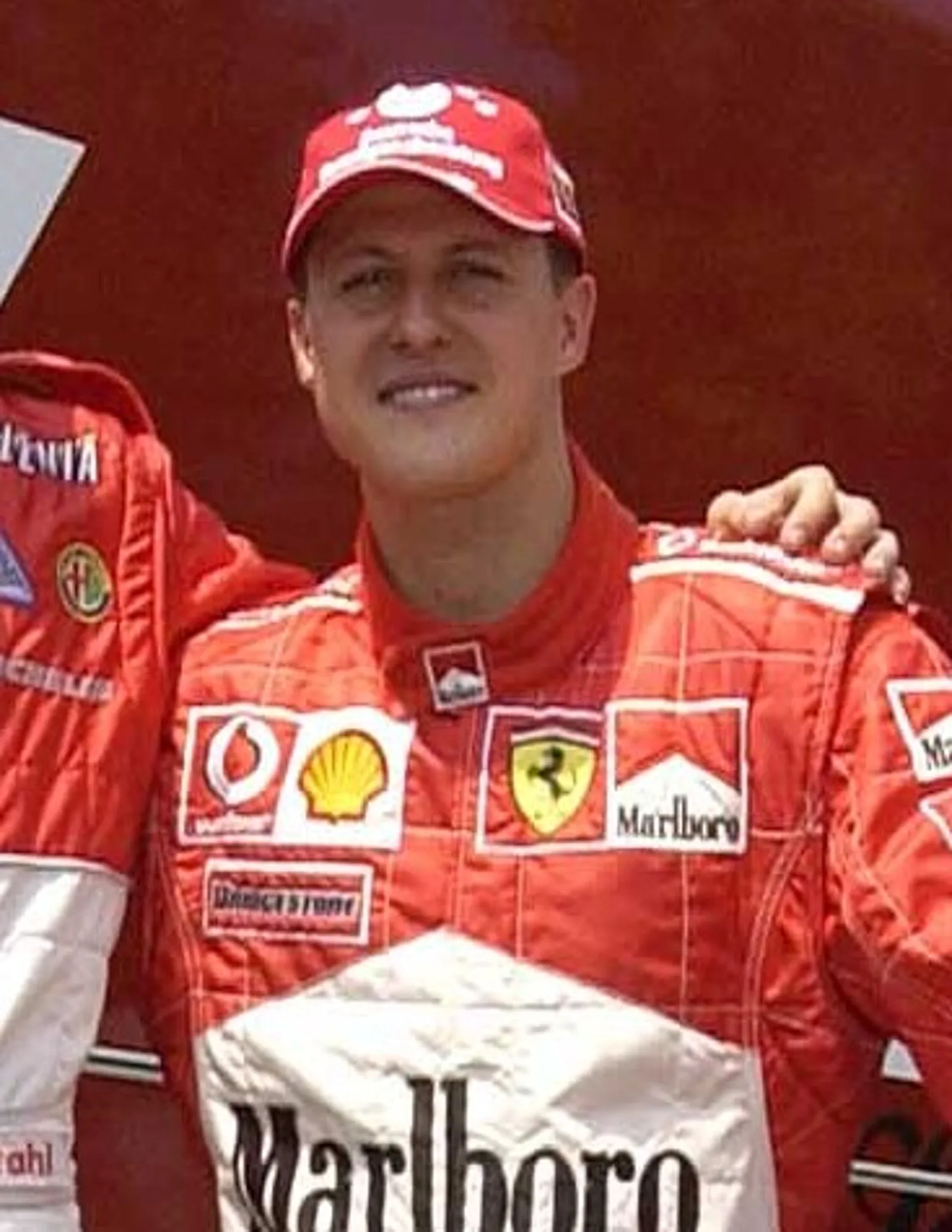

A new points table, tighter rules and a three-way fight with Raikkonen and Montoya ended with Michael Schumacher's record sixth title.
The 2003 Formula One World Championship was the 57th season of FIA Formula One racing, held over 16 races from March to October. Michael Schumacher won his sixth Drivers' title, breaking Juan Manuel Fangio's long-standing record, and Ferrari took its fifth straight Constructors' crown.
The 2003 season ran from 9 March to 12 October and was the first to use a top-eight points table. Schumacher's title came down to a final-round finish, with Raikkonen and Juan Pablo Montoya keeping the race alive until the closing weeks.
What rules changed for 2003?
The 2003 rules tightened the race weekend and the cars. The top eight now scored points under a 10-8-6-5-4-3-2-1 table, team orders were banned, and fuel could no longer be added or removed between qualifying and the race. The fuel rule was adopted on safety grounds.
The HANS head-and-neck device became compulsory after a decision in June 2002, despite complaints from drivers including Barrichello, Villeneuve, Wilson and Heidfeld. Hydraulic power steering also became mandatory for every entrant, because manual steering was judged too difficult for drivers in corners.
The season was the third and last with fully automatic gearboxes and launch control, both of which had been allowed since the 2001 Spanish Grand Prix. The FIA banned both for 2004, and the traction control ban was eventually delayed until 2008.
Sporting changes followed. One-lap qualifying was introduced to give smaller teams more television exposure, and the Friday order set the Saturday running order, with only one timed lap allowed in each session. Optional Friday testing replaced some stand-alone test days, which were due to be banned for 2004.
Only one wet tyre type was permitted in wet races, a rule that alarmed the tyre suppliers. It was scrapped after the chaotic Brazilian race, in which six drivers crashed at the same corner.
Team orders were prohibited after Ferrari's 2002 Austrian instruction to Barrichello to let Schumacher by. The points table also grew from the old top six to the top eight, with the aim of closer title contests between the midfield teams, and it applied to both the drivers' and constructors' championships.
A two-point title win, a new top-eight points table and a fierce three-way fight defined the 2003 season.
Who joined and left the grid in 2003?
Arrows was refused a place by the FIA before the season, and it folded after 25 years in the sport. Jordan and Minardi both moved to Cosworth engines, while Alonso, Button, Webber and Pizzonia were among the drivers on the move.
Arrows had applied for a place in 2003, but the FIA rejected the application before the season began and gave no public reason. Asiatech, which had supplied Minardi, was wound down when its funding was withdrawn.
Jordan's contract with Honda was due to expire at the end of 2003, and Honda would no longer supply free engines. Minardi, which had used Asiatech engines in 2002, also switched to Cosworth units for the season.
Fernando Alonso, the 2002 test driver, was promoted to a full-time Renault seat in place of Button, who moved to BAR. Olivier Panis joined Toyota alongside Cristiano da Matta, the reigning CART champion making his Formula One debut.
Jaguar replaced Irvine and Pedro de la Rosa with Mark Webber, who came from Minardi, and the debutant Antonio Pizzonia. Justin Wilson took Webber's place at Minardi, and Jos Verstappen returned to the grid there after a year on the sidelines.
Felipe Massa left Sauber to become Ferrari's test driver, and Heinz-Harald Frentzen took the Sauber seat. The Belgian round set for 31 August was then cancelled after a row about tobacco advertising.
How did the opening rounds go?
Coulthard won the opener in Australia, Raikkonen won his first race in Malaysia, and Fisichella was finally credited with victory in Brazil after a timing error was corrected. After three races Raikkonen led the points with 24, ahead of Coulthard on 15 and Alonso on 14.
Ferrari went into the season as the team to beat, having won the previous four Constructors' Championships, and the new qualifying format was expected to shake up the order.
Schumacher took pole in Australia with Barrichello alongside, while Montoya started third and most of the McLaren and Williams cars were far back. Rain changed the conditions. Barrichello jumped the start and took a drive-through penalty, and Raikkonen, who had pitted at the end of the formation lap, started last.
Raikkonen led at one stage, but a pit lane speeding penalty dropped him to third behind Schumacher. Schumacher then picked up damage from a kerb, pitted for repairs and fell to fourth, which ended Ferrari's podium run. Montoya spun at the first corner, and Coulthard passed him for the win, the Scot's last victory.
Malaysia saw Renault lock out the front row, with Alonso on pole as the then-youngest driver to take a pole. Schumacher tapped Trulli into a spin at the first corner. Raikkonen took the lead and won his first Grand Prix, with Barrichello second after a late stop, while Montoya was rear-ended by Pizzonia and lost two laps.
Brazil was played out in torrential rain. Drivers petitioned for qualifying to be cancelled, but the session went ahead once the rain eased, and Barrichello took pole for Ferrari. On race day six drivers crashed at turn three, Schumacher among them, and four safety car periods followed. Raikkonen was first declared the winner, but a timing error was corrected and Fisichella was given the win.
Schumacher, the reigning champion, was down in sixth after three races and had a points deficit to make up.
How did the middle of the season unfold?
Schumacher won at San Marino, Spain, Austria and Canada, while Montoya won at Monaco and Germany and Ralf Schumacher took the Williams wins in Europe and France. Alonso won in Hungary, and the points lead passed back and forth between Schumacher and Raikkonen.
San Marino brought pole and victory for Schumacher, with Raikkonen second. Spain marked the debut of Ferrari's new car, with both Ferraris on the front row, and Raikkonen crashed into the stalled Jaguar of Pizzonia. In Austria Schumacher took pole and won again despite a slow stop and a small fire, while Montoya retired with a blown engine.
Monaco was a race without on-track overtakes. Ralf Schumacher took pole, but Montoya won by six tenths from Raikkonen, with Michael Schumacher third. The order was set by the start and the pit stops.
Canada was a race of attrition in which only nine drivers finished. Ralf took pole again, but Michael got ahead of both Williams cars and held on for the win while nursing a damaged car home.
At the Nurburgring Raikkonen took pole and led until his McLaren engine failed on lap 25. Ralf Schumacher won at home, with Montoya second and Barrichello third, after Michael collided with Montoya on lap 43. In France Ralf again started from pole and won his last Formula One race, with Montoya second and Michael third.
At Silverstone Barrichello took pole, but Trulli led into the first corner. On lap 11 a man in a kilt ran onto the track, and a marshal pulled him aside as the cars swerved. The safety car followed and most cars pitted. Raikkonen eventually led but gave up the win under pressure from Barrichello, and Montoya took second.
In Germany Montoya took pole by 0.018 seconds. Ralf Schumacher squeezed Raikkonen and Barrichello at the start, and both crashed out. Ralf also retired, and his ten-place grid penalty was later reversed on appeal. Montoya held on to win, Coulthard was second and Trulli third, the only podium of Trulli's season.
In Hungary Alonso took pole and won, becoming the youngest winner in the sport's history, with Raikkonen and Montoya on the podium. Michael Schumacher could manage only eighth, and Ralph Firman was injured in a practice crash.
How did the final three rounds decide the title?
Schumacher won at Monza and at Indianapolis, and Raikkonen needed a win and a Schumacher non-score in Japan. Schumacher qualified 14th at the final round and lost his front wing in a collision, yet he finished the year two points clear of Raikkonen.
At Monza, with the tifosi behind him, Schumacher took pole and won. Montoya was second and Barrichello third. The race averaged 247.6 km/h (153.9 mph) and was the shortest fully completed race in Formula One history up to the 2023 Italian Grand Prix.
Raikkonen took pole in the United States, and the race turned on rain. Montoya collided with Barrichello on lap 3 and took a drive-through penalty, then passed Schumacher at the second attempt. Schumacher switched tyres as the weather changed, and by lap 38 he had passed everyone ahead to win, with Raikkonen second and Frentzen third.
In Japan Schumacher qualified 14th, his worst grid slot in a Ferrari, and Raikkonen started eighth. Barrichello took pole, and Montoya retired with a hydraulics failure. Schumacher lost his front wing after hitting Takuma Sato, rejoined last and was then run into by his brother Ralf. Raikkonen climbed to second, but that was not enough to overtake Schumacher on points. Barrichello won the race, securing the Constructors' title for Ferrari.
How the title race stood at key stages
| Stage | Leader | Points | Chasers |
|---|---|---|---|
| After three races | Kimi Raikkonen | 24 | Coulthard 15; Alonso 14 |
| After Canada | Michael Schumacher | 54 | Raikkonen 51; Alonso 34 |
| After Hungary | Michael Schumacher | 72 | Montoya 71; Raikkonen 70 |
| Final standings | Michael Schumacher | 93 | Raikkonen 91; Montoya 82 |
The points lead changed hands during the summer, and the final margin was just two points. By Hungary the three title contenders were separated by only two points, with three races still to run.
Why does 2003 still matter?
Schumacher's sixth title broke Juan Manuel Fangio's long-standing record, and it was his fourth Drivers' title in a row. Ferrari's win in the Constructors' table made five straight years at the top for the team.
The points table was introduced to make title contests closer and to give midfield teams more to fight for.
The season closed the era of fully automatic gearboxes and launch control, which the FIA banned for 2004. The points table with the top eight scoring stayed in place until the end of 2009.
Several milestones marked the season. Coulthard's win in Australia was his last race victory, and Ralf Schumacher's win in France was his last. Williams had its last 1-2 finish in that season's France race, a record that still stood as of 2025.