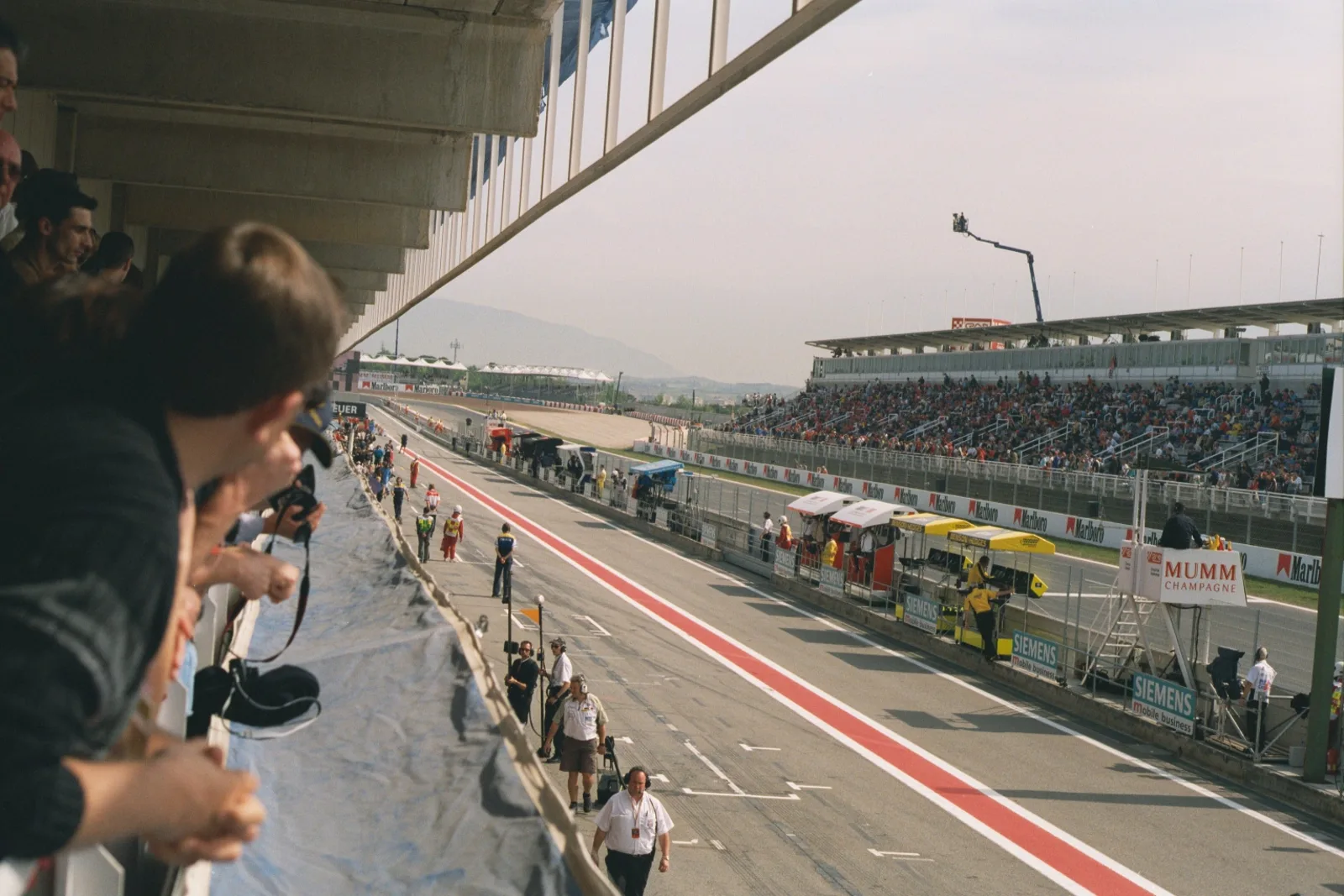

Traction control and launch control were legal again at Catalunya, and Michael Schumacher inherited victory when Hakkinen's clutch failed on the final lap.
Michael Schumacher won the 2001 Spanish Grand Prix for Ferrari at the Circuit de Catalunya on 29 April 2001, his third win of the season. Juan Pablo Montoya finished second for Williams, his first Formula One podium, and Jacques Villeneuve took third for BAR.
Electronic driver aids returned to Formula One at the 2001 Spanish Grand Prix, the first race since 1993 in which traction control, fully automatic gearboxes and launch control were legal. Michael Schumacher started from pole, and a late clutch failure on Hakkinen's McLaren handed him the win ahead of Juan Pablo Montoya. The race was the fifth round of the season, held before 91,000 spectators.
The Circuit de Catalunya at Montmelo, in Catalonia, is 4.730 km (2.939 mi) long and runs clockwise. It was the track's 11th Spanish Grand Prix. Before the race, Schumacher and David Coulthard were level at the top of the drivers' table on 26 points each, with Barrichello third on 14 and Ralf Schumacher fourth on 12.
Electronic driver aids had been banned since the end of the 1993 season. The FIA had feared that the technology would reduce driver ability, and policing the systems was extremely difficult. Two months before the race, the FIA and the teams agreed to reinstate the systems. Some drivers were unhappy, but engineers saw the change as a chance to show their technical skill.
Ferrari led the constructors on 40 points, ahead of McLaren on 30 and Williams on 12. Hakkinen had scored only four points from the first four races, and he said Spain was where his championship would start. Montoya expected a difficult weekend, because his car's pace in recent testing had been modest.
Who changed seats before the race?
Luciano Burti was released by Jaguar and replaced by Pedro de la Rosa, while Prost sacked Gaston Mazzacane for breaching a performance clause and brought in Burti. Prost had first approached Ricardo Zonta, but he declined. Benetton's Jenson Button had been carrying a shoulder injury since the Malaysian Grand Prix, and he raced after visiting specialists.
After Imola, the British teams of Benetton, BAR, Jaguar, Jordan, McLaren and Williams, together with Prost, tested at Silverstone from 17 to 19 April. Frentzen set the first day's fastest time, and Hakkinen led the final two days. Sauber, Ferrari and Minardi tested at Mugello between 18 and 20 April, where Badoer was quickest on the first day and Schumacher on the second and final days.
Teams also made small changes to their cars. The FIA's technical delegate Jo Bauer declared Williams's FW23 diffuser legal after rivals disputed it. Ferrari put temperature sensors inside its wheels, McLaren used smaller and cleaner front brake ducts, and Sauber's C20 ran without power steering because testing had shown it to be unreliable. BAR tried upward-exiting exhausts on the cars of Panis and Villeneuve.
Electronic aids were back in Formula One, and a failed clutch on the final lap decided the winner at Catalunya.
Practice and qualifying
Four practice sessions came before the race. Friday offered two one-hour sessions, while Saturday had two of 45 minutes. Coulthard led the first session at 1:20.107, half a second faster than Barrichello. Villeneuve's engine failed during a standing start with ten minutes left, and flames came from his car in the pit lane. Irvine missed most of the session because of hydraulic gearbox leaks.
On Saturday, Michael Schumacher was fastest in the third session at 1:18.634, with Hakkinen second after locking his tyres. Schumacher was quickest again in the final session, four hundredths of a second ahead of Barrichello. Barrichello had been fastest in the warm-up on race morning at 1:20.680.
Michael Schumacher took pole with 1:18.201, a new track record that he set with 15 minutes left, after switching to his third set of tyres. It was his fourth pole in five races and the 36th of his career. Hakkinen turned off traction control to reduce understeer in some parts of the lap, but his best time was 0.085 seconds slower, which put him second.
Coulthard was demoted to third by his team-mate, and Barrichello qualified fourth. Ralf Schumacher was the best-placed Michelin runner in fifth, while the Jordans of Trulli and Frentzen took sixth and eighth on Bridgestones. Villeneuve, seventh, spun into the gravel at the end of the pit lane straight because his rear brakes had not been connected properly.
Raikkonen was ninth and Heidfeld tenth, with Panis 11th, Montoya 12th, Irvine 13th, Burti 14th and Alesi 15th. Bernoldi and Verstappen qualified 16th and 17th for Arrows, and Alonso took 18th after his engine was replaced following a morning oil system problem. Fisichella was 19th, De la Rosa 20th after rear brake trouble in the spare Jaguar, Button 21st and Marques 22nd.
What happened at the start?
Coulthard's launch control glitch left him stranded on the grid, and he had to start from the back after the field had passed him. Fisichella, in the spare Benetton, then hit Coulthard from behind, and Coulthard struck Bernoldi's rear as his front wing folded. Michael Schumacher kept the lead by moving to the inside line to block Hakkinen.
Coulthard's race then got worse. A replacement front wing took 15.4 seconds to fit in the pit lane, and a severe tyre cut, noticed by his race engineer Pat Fry, had to be changed as well. Frentzen was also stranded on the grid after switching off his launch control, and cars swerved around him as he dropped from eighth to 22nd.
After the first lap, Michael Schumacher led Hakkinen, Barrichello, Ralf Schumacher, Trulli and Montoya. Montoya had climbed from 11th to sixth by the end of the main straight. Schumacher then set a run of quick laps while Hakkinen stayed close behind without being able to challenge him.
On lap 13 Coulthard moved ahead of Marques into 18th, and three laps later he was past Button for 17th. On lap 18 he passed Fisichella for 15th, while Montoya closed on Trulli and began battling him for fifth. Ralf Schumacher, who was fourth, lost control braking for the La Caixa turn on lap 21 when his rear brakes locked. He spun into the gravel and retired, which moved Trulli to fourth and Montoya to fifth.
Both drivers pitted on the next lap, and Montoya's crew was swift enough to put him ahead of Trulli. Hakkinen's pit board later carried a message about the gap to Schumacher, and it told him to push with a series of fast laps to open up a gap large enough to pass after the second stops.
Panis overtook Raikkonen for 10th on lap three, and Alonso slipped to 16th, overtaken by De la Rosa and Frentzen. On lap six, Frentzen tried to pass De la Rosa on the outside at turn ten, lost the rear on a kerb and understeered. His wheels flew over De la Rosa's front wing, and both cars ended up in the gravel. Bernoldi had already retired on lap nine with a loss of fuel pressure.
How did the pit stops shape the race?
Michael Schumacher stopped on lap 23, taking 8.7 seconds, and rejoined third. Hakkinen's stints had been about three laps longer, so he carried more fuel. By lap 43 Schumacher led Hakkinen by 4.2 seconds before making his second stop, which took 9.3 seconds.
Barrichello made his first stop from second on lap 23 and rejoined third behind his team-mate. Hakkinen pitted on the 27th lap, but his stop was slower than Schumacher's, and Schumacher retook the lead on the pit lane straight while Hakkinen emerged second without being able to overcut him.
Trulli stopped on lap 40, falling from sixth to tenth. Montoya and Villeneuve came in together for their second stops the next time round, and Montoya emerged in front. Barrichello's second stop came on lap 45, and he kept third place.
A vibration from the rear tyres of Michael Schumacher's Ferrari could not be traced, so the team suspected tyre delamination. He was advised to slow down rather than risk a third stop, and he could not push hard for the rest of the race.
Barrichello's race ended on lap 49, when a right-rear suspension fault sent him into the gravel at turn seven. He pitted for a new set of tyres and fell to seventh, then returned to the pits to retire with suspension damage on the following lap. Irvine pulled off on lap 50 after losing engine oil pressure, and Button passed Marques for 15th on lap 52.
What went wrong for Hakkinen at the end?
Hakkinen's clutch began to slip on the final lap and then failed on the start-finish straight because of a hydraulic leak. He had extended his advantage to 42 seconds as Schumacher slowed to protect second place, but he had to drive slowly and pull off at the exit of turn seven. Schumacher inherited the lead and won.
It was a bitter end for McLaren, because Hakkinen had been on course for a comfortable victory. He was classified ninth after the race, and Coulthard stopped alongside him and gave him a lift back to the closed parc ferme on his sidepod.
Only Nigel Mansell, at the 1991 Canadian Grand Prix, had previously lost a win in this way after retiring on the final lap. Hakkinen admitted he had been cruising towards the flag, and he said that he had hoped for a fourth win in Barcelona.
Results at a glance
| Position | Driver | Team | Note |
|---|---|---|---|
| 1 | Michael Schumacher | Ferrari | Third win of the season and 47th of his career |
| 2 | Juan Pablo Montoya | Williams | First Formula One podium; 40 seconds behind the winner |
| 3 | Jacques Villeneuve | BAR | BAR's first podium since its 1999 debut |
| 4 | Jarno Trulli | Jordan | Despite brake and gearbox trouble; dedicated to Michele Alboreto |
| 5 | David Coulthard | McLaren | Less than half a second behind Trulli |
| 6 | Nick Heidfeld | Sauber | Sixth, completing the points scorers |
Alesi and Burti finished 10th and 11th on two-stop strategies, while Verstappen was 12th. Alonso took 13th, Button 14th, Fisichella 15th and Marques 16th. Hakkinen was classified ninth despite not reaching the finish.
How did the paddock react?
Schumacher told Brawn that the team had been 'bloody lucky', but that finishing was what mattered. He had sympathy for Hakkinen, saying it was a shame the failure came so close to the flag. Montoya called his first podium really exciting, and Villeneuve said third was the boost the BAR team had needed after three hard years.
Trulli dedicated his fourth-place finish to Michele Alboreto, who had died in a sports car accident in Germany that week.
Ron Dennis of McLaren told British television that Coulthard's stall had been caused by a bit of brain fade. Coulthard hit back, and Dennis later withdrew the remark after telemetry showed a software glitch. Adrian Newey said the start procedure had not been rehearsed properly, and McLaren changed Coulthard's launch control software to stop it happening again.
Ross Brawn said Schumacher could have won without the tyre vibration after his second stop, which he thought would have made the race very close. Barrichello said he would have finished on the podium had his rear suspension not failed. De la Rosa and Frentzen gave different accounts of their collision in the gravel.
What did the win mean for the championship?
Schumacher's win took him to 36 points, eight ahead of Coulthard on 28. Coulthard was 14 points clear of third-placed Barrichello and 16 ahead of Ralf Schumacher. Ferrari's constructors' total rose to 50 points, with McLaren on 32 and Williams on 18. Heidfeld stayed fifth on eight points.