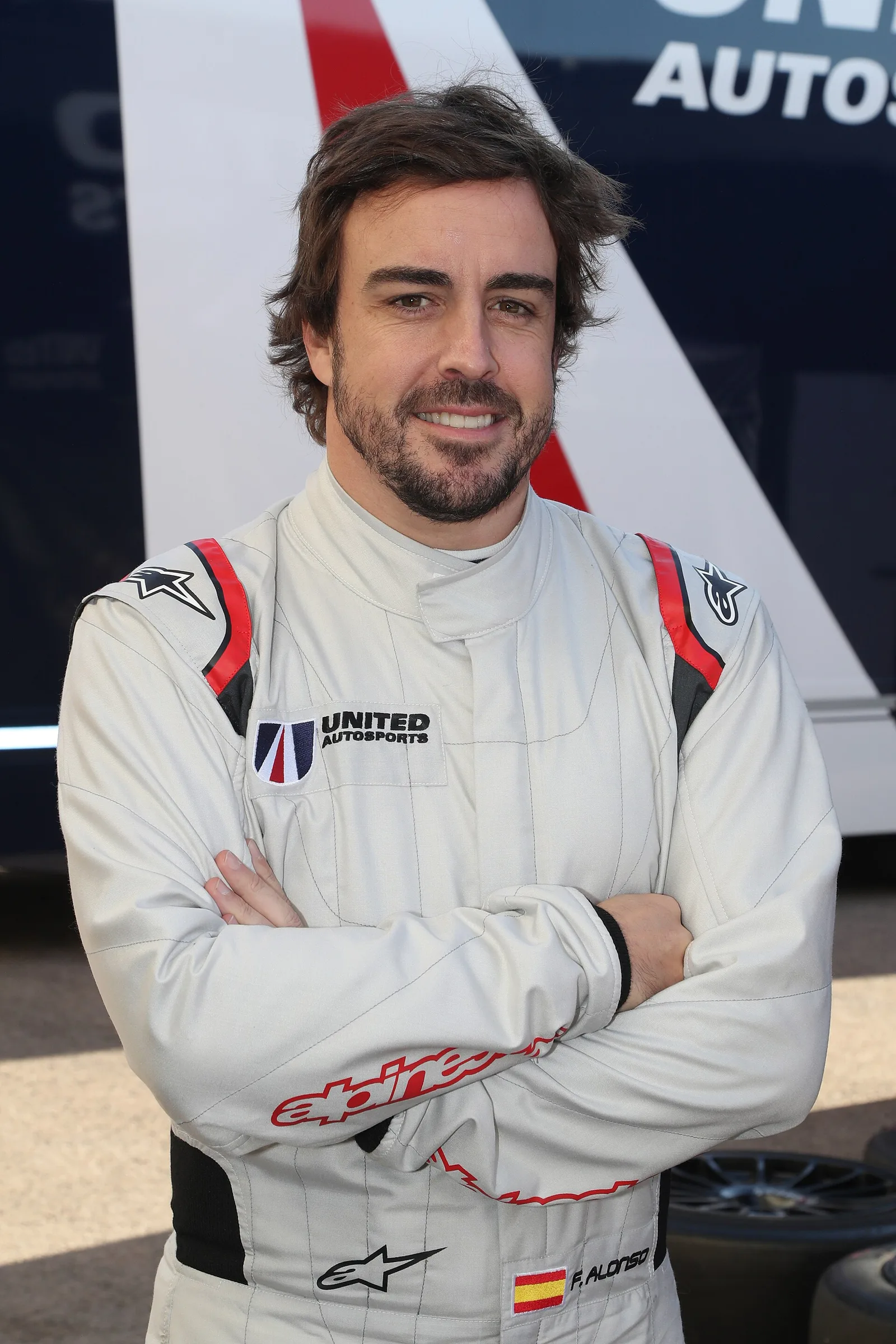
From Oviedo karting to 400 Grands Prix: world titles in 2005 and 2006, Le Mans wins in 2018 and 2019, and a career still running at Aston Martin.
Fernando Alonso is a Spanish racing driver from Oviedo who won the Formula One World Drivers' Championship in 2005 and 2006 with Renault. He has 32 Grand Prix wins, Le Mans victories in 2018 and 2019 with Toyota, and the 2018-19 World Endurance title, and was still racing for Aston Martin in 2026.
Alonso is a Spanish driver whose career runs from karting through Formula One and endurance racing to the Indianapolis 500. He claimed the Formula One title in 2005 and again in 2006, and he is the only driver to have won both that championship and the World Endurance title. He was still racing for Aston Martin in 2026, with 32 Grand Prix wins to his name.
Who is Fernando Alonso and where did his career start?
Alonso was born in Oviedo, Asturias, on 29 July 1981 into a working-class family. He received a go-kart at three, built for his sister, and held a racing licence by five. His father handled the mechanics, finances and management. Aged seven he won his first kart race.
Karting gave him his first titles. He won the Asturias and Galicia junior championships in 1988 and 1989, and he later took the CIK-FIA Five Continents Cup at Genk in 1996. His mentor, Mike Wilson, was a six-time Karting World Champion.
Money was tight at home. The family could not afford rain tyres, so Alonso learned to race wet tracks on slick tyres. That habit later became part of his reputation for extracting pace in all weathers and on all tracks.
Formula One titles in 2005 and 2006, Le Mans wins in 2018 and 2019, and a career built on extracting pace in any weather.
How did Alonso reach Formula One?
Alonso moved up the single-seater ladder quickly. He won the 1999 Euro Open by Nissan title with six wins and nine poles, then finished fourth overall in International Formula 3000 in 2000 with seventeen points. He made his Formula One debut with Minardi at the 2001 Australian Grand Prix.
The 2001 season was hard going. His best result was tenth in the German Grand Prix, which earned no points. He then moved on to Renault, the team where his title years would follow.
What records did Alonso set in 2003?
In 2003 Alonso became the youngest driver to take pole position, at the Malaysian Grand Prix, and the youngest race winner at the Hungarian Grand Prix. The Hungarian win beat a record that Bruce McLaren had held. He finished sixth overall with 55 points and four podiums that season.
The results marked him as a driver to watch. In 2004 he finished fourth overall with 59 points, with no wins.
How did Alonso win his first world title in 2005?
In 2005 Alonso won seven races, took six poles and finished on fourteen podiums, scoring 133 points for Renault. He became the first Spanish World Drivers' Champion, and at 24 he was the youngest champion at the time. His main rival was McLaren's Kimi Raikkonen.
The title fight with Raikkonen came down to reliability as much as speed. Alonso's Renault proved the more dependable car across the season, and that dependability gave him the edge when it counted most.
Did Alonso defend his title in 2006?
Yes. Alonso won six of the first nine races in 2006 and faced Michael Schumacher at Ferrari as his main rival. He won the Japanese Grand Prix after Schumacher's engine failure, then finished second in Brazil to secure a second title.
What happened in the McLaren and Renault years from 2007 to 2009?
Alonso joined McLaren for 2007 on a three-year contract. He won four races that year in Malaysia, Monaco, Europe and Italy. He finished the season third at Brazil with 109 points, level with teammate Lewis Hamilton on points.
The partnership with Hamilton was tense, and the relationship ended by mutual consent in November 2007. Alonso then went back to Renault for 2008, and that year he won in Singapore and Japan. The Singapore win later became known as crashgate.
Renault's 2008 form gave him a fifth-place finish overall with 61 points. The 2009 car was less competitive, and he ended the year ninth overall with 26 points, his lowest placing since 2003. He took one podium that season, at the Singapore Grand Prix.
Why did the Ferrari years matter so much?
Alonso drove for Ferrari from 2010 to 2014 and was runner-up to Sebastian Vettel in 2010 by four points. He was runner-up again in 2012, three points behind Vettel, and second overall in 2013 with 242 points. He won no races in 2014, a season that ended sixth overall with 161 points.
The 2010 season saw five wins for Alonso, while 2011 brought one victory at the British Grand Prix and a fourth-place finish overall with 257 points.
In 2012 he won three races, in Malaysia, Valencia and Germany, and in 2013 he won in China and Spain.
What happened during the McLaren return from 2015 to 2018?
Alonso rejoined McLaren on a three-year contract from 2015, a move that followed his departure from Ferrari after 2014. His first season back began with a concussion from a February 2015 pre-season test crash in Barcelona, and the year ended seventeenth overall with eleven points.
The 2016 season brought a heavy crash with Esteban Gutierrez at the Australian Grand Prix. Even so, he recorded fifth places at Monaco and in the United States, and he finished tenth overall with 54 points. The 2017 season was harder, with a best finish of sixth at the Hungarian Grand Prix.
He left Formula One as a driver at the end of 2018, when he finished eleventh overall with fifty points. His last season with McLaren included a fifth place at the Australian Grand Prix.
| Season | Team | Result |
|---|---|---|
| 2003 | Renault | Sixth overall, 55 points, four podiums |
| 2004 | Renault | Fourth overall, 59 points |
| 2005 | Renault | Champion, seven wins, 133 points |
| 2006 | Renault | Champion, second in Brazil secured the title |
| 2007 | McLaren | Four wins, third at Brazil, 109 points |
| 2008 | Renault | Wins at Singapore and Japan, fifth overall, 61 points |
| 2009 | Renault | Ninth overall, 26 points, one podium |
| 2010 | Ferrari | Five wins, runner-up to Vettel by four points |
| 2011 | Ferrari | One win, fourth overall, 257 points |
| 2012 | Ferrari | Three wins, runner-up with 278 points |
| 2013 | Ferrari | Wins in China and Spain, second with 242 points |
| 2014 | Ferrari | No wins, sixth overall, 161 points |
| 2015 | McLaren | Seventeenth overall, eleven points |
| 2016 | McLaren | Tenth overall, 54 points |
| 2018 | McLaren | Eleventh overall, fifty points |
| 2023 | Aston Martin | Fourth overall, 206 points |
| 2024 | Aston Martin | Ninth overall, 70 points |
| 2025 | Aston Martin | Tenth overall, 56 points |
Did Alonso ever win the Indianapolis 500?
No. He entered the Indianapolis 500 in 2017, 2019 and 2020 without winning it. In 2017 he drove a McLaren-Honda-Andretti car, led four times for 27 laps, and was classified 24th after an engine failure with 21 laps to go.
That 2017 rookie run earned him the Indianapolis 500 Rookie of the Year award. He did not qualify in 2019, and in 2020 he qualified 26th with Arrow McLaren SP and finished 21st, his best result in the race.
Which endurance races did Alonso win?
Alonso won the 2018-19 FIA World Endurance Championship with Toyota, sharing the No. 8 car with Sebastien Buemi and Kazuki Nakajima. He also won the 24 Hours of Le Mans in 2018 and 2019, and in 2019 he won the 24 Hours of Daytona with Wayne Taylor Racing.
His sportscar career began at the 1999 24 Hours of Barcelona, where he finished tenth overall in a Hyundai Accent. The 2019 Daytona win came in a rain-shortened race.
How did Alonso perform in the Dakar Rally?
Alonso entered the 2020 Dakar Rally with Toyota after a five-month testing programme. Co-driving with Marc Coma, he finished thirteenth overall, and his best stage result was second place.
How did Alonso return to Formula One with Alpine?
Alonso returned to Formula One in 2021 to drive for Alpine alongside Esteban Ocon. He retired from his first race at Bahrain after plastic debris entered a brake duct, but at the Qatar Grand Prix he finished third, his first podium since the 2014 Hungarian Grand Prix.
His first points of 2021 came at the Emilia Romagna Grand Prix.
What did Alonso achieve with Aston Martin?
Alonso joined Aston Martin for 2023 alongside Lance Stroll, and he finished third on his debut at the Bahrain Grand Prix. At the 2023 Saudi Arabian Grand Prix he reached 100 podiums, making him the sixth driver to do so.
In 2023 he finished fourth overall with 206 points, while Stroll scored 74. He also took a podium at Sao Paulo, edging out Sergio Perez by 0.053 seconds.
The 2024 season brought ninth overall with 70 points, while Stroll had 24. At the Mexico City Grand Prix he contested his 400th Grand Prix weekend, the first driver to reach that number.
The 2025 season included a fifth-place finish at the Hungarian Grand Prix, his best of the year. He finished tenth overall with 56 points, against Stroll's 33.
The AMR26 used a Honda engine in 2026, the only Honda-powered car on the grid. Alonso's contract was extended through 2027, announced on 29 September.
What is Alonso's driving style?
Alonso is often regarded as one of the greatest Formula One drivers. He is known for extracting pace from cars in all weathers and on all tracks, and Martin Brundle compared his feel for grip to that of Ayrton Senna.
Not every assessment has been positive. Jody Scheckter criticised Alonso for causing problems within teams.
What is Alonso's legacy beyond the cockpit?
Alonso holds the Gold Medal of the Royal Order of Sports Merit and was inducted into the FIA Hall of Fame in 2017 and 2019. He was the first driver to be inducted twice.
He has been a UNICEF Goodwill Ambassador since February 2005. The Fernando Alonso Foundation, founded in 2007, works on road safety education, and he runs the driver management firm A14 Management.
In Oviedo the Fernando Alonso Sports Complex opened in June 2015, with a karting track featuring 29 layouts. A museum dedicated to his racing career opened the same year. Forbes has listed him among the world's highest-paid athletes from 2012 to 2018.
His helmet carries the number 14, a number he chose because of a karting victory on 14 July 1996.