Michael Schumacher won the season opener at Albert Park, but a lap five accident had killed marshal Graham Beveridge and brought out the safety car.
Michael Schumacher won the 2001 Australian Grand Prix at Albert Park in Melbourne on 4 March 2001, starting from pole. David Coulthard finished second for McLaren and Rubens Barrichello third for Ferrari, but the afternoon was clouded by the lap five death of spectator marshal Graham Beveridge.
Michael Schumacher won the 2001 Australian Grand Prix from pole position, his fifth consecutive Formula One victory and the 45th of his career. The race at Albert Park was overshadowed by the death of marshal Graham Beveridge, who was struck in the chest during a lap five accident.
How did the marshal die?
On lap five a major accident involved Williams driver Ralf Schumacher and BAR driver Jacques Villeneuve. Beveridge, a spectator marshal, was struck in the chest by Villeneuve's right-rear wheel. He died of his injuries, and the accident brought out the safety car, which stayed out until eleven laps later when the race restarted.
Schumacher was in front when the race restarted, until the pit stops, when Coulthard led for three laps.
Beveridge was the second marshal to die from injuries sustained in a Formula One race. Paolo Gislimberti had died at the 2000 Italian Grand Prix, just under six months earlier.
The Federation Internationale de l'Automobile (FIA) investigated and concluded that the accident was a freak one. A coroner's report reached a different verdict, finding that the organisers of the race, the Australian Grand Prix Corporation, were responsible and that the death was avoidable.
Schumacher won the season opener, but the day at Albert Park will be remembered for the death of a marshal on lap five.
Why was Albert Park so hard on grip?
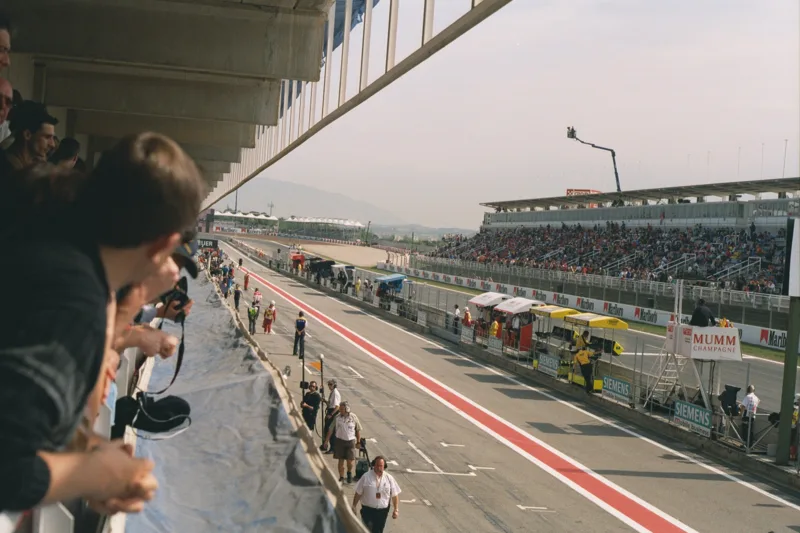
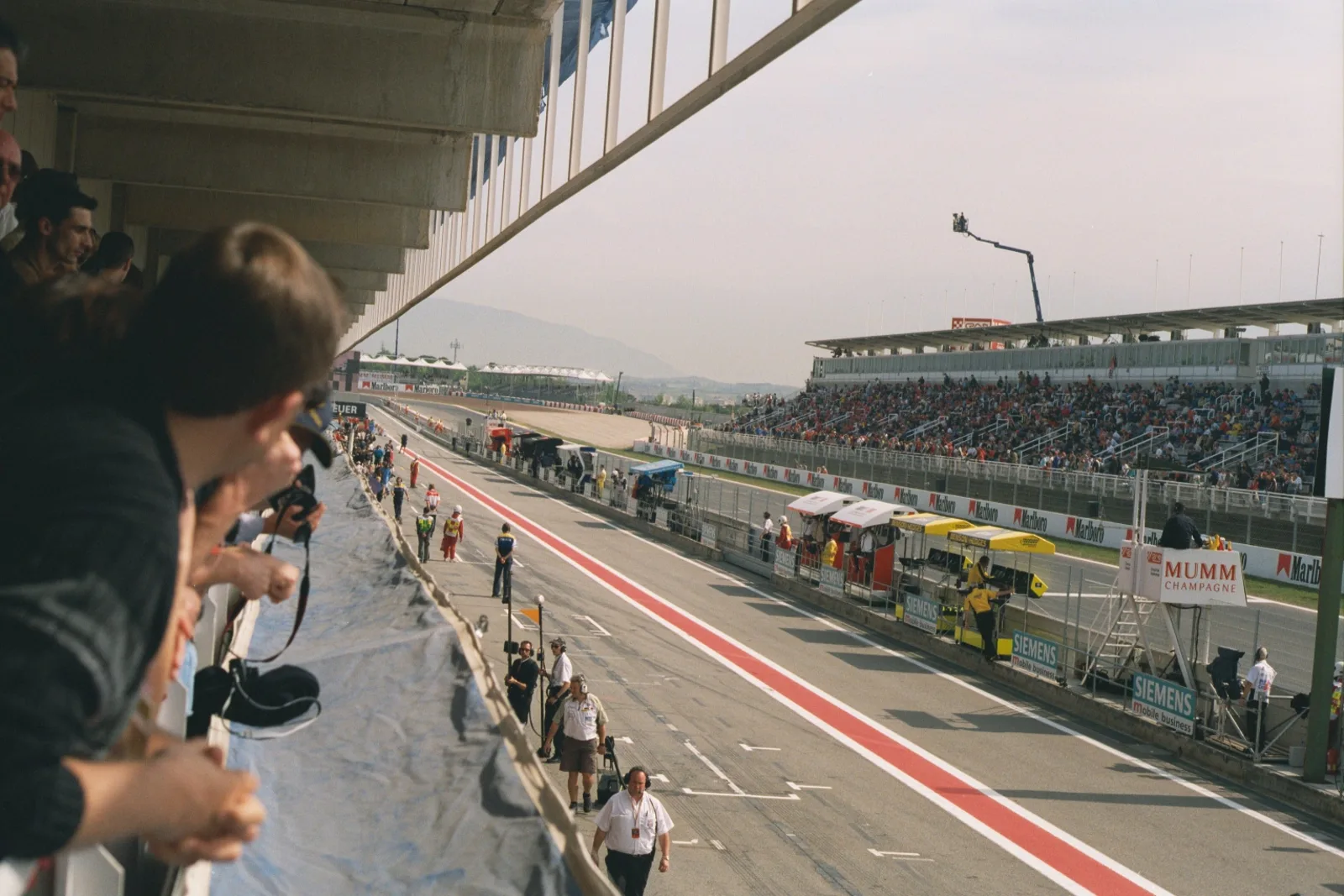
The Albert Park Circuit is a 16-turn, 5.303 km (3.295 mi) semi-permanent road course in the Melbourne suburb of Albert Park. Road traffic lays dust on it all year round, so drivers have low grip and the cars must produce as much downforce as possible at the rear.
Engineers set the cars up to be stable through the high-speed corners, which put strain on traction and braking. That prompted several teams to fit cooling devices to the brake rotors and calipers, and it made the first race of the year a test of set-up as much as speed.
It was the opening round of seventeen in the 2001 championship and the 16th Formula One race held in Australia. It took place on 4 March, and the press saw Schumacher as the favourite for his fourth world drivers' title.
The new faces on the 2001 grid
Of the 22 drivers on the starting grid, four were making their debuts. The most high-profile was Juan Pablo Montoya, the 1999 CART champion and 2000 Indianapolis 500 winner, who joined Williams to partner Ralf Schumacher.
Montoya replaced Jenson Button, who had been loaned to Benetton on a two-year deal. At Arrows, Enrique Bernoldi took the seat of Pedro de la Rosa, who lost his race drive and joined Prost as test and reserve driver.
Fernando Alonso was promoted from a test role at Minardi to a race seat. Kimi Raikkonen, the 2000 Formula Renault 2.0 UK champion, drove for Sauber alongside Nick Heidfeld, and his appointment drew wide criticism.
Irvine, Button and FIA president Max Mosley were among those who objected, because Raikkonen had competed in 23 car races before his debut and had no Formula One experience. He had taken part in a test at Jerez before 25 FIA commission members in December 2000, and the World Motor Sport Council granted him a super licence by 24 votes to 1 on 7 December.
Why was Michael Schumacher the favourite?
Michael Schumacher was the 2000 champion, and the press expected him to win a fourth world drivers' title. Mika Hakkinen was seen as his nearest challenger, and Ferrari had exceeded its target of more than 4,000 km (2,500 mi) of pre-season testing.
Schumacher said the F2001 had behaved very well from the first to the last day of testing, and he described his preparation as the most thorough of his career. He went to Melbourne confident of his chances.
Hakkinen said the pressure he felt at the start of 2000 had increased his desire to win both championships in 2001. McLaren intended to help him do it.
The race also saw Michelin return as a tyre supplier for the first time since 1984. The company supplied Williams, Benetton, Prost, Jaguar and Minardi, giving Bridgestone competition for the first time since Goodyear left after 1998.
That competition pushed Michelin to develop a tyre with more of its surface in contact with the road, which gave drivers more grip. Top speeds rose in pre-season testing, and drivers set lap times below the 2000 levels to offset the lower downforce. The FIA declined to enforce a regulation that would have restricted tyre wear.
How much had the cars changed?
Several teams made major changes compared with the cars shown at the official presentations and in pre-season testing. Ferrari added fins to the external side sections and revised its air intakes to improve brake cooling and the airflow around the wheels.
Williams used vertical bulkheads under the front wing and made use of the 50 mm (2.0 in) space within the wing, so the car could run lower to the ground.
How did Friday practice go?
Practice on the Friday took place in hot and clear weather, with two one-hour sessions before the two 45-minute sessions on Saturday. Ralf Schumacher and Montoya both ran off the circuit that morning, but neither car was damaged. Barrichello was fastest in the morning at 1 minute 29.056 seconds, 0.312 seconds ahead of his team-mate Michael Schumacher.
Barrichello set the day's fastest lap in the afternoon at 1 minute 28.965 seconds. Trulli, Michael Schumacher, Coulthard, Hakkinen and Ralf Schumacher followed him, with Heidfeld, Frentzen, Alesi and Panis in the top ten.
Luciano Burti locked his tyres into the first corner and damaged the front-left corner of his Jaguar R2 against a concrete barrier, and red flags were shown after 35 minutes. Frentzen ended up stuck in the gravel at turn six with six minutes left.
What happened at turn six?
Shortly after, Michael Schumacher did not see the yellow flags at turn five that warned of Heidfeld's stricken car. He had accelerated through that stretch, and he saw the flags only in the braking zone for turn six, where oil had been laid on the approach.
He lost the rear of his Ferrari on the oil, spun after hitting the inside kerb and speared into the gravel at 120 mph (190 km/h). The car dug into a ridge of gravel, lifted into the air, and somersaulted and barrel-rolled twice before landing upright against a tyre barrier.
Schumacher escaped unhurt. He went back to the area later that day to talk over possible changes to the corner, which he had raised as a concern the day before. In the third session he was fastest in his rebuilt car at 1 minute 28.134 seconds, while Coulthard led the final session at 1 minute 27.540 seconds.
Who took pole and who missed out?
Michael Schumacher took his 33rd pole position and his fifth in a row, at 1 minute 26.892 seconds. The time was almost four seconds faster than Hakkinen's pole lap from the 2000 race. The lap was the fastest of the qualifying session.
Barrichello qualified second after traffic slowed him and a gear selection fault cost him a lap. Hakkinen was third, struggling with balance at the bumpy turn one, and Frentzen was fourth. Ralf Schumacher took fifth, the highest-placed car on Michelin tyres.
Coulthard twice ran onto the grass and was sixth, while Trulli was seventh and Villeneuve eighth. Panis was ninth and Heidfeld tenth, and Montoya was the fastest driver outside the top ten, after Bernoldi slowed him leaving turn four.
Irvine qualified 12th in a balanced but slightly heavy Jaguar, although debris removed one of its bargeboards. Raikkonen was 13th as the highest-placed rookie, and Alesi 14th. Verstappen was 15th, Button 16th without his preferred set-up, and Fisichella 17th after a water leak forced him into the spare car.
Bernoldi took 18th, Alonso 19th after losing half a second through an error, and Mazzacane 20th. Burti was 21st, and Marques started last after failing to set a time within the 107 per cent limit.
Marques was granted permission to start under exceptional circumstances. Minardi had appealed to the stewards, and Marques started in Alonso's race car after he spun at turn three in qualifying.
Warm-up and the race start
In the warm-up Coulthard was fastest at 1 minute 30.099 seconds, 0.053 seconds ahead of Hakkinen. Verstappen had led for the opening 20 minutes before dropping to third, with Montoya, Panis and Michael Schumacher next. After leaving the pit lane, Bernoldi lost the rear of his Arrows and removed its nose cone in a collision with the turn one wall.
After a power steering problem on his race car, Irvine changed to the spare Jaguar. Jaguar had also fixed a minor design fault linked to Burti's accident and strengthened the double wishbone suspension on all three of its cars overnight. Button used a spare Benetton, and his mechanics stayed on the grid to work on it, which brought a ten-second stop-and-go penalty from the stewards.
When the five red lights went out, Michael Schumacher made a brisk start and led into the first corner. Frentzen hit the right-hand sidepod of Coulthard's McLaren as the cars jostled for the inside line, and a second, harder contact slowed Coulthard further.
Montoya made up five places before the end of the start-finish straight, but he carried too much speed and ran wide at turn one. At turn three he tried a move around the outside of Irvine, and contact between them left the Jaguar spun through 180 degrees and in the grass.
How did the race go Schumacher's way?
Schumacher led from pole and kept the lead until the pit stops for fuel and tyres. Coulthard led for three laps before his stop, but Schumacher regained the front and kept it to the flag. Coulthard's three laps in front were the only time anyone else led.
The race was 58 laps over 307.574 km (191.118 mi), in dry but overcast conditions. The air was 22 to 23 C (72 to 73 F) and the track 27 to 28 C (81 to 82 F), and analysis had pointed to one pit stop as the ideal strategy.
Coulthard finished second and Barrichello third before a crowd of 128,500. Schumacher's win was his fifth in succession, and it gave him a points lead at the top of the drivers' championship.
Final finishing order
| Position | Driver | Note |
|---|---|---|
| Winner | Michael Schumacher (Ferrari) | From pole; fifth consecutive win and 45th career win |
| Second | David Coulthard (McLaren) | Four championship points behind Schumacher |
| Third | Rubens Barrichello (Ferrari) | A further two points adrift of Coulthard |
What did the result mean for the championship?
Schumacher left Melbourne with ten championship points, four ahead of Coulthard in second and a further two ahead of Barrichello in third. Nick Heidfeld of Sauber and Heinz-Harald Frentzen of Jordan were fourth and fifth. Those points came from a single race, and sixteen races were still to run.
In the constructors' championship Ferrari led with fourteen points and McLaren were second with eight. Sauber and Jordan followed in third and fourth, with sixteen races still to run.